
Stage Review - A Sherlock Carol
Presented By: Harlequin Productions - Olympia, WA
Show Run: November 27 - December 24, 2026
Date Reviewed: Friday, November 27, 2026 (Opening Night)
Run Time: 2 Hours, 20 Minutes (including at 20-minute intermission)
Reviewed by: Greg Heilman
A detective who makes his living noticing what everyone else overlooks ought to be able to tell when something is wrong with his own life. Then again, Sherlock Holmes has always had an easier time explaining other people than explaining himself. That gives Mark Shanahan a good reason to bring him into the world of Charles Dickens in A Sherlock Carol, which Harlequin Productions opened November 27 at the State Theatre in Olympia, where it runs through December 24. Directed by Gerald B. Browning, the play begins with Holmes still feeling the loss of Moriarty when a grown-up Tiny Tim, now Dr. Timothy Cratchit, asks him to look into the death of Ebenezer Scrooge. It’s a case that requires Holmes to take a closer look at himself, with some help from a man who knows exactly how unpleasant that can be.
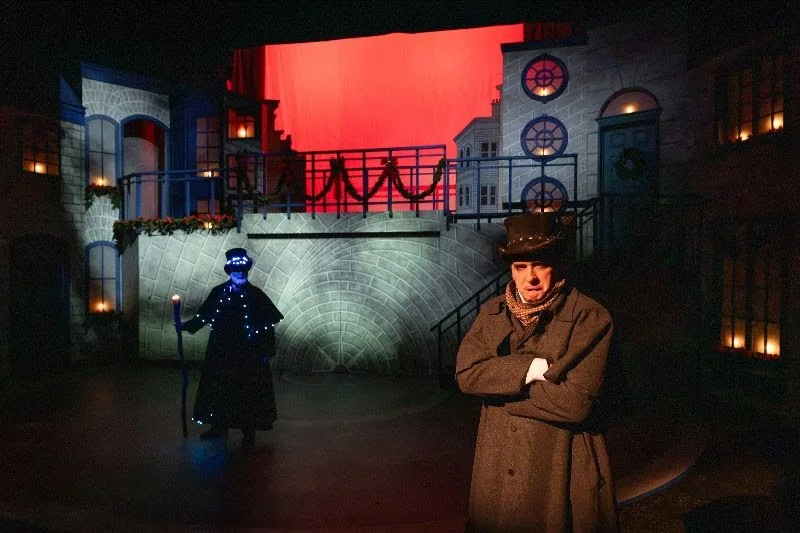
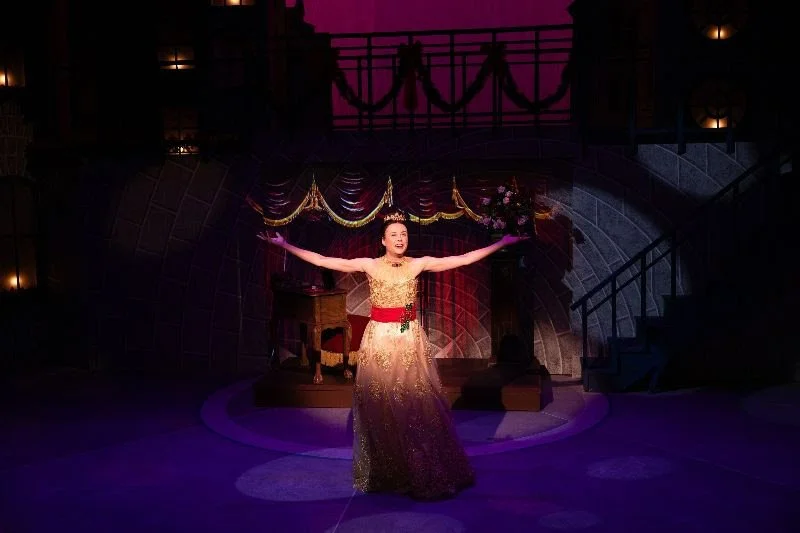
There’s already a sense of Christmas in scenic designer Jeannie Beirne’s London before anyone sings a note or utters a word. Garland hangs from the iron railings, candlelight flickers in the windows, and the blue behind the buildings suggests the hour when the streets have gone dark and the houses are still lit. The opening song from the ensemble quartet, under the musical direction of Stephanie Layton, carries that welcome into the performance. Then, of course, there’s Holmes. Aaron Lamb makes him miserable company, particularly for Dr. Watson, whose joviality Henry Talbot Dorset maintains even as his friend rebuffs him. Aaron lets some of the pain behind that anger show. Moriarty gave Holmes a reason to put his mind to work, and without him there’s a sense that he has little idea what to do with himself, giving his exchanges with Watson a bit of a sting. Someone is making an effort to reach him, and Holmes makes it as difficult as he can.
Sam Edgren’s Dr. Cratchit puts in motion Holmes’ redemption, though Sherlock isn’t buying at first. Eventually, though, the death of Cratchit’s benefactor, one Ebeneezer Scrooge, gives Holmes something to do, and one of the details I appreciate in Sam’s performance is how naturally he uses his cane. It’s part of how Cratchit gets around, an ordinary part of this grown man’s life, and Sam handles it with that familiarity, one of the first times I’ve seen an actor accurately use the device on stage. There’s a similar care in the properties designed by Henry Behrens, from the period wheelchair to the items on Scrooge’s desk. Those details give the actors a world they can go about their business in, even as that world keeps moving around them.
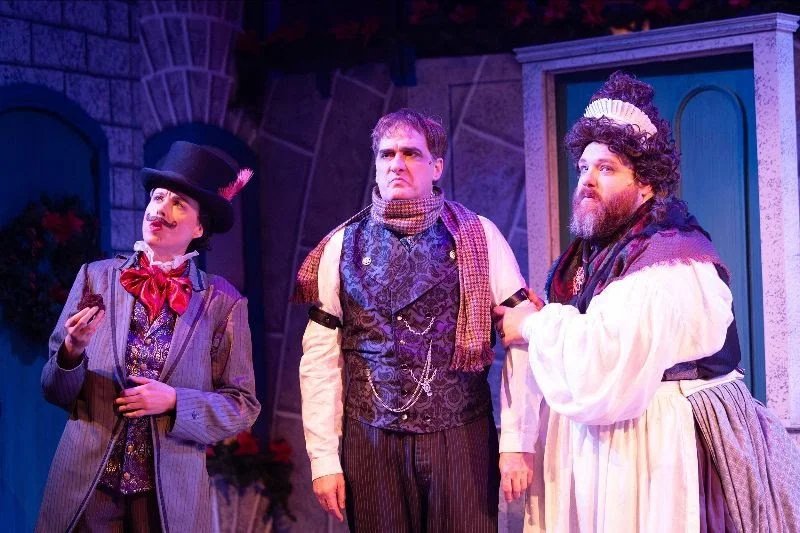
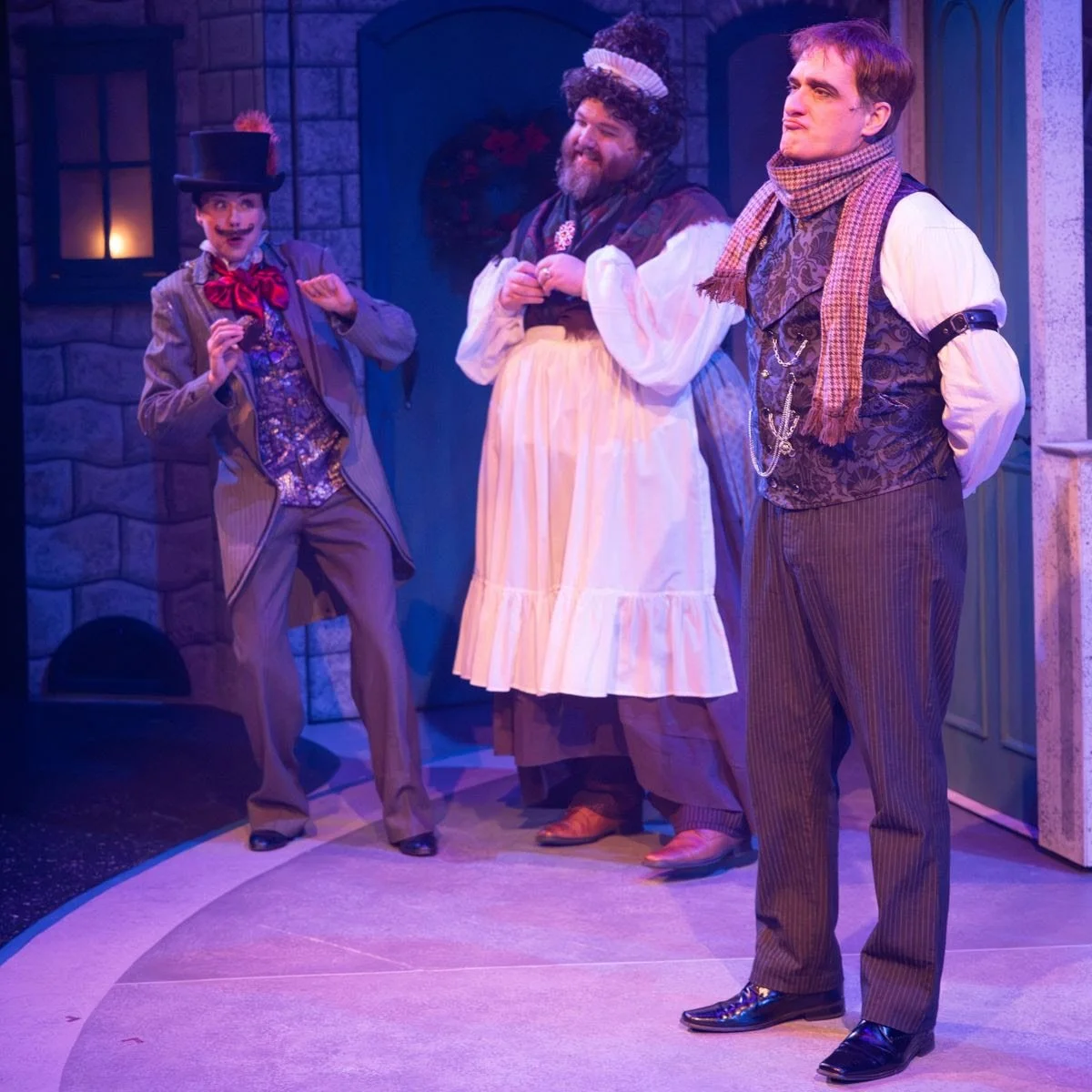
The movement is one of the things I like most about the production. The ensemble keeps the stage active while narrating, and platforms carrying furniture and props glide in through doorways built into the set. There’s a fair amount of coordination in those changes, and stage manager Ashley Winrod and the crew keep them moving at the pace of the story, and a good amount of humor in them as well. At Scrooge’s house, Henry, as Mrs. Dilber, moves a door around the stage with the other actors in pursuit to “Yakety Sax.” It’s one of the funniest sequences in the show, and so much of the laugh is in Henry’s timing, in when he moves that door, how long he makes everyone else follow it, and how he plays to the audience while doing it.
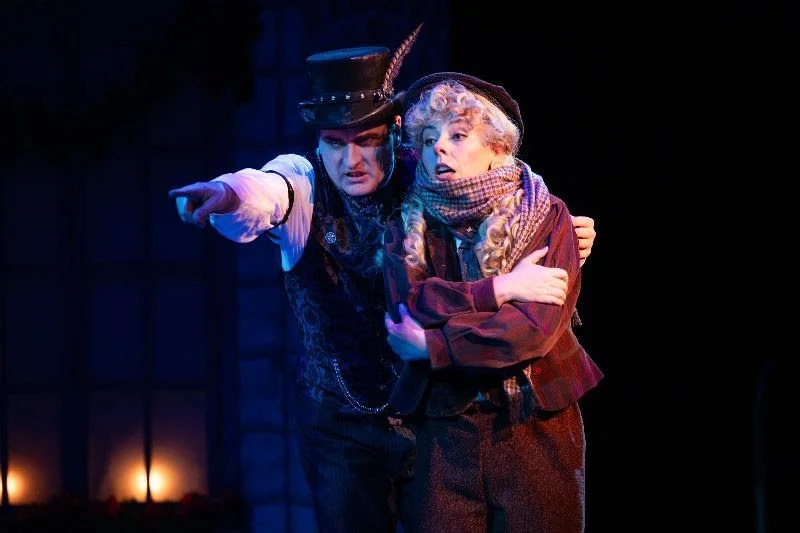
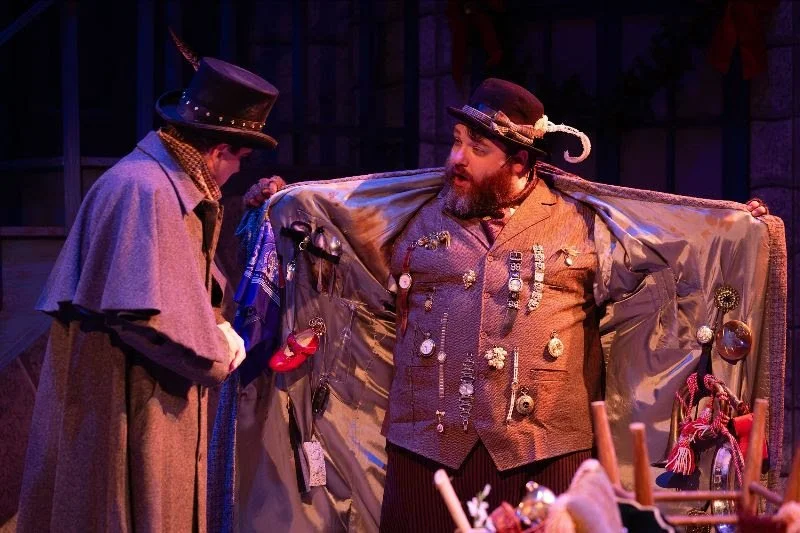
Henry provides most of the show’s humor, and what I enjoy about his work is how differently he gets a laugh from one character to the next. There’s the good humor of his Watson, the physical comedy of Mrs. Dilber, and his particularly funny turn as Old Joe. Helen Harvester gets laughs of her own as Lestrade, with Aaron playing the straight man, and there’s a nice surprise in her Martha Cratchit, who gets to do her own version of Holmes. Her change from the inspector to the countess is a good example of what Gretchen Halle’s costumes do for the actors. Sara Trowbridge does good supporting work as Emma Wiggins and Windigate, filling out a London that feels considerably more populated than its cast of six would suggest.
Part of what makes London feel that populated is how much variety there is in the way people speak. The accents on Holmes and Scrooge are both solid, and I especially like what the ensemble does with the number of accents and dialects they take on between them. Henry’s Irish accent as Henry Burke is a good example. Once an actor has changed costumes and come back through a door, the voice can do a lot to tell the audience who’s just walked in. The ensemble does that wonderfully, and it’s a credit to dialect coach Leah Fishbaugh.
Additionally, I like what Gretchen does with the makeup, specifically on Holmes and Scrooge. Aaron gives Holmes the anger and the pain, and Gretchen makes him look like a miserable shadow of his former self, a man who’s been carrying the loss of Moriarty for some time. With Scrooge, the makeup draws a good distinction between the man who comes out of his own evening with the spirits with a new sense of life and the spirit who comes back to do much the same for Holmes. There’s something I like about seeing those two faces of Scrooge in the same show.
Along side Aaron’s Sherlock, Corey McDaniel’s Scrooge has the advantage of having heard just about every objection Holmes can make. He probably made a few of them himself. There’s something funny in that recognition, and there’s also a measure of sympathy in the way Corey plays it. Scrooge sees himself in Holmes, and that gives him a personal reason to stay with the man through his glimpses of Christmas past, present, and yet to come. There’s a pleasing reversal in watching Scrooge, who once needed somebody to show him the consequences of the way he was living, take on that responsibility for someone else.
Some of the best design work comes when the play gets spooky. Gina Salerno gives Scrooge’s spirit an echo that changes the feel of the room, and Olivia Burlingame moves from cool blues in the past to warmer pinks and reds in the present before draining the color from what is yet to come. I especially like the lighting in that last sequence, where it works with John Serembe’s cemetery projection to give the future a chill of its own. Elsewhere, I feel the use of projections are a bit overdone. They add some detail and context, though the shifts between color and black and white make them feel visually disconnected, and I’d rather have a little room to fill in the blanks when the set and the actors already give the audience plenty to work with. The cemetery is where I most appreciate what the projections can do, because the image, the light, and the sound all contribute to the same feeling.
There’s enough of a mystery in A Sherlock Carol to appeal to a Sherlock Holmes fan, and enough spirits and lessons in the true meaning of Christmas to satisfy the Dickensians in the audience. What makes the two stories fit is that Scrooge understands something about Holmes that the detective has yet to figure out for himself, and it’s a pleasure to see their roles change even as the lessons stay the same. At the end of the day, it’s a whimsical holiday tale with a dash of spookiness, an enjoyable way to spend a few hours at the theatre during the holiday season. The fact that Gerald B. Browning and his company pull it off as well as they do doesn’t hurt either.
A Sherlock Carol, from Harlequin Productions, runs on stage at the State Theatre in Olympia through December 24. For more information, including ticket availability and sales, visit https://harlequinproductions.org/.
Photo credit: Shanna Paxton Photography