
Stage Review - Ashes, Ashes, We All Fall Down (As If Theatre)
Stage Review - Ashes, Ashes, We All Fall Down
Presented By: As If Theatre - Kenmore, WA
Show Run: February 05 - February 08, 2026
Date Reviewed: Thursday, February 05, 2026 (Opening Night)
Run Time: 1 Houtr, 45 minutes (including a 15 minute intermission)
Reviewed by: Greg Heilman
Families carry their histories whether they want to or not, and sometimes the only way forward is to finally stop pretending those histories don’t hurt. Gretchen Douma’s Ashes, Ashes, We All Fall Down, receiving its world premiere from As If Theatre at the Kenmore Community Center under the direction of Cindy Giese French, begins with a simple premise: three siblings reunite to decide what to do with their parents’ ashes. What unfolds from there is anything but simple, as years of unspoken resentment, grief, and love surface in ways that are at once painful, honest, and deeply human.
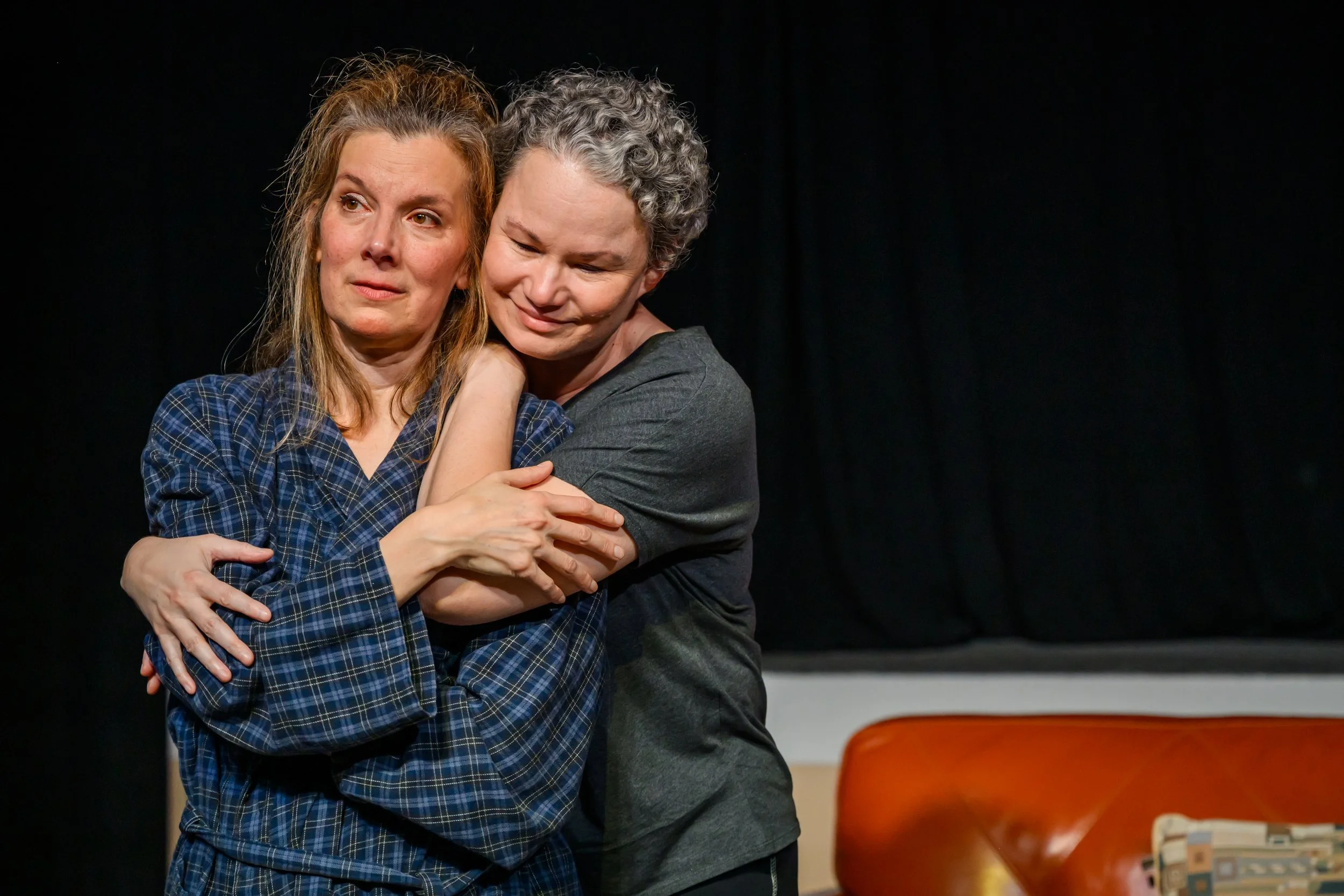
At the center of the story is a family dynamic that feels painfully familiar. Parents Vivian and William Miller linger even after death, their presence shaping the lives of their children in ways both comforting and corrosive. Charlie, portrayed by Jack Lush, is the golden child, the family favorite whose closeness with his mother remains a defining force. Madeline, the eldest and played by Molly Hall, carries the weight of a deeply contentious relationship with her mother that began when she came out as gay, a rupture that was never fully healed. Carolyn, the youngest, brought to life by Skye Stafford, was left to shoulder the practical burden of caregiving, tending to her father as his Alzheimer’s disease progressed and later caring for her increasingly ill mother.
This dynamic alone is enough to fracture a family. Left unresolved, it festers into something far more dangerous, and the play makes clear how those buried grievances can grow into a force that shapes every interaction. Ashes does not shy away from showing the damage these unresolved issues can cause, but it is equally invested in what becomes possible when understanding replaces assumption. Healing here begins with sharing, listening, and open communication. The play is built on a foundation of empathy, and it understands that only through empathy can relationships become something that draw us together rather than push us further apart.
The maturity of Gretchen’s writing is striking. It is difficult to believe this is her first full-length play, but it is, and the confidence of the work speaks volumes. The family dynamic rings true, particularly in the relationship among three siblings, a configuration with its own specific rhythms and tensions. The canvas is deceptively simple — siblings gathering to decide what to do with their parents’ ashes — but it is the emotional layering placed atop that premise where the play truly soars. The unresolved differences, the damage they cause, the value of a support system, and the way we are haunted by our parents long after they are gone all coexist here, even if most of us do not experience quite such a Blithe Spirit-like relationship with the dead.
Some of the strongest moments occur when the living and the dead share the stage. Conversations between the children and their parents, or scenes where Vivian and William speak to one another while their children argue nearby, are beautifully constructed. The interjection of dialogue between generations feels fluid rather than gimmicky, allowing humor, tension, and emotional truth to overlap naturally. Mothers, the play reminds us, are still mothers — even from the grave.
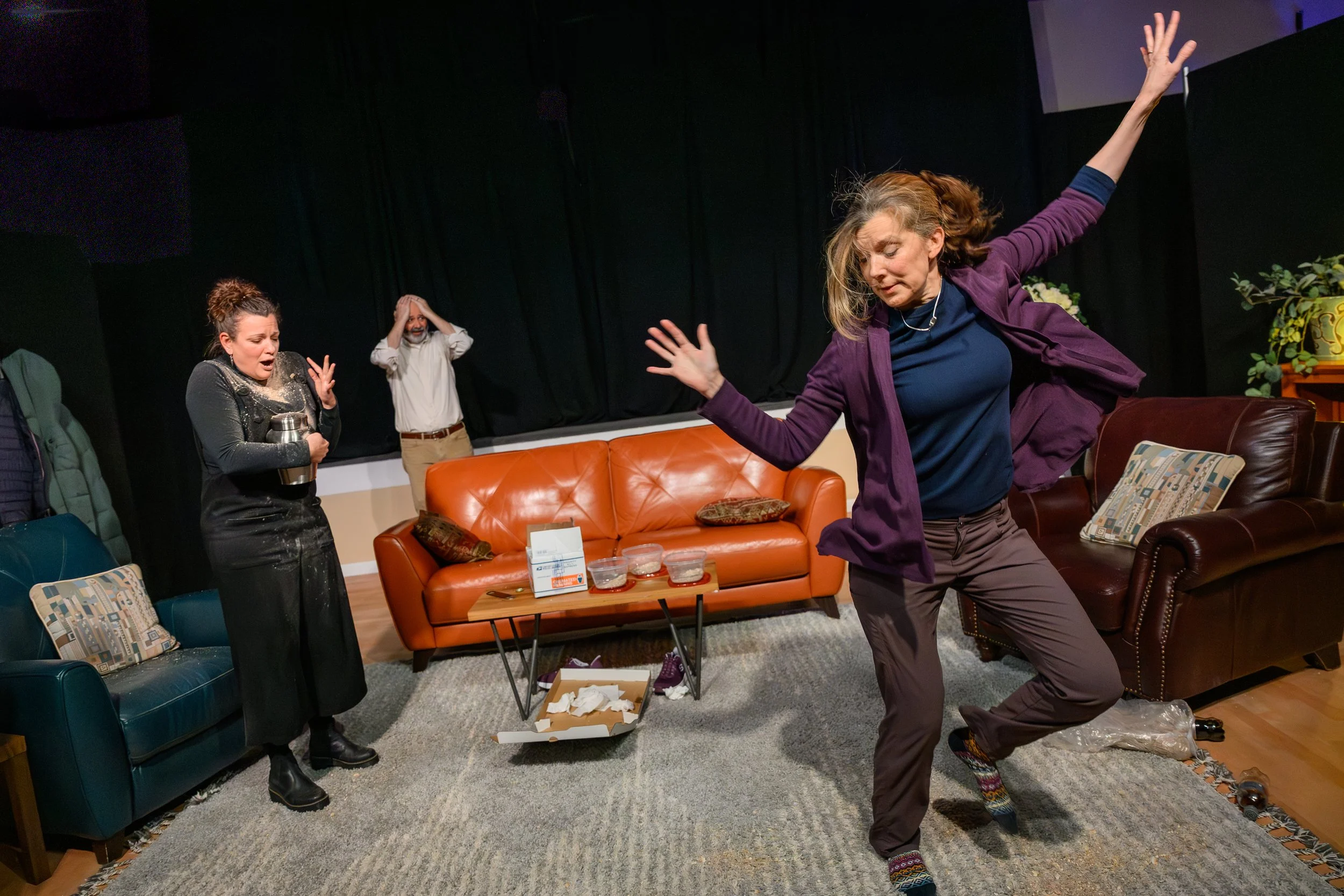
The ensemble is strong across the board, but the individual performances are just as compelling. Molly’s portrayal of Madeline is the emotional tour de force of the production. She embodies years of resentment that have been carefully suppressed, allowing that tension to simmer beneath the surface before it finally erupts. By the end of Act One, Madeline is visibly frazzled, both physically and emotionally, pushed to a breaking point that feels inevitable and entirely earned. Molly digs deep for this role, and her performance stands out even within an already impressive ensemble.
Christina Williams’s Rebecca provides an essential counterbalance to the sibling dynamic. She opens Act Two with a beautifully observed scene of cleaning up the aftermath of the previous night, both literal and emotional, a moment that lands with quiet precision. Christina finds the humor in the situation without undercutting the sadness beneath it, offering a pause that allows the audience to reset while also deepening our understanding of how this family copes when things fall apart.
Judith Shahn presents a mother who will feel deeply familiar to anyone who has experienced the pressure of trying to live up to their parents’ expectations and repeatedly falling short. There is sharpness in her Vivian, but also vulnerability. Bradley Goodwill’s William carries a quiet sadness and lingering regret, shaped by the helplessness he felt as his dementia progressed. A scene between Judith and Bradley in Act Two is especially effective, an introspective exchange in which the couple attempts to come to terms with how William’s illness affected them individually and as partners. The scene is beautifully written and played with an honesty that resists easy sentiment.
Jack delivers a solid Charlie, the family favorite who nevertheless finds himself caught squarely between Madeline and Carolyn. He balances affection, loyalty, and emotional blind spots with care. Skye’s Carolyn begins the play guarded, shaped by years of responsibility and quiet sacrifice, but it is in Act Two, as the siblings begin to truly hear one another, that the character opens up. Skye reveals a deep emotional range in these moments, and as the family dynamic shifts, the ensemble elevates one another, their performances becoming increasingly complementary rather than combative.
This material fits squarely within Cindy’s strengths as a director. She has a distinct ability to draw the heart and emotional core out of the stories she tells, fully immersing the audience in the humanity of the work. The casts she assembles and the way she collaborates with them consistently support this kind of storytelling. There is humor exactly where it is needed, and when the emotional blows land, they land with force. Ashes feels confident in its pacing and assured in its tone, trusting the audience to sit with discomfort as well as tenderness.
The lighting and sound design effectively support the story without calling undue attention to themselves. At times, effects such as the doorbell or phone ringing feel slightly louder than necessary, but overall the design works in service of the narrative. The atmosphere created by the lighting and the original music reinforces the emotional landscape without overwhelming it.
Special mention must be given to Chandria Danelle, whose work as both stage manager and props designer is essential to the success of this production. Without venturing too far into plot specifics, this is a play that requires a great deal of coordination, and when dealing with something as symbolically loaded as ashes, authenticity matters. Chandria’s props design meets that challenge, creating elements that feel real and credible to the audience, while her stage management keeps the production moving smoothly and at a strong, consistent pace.
Ashes, Ashes, We All Fall Down is a powerful reminder of how assumptions and long-held grudges can calcify into lasting harm, and how understanding can begin to undo that damage. Though the run is sold out, this is a production worth the effort to see. Get on the waiting list or stand by at the door — the As If Theatre team will do their best to make sure everyone can get in. This world premiere affirms why new work matters, and why stories rooted in empathy remain essential to the theatre we need now.
The As If Theatre world premiere production of Gretchen Douma’s Ashes, Ashes, We All Fall Down runs on stage at the Kenmore Community Center through February 8. The run has sold out in advance, but if you’re interested in joining a wait list (standby is also available at the door), and to learn about As If’s upcoming show Yoga Play, opening on March 19, visit https://asiftheatre.com/.
Photo credit: Christine Mitchell