
Stage Review - Conscience (Taproot Theatre)
Stage Review - Conscience
Presented By: ArtsWest - Seattle, WA
Show Run: September 16 - October 17, 2026
Date Reviewed: Wednesday, September 23, 2026
Run Time: 2 Hours, 20 Minutes (including a 15-minute intermission)
Reviewed by: Greg Heilman
A big, loud, boisterous, fear-mongering politician convinces a nation to follow him with claims that, at worst, are manufactured and, at best, conveniently skewed away from facts and truth. He is willing to step on anyone, or any institution, that stands between him and power, while members of Congress, fearful for their own political futures, largely stand by and let it happen. Sound familiar? It could easily be the premise of a play written about America’s current political climate. But when director Karen Lund selected Joe DiPietro’s Conscience for Taproot Theatre a year and a half ago, she could hardly have known just how closely its story of Senator Joe McCarthy and Senator Margaret Chase Smith’s lonely stand against his politics of fear and mistruth would mirror our own moment. Then again, we’re told that those who fail to learn from the past are destined to repeat it, so perhaps we shouldn’t be surprised that here we are. And that “here” is Taproot Theatre’s Jewell Mainstage, where Conscience runs through October 17.
DiPietro’s play takes us back to Washington, D.C. in the early 1950s, when Wisconsin Senator Joe McCarthy was building a political movement by claiming that communists had infiltrated the United States government. At its center is Maine Senator Margaret Chase Smith, who became one of the first members of Congress willing to publicly challenge McCarthy and his methods. Conscience mixes that history with a more intimate look at the people behind it, moving smoothly between moments that present historical context directly to the audience and more traditionally dramatic scenes. The result is a play that looks backward while asking questions that feel anything but historical. What happens when fear becomes a political weapon, when truth becomes negotiable, and when protecting one’s career becomes more important than confronting something one knows is wrong?
At one point Margaret describes how “cowardly politicians acquiesced to save their measly careers,” a line that may be one of the most painfully timeless in DiPietro’s script. McCarthy’s rise requires more than one man willing to exploit fear, rather it requires an environment in which enough people are unwilling to challenge him because doing so might threaten their own positions. Conscience shows the power that politicians and their aides can wield, but just as importantly, it shows what can happen when those around them choose self-preservation over principle.
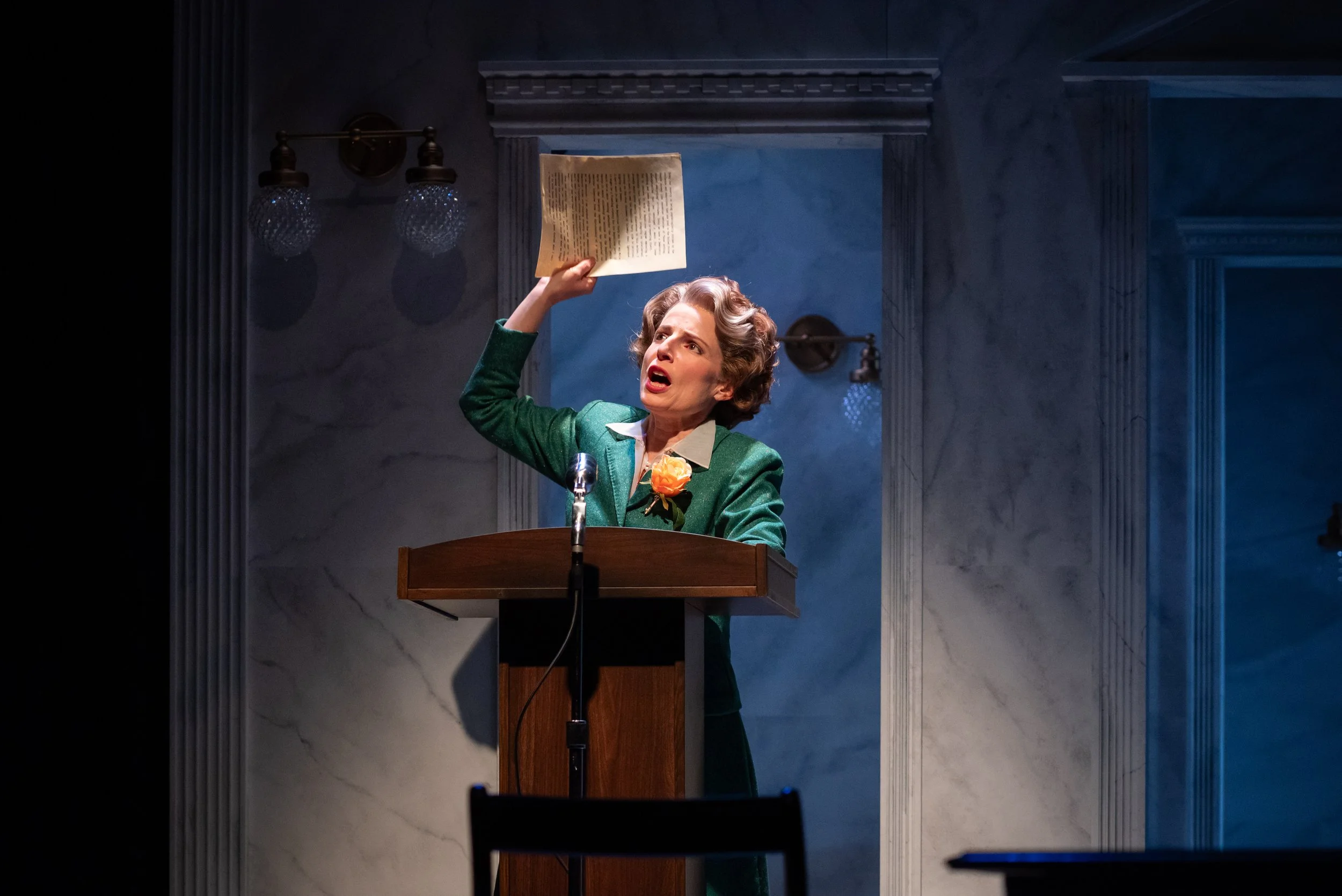
All of this makes Margaret’s choice all the more remarkable. It is easy, more than 75 years later and knowing how history ultimately judged McCarthy, to see her Declaration of Conscience as an inevitable act of political courage. There was nothing inevitable about it at the time. Margaret was the only woman serving in the United States Senate, standing before a body filled with men who were either supportive of McCarthy, willing to exploit his tactics for their own purposes, or simply too frightened of the political consequences to confront him. Yet there she stood, calling out not only McCarthy’s methods but the culture of fear and political cowardice that allowed them to flourish.
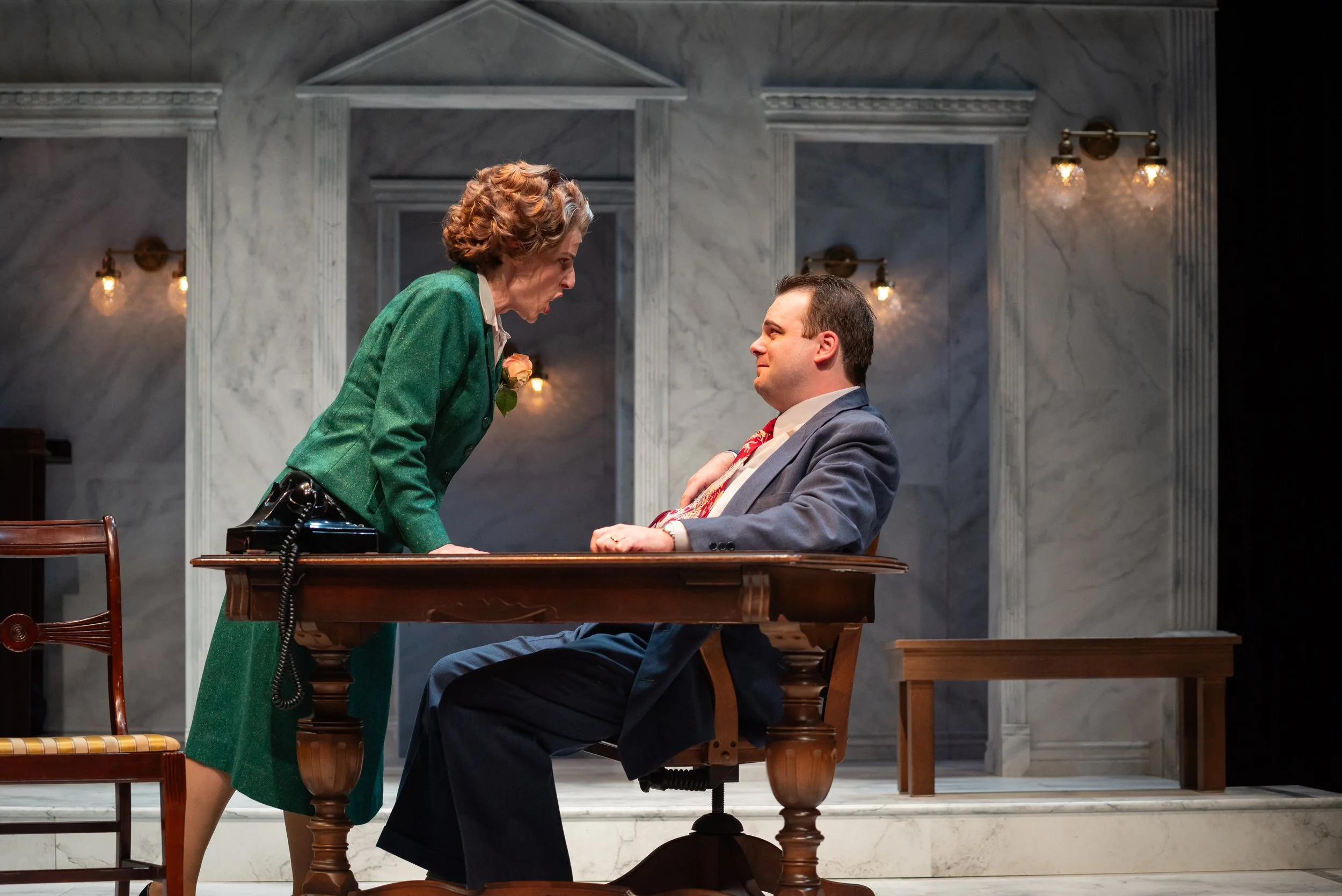
There is a brazenness to that act that Alyssa Keene captures beautifully in her portrayal of Margaret Chase Smith. Her posture, poise and confidence establish someone accustomed to holding her ground in rooms dominated by men, while dialect coach Marianna de Fazio’s work is evident in a Maine accent that remains strong and consistent throughout. But Alyssa doesn’t turn Margaret into a monument. There is humor in her delivery and warmth beneath the confidence, making her feel like a person who understands exactly what standing on principle might cost and chooses to do it anyway. Her Declaration of Conscience ultimately becomes more than a historical document within the production, it feels like a page from a book on political courage that perhaps a few of our current elected officials might want to dust off and read.
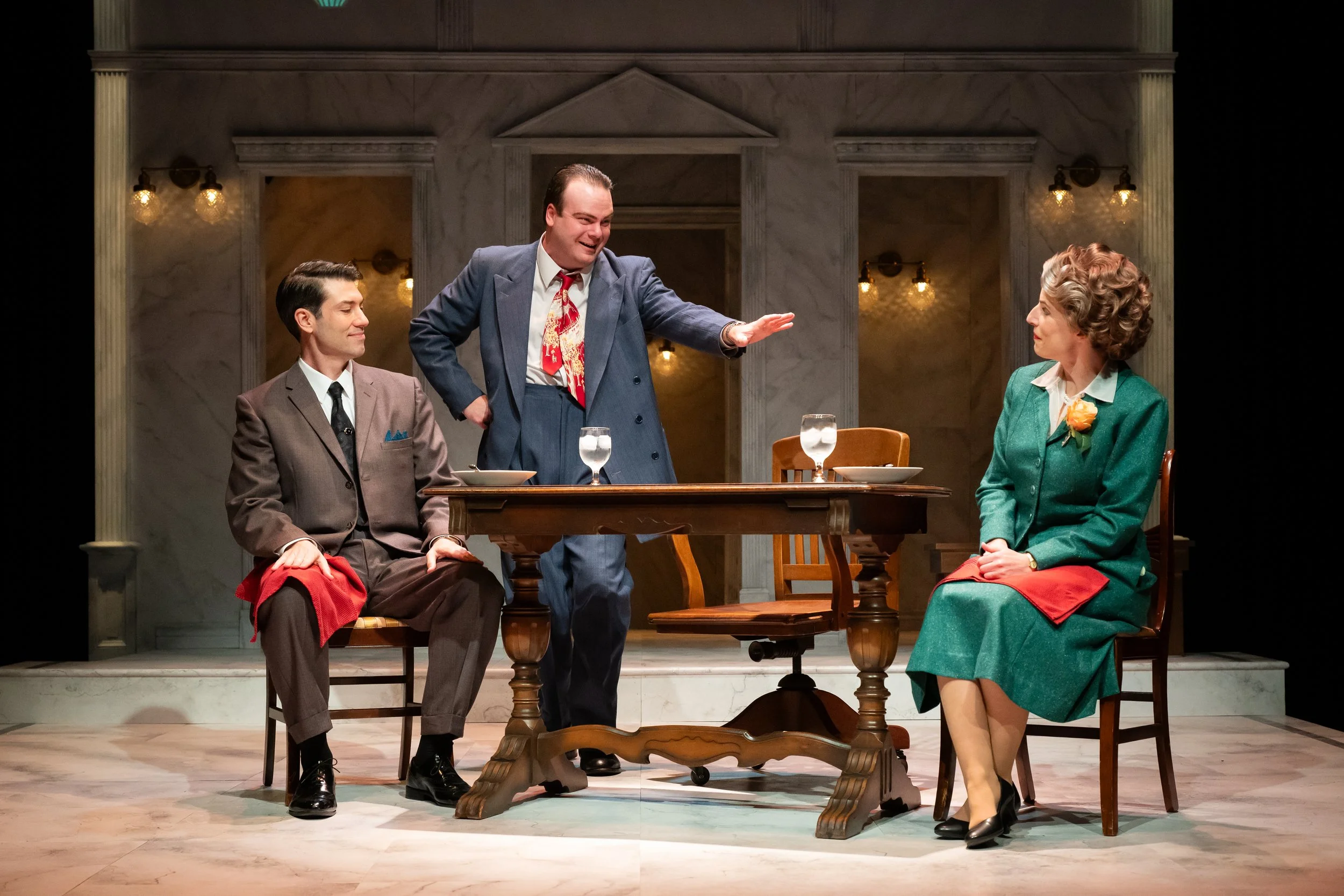
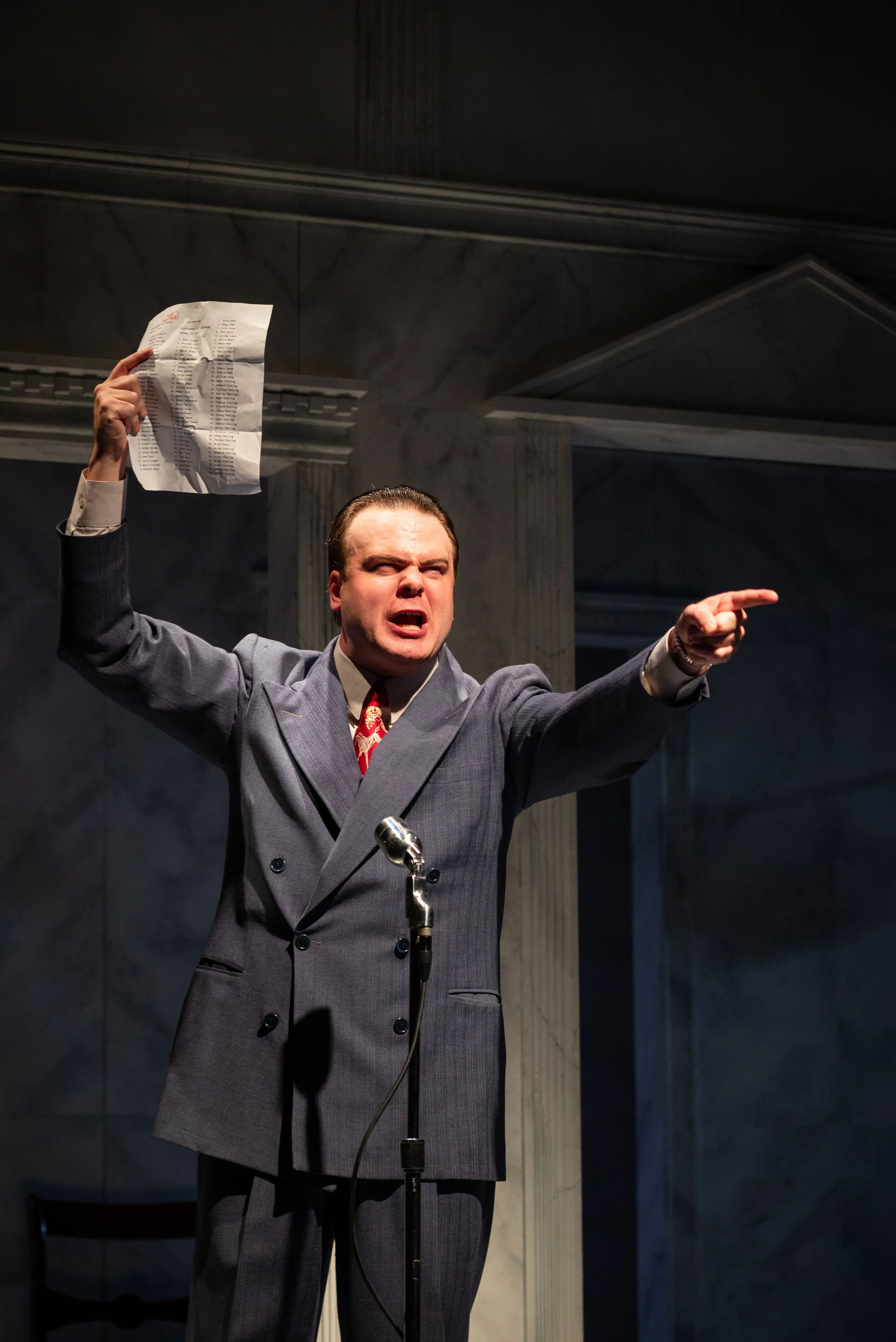
If Margaret is controlled and principled, Jonathan Swindle’s McCarthy is almost her complete opposite. He is loud, gluttonous, chauvinistic and frequently despicable, but Jonathan wisely avoids making him merely a caricature. What makes his performance so effective is the ease with which this McCarthy understands emotion as a political tool. He knows how to manipulate an audience, how to turn suspicion into fear and fear into loyalty, and he is never afraid to challenge anyone who gets in his way. There are moments when he seems so convinced by his own version of events that truth itself becomes secondary to whatever story best serves him. Jonathan makes it easy to understand how a dose of fear-mongering, delivered with enough certainty and repeated often enough, can become a movement. His is a performance that requires he reach a place inside that few of us ever give ourselves permission to access, and then he goes even deeper still.
By the time McCarthy’s carefully constructed public persona begins to fracture, Jonathan’s breakdown feels like the culmination of everything that has come before it. Fear may be an extraordinarily effective way to gain power, but maintaining that power requires continually feeding the fear that created it. Eventually, there must always be another enemy, another accusation and another person whose loyalty can be questioned.
That is where the parallels between McCarthy’s America and our own become difficult to ignore. The specifics may change, but the tactics are remarkably recognizable. Build a movement around fear, repeat mistruths until they become accepted by supporters, identify enemies, demand loyalty and threaten the political futures of those unwilling to fall in line. Conscience doesn’t need to announce those parallels or underline them for the audience. They are already sitting there, uncomfortably close to the surface, allowing each person watching to decide what lessons, if any, have actually been learned in the intervening decades.
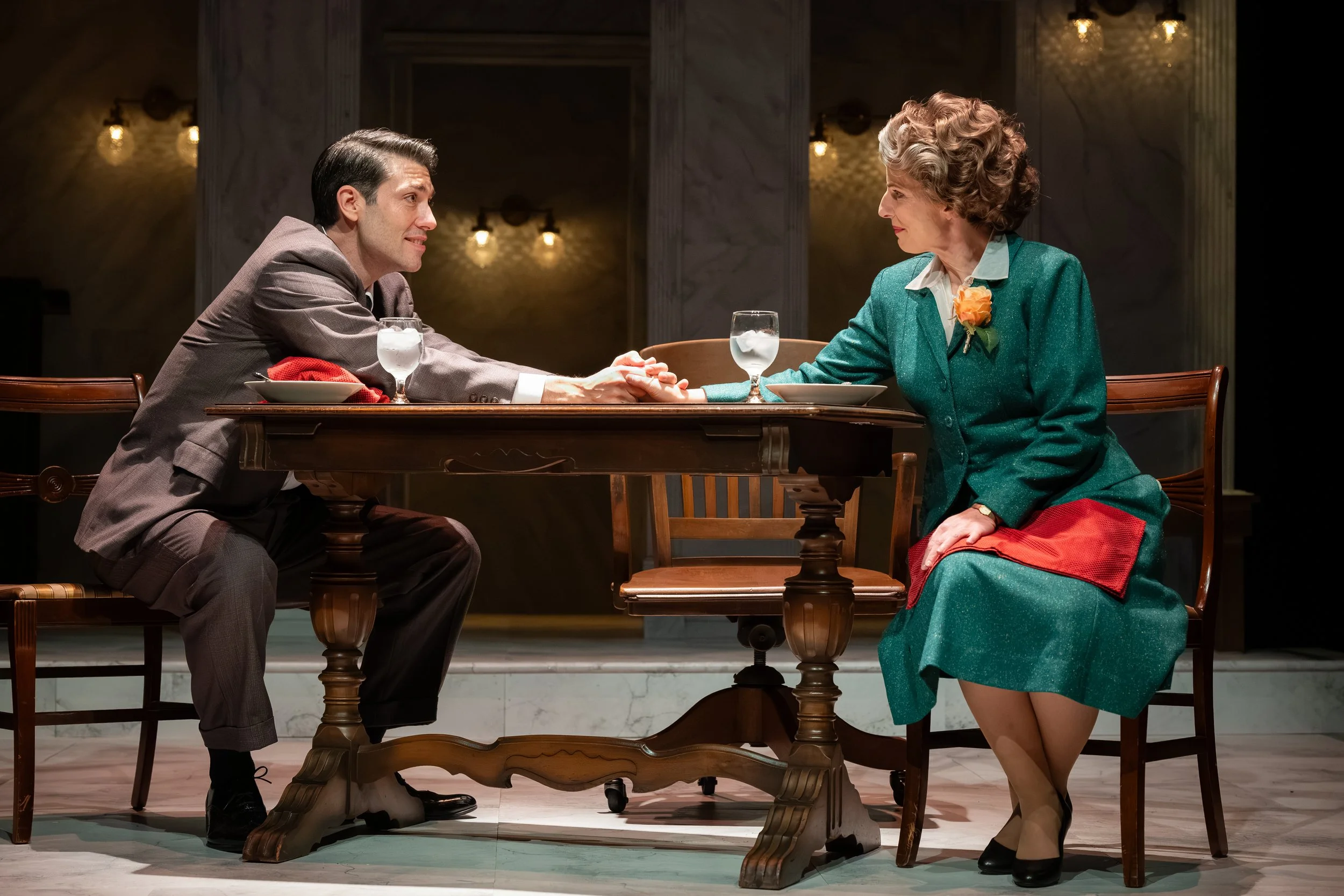
Christopher Clark brings a different energy as William Lewis Jr., Margaret’s executive assistant, with an easy poise and confident delivery that provides a steady counterweight to the increasingly volatile political world surrounding them. Some of the production’s most memorable work comes when Bill and Margaret step away from politics long enough to bare their souls to one another and reveal secrets they have been carrying. It is a wonderfully emotional turn for both Christopher and Alyssa, and one that shows considerable depth in their performances. After so much of the play is concerned with public personas, political calculation and the power of words spoken before an audience, these quieter moments remind us of the private people who still exist underneath all of it.
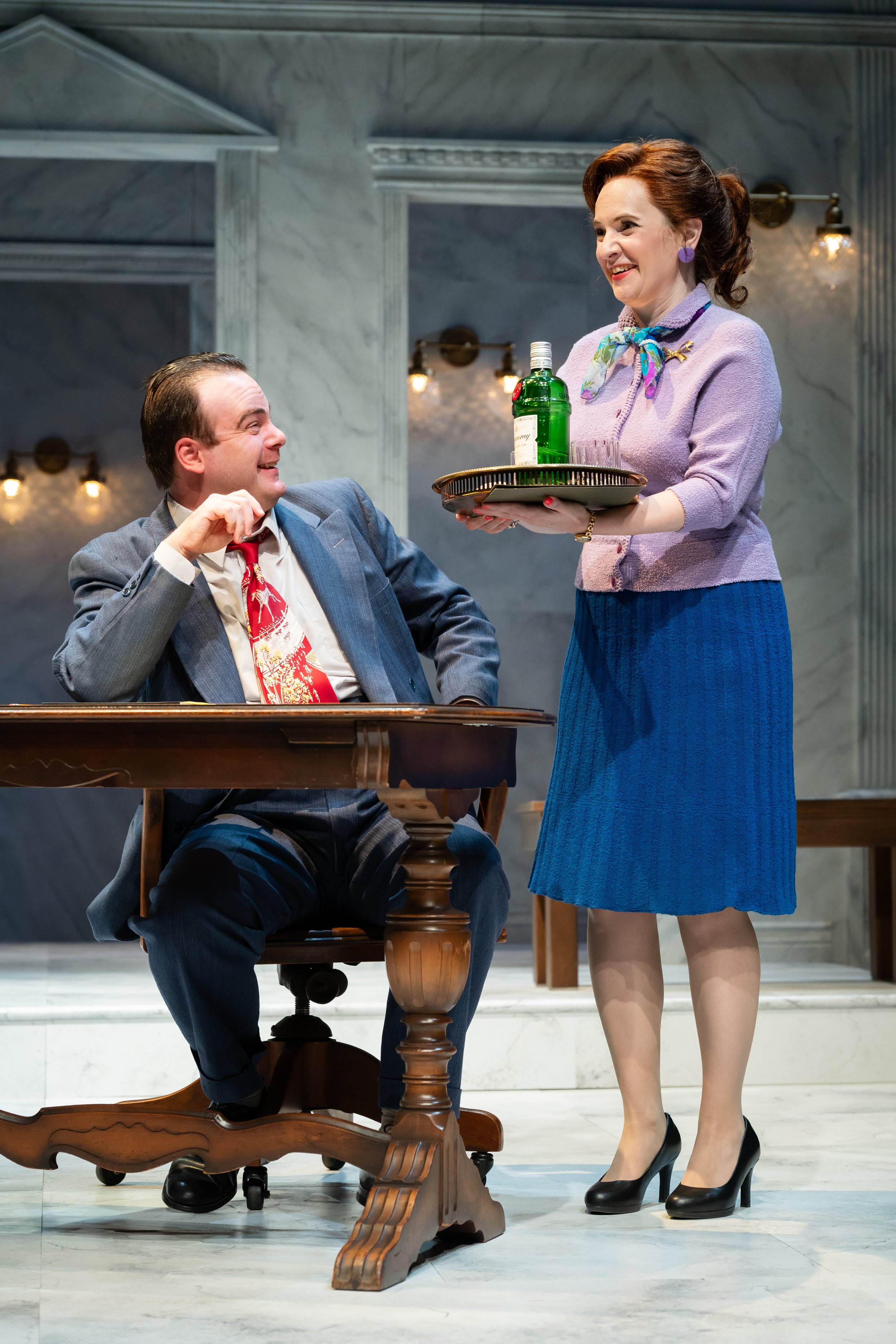
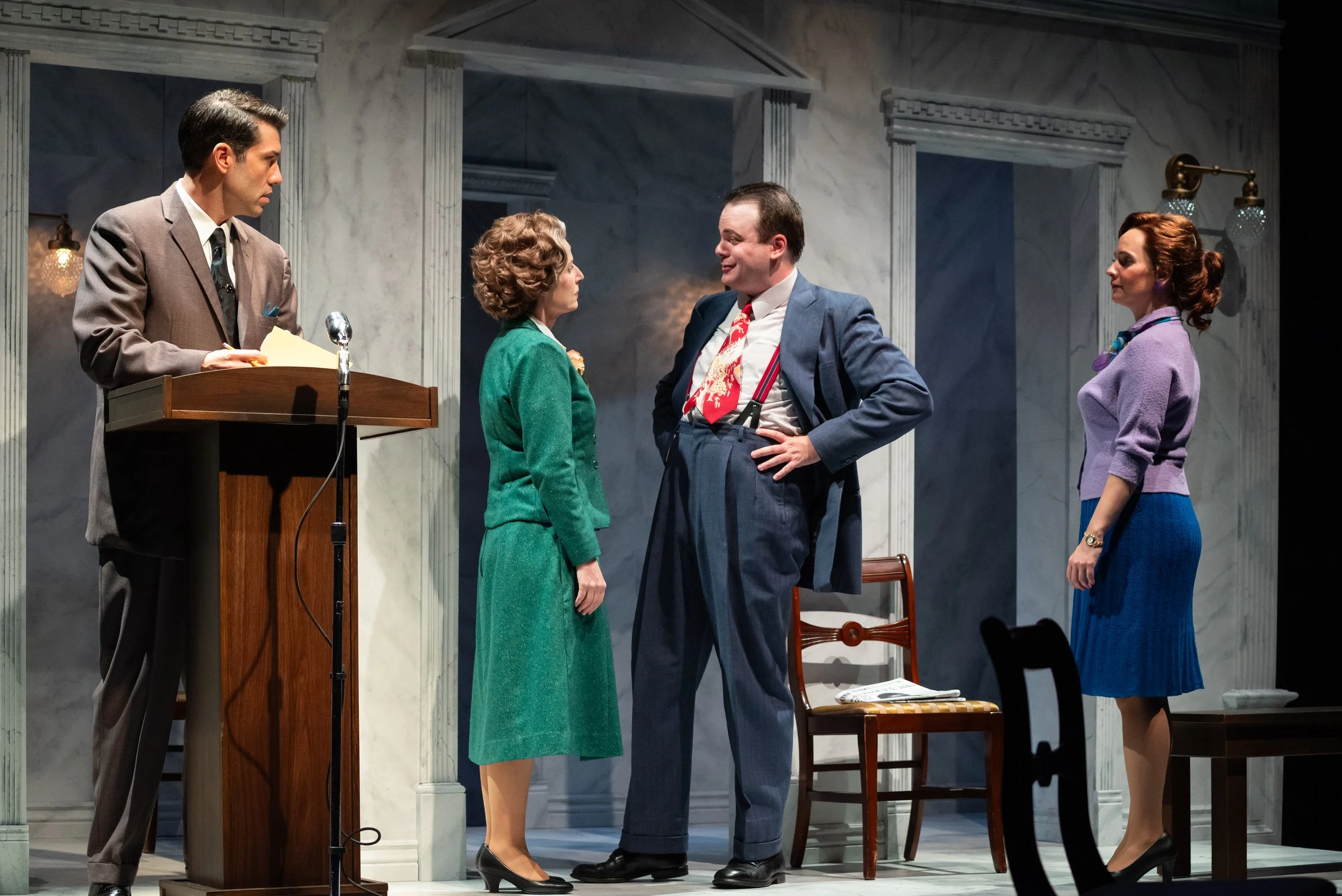
Kelly Karcher, meanwhile, rounds out the four-person cast as Jean Kerr, McCarthy’s aide and eventual wife, adding another perspective to the orbit surrounding him. Jean helps reinforce one of the more interesting ideas running beneath DiPietro’s script, powerful political figures do not operate in isolation. The people surrounding them can encourage, temper, enable or challenge their worst instincts, and those choices carry consequences of their own.
As director, Karen Lund keeps all of that history accessible without allowing the production to become a lecture. Historical projections provide context while also extending the physical world of the production, allowing the story to move fluidly between public history and private conversation. Scenic and sound designer Mark Lund gives the stage a stately, almost Federalist quality, with a marble-like appearance across the floor and walls and relatively simple furnishings that can quickly establish a desk, an office or another location without interrupting the momentum. Props master Jaiden Clark’s work fits naturally within that simple approach, supplying the period detail needed to complete the world without cluttering the stage or distracting from the people occupying it.
Brian Engel’s lighting further helps define those spaces, brighter and more institutional in the office and softer in the restaurant scenes. Mark’s sound design is equally effective, particularly when an echo fills the theatre as McCarthy addresses a crowd in West Virginia, amplifying not only his voice but the sense of a movement growing around him. Together, the scenic, lighting, sound and projection work allow the production to move easily between the private and public sides of these historical figures.
Co-costume designers Melanie Burgess and Ruby Carter are equally successful in establishing the period, with costumes that feel appropriate to the era without drawing unnecessary attention away from the characters wearing them. Overall, this is a strong design package, with the elements working together to establish time and place while leaving the focus where it belongs.
The one design element that doesn’t work quite as well is Jean’s wig. Wigs can sometimes disappear into a character so naturally that after a few moments you stop noticing them at all, as is largely the case with Alyssa’s as Margaret. Other times, something about the fit or appearance remains just unnatural enough that you never completely stop seeing the wig rather than the character. Kelly’s falls into that latter category, an admittedly small distraction in an otherwise convincing period design.
What makes Conscience so unsettlingly effective in 2026 is that it’s not simply a play about McCarthyism or a courageous senator from Maine who chose to challenge it. It is about how easily fear can overwhelm fact, how quickly political self-preservation can replace principle, and how much courage it can take for one person to finally say enough. Karen Lund and her cast don’t need to manufacture contemporary relevance for Joe DiPietro’s play. History, unfortunately, has taken care of that for them. Conscience may take place more than seven decades ago, but sitting in the Jewell Mainstage today, it can feel uncomfortably like watching the evening news.
The regional premiere of Joe DiPietro’s Conscience runs on stage at Taproot Theatre’s Jewell Mainstage through October 17. For more information, including ticket availability and sales, visit https://taproottheatre.org/.
Photo credit: Robert Wade