
Stage Review - Green Day’s American Idiot (Bainbridge Performing Arts)
Stage Review - Green Day’s American Idiot
Presented By: Bainbridge Performing Arts - Bainbridge Island, WA
Show Run: May 01 - May 23, 2026
Date Reviewed: Thursday, April 30, 2026 (Preview)
Run Time: 90 Minutes (no intermission)
Reviewed by: Greg Heilman
I love a good backstory, and the one surrounding Green Day’s American Idiot, the musical running on stage at Bainbridge Performing Arts’ Buxton Center through May 23, is as good as it gets. After the band’s 2000 album Warning, which skewed more toward the folk-inspired side of their music and away from their trademark neo-punk sound, proved less commercially successful than expected, the band stepped back and reassessed where they wanted to go creatively. What emerged was an ambitious concept album rooted in the rock operas of decades prior while still embracing Green Day’s unmistakable sound, fusing punk rock with elements of pop, new wave, latin influences, and even touches of rap-inspired rhythm. The result was 2004’s American Idiot, an album built around a generation’s anger, confusion, and disillusionment. It spoke directly to young adults coming of age in the aftermath of 9/11, during economic instability, endless media noise, and the lingering cultural influence of the baby boom generation that preceded them. For years, there had been talks of a feature film adaptation, and while that never came to pass, it did find new life on the stage, which ultimately shouldn’t be too much of a surprise given that Billie Joe Armstrong reportedly studied classic Broadway musicals while shaping the album’s structure.
Like the music Green Day has become known for, American Idiot is loud, energetic, and rebellious. The musical lashes out at the forces that have overwhelmed this generation, a generation that would ultimately become more commonly identified by its “millennial” label than by any singular defining cultural moment. There is anger throughout the piece, anger at politics, at media saturation, at economic instability, at war, and perhaps most importantly, at the feeling of being directionless in a world that seems increasingly disconnected and impossible to navigate. Yet beneath that anger is also uncertainty, loneliness, and an aching search for identity and purpose, themes that give the musical far more emotional weight than its aggressive exterior initially suggests.
The story and its characters also reflect the evolution of the neo-punk movement itself. Johnny, Tunny, Will, and those around them rebel constantly, but unlike earlier generations of punk culture that often carried an overtly anarchistic worldview, the rebellion here feels less organized and more existential. These characters are not rallying against one clearly defined institution so much as they are lashing out at a world that constantly demands compliance, conformity, and emotional numbness. They throw out countless reasons for their frustration and angst, but rarely sort them neatly into ideological boxes. That becomes one of the key distinctions between this era of punk expression and what many witnessed in the genre’s earlier incarnations. The anger here is less about dismantling systems and more about trying to survive within systems that feel emotionally suffocating and impossible to escape.
The stage adaptation expands upon the loose narrative structure that existed within the album itself, transforming thematic threads and recurring characters into a more fully realized story. At its center are Johnny, Tunny, and Will, three young men stuck in suburbia and desperate to escape the stagnation surrounding them. As the story unfolds, their paths diverge dramatically. Johnny falls deeper into addiction and emotional self-destruction, Tunny is swept into the machinery of war after enlisting in the military, and Will finds himself trapped by responsibilities and a life he never expected to inherit so quickly. While the original album carried these ideas largely through implication and recurring lyrical imagery, the musical adaptation gives those emotions and conflicts a clearer dramatic framework, turning the album’s angst into something more personal and character driven without losing the raw energy that made the music resonate in the first place.
That restless energy is fully embraced in Bainbridge Performing Arts’ production, directed and choreographed by Troy Wageman. The result is a staging that feels loud, emotionally volatile, and constantly in motion, a production that understands American Idiot works best when it feels like the emotional equivalent of a live wire.
If there was any doubt as to what audience members are about to experience coming into American Idiot, the fact that earplugs are distributed in the lobby quickly makes things clear. American Idiot is not interested in subtlety when it comes to sound or energy. This musical is meant to hit the audience head on, and with volume. Upon entering the theatre itself, however, there is almost no indication of what visual world is waiting on the other side of the curtain. The audience is greeted simply by a closed red curtain, understated and almost traditional in appearance. But once that curtain rises and the ensemble launches into the musical’s explosive title track, “American Idiot,” what follows becomes a relentless ninety-minute roller coaster of sound, movement, emotion, and rebellion.
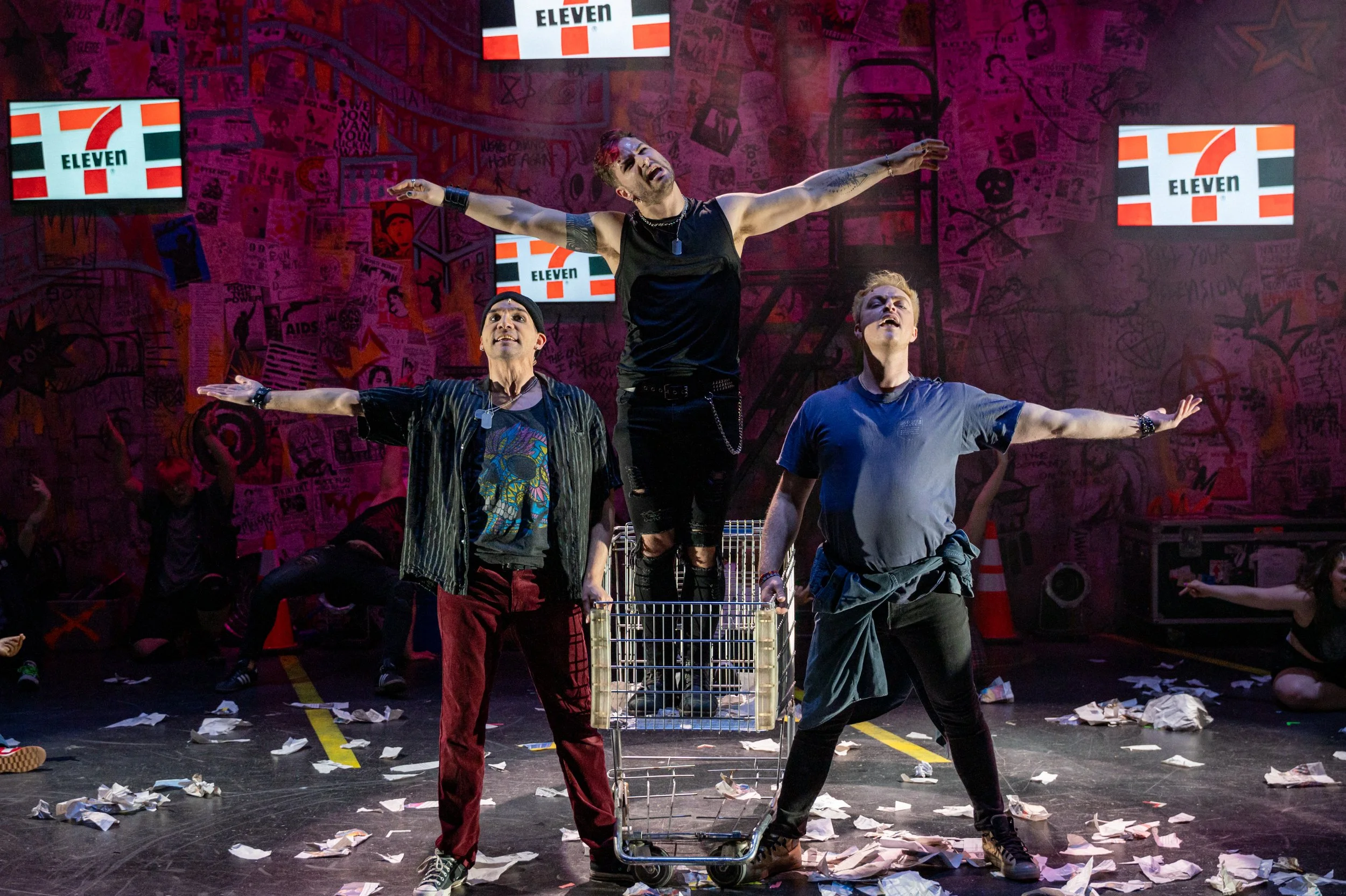
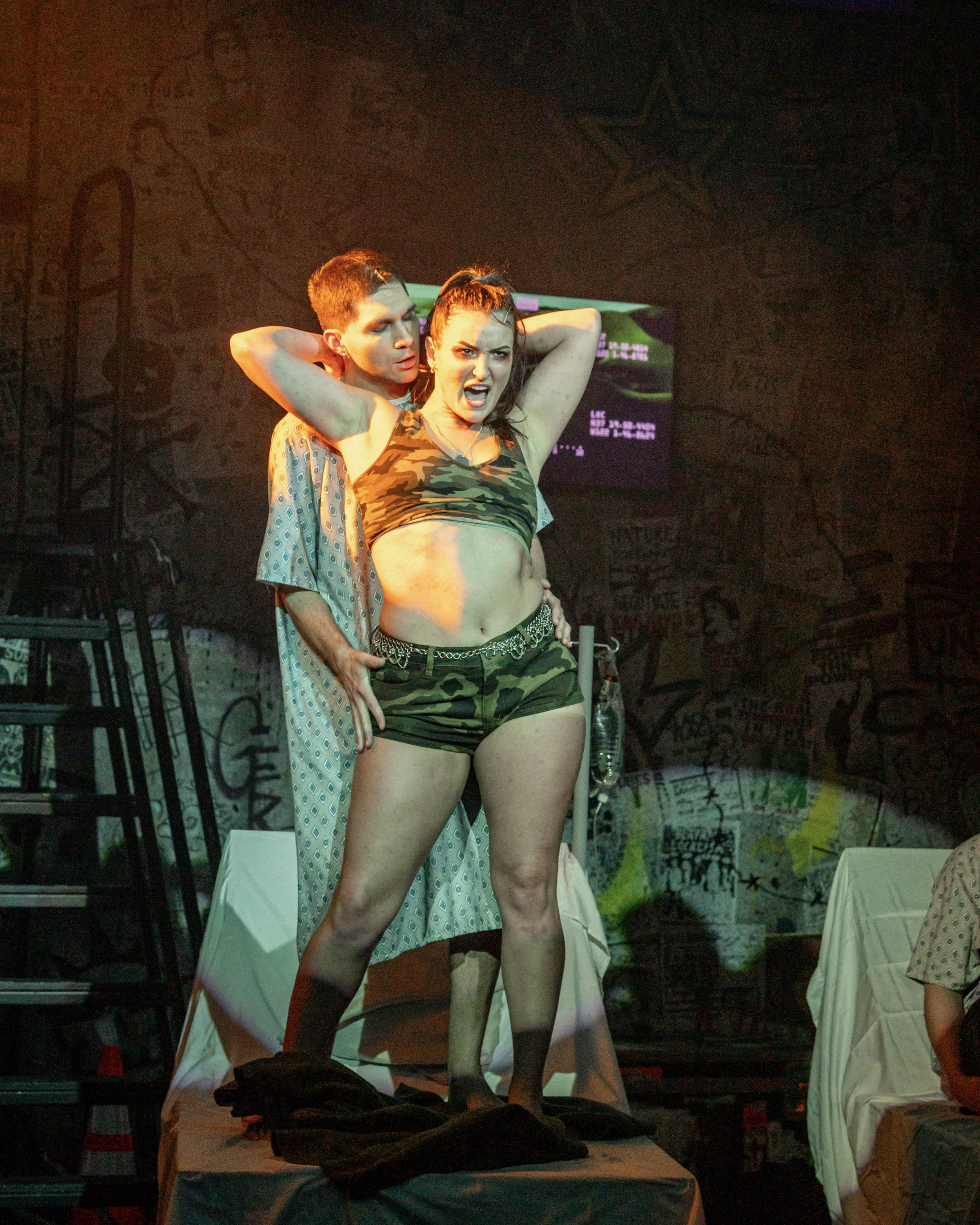
Troy’s scenic design, with construction work from Dave Tier and Oscar Hernandez and scenic artistry by Matthew Lazure, creates a worn, urban environment that feels pulled from alleyways, clubs, basements, and city streets. It is a visual world that reflects the emotional state of the characters themselves, fractured, angry, searching, and uncertain about where they fit. Matt Longmire’s video design becomes one of the strongest storytelling tools in the production, with projections and imagery that reinforce the themes of media saturation, isolation, political unrest, and emotional fragmentation that define the musical.
The highlight of the production side, however, is Rob Falk’s lighting design, which captures the angst, animosity, sadness, and anger coursing through the lives of these characters. More than simply illuminating the stage, the lighting actively contributes to the storytelling as much as any other design element in the production. Rob constantly shifts the emotional temperature of the room, whether through stark concert-style looks, isolated pools of intimacy, or chaotic flashes that mirror the instability surrounding Johnny, Tunny, and Will. One of the strongest examples comes during “Know Your Enemy,” creatively staged and lit with flashlights and lanterns that reinforce the competing intentions, fractured loyalties, and internal conflicts driving the characters forward. Credit also goes to Deirdre Hadlock, whose work as production manager and stage manager keeps the enormous number of lighting cues in Rob’s design moving with precision throughout the evening.
Musically, the production commits fully to the Green Day sound. Will Sanders serves as music director while also leading the onstage band from the keyboard, and the musicians bring an appropriately aggressive edge to the score. Cam Schneider and Daniel Powers drive the guitar-heavy sound with force, while Devin James on drums and Peter Vosshall on bass provide the relentless backbone that powers the show forward. Lin Chen’s violin and Erika Fiebig’s cello add texture and emotional contrast that help some of the quieter moments land effectively amidst the sonic assault.
Because the performance I attended was a preview, many of the areas that still need refinement feel like the sort of things that will very likely be tightened by opening night and continue improving throughout the run. There were occasional moments where the band and performers fell slightly out of synchronicity, along with a few harmonies that landed a bit unevenly, and there are also moments where actors playing instruments on stage appear understandably focused on the mechanics of the music itself, sometimes at the expense of the emotional connection within the scene or song. That balance between musicianship and storytelling is especially important in a show like American Idiot, where emotional authenticity carries as much weight as the score itself. One example comes during “Wake Me Up When September Ends,” where the emotional resonance of the number occasionally competes with the visible concentration required of the performers musically. Even so, these moments feel far more like the natural polish points of an ambitious preview performance than larger structural concerns, particularly given the sheer complexity and energy demanded by the production overall.
Where BPA’s American Idiot succeeds most strongly is in its physicality and movement. Troy’s choreography and staging create an almost nonstop sense of momentum. Characters rarely remain still for long, and the production understands that this musical works best when it feels like emotional chaos barely being held together. The choreography, from Troy and associate choreographer Annalisa Brinchmann, contributes greatly to that feeling, with movement that captures the anxiety, recklessness, and impulsiveness of youth. Even scenes that are comparatively intimate retain an undercurrent of tension, something aided significantly by Kathryn Van Meter’s intimacy direction. There is a great deal for Kathryn to navigate in a production built around relationships that are both emotionally and physically complicated, often unfolding in moments of vulnerability, anger, addiction, or emotional collapse. Creating an environment where the actors can tell those stories honestly and authentically while still remaining within clearly established comfort zones is both a difficult and deeply important responsibility, and Kathryn’s work here allows those moments to feel believable without losing the emotional volatility that defines the piece.
On the performance side, David Naber, Anden J Leo, and Leif Layman work effectively as the emotional core of the production, not simply because each actor succeeds individually, but because together they capture three very different responses to the same frustration and disillusionment. David’s Johnny becomes the volatile center of the story, a young man desperate to escape his environment yet increasingly consumed by addiction and emotional self-destruction. There is an urgency to David’s performance, particularly vocally, that allows Johnny’s unraveling to feel authentic rather than theatrical. Opposite that energy, Anden’s Tunny evolves from restless suburban aimlessness into someone physically and emotionally shaped by war, and Anden handles that progression with a vulnerability that gives some of the production’s heavier moments real emotional impact, particularly during the military hospital sequences. Meanwhile, Leif’s Will represents the path of reluctant stagnation, the young man who never escapes at all, instead becoming trapped beneath responsibility and domestic pressures before he has fully figured out who he wants to be. Leif captures that frustration and simmering resentment well, presenting the character with a realism that contrasts effectively with the heightened chaos surrounding Johnny and Tunny. Together, the three performances reinforce one of the musical’s central ideas: that even people who begin in the same place can fracture into entirely different versions of themselves depending on the choices they make and the systems surrounding them.
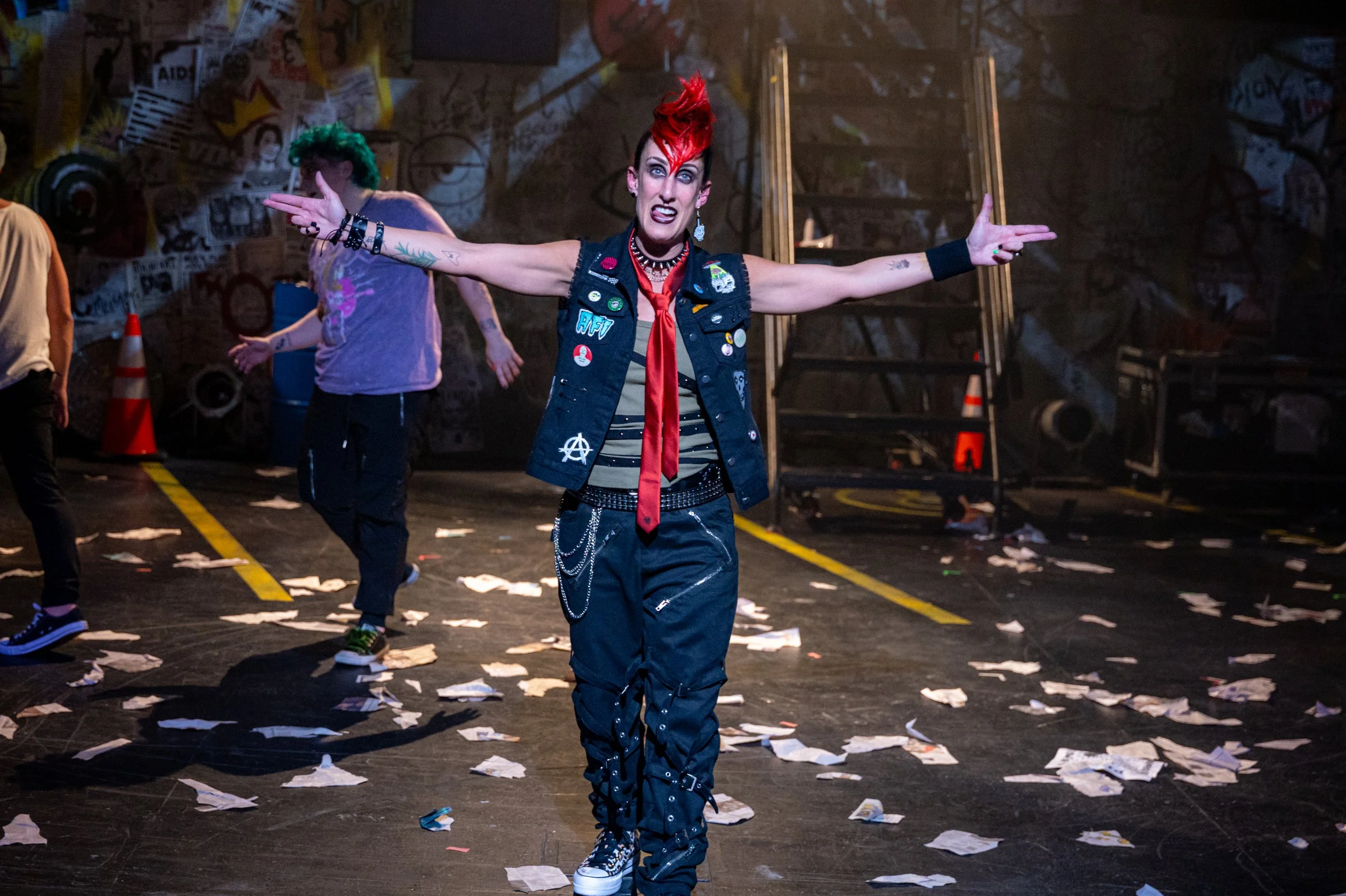
Olivia Lee and Sarah Conte serve as two opposing emotional forces within Johnny’s journey, each representing very different versions of the life and identity he is searching for. Olivia’s St. Jimmy is one of the standout performances in the production, gutsy, commanding, and impossible to ignore whenever she steps onto the stage. Rather than presenting the character as simply chaotic, Olivia creates a figure who is devilish in look, manner, and behavior, seductive in all the wrong ways and constantly tempting Johnny toward the more destructive path in front of him. There is swagger and danger in the performance, but also a sense of manipulation beneath it, as though St. Jimmy exists as both a person and a manifestation of Johnny’s worst impulses. In contrast, Sarah’s Whatsername carries herself with a grounded emotional sincerity that relies heavily on the strength and vulnerability of her vocal delivery. Sarah creates the sense of someone who briefly represented hope, connection, and the possibility of stability before ultimately becoming another abandoned road in Johnny’s fractured life. Where Olivia’s performance pushes the story toward chaos and self-destruction, Sarah’s reminds the audience of the humanity and emotional intimacy Johnny risks losing along the way, making the contrast between the two characters all the more effective.
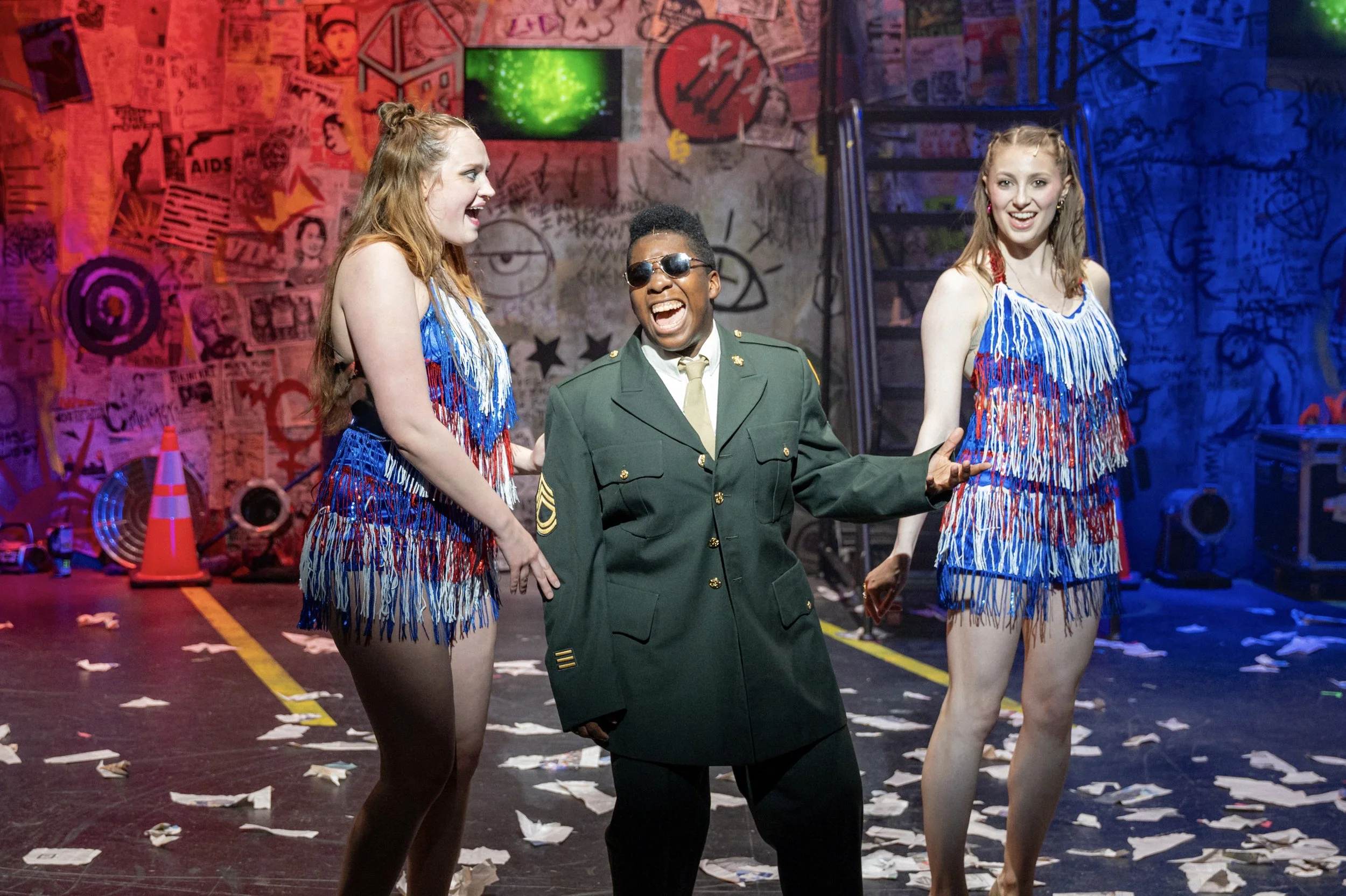
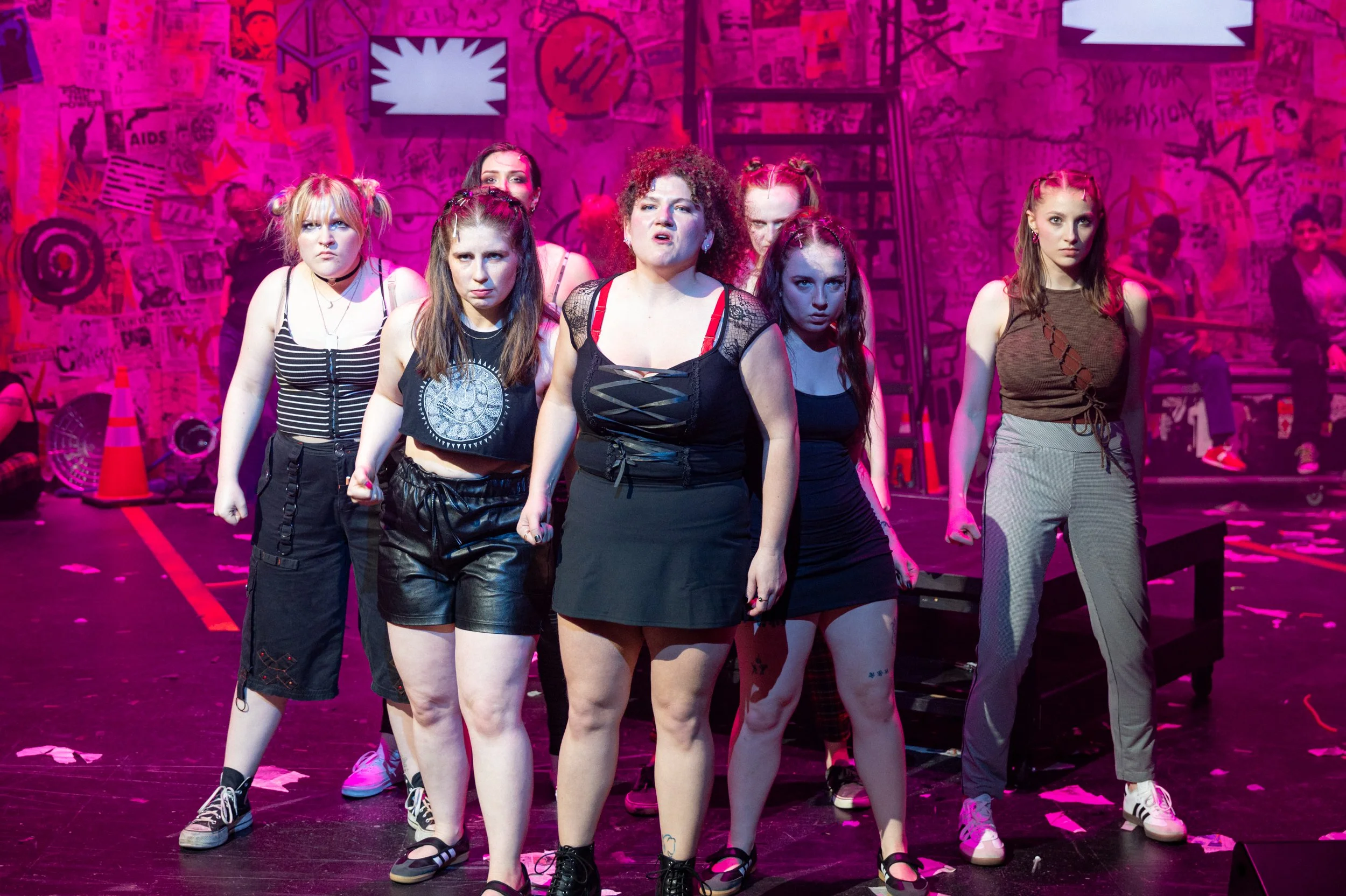
The supporting cast contributes heavily to the success of the production’s atmosphere, not only emotionally but technically as well. Kristin Sorensen’s Heather brings an emotional honesty to a character attempting to navigate an unstable relationship and uncertain future. Catalina Jarocki’s Extraordinary Girl provides some of the production’s more tender moments opposite Tunny, while Joey Chapman, Steven Rigaux, Reese Sigman, Dana A Benson, Shane Kiwini Smith, Jasmine Joshua, Mykahla “Mickey” George, Anna Vizzare, Avery Rose, Emma Drazkowski, and Dov Matthews help populate the production with a strong ensemble presence that constantly reinforces the emotional and physical momentum of the show. A standout in the ensemble is Carin Young, who brings a great amount of energy and expressiveness to her Alysha. Sometimes ensemble performers can get lost in the sheer number of people on stage, but Carin has a way of standing out among a talented group that helps lift the musical.
What makes the ensemble work especially impressive is the sheer technical difficulty involved. The choreography here is not easy. Troy’s staging demands near constant movement along with a wide variation of styles and physical vocabulary, often while maintaining the aggressive pace and emotional volatility the material requires. The cast is asked to transition rapidly between moments of explosive punk concert energy, emotionally vulnerable storytelling, militaristic movement, and more intimate character-driven scenes, all without allowing the production’s momentum to collapse. Vocally, American Idiot is equally demanding for an ensemble of this size, requiring tight harmonies, sustained intensity, and the ability to cut through a heavily amplified rock score. Aside from the few preview-night inconsistencies noted earlier, the ensemble handles those demands very well overall, and Shawna Avinger’s vocal direction deserves significant credit for helping the group maintain both the musical aggression and emotional texture the score requires. There’s a number of highlights from this group, not the least of which is the opening sequence of American Idiot and the wonderfully energetic and strong Jesus of Suburbia.
One of the more effective aspects of the ensemble work is how clearly the production captures the feeling of young people searching for identity and purpose. The cast handles the transitions between explosive punk energy and quieter emotional material with a commitment that keeps the production moving even when the narrative itself occasionally becomes abstract or fragmented. American Idiot has never been a conventionally structured musical, and Bainbridge Performing Arts wisely avoids trying to over-explain it. Instead, the production embraces the emotional logic of the piece.
American Idiot understands the heart beneath the anger of the generation at the heart of its story. Beneath the loud guitars, political frustration, addiction, rebellion, and chaos is a story about young people desperately trying to figure out who they are and whether there is still hope for something better. The production is loud and energetic, and emotionally it remains locked in on that central idea. In a world that often still feels fractured, angry, and uncertain, American Idiot continues to resonate, and this production captures that restless spirit with conviction.
Green Day’s American Idiot runs on stage at Bainbridge Performing Arts, in their Buxton Center, through May 23. For more information, including ticket availability and sales, visit https://www.bainbridgeperformingarts.org/.
Photo credit: Adam Othman