
Stage Review - I Am My Own Wife
Presented By: Intiman Theatre - Seattle, WA
Show Run: November 04 - November 22, 2026
Date Reviewed: Thursday, November 05, 2026 (Opening Night)
Run Time: 2 Hours (including a 15-minute intermission)
Reviewed by: Greg Heilman
For Charlotte von Mahlsdorf, preserving the past was a lifelong passion. A German trans woman who survived both the Nazi regime and the Communist government of East Germany, Charlotte collected furniture, clocks, phonographs, and the everyday belongings of a world disappearing around her. Her collection became the Gründerzeitmuseum in Berlin’s Mahlsdorf district, a museum in her own home where objects rescued from destruction carried their histories forward. Among them were the furnishings of the Mulackritze, a Berlin tavern whose interior she reconstructed in the her museum’s basement. In saving these pieces, Charlotte created a place for their stories while living a remarkable and complicated story of her own.
That life captured the attention of American playwright Doug Wright, whose interviews with Charlotte became the foundation of I Am My Own Wife. The play is as much about Charlotte’s life as it is about the considerable effort Doug put into building and telling her story. The result is a piece that traces his efforts to understand a woman whose survival initially seemed to offer precisely the inspiration he was seeking. As questions emerged about her relationship with the Stasi, East Germany’s secret police, admiration encountered uncertainty. The play grew from his exploration of Charlotte’s life and the challenges of interpreting it, specifically how to reconcile conflicting accounts, what her survival demanded, and how his own hopes influenced the portrait taking shape.
Intiman Theatre brings those intersecting stories to Erickson Theatre through November 22 under the direction of Wesley Frugé, with Dani Davis portraying Charlotte and the many people who populate her world. It is an exceptional performance within a thoughtfully constructed production, where shifts in voice, body, light, and perspective continually change how the audience sees the person at its center. The care Charlotte gave her collection finds a counterpart in the precision of the storytelling, allowing the objects and the people connected to them to reveal their histories piece by piece.
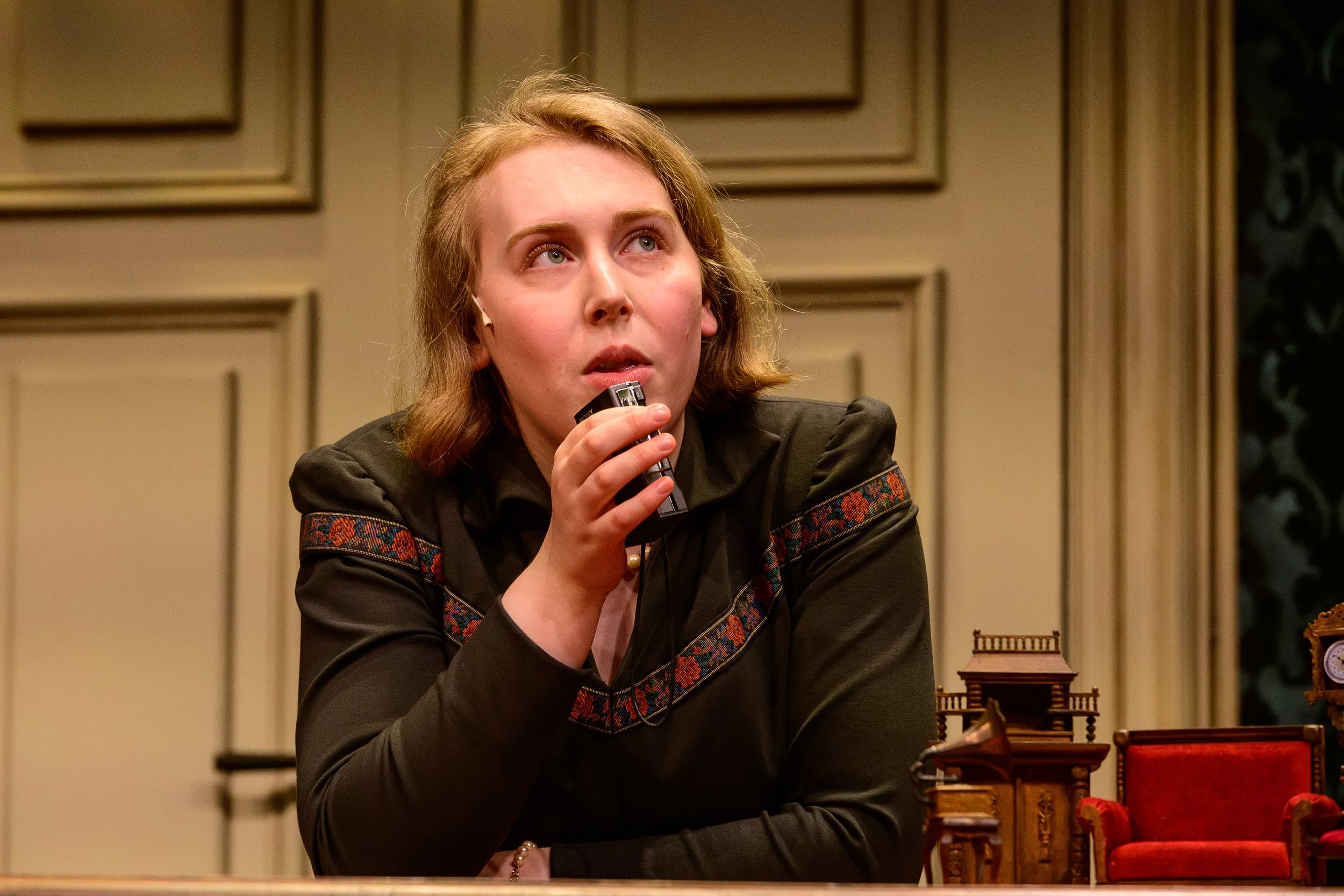
Dani’s performance makes that complexity compelling from moment to moment. Her Charlotte has a distinctive voice, posture, and collection of mannerisms, but just as striking is how completely those characteristics change when another person enters the conversation. A shift in expression or the way she carries her body accompanies each vocal transformation. The effect is a succession of people who appear physically different, even though the audience is watching the same performer throughout.
The vocal work alone is extraordinary. Dani moves among German, American, English, Indian, and even Japanese accents, finding distinctions within those broader categories that keep the individuals recognizable. Her Charlotte, John Marks, and Doug Wright each have a clear identity, and her agility extends to switching languages as well. Marianna de Fazio’s dialect coaching deserves recognition here, with the precision and consistency of the voices contributing substantially to the clarity of the storytelling. During the sequence in which Charlotte faces questions from the press, the rapid succession of voices is especially impressive. Dani creates the sense of a room full of people pressing in on one woman, with each new question arriving from another distinct personality.
What makes the performance so effective, though, is that the technical accomplishment serves the relationships. Conversations have rhythm, reactions have specificity, and the audience can follow the exchanges without needing another actor to establish the other side. Under Wesley’s direction, these transformations allow the story to move fluidly while giving its emotional turns the attention they require, and deserve. The audience has time to become interested in Charlotte before being asked to reconsider what it thinks it knows about her.
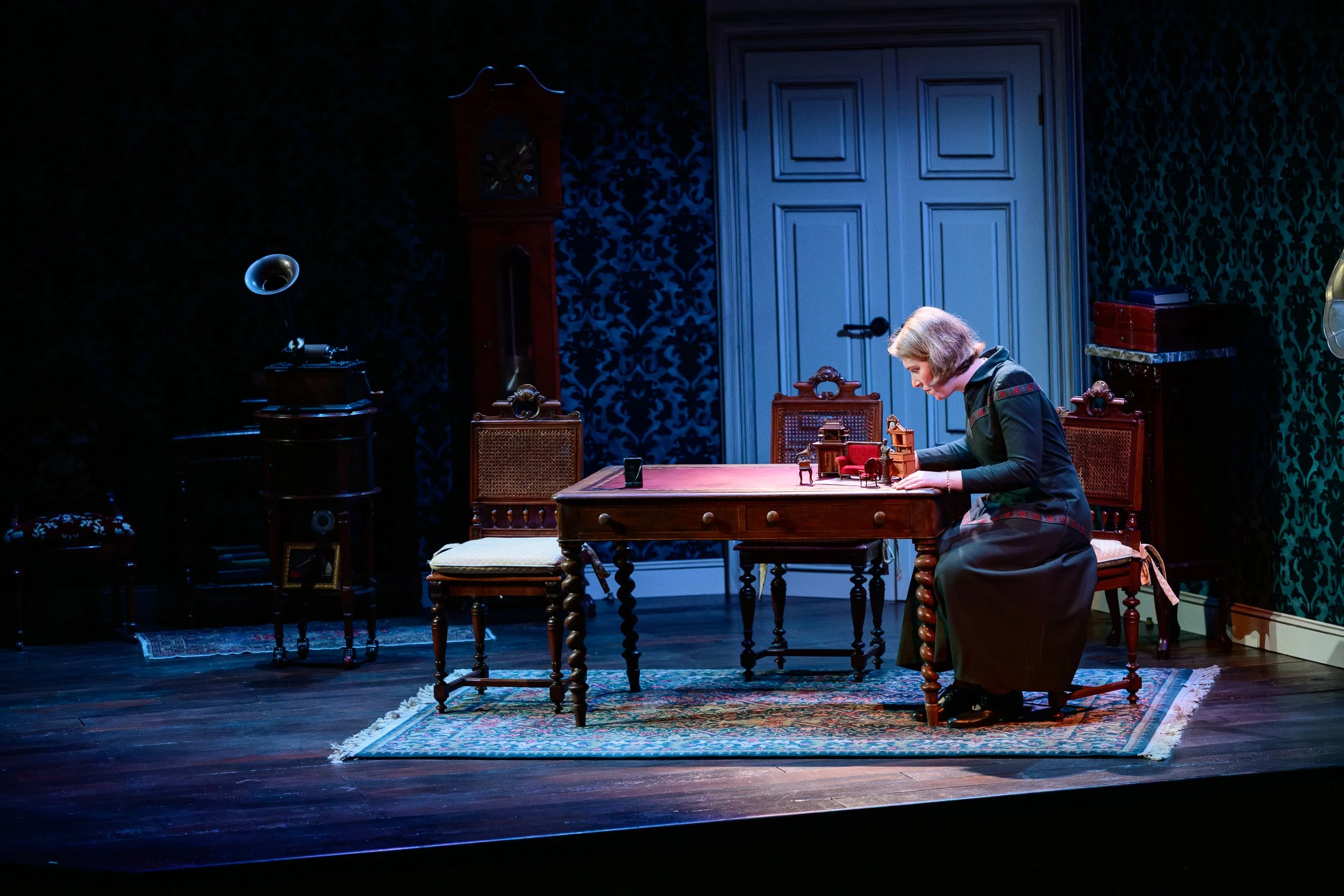
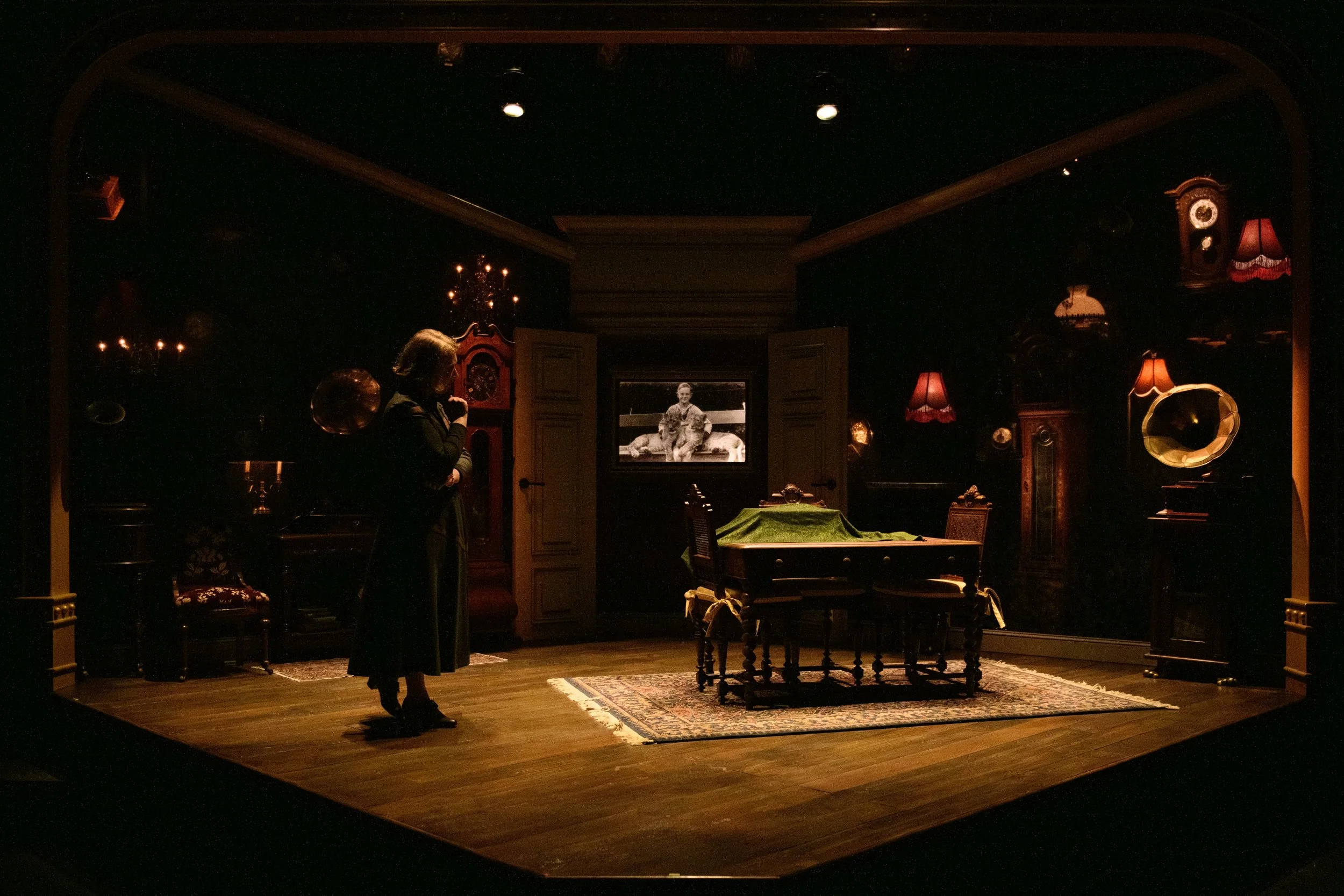
That attention to perspective carries into Marcos Gerardo Everstijn’s scenic design. Beneath a broad gold frame, angled, darkly patterned walls converge toward tall, cream-colored double doors. The forced perspective gives the room an impression of depth beyond its physical dimensions, while antique wooden furnishings establish the world Charlotte works so diligently to preserve. Clocks, lamps, and phonographs behind a scrim extend that world beyond the immediate room, suggesting a collection larger than the space initially reveals.
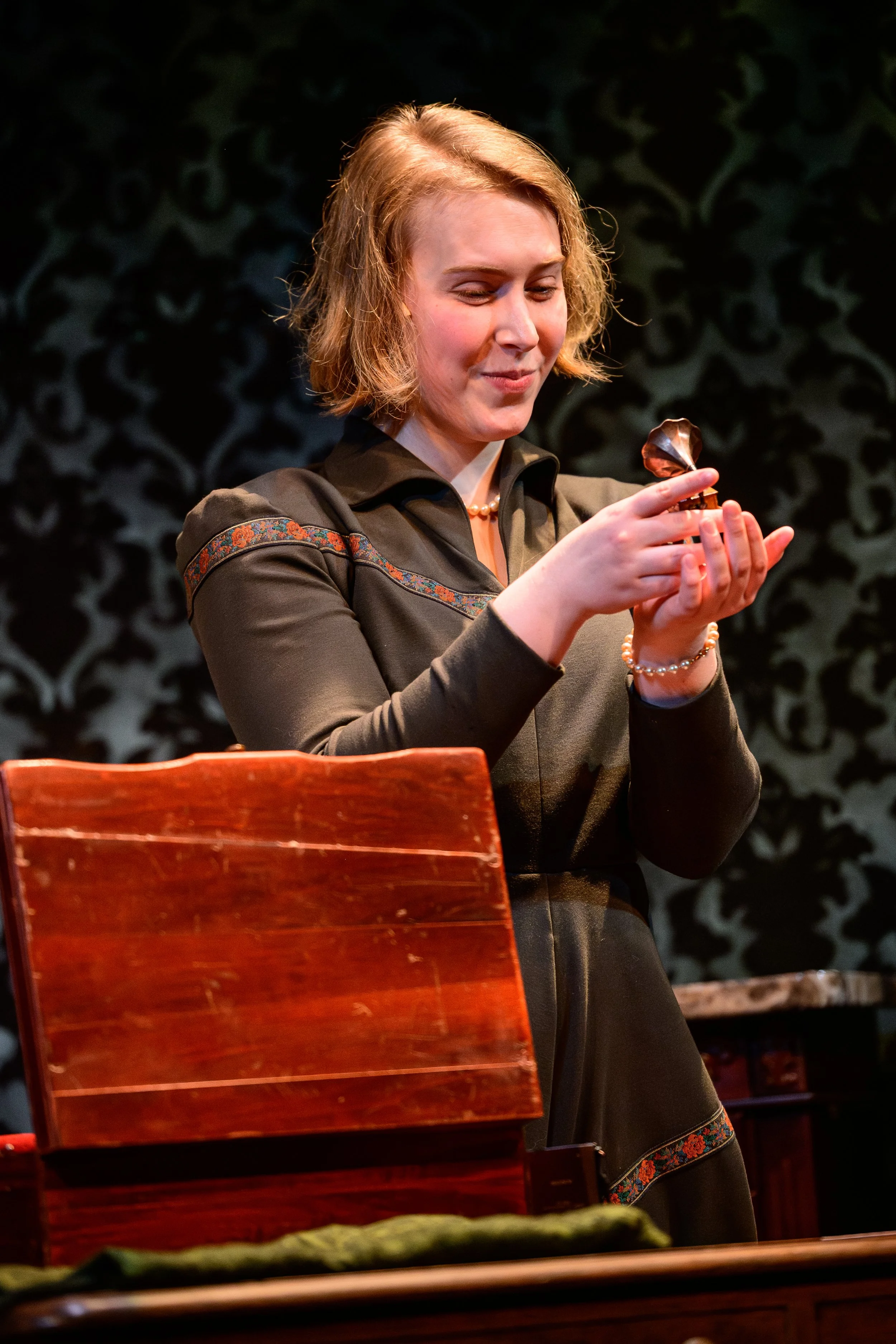
One of the most effective expressions of that design comes during Charlotte’s museum tour for John and Doug. Taking miniature clocks, phonographs, dressers, and other furnishings from a case, she describes each piece and its history before placing it on the desk. As the tour continues, the objects gradually form a small room, each meticulously positioned. The audience hears about a museum while watching a version of it emerge in miniature. It is another thoughtful manipulation of scale and perspective, and it gives Charlotte’s care for these objects a physical expression. Every piece has a story, and every placement reflects the attention of someone who understands its value.
Intiman’s Props Manager, Tori Stephens, is at the heart of this production’s success in its design, for collecting the pieces that populate this production and collaborating with the scenic design team on their placement. In a play where objects carry so much of the history, their selection matters enormously. The full-sized furnishings and their miniature counterparts give substance to Charlotte’s passion, allowing the audience to see what she sees in the things she saves.
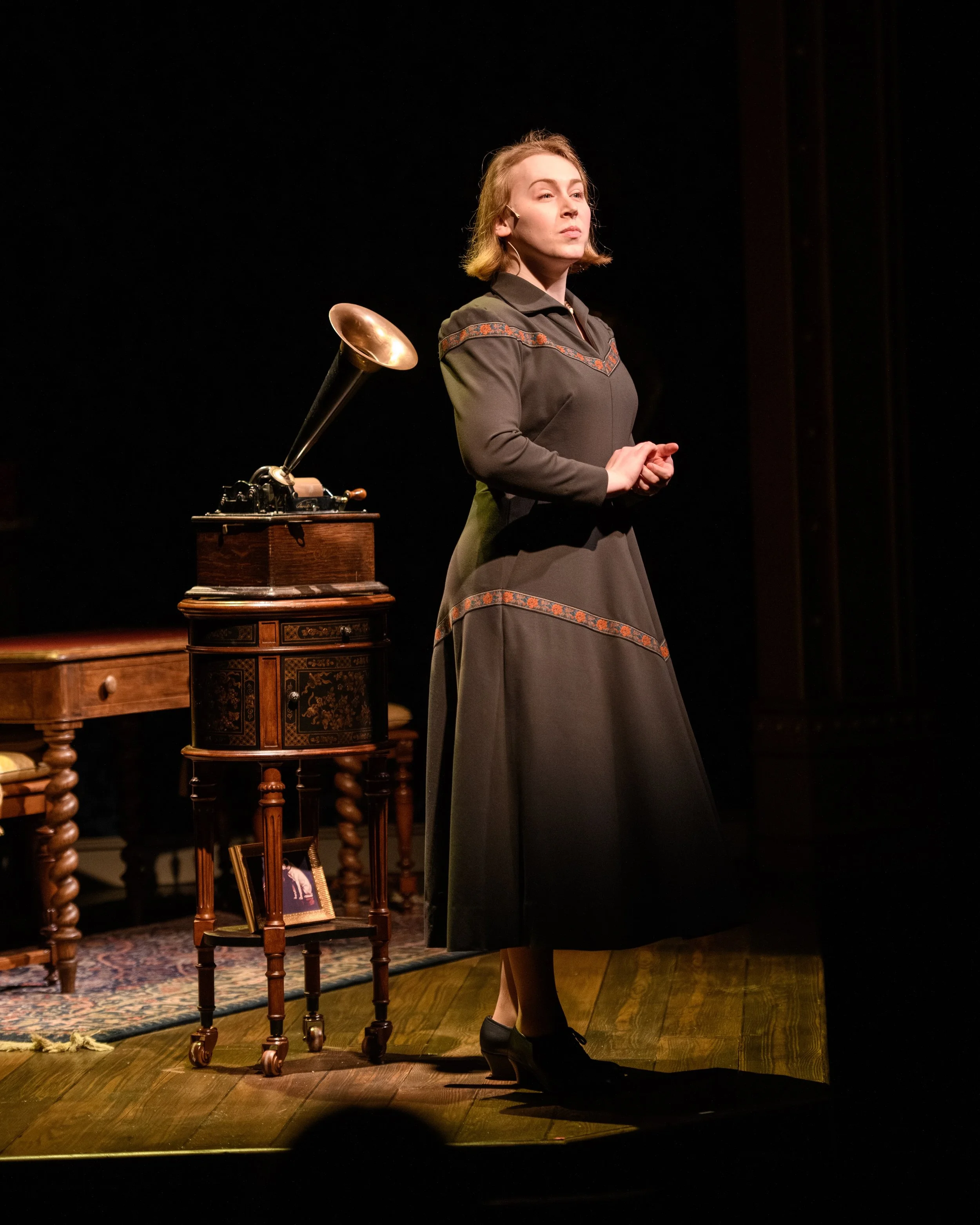
Casey Price’s lighting is equally attentive to the details of the storytelling. The initial spotlight isolates an antique phonograph downstage while the furniture behind it waits in shadow. The light catches enough of the surrounding display to suggest the history still waiting to be revealed. When Dani occupies that same light, the glow around her blond hair creates a halo-like effect, a particularly striking image in a play that will complicate its subject’s apparent sainthood.
Throughout the performance, subtle lighting changes register shifts in conversation and emotional temperature. The transitions help distinguish the spaces and circumstances Dani creates, giving the audience another means of following the changing perspectives. The interrogation sequence is especially effective, with the lighting helping establish the pressure of the encounter. Casey’s work remains closely connected to the performance, responding to its changes without distracting from them.
Erin Bednarz’s sound design supplies a similarly well-balanced accompaniment. Music, airplanes, and the sounds of Charlotte’s world form a mosaic around the storytelling, bringing the larger circumstances of her life into the room. The sound offers atmosphere and emotional support while allowing the voices to remain clear. Together, the lighting and sound give this solo performance a wider world to inhabit.
There is also a particular resonance in encountering Charlotte’s story in the days surrounding this past week’s election, when questions of identity, belonging, and trans rights were (and continue to be) part of the audience’s mindset. Her determination to live as herself gives the history an immediate human significance. The complications in her story make that encounter more challenging, asking the audience to consider the pressures of survival alongside the desire for an uncomplicated hero.
With I Am My Own Wife, Wesley Frugé, Dani Davis, and the Intiman Theatre creative team create a carefully constructed setting for an exceptional central performance. The production’s changing perspectives echo the challenge of understanding the complicated person at its center. It asks the audience to consider what survival demands of a person and how much of another life anyone can truly understand. The contradictions make Charlotte’s story all the more compelling, asking each one of us how this one person’s life can inform us about identity, resilience, the people history remembers, and how we remember them.
The Intiman Theatre production of I Am My Own Wife runs on stage at the Erickson Theatre in Seattle through November 22. For more information, including ticket availability and sales, visit https://www.intiman.org/.
Photo credit: Quinlan Corbett