
Stage Review - The Aves
Presented By: Union Arts Center - Seattle, WA
Show Run: April 18 - May 03, 2026
Date Reviewed: Thursday, April 23, 2026 (opening night)
Run Time: 90 minutes (no intermission)
Reviewed by: Greg Heilman
Jiehae Park’s The Aves arrives at Union Arts Center with a deceptively simple premise: two people on a park bench, returning to the same place across the span of their lives. Under the direction of Sheila Daniels, that simplicity becomes the framework for something far more expansive, a meditation on time, memory, love, and the quiet, complicated act of forgiveness.
The play unfolds in a series of moments shared between an older man and woman, individuals who have known each other for decades and yet continue to discover new facets of one another. Park’s script resists linearity in favor of emotional accumulation, allowing conversations to echo and evolve. The question posed in the program’s imagery, “isn’t it wonderful to forgive?”, lingers throughout, not as a tidy resolution, but as something harder won and more deeply felt.
The lack of a linear structure isn’t conveyed simply through time jumps or flashbacks, but through the physical embodiment of younger selves in older bodies and vice versa. It’s a creative way of threading this couple’s life together, though that thread doesn’t always hold with the same strength. At times it stretches, frays, or tightens unexpectedly, mirroring the uneven nature of a long relationship lived over decades. That construction also gives the cast a unique opportunity to shine, requiring them to move fluidly between ages while maintaining a clear through-line of character. The results range widely in tone—at times heavy and difficult to watch, at others genuinely funny. One of the most memorable moments comes with Kathy Hsieh stepping into a much younger, more vibrant version of her character, a shift that lands with both humor and an undercurrent of poignancy.
All of this is made possible through a transactional process that is never fully explained, instead presented in abstract terms. That choice proves extremely effective, inviting the audience to engage with the concept beyond its mechanics. It’s easy to consider the scientific implications of what’s being suggested, but the more compelling questions exist on a different plane—what someone is willing to give up for love, what happens when even the most carefully considered plans fall short, and how forgiveness factors into balancing the emotional ledger at the end of a life shared.
Sheila’s direction guides the piece in a way that allows the pacing to breathe while maintaining clarity in its shifting timelines, not afraid to use silence as a part of their communication. There is a fluidity to how scenes transition, aided by design choices that reinforce the cyclical nature of the story. The result is a production that feels both intimate and expansive, rooted in human connection while stretching across years of shared history.
It’s the performances, though, that carry that emotional weight of The Aves, and they do that with care and precision. More importantly, they are the primary vehicle through which the play’s non-linear storytelling comes to life. With characters existing across multiple points in time—sometimes simultaneously—the cast is tasked not just with portraying who these people are, but when they are, and how those versions intersect.
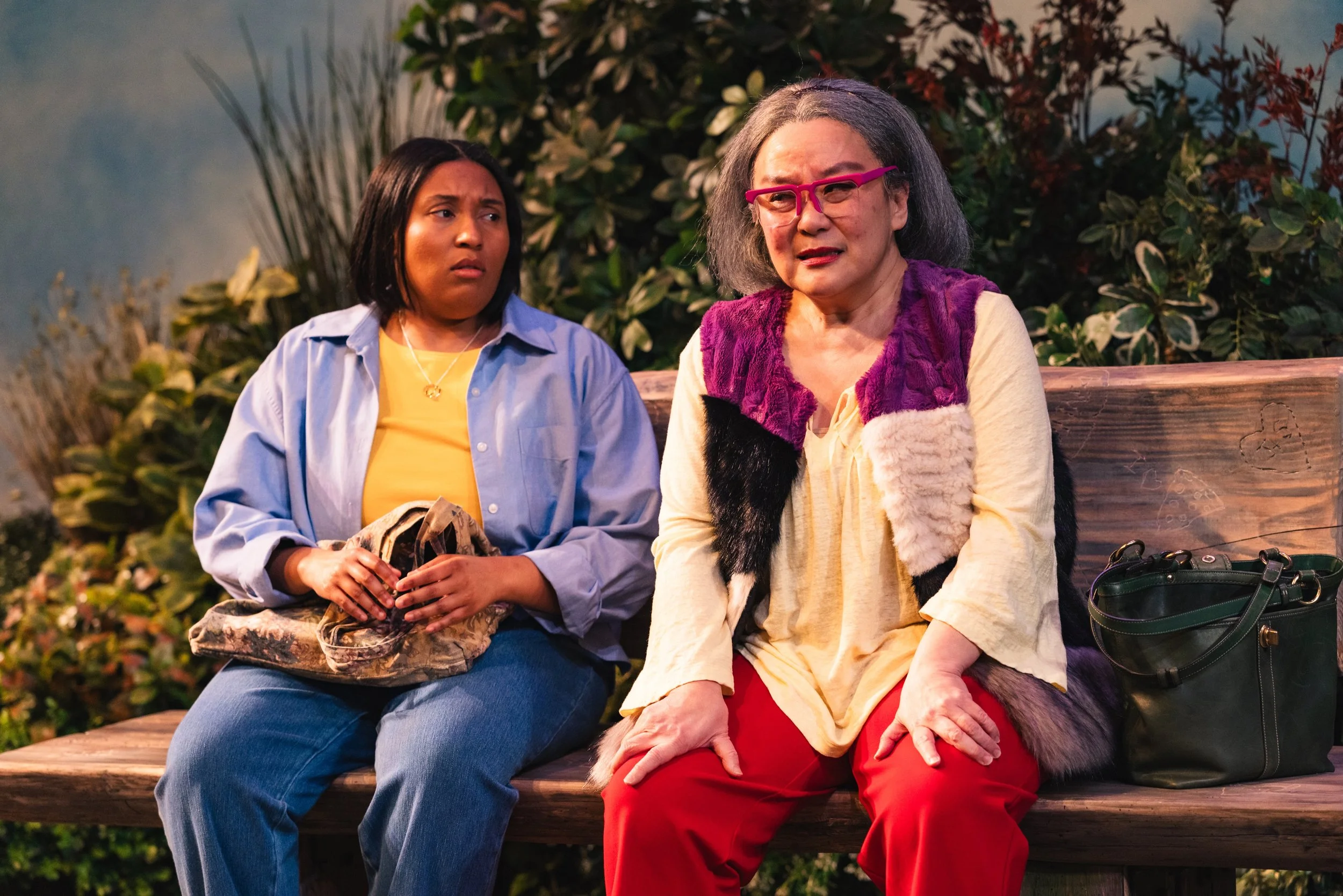
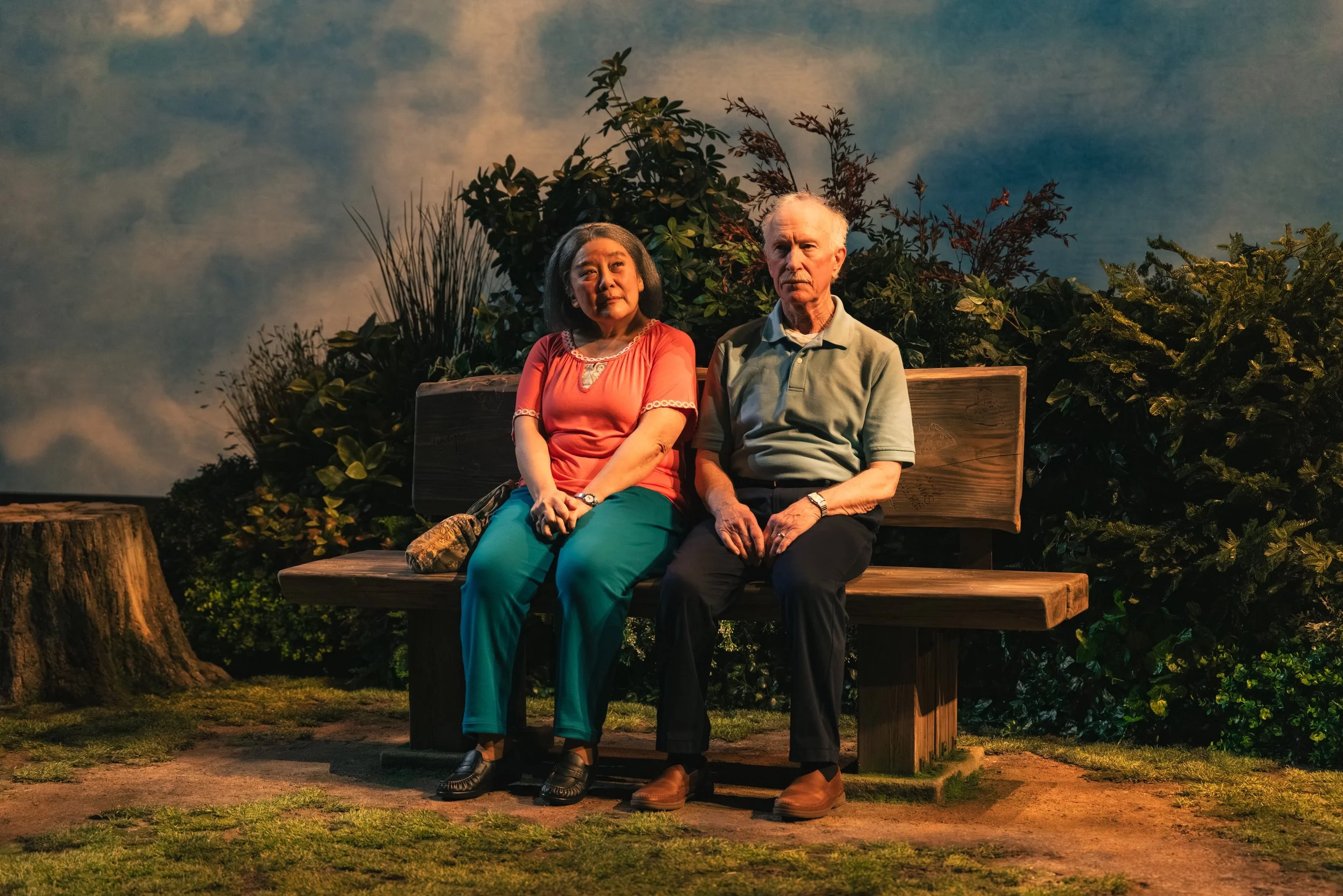
Kathy, as Old Woman, delivers a portrayal rich with lived experience, but it’s in her ability to shift along that timeline where her work becomes especially compelling. Whether inhabiting the weight of decades lived or stepping into a younger, more vibrant version of the same character, Kathy maintains a consistency in her performance that keeps those iterations connected. That continuity makes the transitions feel intentional rather than disjointed, even as the structure itself resists a traditional sense of progression.
Opposite her, R. Hamilton Wright as Old Man brings a similarly layered approach, revealing the character in pieces rather than as a fixed point. As the timeline bends and overlaps, R. Hamilton adjusts accordingly, allowing moments of humor, stubbornness, and vulnerability to surface depending on where in that emotional chronology the scene resides. The performance becomes less about a single version of the character and more about the accumulation of them.
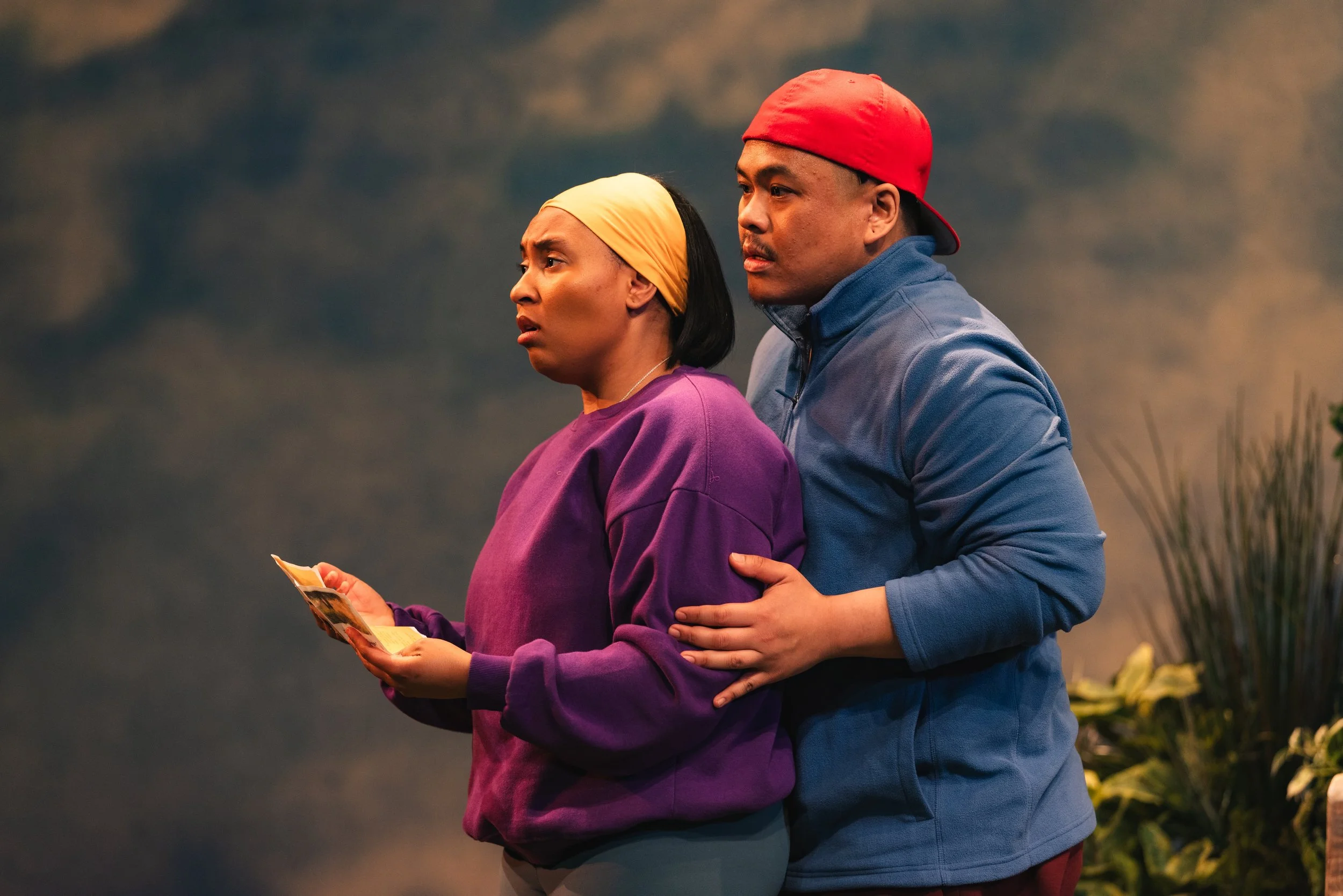
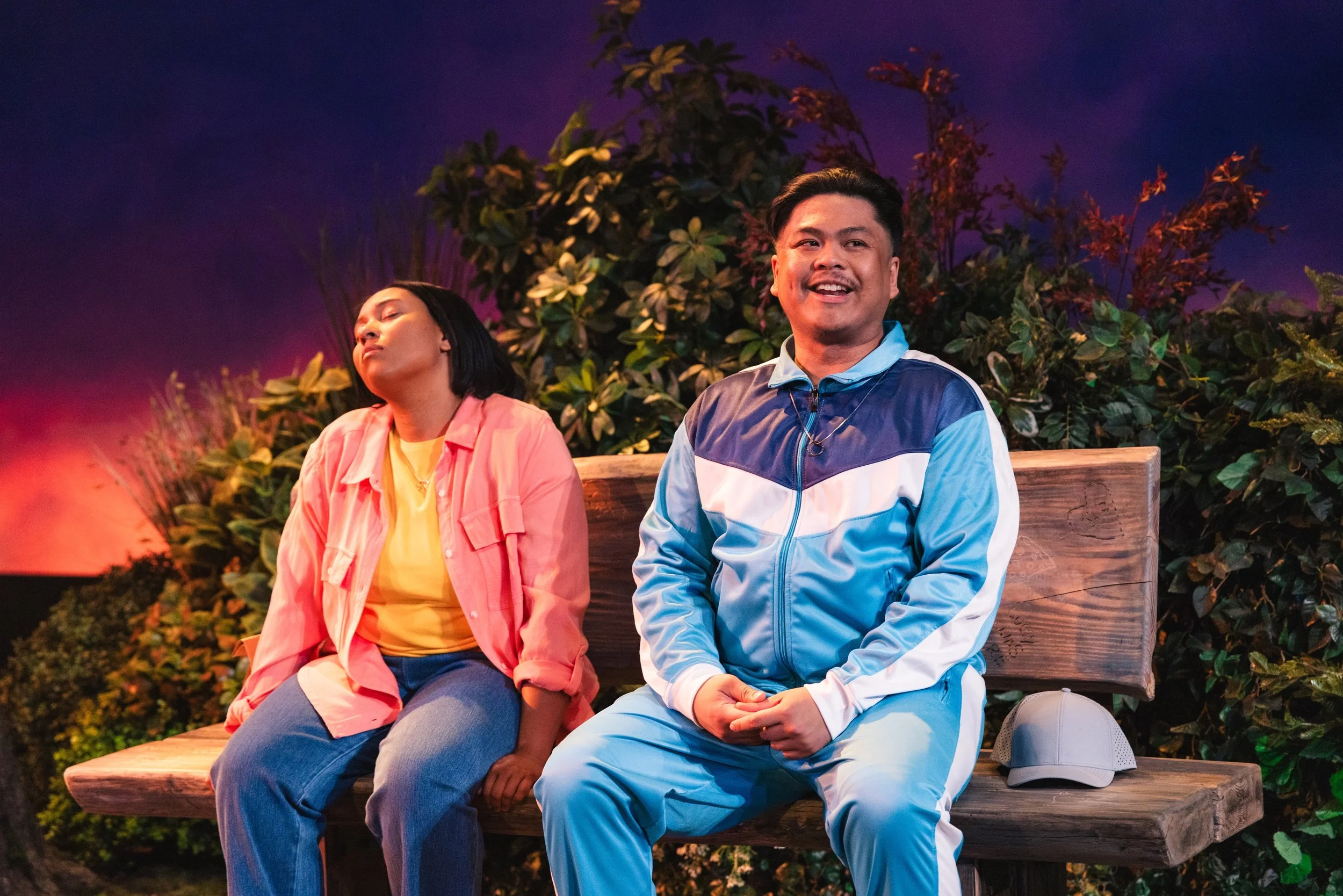
The younger counterparts, Varinique “V” Davis as Young Woman and Jerik Fernandez as Young Man serve not simply as earlier versions, but as active participants in this fluid timeline. Their energy contrasts with the older versions of themselves, but the connection remains clear, creating a dialogue between past and present that unfolds in real time. V captures a sense of openness and possibility, while Jerik balances charm with uncertainty, both performances helping to establish the emotional foundation that the later versions build upon. Rounding out the cast is Zé Zé Cramer’s Girl, a character who further complicates that structure, existing somewhere between memory, imagination, and reality. In a piece that already resists linearity, this presence adds another layer, reinforcing the idea that identity is not confined to a single moment, but is instead something that shifts, overlaps, and redefines itself over time.
One of the most striking aspects of this production is its design, led by scenic designer L.B. Morse. The stage is anchored by a park bench, surrounded by elements that evoke a natural environment without overwhelming the space. Shrubs and a tree stump frame the playing area, while the backdrop suggests an open sky, creating a setting that feels both specific and universal. Above the stage, four branches represent the changing seasons, with lighting shifts guiding the audience through time. Robbie Matos’ lighting design, my favorite aspect of the overall design, works in concert with the script, rotating through these seasonal cues with precision, each shift accompanied by subtle changes in sound and ambiance. Matt Starritt’s sound design enhances this progression, providing a sense of continuity while marking the passage of time in a way that feels organic rather than imposed.
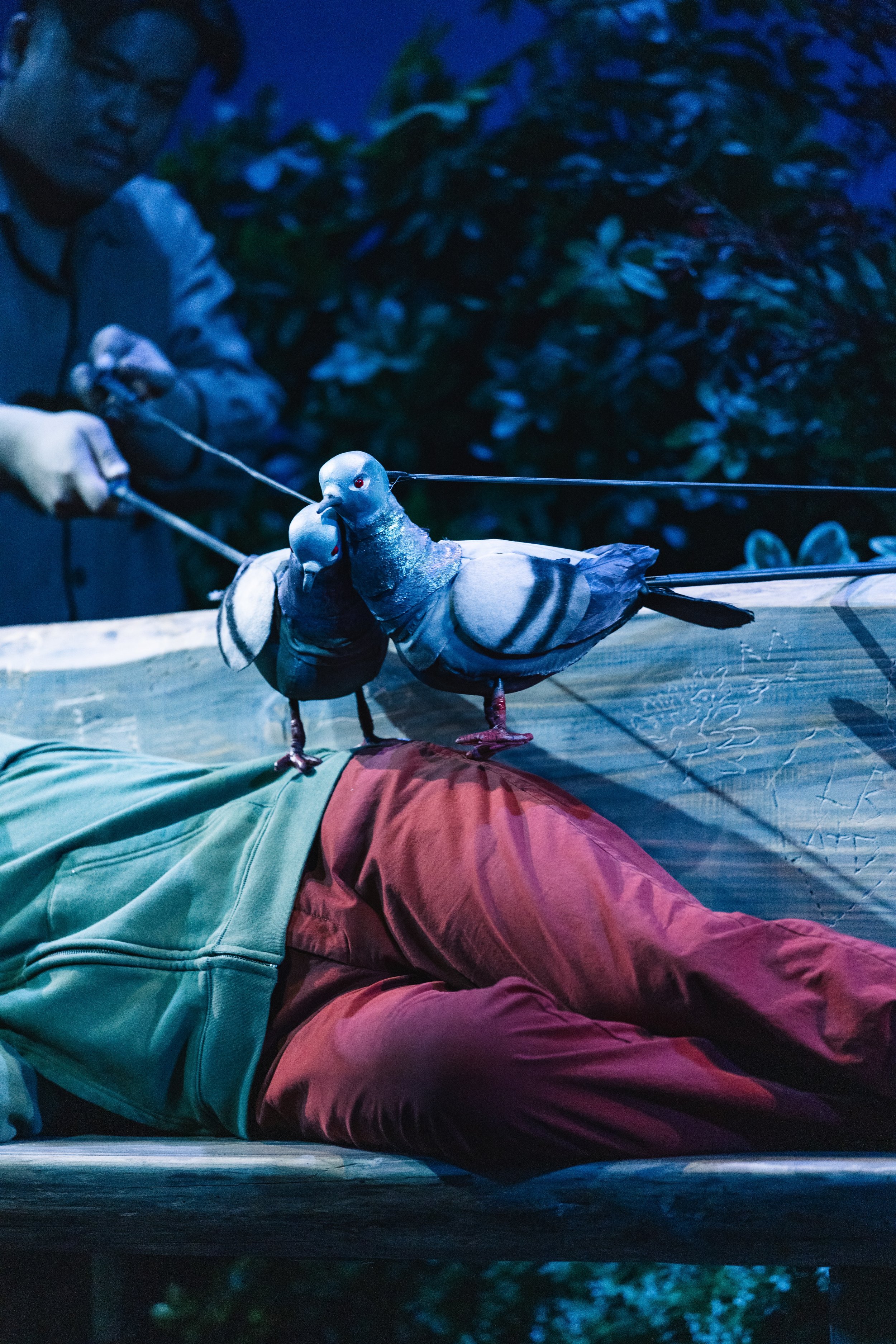
The bench itself, constructed to resemble repurposed wood, becomes more than just a piece of scenery. It carries the weight of the characters’ shared history, a constant in a world that is otherwise always changing. It’s the kind of detail that grounds the production, making the environment feel recognizable and accessible. Melanie Burgess’ costume design supports the storytelling with choices that reflect the characters’ journeys without calling undue attention to themselves. Meanwhile, Annette Mateo’s work as puppet designer and coach introduces a wonderfully fresh, additional layer of visual storytelling that aligns with the play’s exploration of memory and perception. Raya Tuffaha’s fight direction and Sarah Harlett’s intimacy direction deserve callouts as well, both ensuring that the physical interactions between characters feel realistic and engaging, as well as important to the storytelling.
What resonates with The Aves and especially with this production, is how the complexity of long-term relationships is captured and presented. These are two people who know each other deeply, who have hurt and supported one another in equal measure, and who continue to navigate that shared history. There is a sense that even after decades, they are still learning, still uncovering new truths. That idea carries through to the quieter moments, the ones where the characters seem both settled and searching at the same time. There is comfort in their familiarity, but also a recognition of what has been lost or left unsaid. It is in those moments that the play finds its soul.
The Aves does not offer easy answers, nor does it try to. Instead, it presents forgiveness as something complicated, something that requires time, reflection, and a willingness to confront the past. In doing so, it creates a theatrical experience that feels both intimate and universal. At Union Arts Center, this production brings together thoughtful direction, cohesive design, and a cast fully invested in the material. The result is a piece that resonates, not because of any grand gestures, but because of its honesty and its understanding of what it means to share a life with another person.
The Aves runs on stage at Union Arts Center’s Falls Theatre through May 3. For more information, including ticket availability, visit https://www.unionartscenter.org/.
Photo credit: Giao Nguyen