
Stage Review - The Chinese Lady (ArtsWest)
Stage Review - The Chinese Lady
Presented By: ArtsWest - Seattle, WA
Show Run: September 17 - October 11, 2026
Date Reviewed: Wednesday, September 16, 2026
Run Time: 1 Hour, 40 Minutes (no intermission)
Reviewed by: Greg Heilman
The Chinese Lady asks its audience to look into a mirror, and while the reflection can sometimes be lighthearted, it is often difficult to confront. Written by Lloyd Suh and presented at ArtsWest in a co-production with Yun Theatre, this two-person play uses the true story of Afong Moy, the first known Chinese woman to enter the United States, to examine cultural appropriation, exploitation, racism, and the way America embraces an underdog only until the next shiny object comes along. Co-directed by Zenaida Rose Smith and Christie Zhao, The Chinese Lady runs at ArtsWest in West Seattle through October 11.
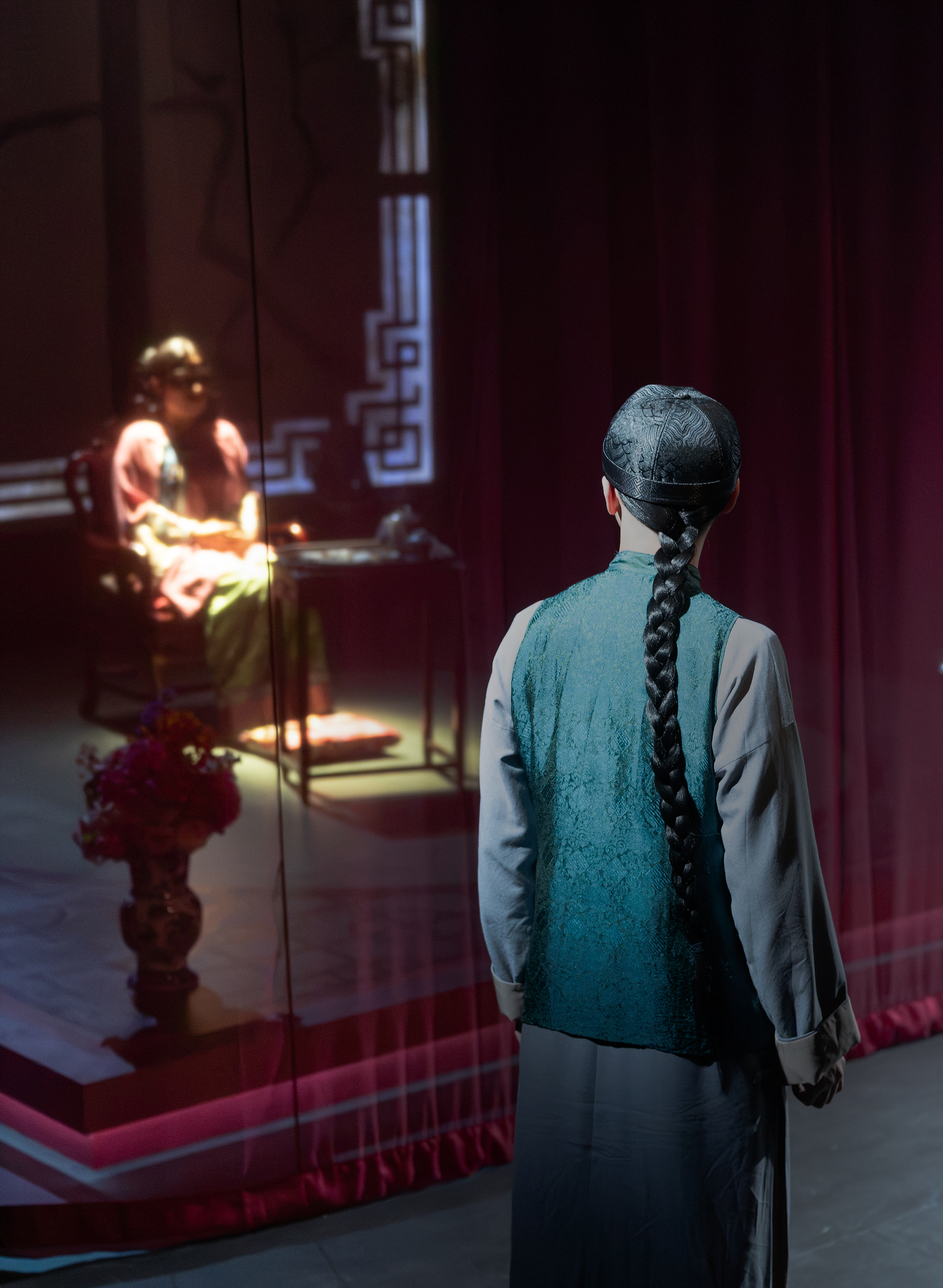
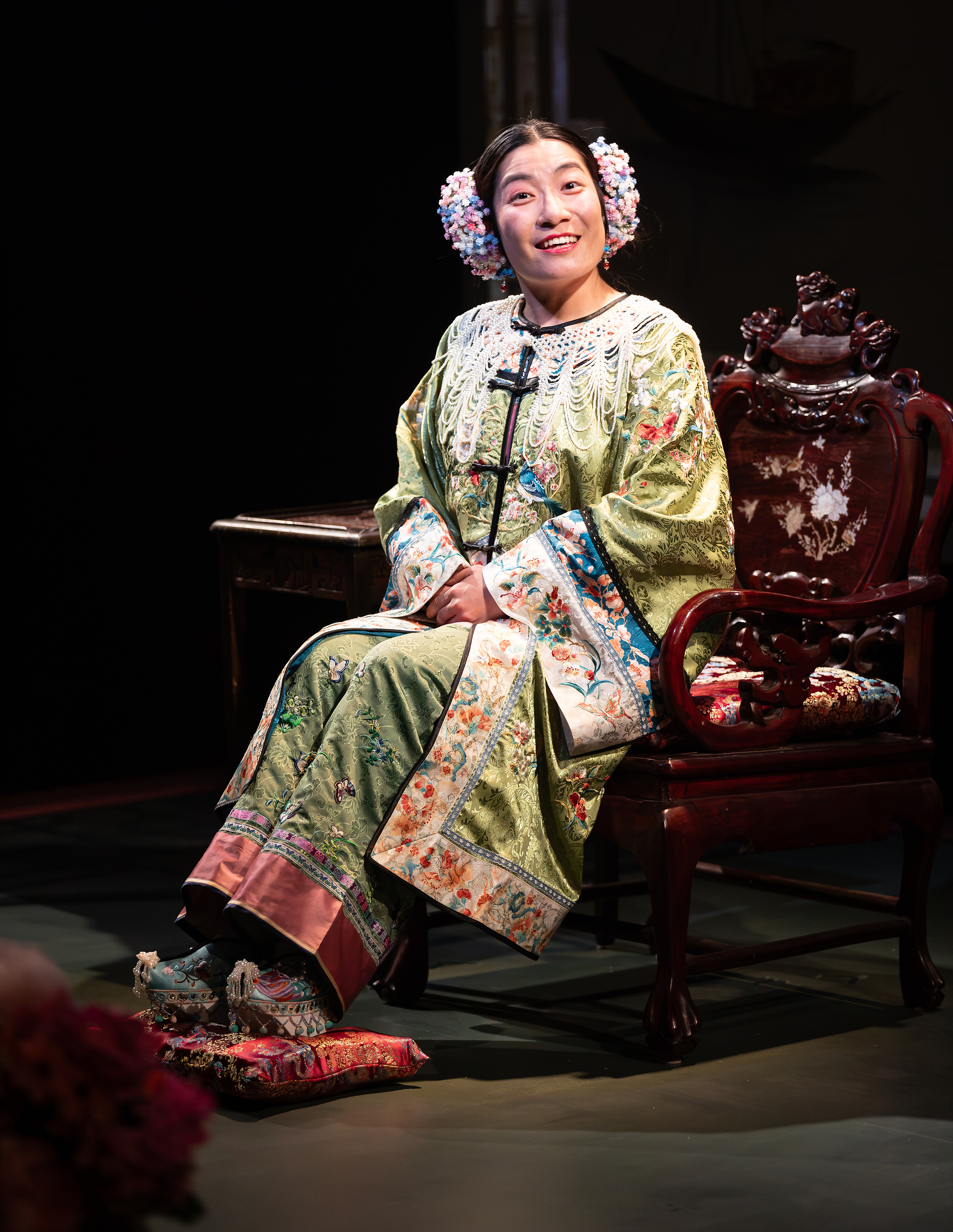
Afong Moy arrives in America as a teenager and is placed on display as “the Chinese Lady,” performing what her handlers present as authentic Chinese life for paying American audiences. Inside a room supposedly representative of one in China (although Afong acknowledges that it looks like no room she has ever seen there) she demonstrates the use of chopsticks, walks on tiny platforms designed to keep her bound feet from touching the ground, and attempts to educate curious spectators about her culture. At her side is Atung, her translator and manservant, who facilitates the exhibition while possessing a far less romantic understanding of what is happening to them.
The show has a particularly effective way of introducing social and cultural lessons without reducing them to lectures. Subjects such as appropriation, slavery, and the treatment of immigrants are not initially presented under a harsh spotlight or framed with instructions about how the audience should interpret them. Instead, the play allows viewers to come to grips with these ideas through the changing context of Afong’s perspective. She begins her journey with optimism (though naïveté may be the more accurate word) but becomes less trusting and more independent in her thinking as the years pass.
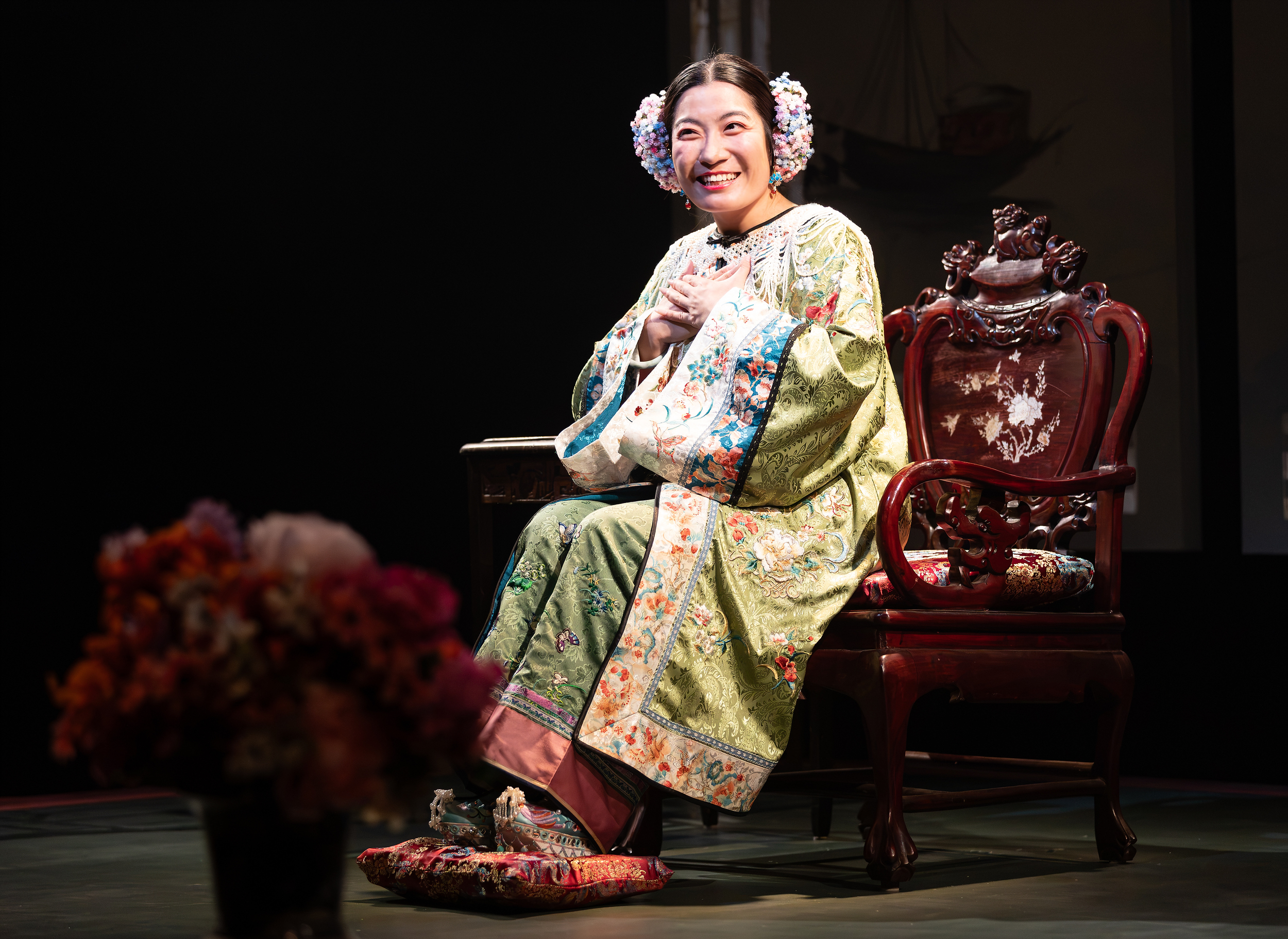
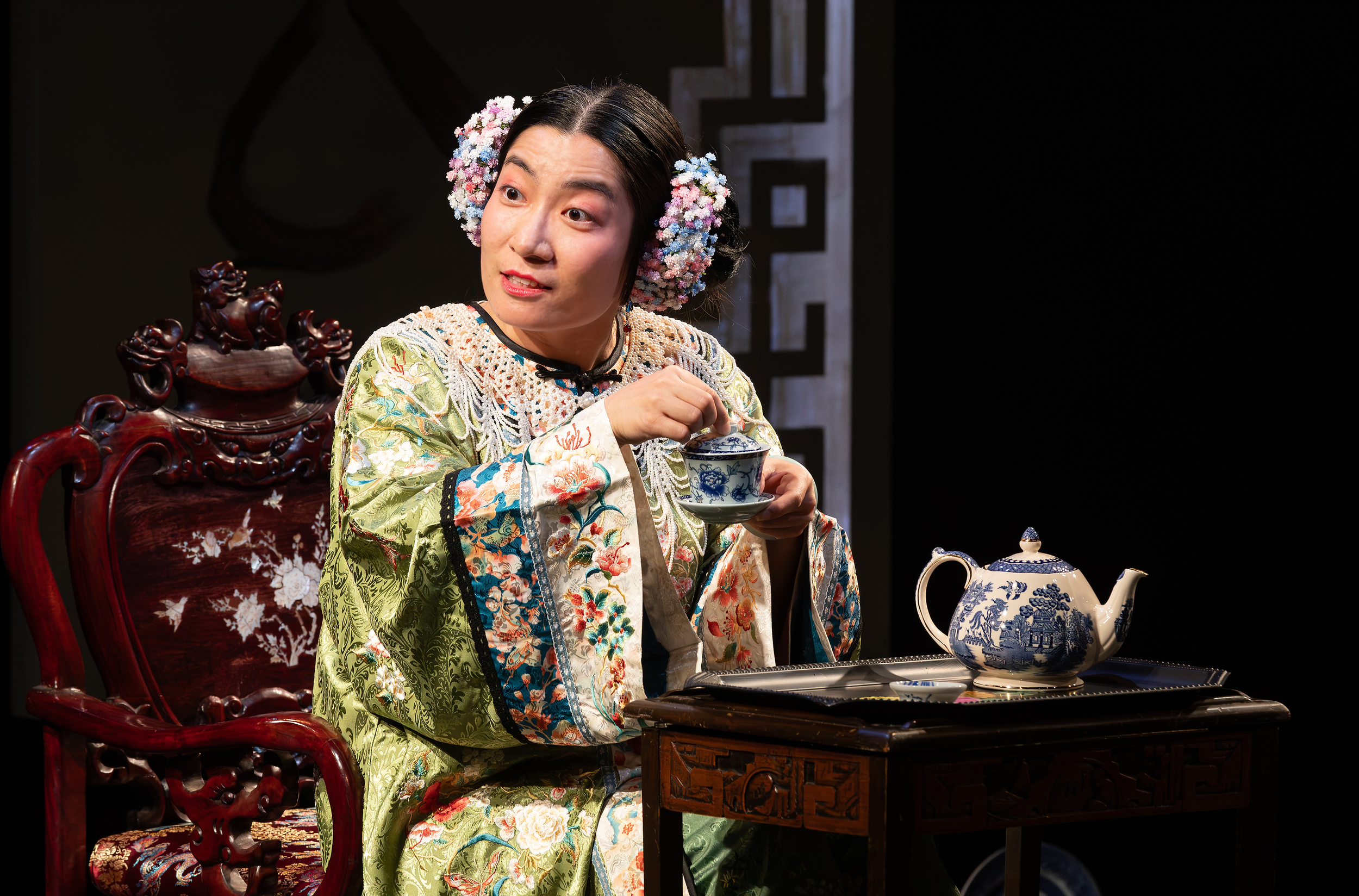
That intellectual journey is at the center of Zoe Ding’s beautifully layered performance as Afong. At first, Zoe gives her an imaginative, creative, and joyful spirit. Afong believes in the purpose of her exhibition and in her ability to build a bridge between two cultures. She approaches each demonstration with ceremony and treats her audience as though its curiosity might lead to genuine understanding.
Time gradually strips away that optimism. Zoe carefully changes Afong’s demeanor as she grows older, allowing bitterness, disappointment, and self-awareness to emerge without making any single transformation feel abrupt. Her English becomes stronger and her Chinese accent less pronounced, reflecting the years she has spent in America, while her thinking becomes more distinctly her own. Zoe’s accent remains consistent and convincing throughout, but the greater accomplishment is how clearly she communicates Afong’s internal development. We can see her questioning the narrative constructed around her before she has the language or confidence to challenge it.
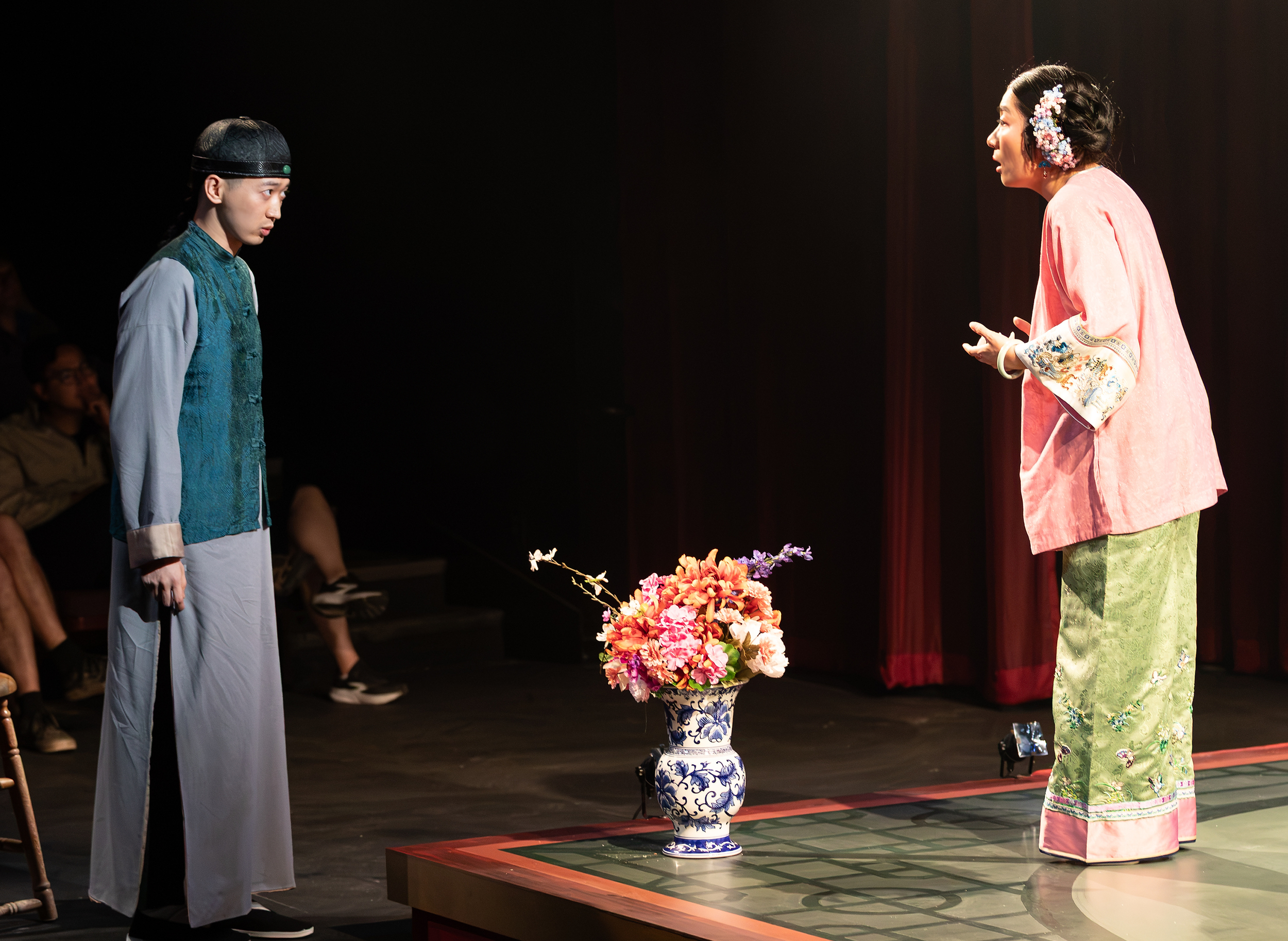
Sebastian Wang provides an essential counterweight as Atung. Where Afong is initially imaginative and joyful, Atung is practical and matter-of-fact. He carries a bitterness that Afong does not yet understand but will not take long to discover for herself. Sebastian never allows that bitterness to flatten Atung into simple cynicism. His restraint suggests a man who already recognizes the machinery behind their exhibition and understands that neither of them has as much control as Afong would like to believe.
The difference between them gives the production much of its humor as well as some of its most affecting moments. Their discussion of chopsticks and forks becomes more than a comparison of eating utensils. Chopsticks are associated with elegance and connection, while forks are described as violent and easy. Meanwhile, a recreated conversation between Afong and Andrew Jackson is funny, but it also provides an enlightening examination of translation and interpretation, who controls the words, what reaches the listener, and how much can be altered in between. Later, a tender and deeply sad moment in which Atung helps Afong rest reveals the affection and shared weariness underneath their contrasting outlooks.
The audience itself becomes the play’s secondary character. The collective is not merely watching Afong perform for nineteenth-century spectators, rather it is occupying their place. Her words are directed toward the audience, making it impossible to regard the exhibition as something safely confined to the past. At one point, Afong observes that there is “nothing authentic here,” a realization that applies not only to the room or the performance she has been instructed to give, but to the identity others have constructed for her.
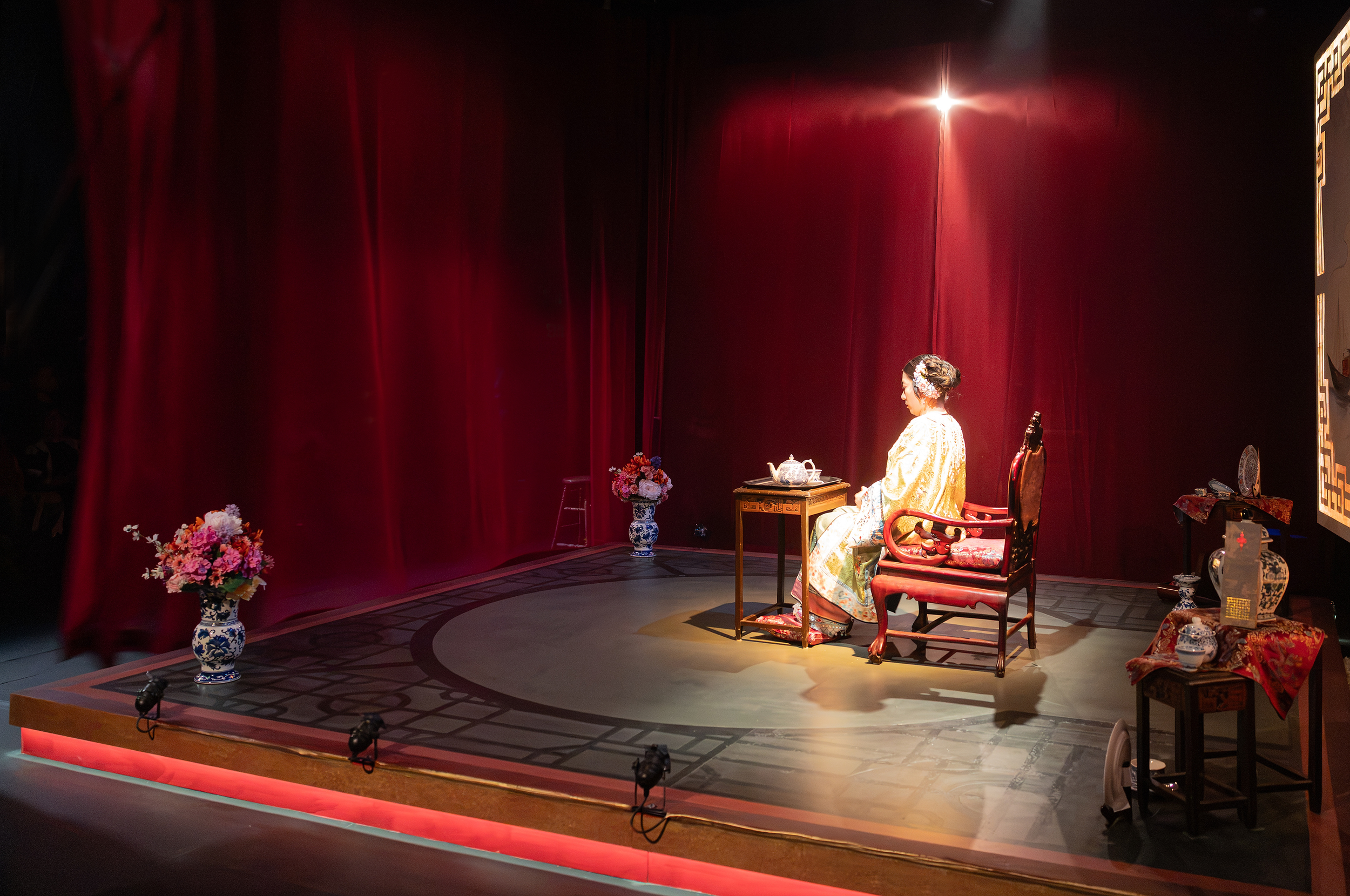
Adair MacCormack’s scenic design reinforces that idea immediately. A raised panel at the back of the stage adorned with a beautiful mural, combined with a single chair and side table, creates an attractive and carefully symmetrical room It resembles a museum installation, complete with the sense that explanatory signage should stand nearby to provide context, which in a nice detail it does pre-show. Yet its beauty also makes it feel like a cage. Afong may describe it as a theatre and a place of cultural exchange, but it is still a box from which she is observed.
Tianxing Yan’s costumes help chart Afong’s journey through time. Her clothing becomes simpler, more casual, and more American as the years pass, reflecting both her assimilation and her changing relationship with the identity she has been paid to perform. The layered costume changes distinguish each period while also showing how cultural presentation can become another set of external trappings placed upon her.
Lighting designer Yichen Zhou and sound designer M. L. Dogg create an atmosphere that grows increasingly uncomfortable alongside Afong’s changing perspective. The lighting tones shift as the story darkens, while the music accompanying Afong’s carefully measured walks gives the exhibition a controlled, almost drone-like quality. These elements are especially effective during the transitions, allowing the passage of time to register even before the characters tell us how many years have elapsed.
Properties designer Jack Bateman-Iino supplies the carefully selected objects needed to sustain the illusion of Afong’s exhibition, while stage manager P. Alyda Sorm and assistant stage manager Hope Fyffe maintain the production’s deliberate rhythm. Its movements and transitions have the formality of a practiced ritual, reinforcing how thoroughly Afong’s life has been arranged for the consumption of others.
The production’s design undergoes its most dramatic transformation following a major passage of time, when the orderly exhibition begins to come apart. Afong’s departure from the theatre (her “box”) marks the culmination of her growing self-awareness. As she removes the external trappings that have defined her for others, she figuratively sheds her skin and bares her soul, perhaps for the first time in her life. It is a powerful scene because Zoe has allowed us to witness every stage of the journey leading to it.
Afong lived the American Dream, at least in one of its more realistic forms. America noticed an underdog while her novelty made her useful, celebrated her as long as audiences were willing to pay, and then discarded her in favor of the next shiny object. Yet The Chinese Lady refuses to let that disappearance be the final word. Through Afong’s reclamation of her own narrative, the play considers how storytelling keeps people and cultures alive, even when history has attempted to erase them.
The Chinese Lady is funny, intimate, and increasingly hard to watch, not because the production falters, but because it becomes more honest as it proceeds. Afong Moy begins by displaying herself to the audience, but by the end, it is the audience that has been placed on display. The reflection offered by this production may span nearly two centuries, but what looks back at us remains unmistakably contemporary.
The ArtsWest production of The Chinese Lady runs on stage in West Seattle through October 11. For more information, including ticket availability and sales, visit https://www.artswest.org/.
Photo credit: John McLellan