
Stage Review - The Courage to Right a Woman’s Wrongs (Burien Actors Theatre)
Stage Review - The Courage to Right a Woman’s Wrongs
Presented By: Burien Actors Theatre - Burien, WA
Show Run: July 24 - August 14, 2026
Date Reviewed: Sunday, August 02, 2026
Run Time: 90 Minutes (no intermission)
Reviewed by: Greg Heilman
There is a certain kind of fun that comes with outdoor theatre, especially when it is performed in a public park. Sometimes, it is difficult to determine what is more entertaining: the action taking place onstage or the entirely unscripted activity unfolding around its edges. At Burien Town Square this past Sunday, the two occasionally became one and the same.
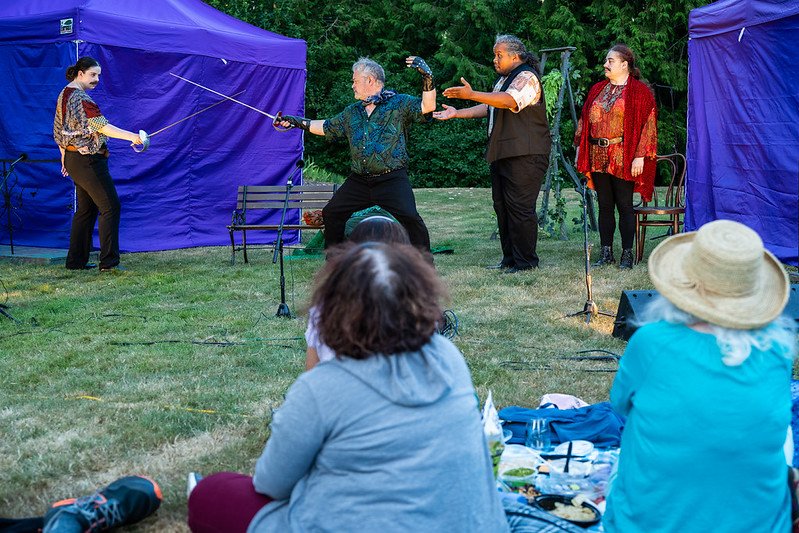
After arriving, we claimed the high ground with our lawn chairs and settled in to watch a classic revenge story from the Golden Age of Spanish theatre. That is exactly what Burien Actors Theatre delivered with The Courage to Right a Woman’s Wrongs, although the performance also came with a healthy assortment of characters who were clearly not part of the cast. Some of those ancillary characters remained on the periphery, while others wandered directly through the center of the action. Hats off to the cast, who, to a person, remained unfazed by the distractions and steeled themselves to deliver a collection of very good performances, and hats off to Artistic Director Eric Dickman for choosing a comedy, with anything heavier, the interruptions might have been aggravating rather than another memorable part of the overall experience.
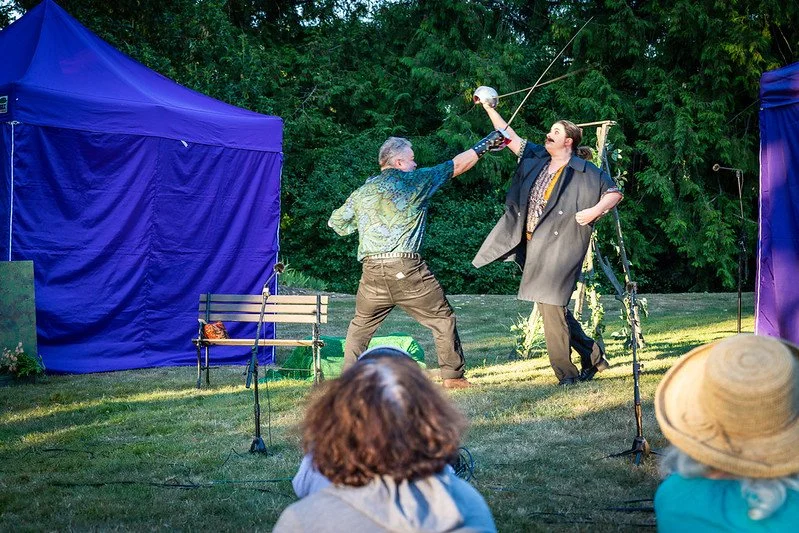
The Courage to Right a Woman’s Wrongs may be Spanish in origin, but it carries many of the qualities audiences commonly associate with Shakespearean comedy, all of which make it an excellent choice for an outdoor theatre piece. Its plot is filled with misdirection, romantic entanglements, disguised identities, characters pretending to be other people, and enough swordplay to make one wonder whether Shakespeare might somehow have had a hand in it. Alas, he did not.
Originally titled Valor, Agravio y Mujer, The Courage to Right a Woman’s Wrongs was written around 1640 by Ana Caro Mallén de Soto, one of the relatively few female playwrights of Spain’s Golden Age whose work has survived. The play belongs to the tradition of the Spanish comedia, a theatrical form that flourished during the late 16th and early 17th centuries and frequently combined romance, questions of honor, mistaken identity, social commentary, and comedy. The UCLA Working Group on the Comedia/Diversifying the Classics translated the play in 2019, and Rachel Rene adapted that translation for BAT’s approximately 90-minute Summer in the Parks production, which she also directs.
At the center of the story is Leonor (Shona Carter), a woman abandoned and dishonored by her former lover, Don Juan de Córdoba (John Dugaw). Rather than quietly accepting what has been done to her, Leonor disguises herself as a man named Leonardo and sets out to find Don Juan, confront him, and restore her honor. Her arrival sets in motion an increasingly tangled web of disguises, deceptions, romantic maneuvering, and shifting allegiances, all constructed around the possibility that this notoriously fickle Don Juan may finally have encountered someone capable of beating him at his own game.
Leonor’s disguise allows her to move through a society in which men possess freedoms unavailable to women, but it also gives her an opportunity to manipulate the assumptions of nearly everyone around her. Shona handles the production’s pivotal role with confidence, moving between Leonor and the outwardly dashing Leonardo while keeping the character’s purpose clear underneath the layers of deception. Leonor may be operating within an elaborate comic scheme, but she is steadfast in her motivation, to assure Don Juan that he will not get away with his abandonment of her without consequence.
Don Juan is played wonderfully by John Dugaw as a comically gallant embodiment of masculinity. His strong posture, confident delivery, and purposeful over-dramatization make Don Juan appear completely convinced of his own importance, even when the play demonstrates time and again how vulnerable he is to Leonor’s maneuvering. John finds much of the character’s humor in that oversized confidence, creating a Don Juan who is ridiculous, but is never farcical.
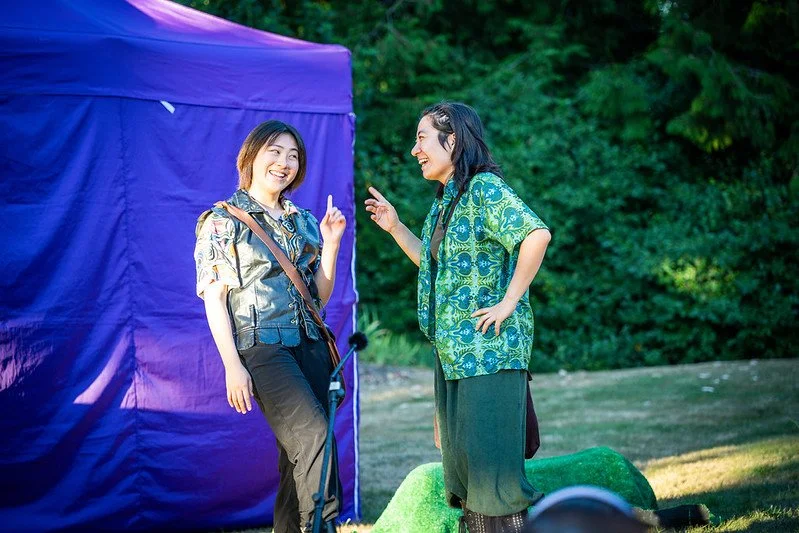
Riko Kishitani brings an energetic, jester-like quality to Ribete, Leonor’s servant and companion in her scheme. Riko has a particularly good relationship with the audience, occasionally breaking the fourth wall and acknowledging the absurdity unfolding around Ribete, bringing the audience directly into the joke. Rachel’s adaptation also makes room for contemporary and regional references, including mentions of Washington and California, which help bridge the centuries between the original play and the audience sitting in a Burien park.
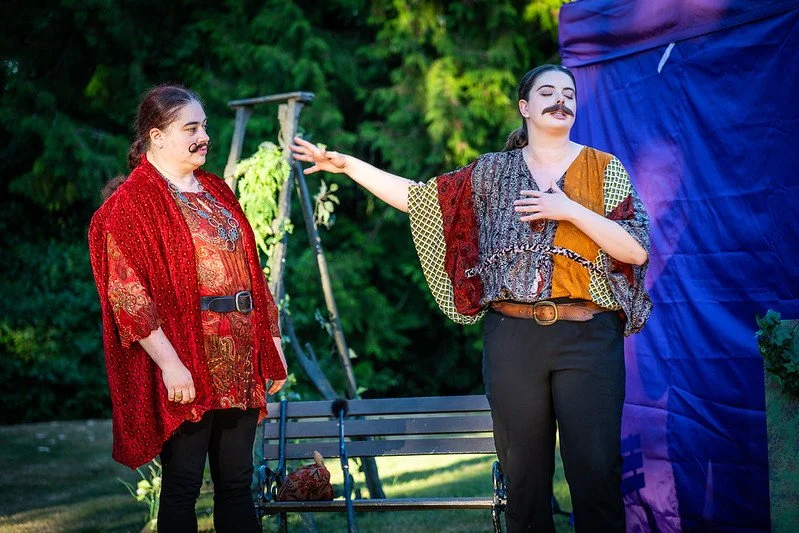
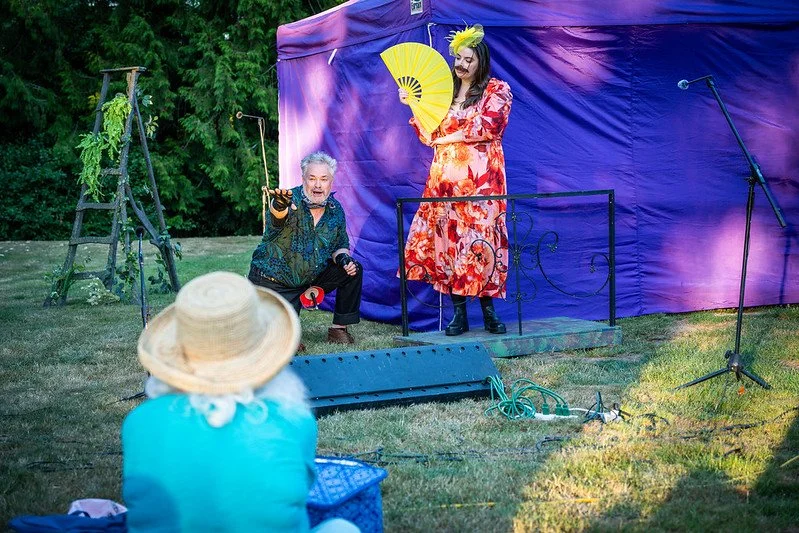
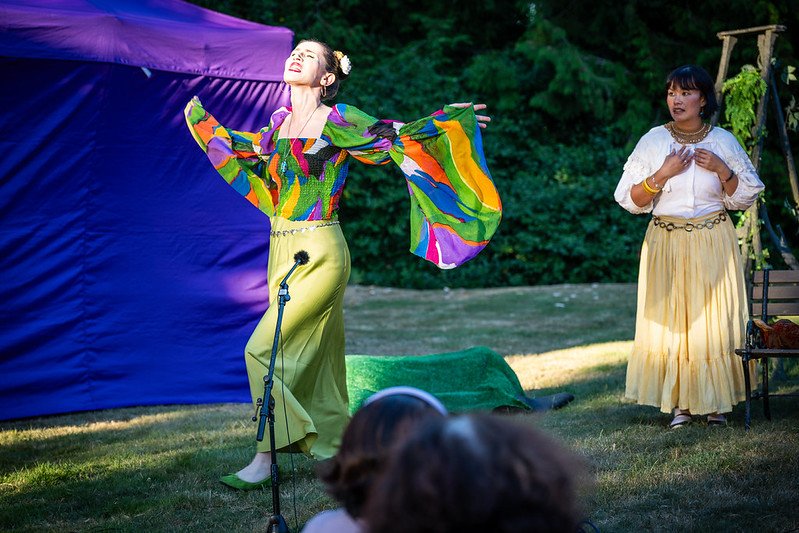
The production’s romantic complications expand with Don Fernando de Ribera (Mandela Gardner), his sister Estela (Natasha Halfin), and Estela’s cousin Lisarda (Cindy Chen). Mandela makes Fernando a fun character, approaching his involvement in the rapidly growing confusion with an amusing delivery. Natasha and Cindy contribute to the intrigue surrounding Leonor’s assumed identity, while the bright clothing worn by Estela and Lisarda provides some of the strongest visual connections to the play’s Spanish setting.
Rounding out the cast is Zoe Ding as Tomillo, Don Juan’s servant, and Julia Kulyk, who plays both Prince Ludovico and the highwayman Tibaldo, just one of the many members of this cast taking on multiple identities, adding another layer to a story already built around people not being entirely who they appear to be. And with everyone pursuing someone, avoiding someone, or pretending to be someone else, Rachel keeps the story moving and prevents its many relationships and disguises from becoming impossible to follow.
That clarity is important in a production without the controlled environment of an indoor theatre. Rachel’s staging makes use of the available space, with actors entering from and moving through the surrounding area rather than confining all the action to a narrow stage. That choice gives the production an expansive quality and draws the audience more fully into the story. It also means the actors must remain prepared for whatever else happens to be passing through the park. They prove more than capable of doing so.
The outdoor setting naturally requires simplicity. Individual pieces, including a bench and a suggestion of a balcony railing, provide the necessary context without creating an elaborate set that would be cumbersome to transport between parks. The economy suits the production, leaving space for the performers, sword fights, and rapid shifts in the story. Cyndi Baumgardner’s props support both the action and comedy, including the swords and a certain small kneeling pillow that protects the actors’ knees while also becoming a visual joke in its own right.
Ashley McEneny’s costume design establishes character and period without becoming overly heavy for a summer production performed outdoors. Estela and Lisarda’s bright, colorful clothing carries a particularly clear Spanish influence, while the black capes and masks of the highwaymen immediately communicate who they are. Leonor’s transformation into Leonardo must be convincing enough for the plot to function while remaining transparent enough to an audience that is in on the deception, and the costuming maintains that balance.
Sound is another potential challenge in a park, where performers must compete with traffic, conversations, car alarms, and anything else the surrounding community contributes. Microphones positioned around the perimeter of the performance area help the dialogue carry while allowing the actors to move freely through the space. The system cannot prevent every outside sound from intruding, but the cast’s focus and projection keep the clarity of the story well within the realm of comprehension.
There is a certain amount of symmetry in presenting The Courage to Right a Woman’s Wrongs as part of an outdoor theatre series created to offer audiences something beyond the Shakespeare normally associated with outdoor summer theatre. Ana Caro’s comedy possesses many of the ingredients that make Shakespeare’s comedies so enduring, but it approaches them through the voice of a woman writing about another woman who refuses to accept the role society has assigned her. Nearly four centuries later, Leonor’s determination, ingenuity, and demand for accountability remain surprisingly immediate.
Burien Actors Theatre has turned that rediscovered classic into a lively and approachable summer comedy. The production is funny, colorful, and performed by a cast capable of navigating both Ana Caro’s complicated plot and the unpredictable supporting cast supplied by the park itself. Whether the commotion is scripted or simply wanders into the middle of the show, Rachel Rene and her actors take it in stride, and in the end, it’s all part of the fun.
Burien Actors Theatre’s annual Summer in the Parks series presents The Courage to Right a Woman’s Wrongs, which closes on Friday, August 14. To learn more about the show and specifics on the upcoming dates, head to https://battheatre.org/courage-to-right-a-womans-wrongs-summer-2026/.
Photo credit: Michael Brunk