
Stage Review - Till We Have Faces (Taproot Theatre)
Stage Review - Till We Have Faces
Presented By: Taproot Theatre - Seattle, WA
Show Run: January 21 - February 28, 2026
Date Reviewed: Friday, January 23, 2026 (Opening Night)
Run Time: 2 Hours, 30 Minutes (including a 15 minute intermission)
Reviewed by: Greg Heilman
Taproot Theatre has never been afraid of asking big questions, but with Till We Have Faces, the company leans fully into myth, mystery, and spiritual inquiry. Now playing on the Jewell Mainstage through February 28, this world premiere adaptation by Karen Lund brings C.S. Lewis’s philosophical retelling of the Cupid and Psyche myth to theatrical life — and in doing so, offers audiences something rare: a piece that feels both richly literary and deeply theatrical, intimate in its character focus while still carrying the weight of epic myth.
Lewis’s novel is a story of faith and doubt, love and longing, told through the eyes of Orual, a woman wrestling with what she believes she deserves, what she has lost, and what the gods may or may not demand. At its heart is a central, haunting idea: that in order to truly know anything beyond ourselves — the divine, the eternal, the unknowable — we must first come face-to-face with who we are. The gods remain silent, Lewis suggests, not because they are absent, but because we are not yet ready to hear them until we understand our own hearts.
Adapting such a work for the stage is no small feat. Depending on the edition, Till We Have Faces runs upwards of 370 pages, dense with interior reflection and philosophical tension. Karen’s script is an impressive achievement — not only for how elegantly it compresses such a sprawling story into a stage production of under three hours, but for how successfully it preserves the heart of Lewis’s message. She has abridged boldly, stripping away extraneous characters and details that do not serve her particular telling, yet the result never feels diminished. Instead, it feels distilled: the essential emotional and spiritual questions remain fully intact, now given new immediacy through live performance. This adaptation understands that Orual’s journey is not simply toward the gods, but toward herself — that the face she must finally see is her own.
That theatrical momentum is further strengthened by Marianne Savell’s direction, which keeps the pacing sharp and the audience continually engaged, something that’s not easy to do with subject matter this deep in nature, and in a production that moves well beyond two hours in length. The dialogue moves with purpose, scenes transition cleanly, and the production never loses its grip on the story’s urgency, even as it wrestles with ideas far larger than the stage itself.
At the center of the story is Orual, played with commanding presence by Candace Vance, whose performance carries the weight of memory and bitterness like a cloak. The production smartly contrasts this older Orual with the younger version of the character, portrayed by Alanah Pascual, who brings an expressive vulnerability to the role. These are not simply reflections of the same person, but distinct lives shaped by time, regret, and the slow erosion of certainty. Candace’s older Orual is essentially the narrator of the story, bringing the audience through the past, until the timelines connect and she becomes the Orual of the story in her present time. I’m impressed with the manner in which Marianne moves Candace in and around her history on stage, never interfering with the action as it takes place, but acting more as a thread that stitches it all together as she weaves in and out of the characters from her past.
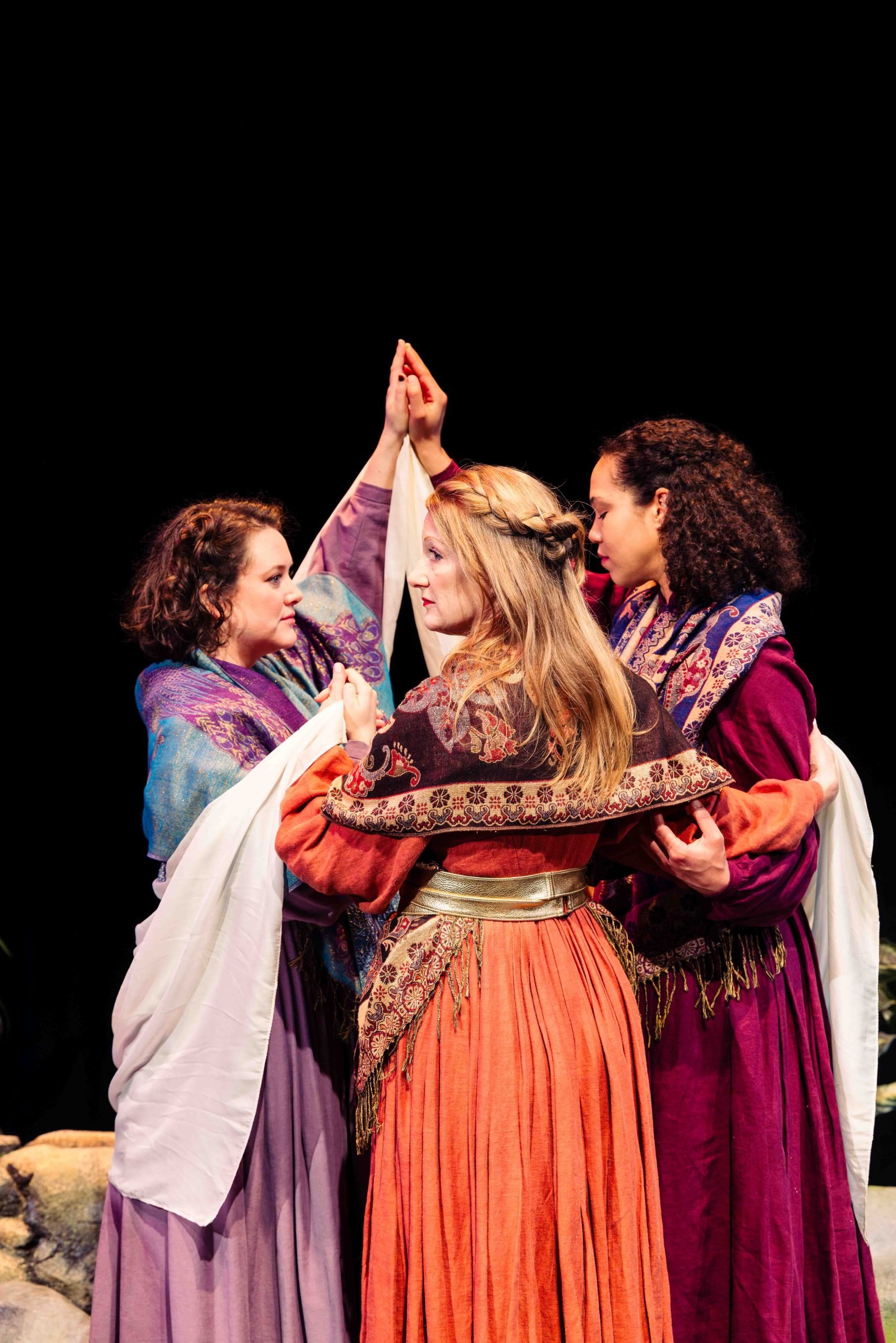
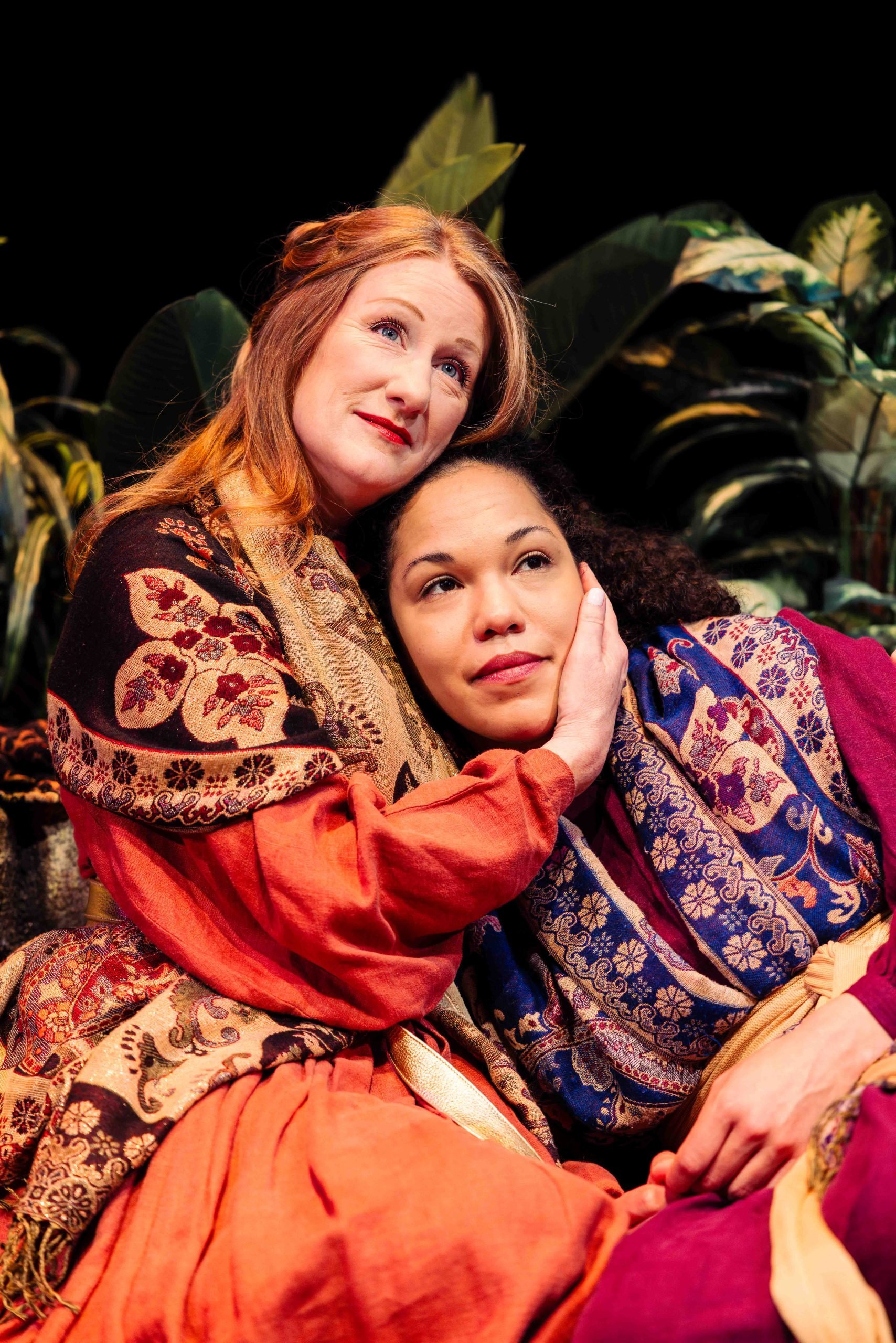
Ayo Tushinde’s Psyche is another highlight, capturing both the youthful innocence of the character and her radiant enthusiasm. There is an openness to her physicality, an ability to inhabit youth with sincerity, which makes the later turns of the story all the more haunting. Psyche’s relationship with Orual is the emotional core of the piece, and one of the production’s most powerful moments comes in the exchange between them as Psyche tries desperately to draw Orual into understanding. When Orual begs her sister to truly look upon her beloved god, the scene becomes something more than argument — it is longing made theatrical, a collision between love, jealousy, fear, and the unbearable possibility that the divine might be real. Psyche’s insistence is tender but unwavering, and Orual’s resistance is charged with desperation. It is one of the most affecting conversations in the production, and it lands with the weight of heartbreak rather than mere mythology.
A similarly charged discourse unfolds in the passionate confrontation between the King and the Priest, where questions of sacrifice and religious obligation erupt into a heated philosophical and emotional debate. Nolan Palmer’s King brings an imposing sternness, bordering on anger, to the stage, and Jeff Allen Pierce’s Priest meets him with authoritative force. Their exchange, centered on the belief that the gods require sacrifice, is gripping not only for its intensity but for what it reveals about a society built on fear of divine consequence. The Priest’s insistence that suffering demands ritual explanation, and the King’s fury at what is being asked of him, cuts to the heart of the play’s theological tension. This is not abstract philosophy — it is power, grief, and survival colliding in real time, and a discourse that is surely relevant in today’s faith-charged conversations.
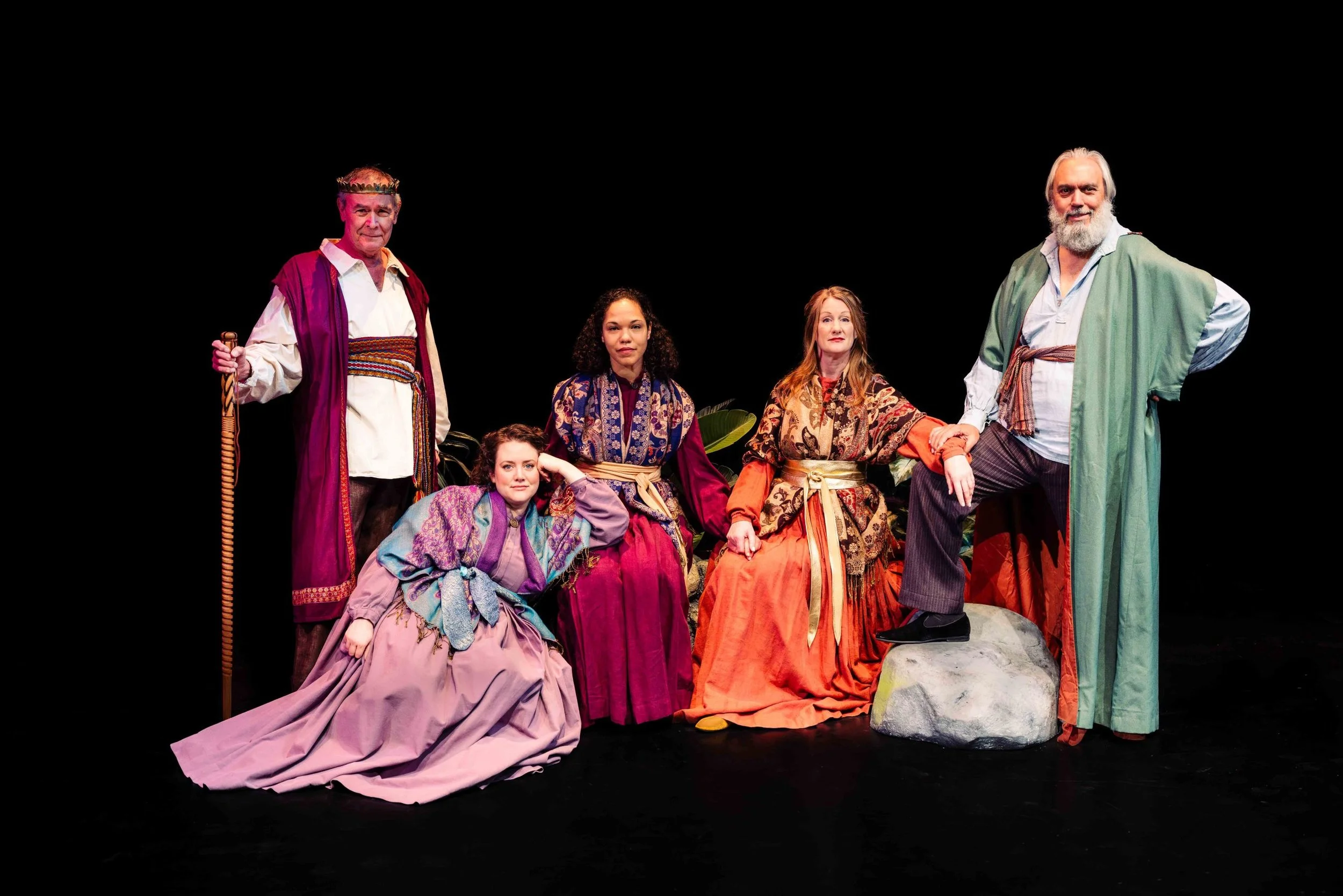
Eric Polani Jensen’s slave-turned-caretaker Fox provides a grounded counterpoint throughout, skeptical but nurturing, offering Orual guidance that feels both intellectual and deeply human. The rest of the supporting cast further enriches the world of Glome. Melanie Godsey brings a free-spirited energy to Redival while also turning sharply authoritative as the Judge, two distinctly different roles that show the actor’s versatility. Kim Morris is especially strong as Batta, grounding the household with presence and clarity while Brian Pucheu’s loyal guard Bardia adds steadiness and devotion. Brandon Riel makes the most of his limited stage time as the vengeful Cupid, the God of the Mountain, and though Psyche’s husband is not a constant physical presence, Brandon’s performance takes full advantage of the moments he has, delivering with strength and stage presence.
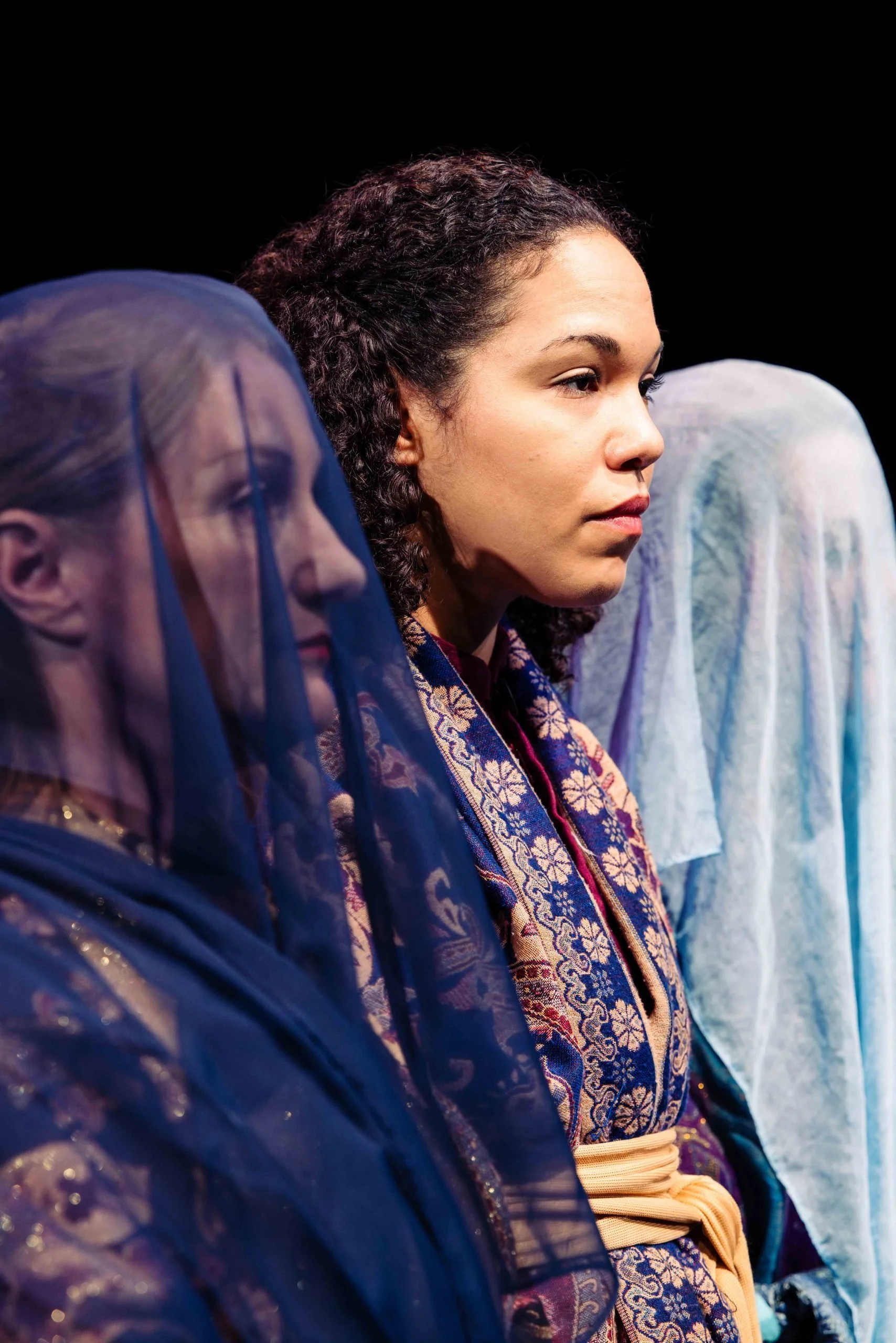
Design elements support the mythic tone beautifully. Scenic designer Jordan Gerow frames the action with a squared-off archway adorned with flowers, a structure that feels both ceremonial and symbolic — a threshold between the earthly and the divine. Sarah Burch Gordon’s costume design is an undeniable highlight of the production, offering wide variety and rich detail. From the ornate blues and golds of the King’s robes to the more practical, servant-like clothing worn by his daughters, the costumes establish social order instantly. And then there is the god costume itself — extraordinarily spectacular, glowing with otherworldly power even from behind a screen. The visual storytelling here is as potent as the dialogue.
Technical elements further enrich the atmosphere. Mark Lund’s sound design creates an undercurrent of environmental texture, a constant reminder that unseen forces press against the edges of this world and Alyssa Keene’s dialect coaching adds variety and specificity, with accents that reflect each character’s social and economic station, strengthening the sense of culture and hierarchy. Tucker Goodman’s lighting design and the production’s careful use of projection deepen the mythic aura, while props — swords, knives, and ritual objects — give the story occasional sharpness, grounding the myth in physical stakes.
The central achievement of Till We Have Faces is that it understands this is not a story meant to be neatly resolved, but one that lives in the tension between what we can know and what remains beyond comprehension. Taproot’s world premiere staging embraces that uncertainty with thoughtful craftsmanship, strong performances, and design work that supports the mythic scale while never losing sight of the intimate human core. Lewis’s story reminds us that before we can reach for what lies beyond us, we must first come to terms with what lies within — that only by truly understanding ourselves, our jealousy, our devotion, our pride, our need, can we begin to comprehend the divine. In bringing this messaging forward with such clarity, and in delivering a production that is both intellectually engaging and theatrically compelling, Taproot has offered an achievement worthy of this literary work: a powerful reminder that the gods may not be revealed until, at last, we have faces.
Till We Have Faces runs on stage at Taproot Theatre through February 28. For more information, including ticket availability and sales, visit https://taproottheatre.org/.
Photo credit: Giao Nguyen