
Stage Review - A Picasso
Presented By: Theatre33 - Bellevue, WA
Show Run: October 16 - October 25, 2026
Date Reviewed: Sunday, October 25, 2026
Run Time: 1 Hour, 15 Minutes (no intermission)
Reviewed by: Greg Heilman
What is the value of art? Is it found in the skill of the artist, the meaning behind the work, or the emotional response it elicits from those who experience it? And what happens when those who hold political power decide that art must conform to their own definition of what is acceptable? These are among the questions explored in Jeffrey Hatcher's A Picasso, presented by Theatre33 in Bellevue under the direction of Greg Loproto, which concluded its run on October 25. Set in Nazi-occupied Paris in 1941, the two-person play imagines a confrontation between Pablo Picasso and a German cultural official tasked with determining the authenticity of several works attributed to the celebrated artist. What follows is a battle of intellect, ideology, and artistic conviction, one in which the paintings themselves become something considerably more significant than objects hanging on a wall.
The premise is relatively straightforward. Picasso has been summoned to a room containing artwork confiscated by the Nazis, where he is expected to authenticate three paintings believed to be his. His interrogator, Miss Fischer, represents a regime whose relationship with art is complicated by its desire to control not only what people create but also what they are permitted to appreciate. For Picasso, whose work challenges traditional artistic conventions, the encounter presents a particularly troubling contradiction. Here is a government that condemns much of what he represents, yet still finds value in possessing his creations. The tension between those two positions provides much of the foundation for Hatcher's script.
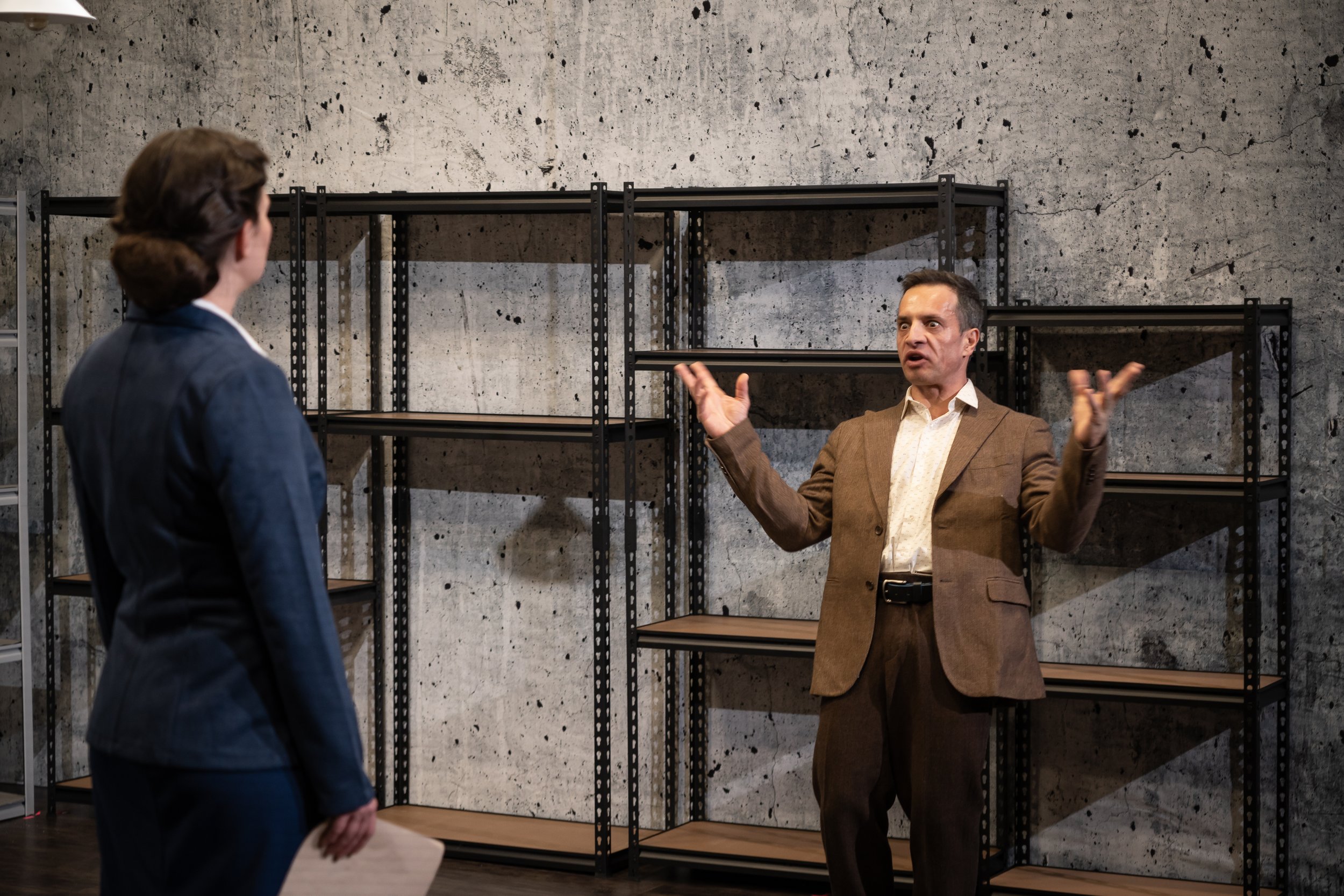
Christophe Peyras, as Picasso, enters the room before his interrogator, taking in his unfamiliar surroundings with an understandable curiosity. When Ines Kreitlein's Miss Fischer arrives, their initial exchanges establish a rhythm that carries through the rest of the play. Fischer mentions that the Führer has an interest in art and paints landscapes, prompting Picasso to quip that "he has problems with the borders." Later, when she asks whether he could copy the Mona Lisa, he responds that he could, but she would never recognize her. These quick retorts provide some welcome humor amid the seriousness of the circumstances, but they also serve a greater purpose. They establish Picasso's irreverence, Fischer's more controlled approach, and, perhaps most importantly, the chemistry between Christophe and Ines. From these earliest moments, the two demonstrate an understanding of how to play off one another, with the timing and delivery of their exchanges suggesting that neither character intends to surrender control of the conversation easily.
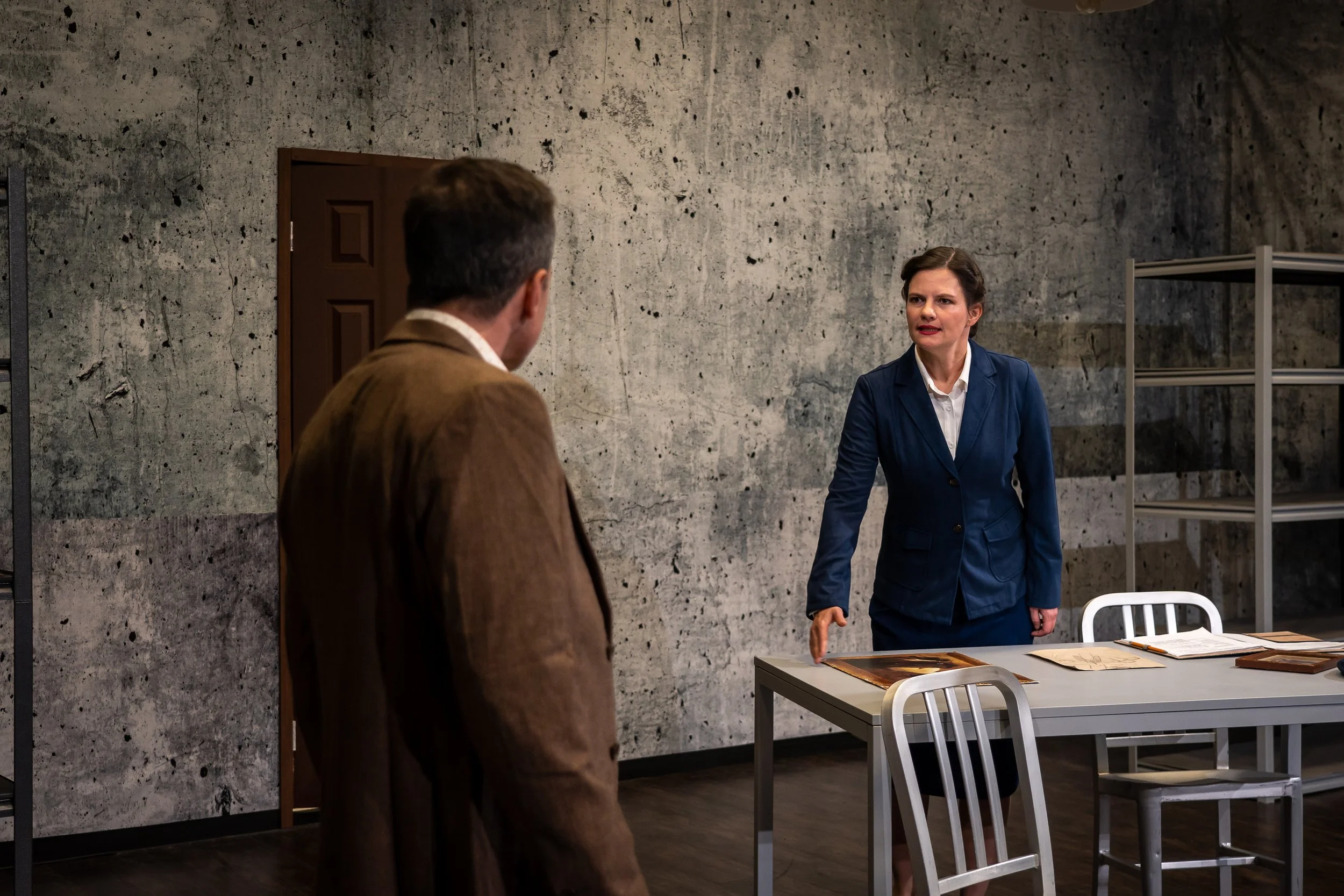
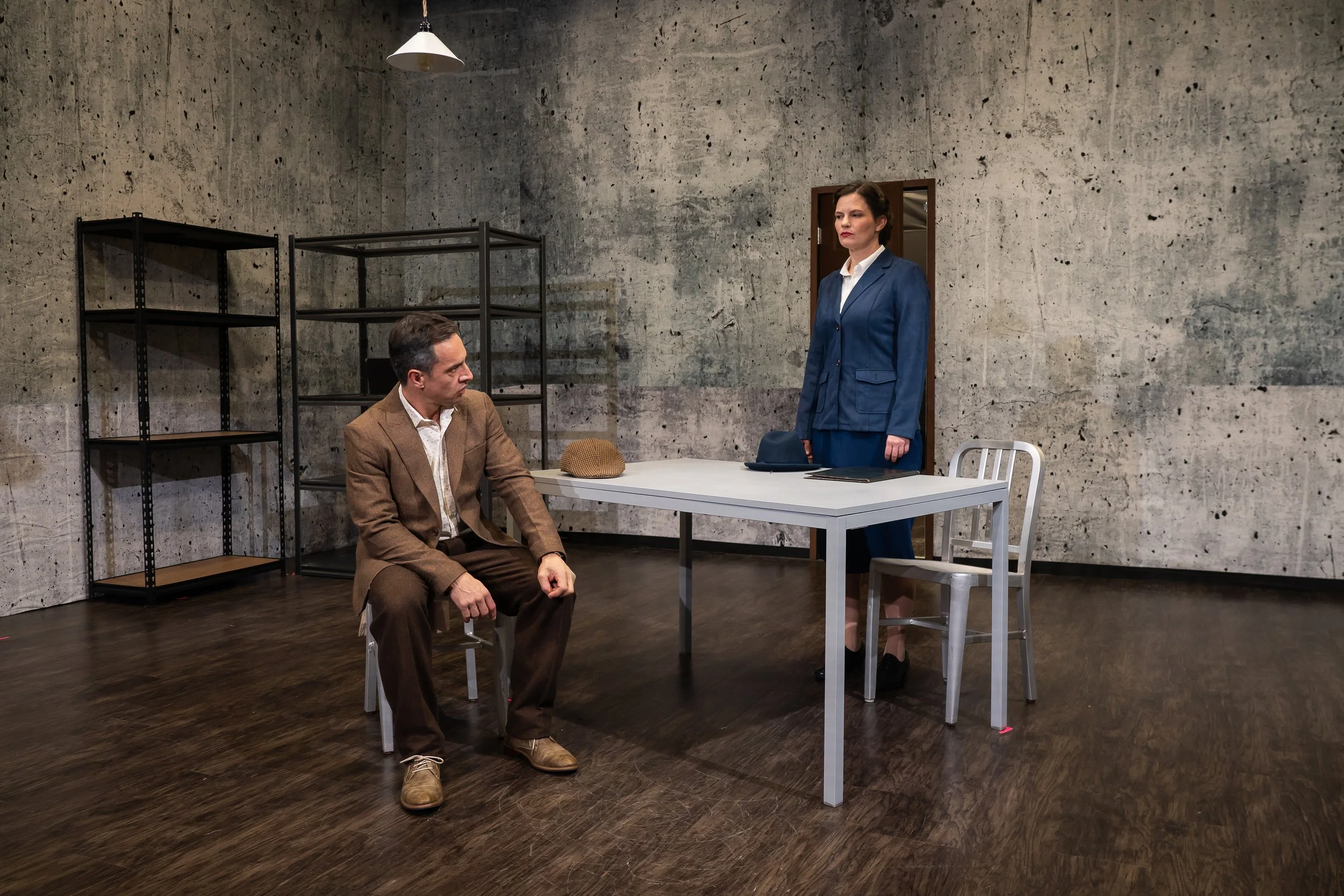
Ines presents Fischer as a woman whose stern exterior is tempered by a certain subtlety. There is a precision to her portrayal that extends beyond her dialogue and into her physical presentation. Dressed in a navy skirt and lighter blue jacket, with practical black shoes and her hair carefully arranged, Fischer looks every bit the disciplined German official. Yet Ines avoids making her simply an unyielding representative of the Nazi government. Her reactions to Picasso's provocations, including a particularly convincing response when he dismisses the notion of participating in group shows, suggest someone who is continually assessing the man standing before her. It is a performance that relies as much on what Fischer chooses not to reveal as on what she says, and that restraint makes the moments when her emotions begin to surface all the more effective.
Christophe, meanwhile, brings a passionate energy to Picasso, presenting an artist whose creative identity is inseparable from his understanding of the world. There is a confidence to his portrayal, but it is not without vulnerability, particularly as the conversation moves beyond the authentication of paintings and into questions of artistic freedom and personal conviction. One of his strongest moments comes in an excellent monologue about the death of God and the nature of rules, a passage in which Christophe communicates not only Picasso's intellectual perspective but also the depth of his emotional investment in his work. It is a particularly effective example of how the actor makes the character's passion accessible, allowing the audience to understand why the freedom to create is so essential to the man.
As the play progresses, Hatcher gradually moves the conversation away from its seemingly simple purpose and toward a more personal examination of art's place in society. Fischer's recollections of her family's appreciation for Picasso's work are especially revealing. She describes a time when his paintings were admired in her home, before the political climate changed and visitors who once came to appreciate the artwork began looking at it differently. The paintings themselves had not changed, but the world around them had, and what had once been a source of pride became something viewed with suspicion. It is an effective illustration of how political ideology can alter the perception of art without changing a single brushstroke, and Ines handles the recollection with a sensitivity that allows the contradiction to speak for itself.
The discussion surrounding Picasso's Guernica provides another particularly charged exchange. The painting, created in response to the bombing of the Basque town during the Spanish Civil War, stands as one of the artist's most powerful statements against the horrors of war. Its significance within the context of Nazi Germany gives the conversation an additional weight, and both performers rise to the emotional demands of the moment. Indeed, it is when these characters move beyond their carefully constructed defenses that the production is at its strongest. The verbal sparring that initially provides moments of humor develops into something considerably more personal, with the two actors demonstrating an impressive ability to shift the emotional temperature of a scene without losing the connection they established at the outset.
Greg Loproto's direction allows this evolving relationship to remain at the center of the production. The setting is a wartime storage room, with a metal table and two chairs occupying the middle of the stage, surrounded by shelves containing frames, artwork, boxes, and other materials. It is a practical environment that reinforces the circumstances of the encounter while keeping the audience's attention on the two people occupying it. There is something particularly appropriate about placing these discussions of artistic value in a room where paintings have been reduced to objects awaiting examination and classification. With little to distract from the dialogue, the production depends heavily on the actors' ability to maintain the audience's interest, and Christophe and Ines prove more than capable of meeting that challenge.
What makes A Picasso particularly interesting is that neither character approaches art from an entirely impersonal perspective. Picasso's passion is rooted in his identity as a creator, while Fischer's relationship with his work is complicated by her own experiences and the political system she represents. Their confrontation becomes more than an argument about whether a painting is authentic. It is a debate about who has the authority to determine the worth of art, whether artistic expression can ever be separated from politics, and what happens when personal appreciation comes into conflict with public allegiance. Hatcher gives both characters opportunities to challenge the other's convictions, and the resulting exchanges are frequently as intellectually engaging as they are emotionally compelling.
In Theatre33's production of A Picasso, passion is brought to Jeffrey Hatcher's examination of art, politics, and personal conviction in Nazi-occupied France. What begins as a seemingly straightforward exercise in authentication becomes a confrontation between two people whose understanding of art is shaped by very different circumstances. Humor gives way to moments of genuine emotional intensity, with both actors demonstrating an excellent command of the shifting relationship between their characters. It is a compelling reminder that while governments may attempt to control artistic expression, the meaning and influence of art are not so easily confined, and that a painting's greatest power may lie not in what it depicts, but in what it inspires people to think, feel, and question.
A Picasso, from Theatre33, closed on October 25 in Bellevue, but for more information about the theatre and upcoming events, head to https://www.theatre33wa.org/.
Photo credit: Sergey Prozhogin