
Stage Review - Neha and Neel | नेहा और नील
Presented By: Pratidhwani and Seattle Public Theater - Seattle, WA
Show Run: October 16 - November 08, 2026
Date Reviewed: Friday, October 23, 2026
Run Time: 90 Minutes (no intermission)
Reviewed by: Greg Heilman
Parents spend much of their children’s lives preparing them to leave “the nest”, to set them up for a fulfilling life outside the childhood home, though being ready for that departure is another matter entirely. There are practical concerns, of course, but beneath those can lie harder questions about what a child will carry into the world and what might be left behind. For a parent raising a child between cultures, those questions take on additional weight. In Neha and Neel | नेहा और नील, written by Ankita Raturi and directed by Agastya Kohli, a mother and son’s travels become an opportunity to explore the distance between sharing a heritage and deciding how someone else should live within it. The co-production from Pratidhwani and Seattle Public Theater runs through November 8 at the Theatre at Green Lake.
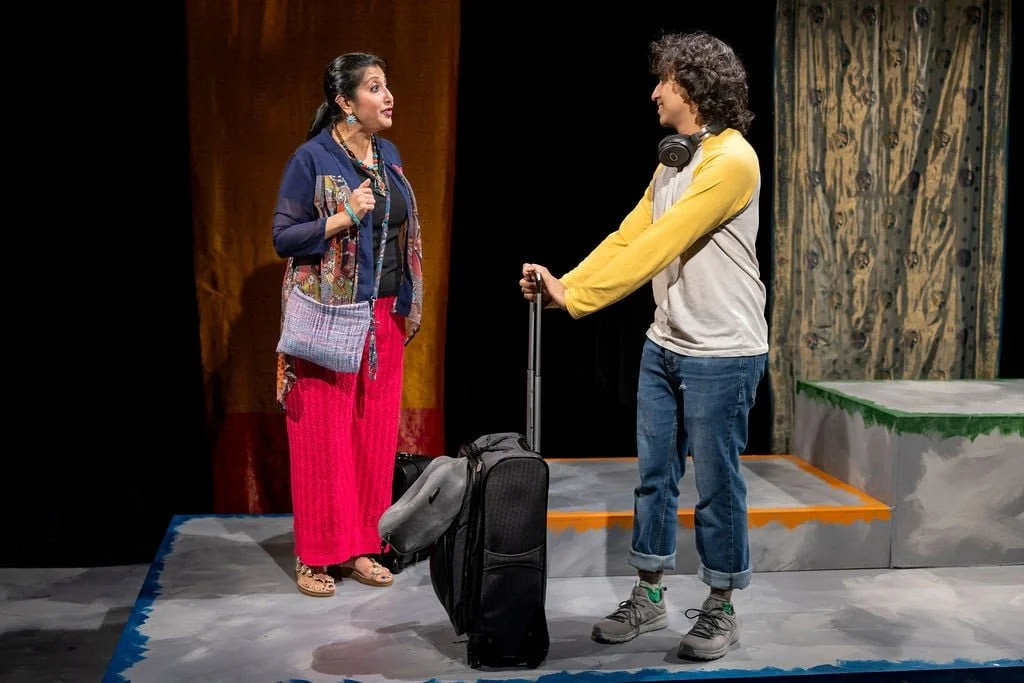
Neha and her teenage son, Neel, have different priorities for their trip. He wants to tour universities, while she has interests of her own, including seeing the Hope Diamond in Washington, D.C. Their opening exchange establishes a recognizable dynamic, a teenager irritated with his mother, a mother trying to manage the situation, and an argument about whose fault it is that they are running late. It is familiar territory for anyone who has traveled with family, and that familiarity provides the entry point into a story whose concerns gradually become more personal.
For Neha, the prospect of Neel leaving home involves more than adjusting to his absence. She worries about what happens to the culture and stories she has tried to pass down if he does not carry them forward. For Neel, those expectations complicate the work of figuring out who he is. His relationship with his Indian heritage belongs alongside his experience growing up American, but finding room for both becomes difficult when his mother seems to find him too American or not Indian enough, especially when those characterizations are associated with behavior that she feels is unbecoming. Their disagreements expose the challenge of sharing a cultural identity without requiring an identical relationship to it.
While the cultural details belong to Neha and Neel, the tension between honoring a heritage and supporting a child’s future is relatable to any parent or child who has tried to navigate that balance. A parent’s desire to preserve a connection to the past can collide with a child’s need to explore what comes next, even when both want to remain close. The play gives each perspective room to be understood, allowing the audience to recognize something of their own family relationships in these exchanges.
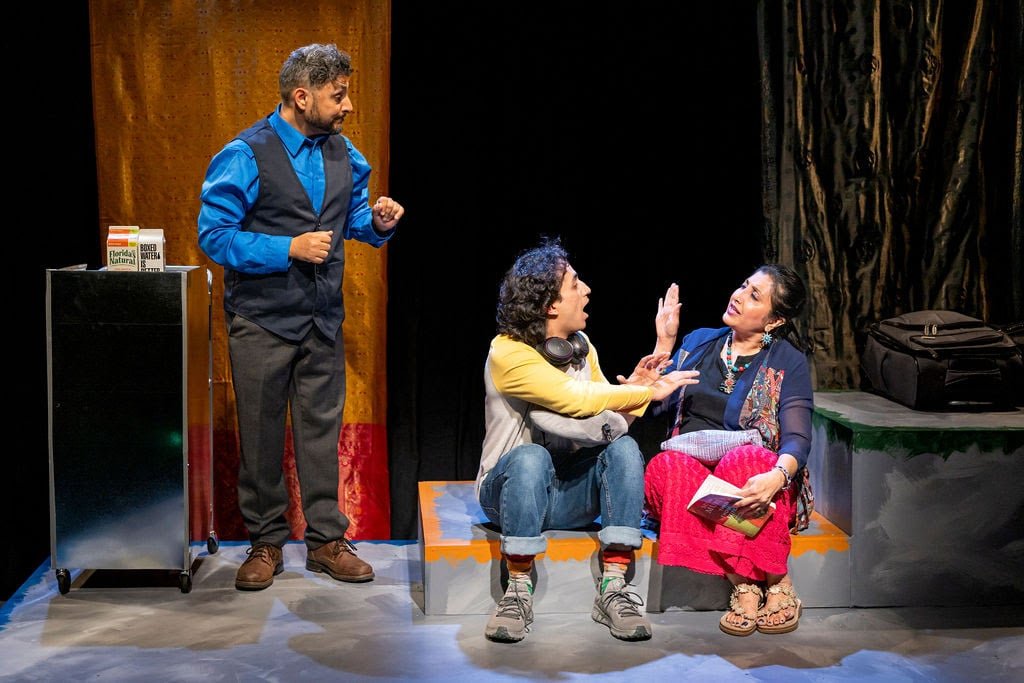
As mother Neha, Manisha Advani provides an expressive presence, allowing her reactions to communicate as much as her dialogue. Her quips land with humor, while her face makes her frustration, delight, and concern readily apparent. There is particular pleasure in watching her light up when Neel plays Bollywood music in the car. These moments extend the character beyond the arguments, revealing the joy attached to the culture she is so determined to preserve. That makes her fear of losing its connection to her son easier to understand, even when the pressure she places on him becomes a source of conflict.
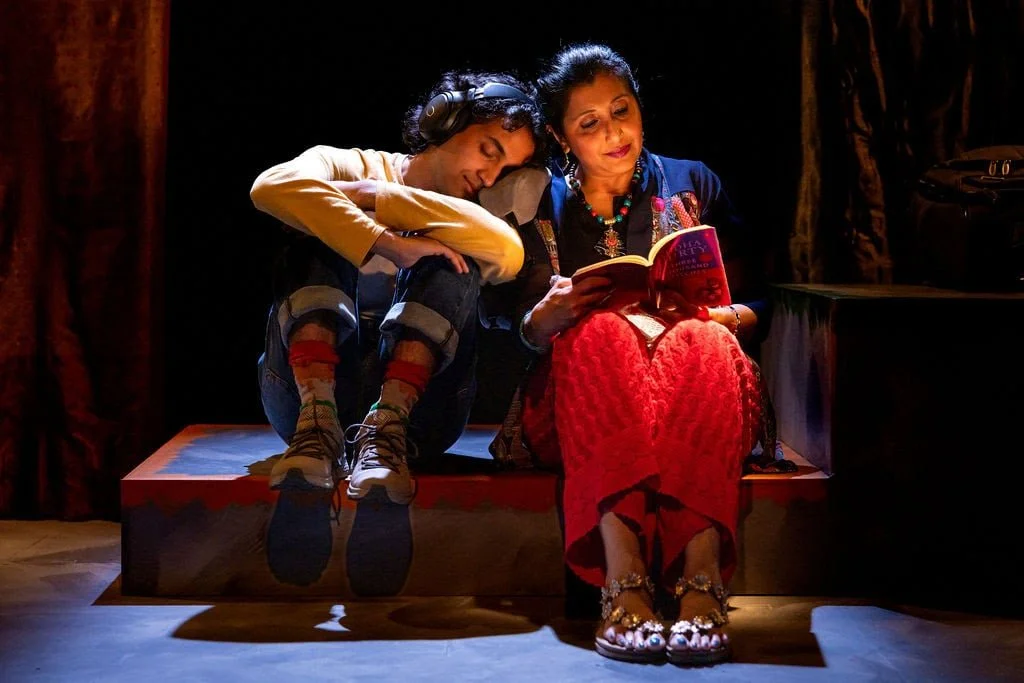
Alongside Manisha is Ankit Madhira, who captures Neel’s teenage impatience while at the same time leaving room for affection beneath it. His irritation with his mother feels familiar, but their relationship has quieter dimensions as well. A tender airplane scene, in which Neel falls asleep against Neha, offers a welcome pause in their disagreements. Neither needs to explain the bond in that moment. Ankit also brings a delightful physical ease to Neel’s dancing in his car seat, giving the scene a sense of spontaneous enjoyment that briefly releases the tension between them.
The production’s most consistent source of comic surprise is Varun Kainth, who plays Arnav and the Avatars, supplying the many other people and presences encountered along the way. I’ve said before how much I have been enjoying watching Varun’s continuing journey as a Seattle theatre artist. Each performance seems to reveal another skill, or at least one I haven’t discovered yet, and this production puts his comic chops on full display. His grasp of timing, expression, and mood makes each character distinct, with transformations that involve considerably more than the numerous costume changes. The casual bearing of a driver, the posture of a businessman, and the swagger of a TSA agent (just an hint of the plethora of characters he plays here) each establish a different personality.
Varun also understands how to build anticipation. As the performance progresses, wondering who he will play next becomes part of the fun, to the point that his entrance alone can garner laughter. His work as a GPS, offering both directions and life advice, is especially entertaining. Each encounter also offers its own piece of cultural insight. There is a pleasure here similar to reading a local author while visiting a place, the particulars of an individual exchange provide another way to understand a culture and the people who inhabit it.
As the one who puts all of this together, Agastya ably captures what happens when two people spend an extended period in close proximity, with little opportunity to retreat from each other. Anyone who has traveled with family will recognize the progression. As the trips continue, walls come down, frustrations become harder to contain, and emotions move closer to the surface. The car scenes are especially effective, capturing both the discomfort of a tense silence and the shared enjoyment that can briefly dissolve it. Eventually, though, the things left unsaid demand to be heard, which brings this story to a fitting climax and a heartfelt resolution.
Robin Macartney’s scenic design provides a simple, thoughtfully arranged setting for the changing locations. Swati Srivastav’s props supply enough information to establish an activity without requiring an elaborate reconstruction of every stop. A steering wheel or gas pump nozzle helps create the place while also becoming part of the humor. Pallavi Garg’s costumes further distinguish the characters, Neha’s clothing reflects a more traditional influence, Neel’s has a casual American style, and Varun’s many changes support the range of personalities he inhabits.
Jacob Viramontes’ lighting gives the quieter moments a welcome intimacy. The airplane scene is especially well handled, with a small pool of light on Neha when she presses the overhead light button. Within a production that asks the audience to accept a few scenic elements as a succession of locations, that detail makes the moment feel specific and personal. It focuses attention on a mother sitting beside her sleeping son, giving their closeness space to register.
The gradual surfacing of their frustrations gives the heated disagreement its emotional weight. Manisha brings together Neha’s fears about being a single mother, letting her son move far away, and losing the cultural connections she has worked to preserve. As Neha pours her heart out, the argument becomes an opportunity for each to understand what the other has been struggling to express. It is a recognizable, sometimes painful part of a relationship, the confrontation in which everything is laid bare, and from which both people emerge with a clearer understanding of each other. Here, that honesty makes the movement forward feel earned.
Directed by Agastya Kohli, Pratidhwani and Seattle Public Theater’s Neha and Neel | नेहा और नील pairs the expressive work of Manisha Advani and Ankit Madhira with Varun Kainth’s wonderfully varied comic performances. Its cultural specificity gives the story texture, while its understanding of parents and children makes it widely relatable. Funny and tender, it captures how traveling together can bring long-held frustrations to the surface, and how the difficult conversations that follow can help a relationship grow. At its heart is a question familiar to generations of families: how does a parent pass something precious to a child while giving him the freedom to carry it into a future of his own?
Neha and Neel | नेहा और नील, a co-production from Pratidhwani and Seattle Public Theater, runs on stage at the Theater on Green Lake through November 8. For more information, visit either https://www.seattlepublictheater.org/ or https://www.pratidhwani.org/.
Photo credit: Colin Madison Photography