
Stage Review - Anne of Green Gables
Presented By: Port Gamble Theatre - Port Gamble, WA
Show Run: October 02 - October 18, 2026
Date Reviewed: Saturday, October 17, 2026
Run Time: 2 Hours, 30 Minutes (including a 15-minute intermission)
Reviewed by: Greg Heilman
How do you bring a place to life on stage when that place is as much a character as the people who inhabit it? That’s one of the challenges facing any theatrical adaptation of Anne of Green Gables. Prince Edward Island, and specifically the fictional community of Avonlea, provides more than a picturesque backdrop for L. M. Montgomery’s story. It’s a world transformed through the imagination of its central character, a place whose beauty and possibilities become inseparable from her search for belonging. Port Gamble Theater’s production, which ran October 2nd through the 18th, used Sylvia Ashby’s nonmusical adaptation, with director Trina Williamson taking a minimalist approach that invited the audience to help create that world.
The story begins with a misunderstanding. Siblings Matthew and Marilla Cuthbert intend to adopt a boy who can help work their farm, but instead find themselves responsible for Anne Shirley, a spirited, talkative orphan whose imagination is matched by her capacity for getting into trouble. Matthew is quickly won over, while Marilla takes considerably more convincing. What follows is the story of Anne finding a home, forming friendships, navigating school rivalries, and gradually discovering that being loved doesn’t require becoming someone else.
Having previously seen Peter DeLaurier’s adaptation at Red Curtain Foundation for the Arts, I find it interesting how differently this familiar story can move on stage. My impression of that production is of a succession of short scenes, giving it an almost cinematic quality that can make the story feel somewhat fragmented. Here, the combination of Ashby’s adaptation and Trina’s direction makes the storytelling feel more continuous. Characters express their thoughts aloud, providing context in a manner that approaches narration while maintaining a connection to the action. With little need to interrupt that action for changes of scenery, the production moves comfortably from one episode of Anne’s life to the next.
That continuity matters, because capturing the full heart of this story on stage is difficult. Regardless of the adaptation, familiarity with the novel or one of its many television treatments feels almost like a prerequisite for appreciating everything being presented. Thankfully, many audience members arrive with that background, carrying an image of Avonlea that a production can draw upon. It reminds me of the challenge in a stage adaptation of It’s a Wonderful Life: how do you tell that story without Bedford Falls? The events and relationships are essential, but so is the place that gives them meaning.
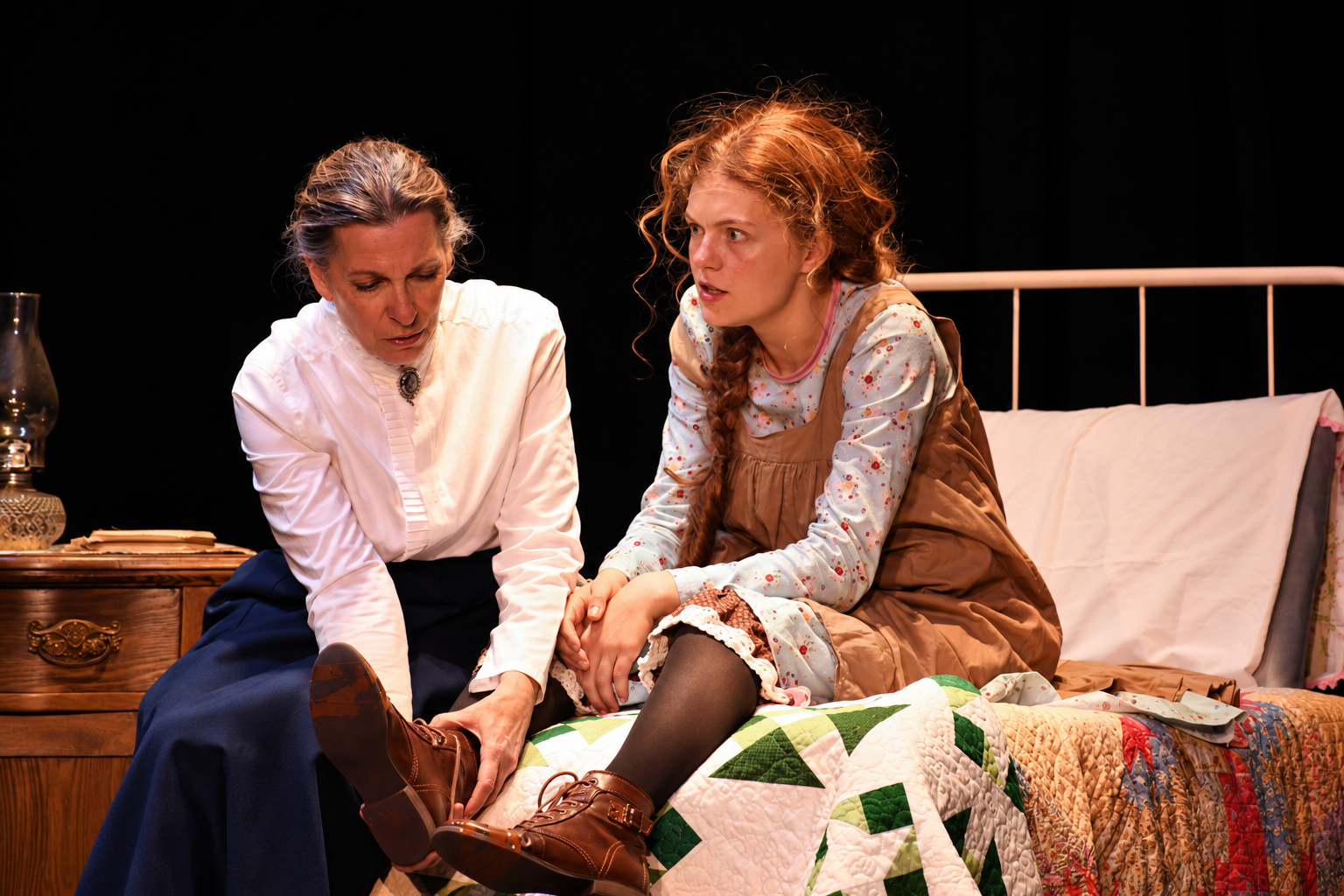
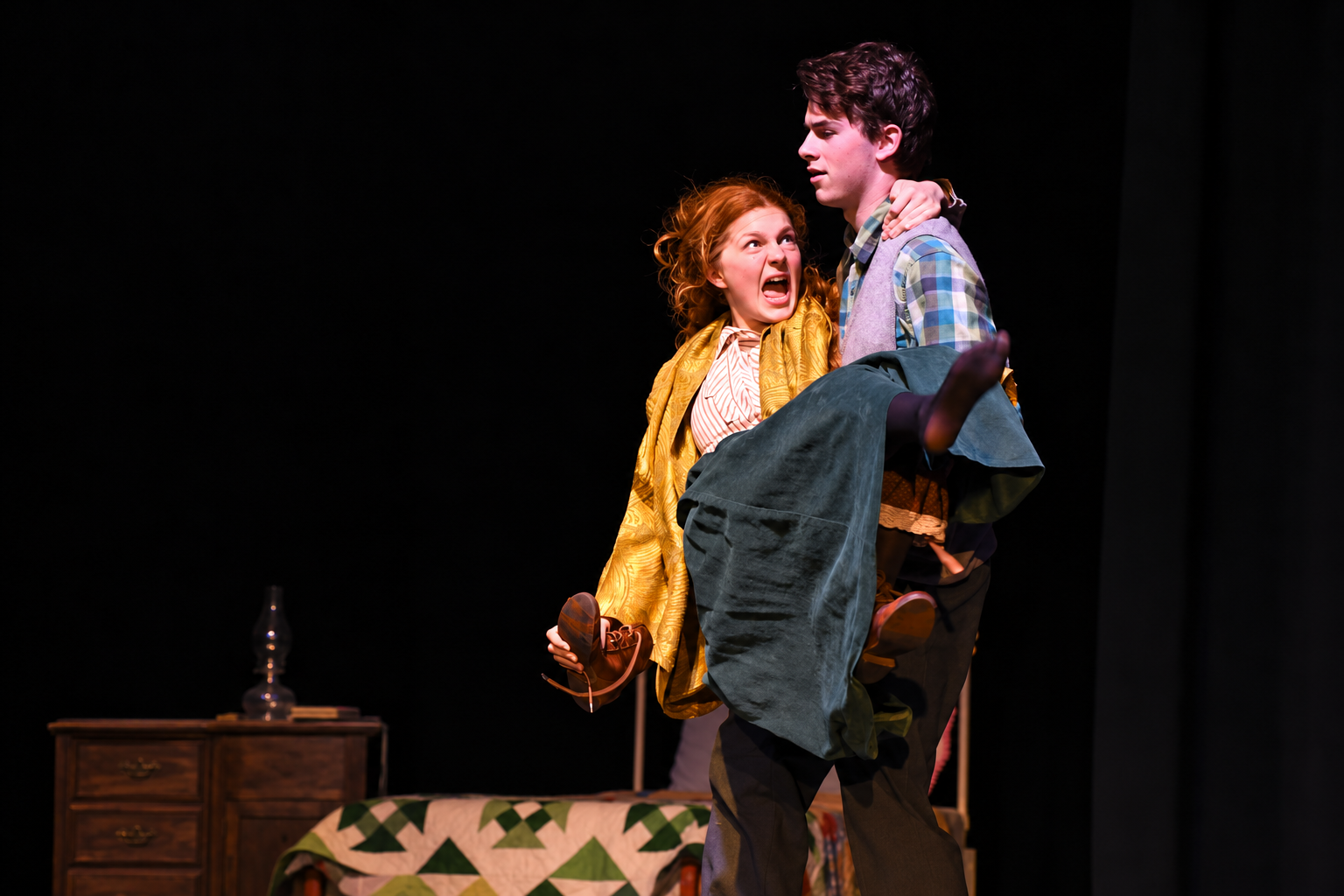
Trina’s approach allows the audience room to supply that sense of place. Without a backdrop or an elaborate series of constructed locations, the stage relies on rustic furniture and a few practical pieces to suggest Anne’s surroundings. Cupboards and a table establish the domestic world of Green Gables, while the open space allows other locations to emerge without cumbersome transitions. Mary Camp, credited as charge artist and as part of the set build team alongside Brad Camp, helps provide those physical foundations. Sue Michaelis’ properties contribute to the setting, while Beth Anne Galloway and the costume team supply clothing that supports the period and its characters. The simplicity gives the performances room to establish what the scenery can only suggest.
At the center of it all is Annie Strum as Anne. The character’s imagination needs to be more than something described in dialogue, it has to inform how she occupies the world. Annie conveys that quality, making Anne’s tendency to experience life at full emotional volume a natural part of her presence. I particularly enjoy the physical expression she brings to the role, including the way she plunks herself down on the bed in frustration. It’s a small detail, but one that makes Anne’s feelings visible beyond her considerable ability to explain them. Those gestures help keep her a recognizably impulsive young person rather than simply a vehicle for the story’s familiar adventures.
The strongest scenes are those that bring Anne together with the contrasting personalities of the Cuthberts. Gary Hammond is particularly well cast as Matthew, capturing the warmth that makes him Anne’s early advocate. Gary is extremely appealing in this role, and his Matthew provides a welcoming counterbalance to the more guarded Marilla. Rilla Hughes is equally good at allowing Marilla’s acceptance of their unexpected houseguest to grow over time. Her affection develops gradually, giving the relationship somewhere to go and making the eventual recognition of Anne’s place in her life especially meaningful. Together, Gary and Rilla give Annie two distinct personalities to respond to, and the changing balance among the three supplies the production’s emotional heart.
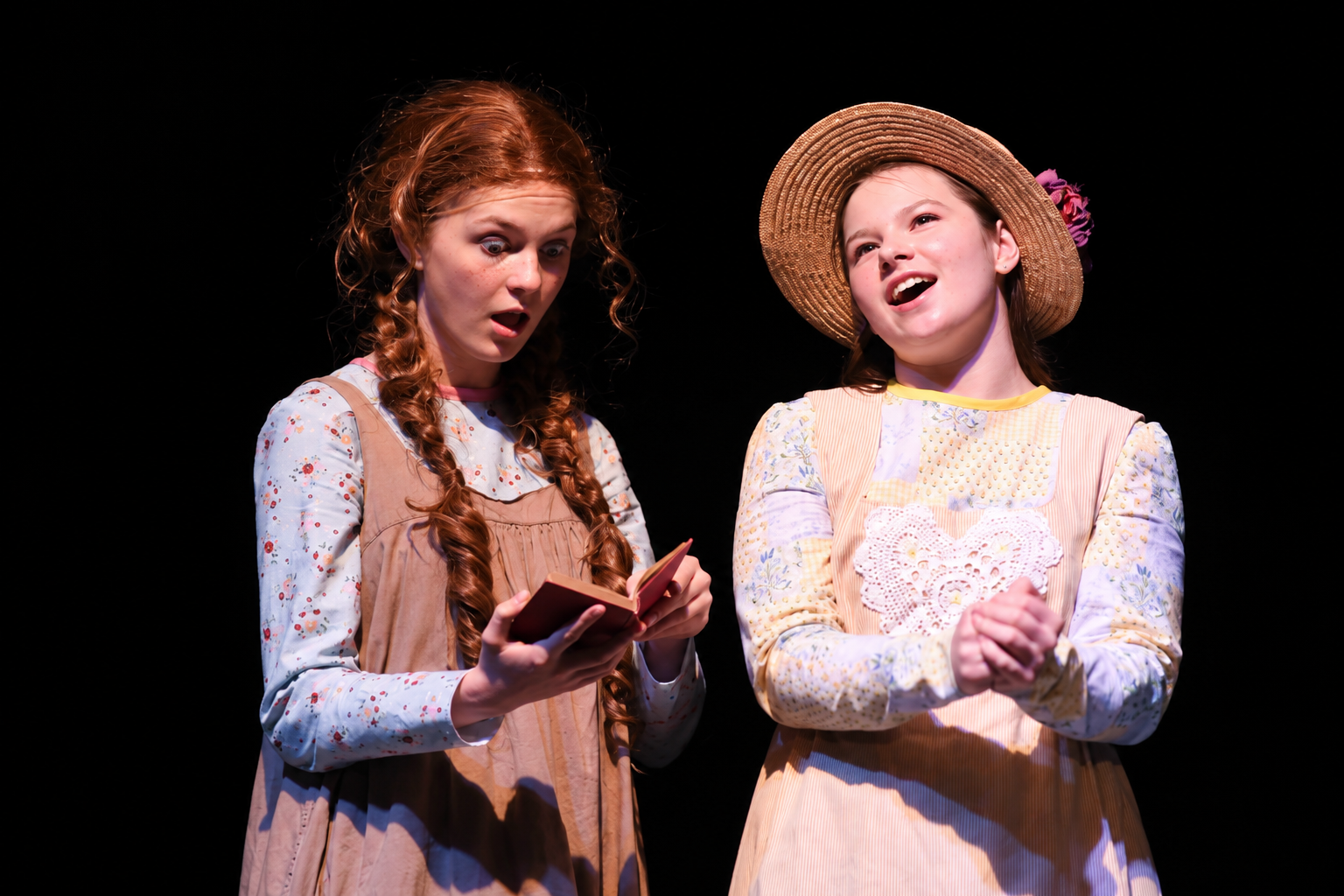
Outside Green Gables, Persephone Berg’s Diana Barry provides Anne with the friendship she so desperately wants. Persephone is particularly enjoyable in the raspberry-cordial scene, as an attempt at hospitality goes memorably awry. It’s an episode that captures how easily Anne’s good intentions can lead to trouble while giving the friendship a playful life of its own. Avery Dearborn is very good as Josie Pye, and Emily Stephens Kasper makes a similarly strong impression as Miss Stacey, each contributing to the school community that helps shape Anne’s growth.
The rest of the ensemble fills out that community, with Melissa Denny as Rachel Lynde, Ron McClung as the Station Master, Stephen Dearborn as Mr. Spencer and Mr. Phillips, and Brittany Martin as Mrs. Blewitt and Mrs. Barry. Clayton Lamar plays Gilbert Blythe, with Emma Layton as Moody McPherson, Lorrayne Orbea as Charlie Sloan, and Addy Heuschele as Ruby Gillis rounding out Anne’s schoolmates. This is Anne’s story, and the ensemble’s responsibility is to give her a world to respond to, challenge, and eventually call her own. They do that well here, supporting the central performance while making the people around Anne part of the reason her story matters.
Port Gamble Theater’s Anne of Green Gables, directed by Trina Williamson, offers an appealing answer to the challenge of bringing a place as memorable as Avonlea to life on stage. The minimalist setting and flowing storytelling invite the audience to imagine the landscape, while a strong central performance and a supportive ensemble fill it with warmth and personality. It’s an approach that captures the heart of Montgomery’s story, allowing the audience to help create the world that makes it so enduring. For a visit to Anne’s Avonlea, it’s the next best thing to being on Prince Edward Island.
The Port Gamble Theatre production of Anne of Green Gables has closed, but for information about the theatre, including upcoming events, head to https://portgambletheater.com/.
Photo credit: Port Gamble Theatre / Brad Camp