
Stage Review - Our Town
Presented By: Harlequin Productions - Olympia, WA
Show Run: October 02 - November 01, 2026
Date Reviewed: Sunday, October 18, 2026
Run Time: 2 Hours, 20 Minutes (including two 10-minute intermissions)
Reviewed by: Greg Heilman
What do you think you would see if you could look at your life today through the eyes of your future self? What would matter, what would seem trivial, and what might you wish you had taken the time to appreciate? Writers have long asked readers and audiences to consider how a different perspective on time might change the way they live, with Dickens’ A Christmas Carol among the most familiar examples. But few bring that question into such intimate, aching focus as Thornton Wilder’s Our Town. In this story, the audience is invited to imagine returning to an ordinary day with the knowledge of everything that followed. If faced with that, would you linger over a familiar voice, look more closely at a loved one’s face, or finally recognize the value of something you once scarcely noticed? Harlequin Productions makes those questions deeply personal, opening a window into the everyday life of a town before asking those looking in to consider how much of their own they might be missing.
Directed by Aaron Lamb, Our Town runs through November 1 at the State Theatre in Olympia. Set in the fictional community of Grover’s Corners, New Hampshire, its three acts explore daily life, love and marriage, and death through three days spanning twelve years, from 1901 to 1913, with occasional returns to earlier moments. The Webb and Gibbs families provide its central relationships, particularly the growing connection between Emily Webb and George Gibbs, but the story belongs to the entire town. Its residents work, raise children, fall in love, worry, gossip, and carry on, largely unaware that the lives they consider ordinary contain everything that makes this story worth telling.
Our Town can carry the expectation of a long evening at the theatre, but length and the feeling of length are different things. At approximately two and a half hours, including two ten-minute intermissions, this production pulls the audience into its world and holds its attention. The breaks fall at meaningful transitions, allowing time to absorb one part of the story before moving into the next. There is nothing manufactured about them, they belong to the play’s structure and make the experience quite manageable. Aaron and his cast together give the daily rhythms of the town room to establish themselves, allowing relationships to develop and those watching time to recognize something of themselves in the people onstage.
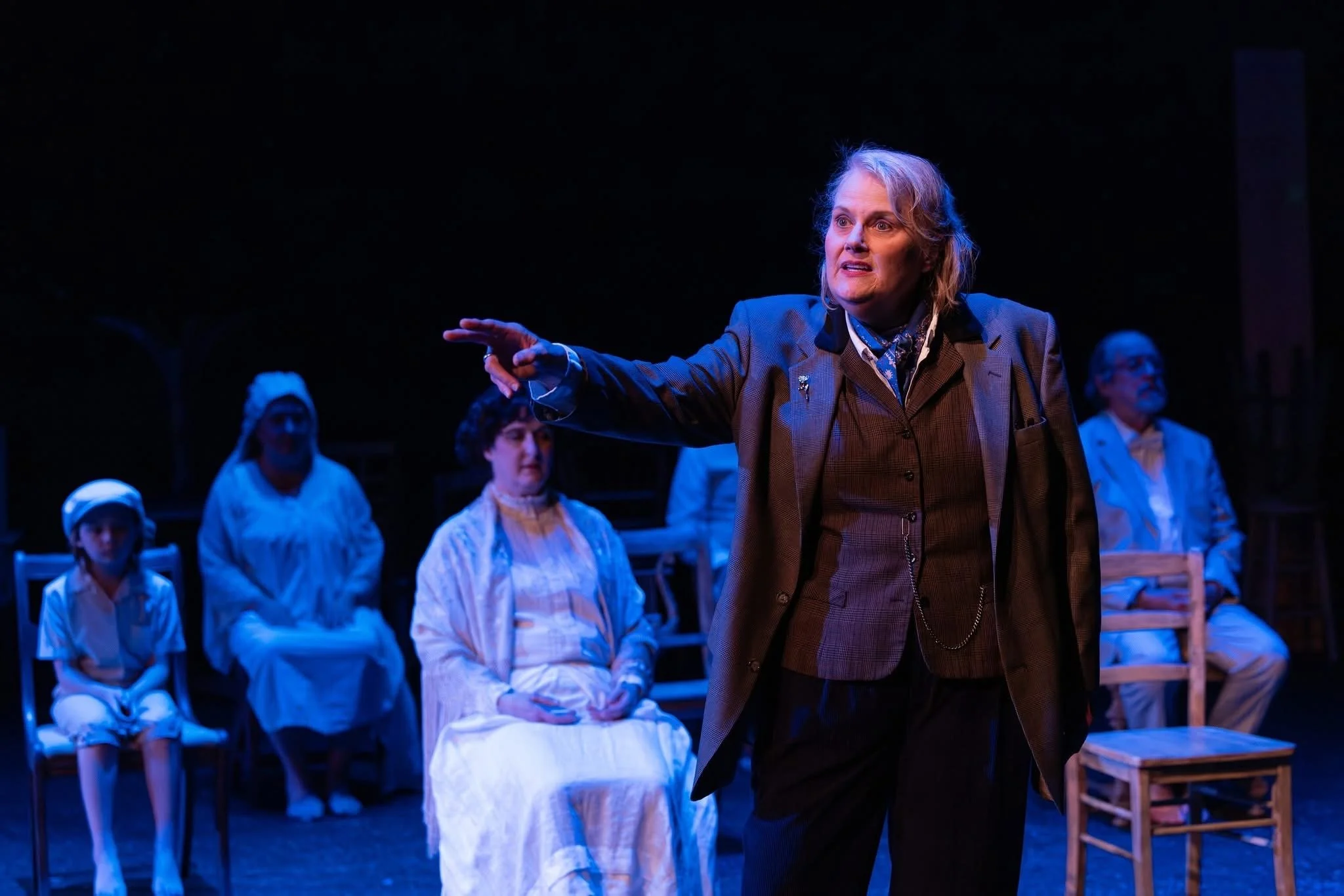
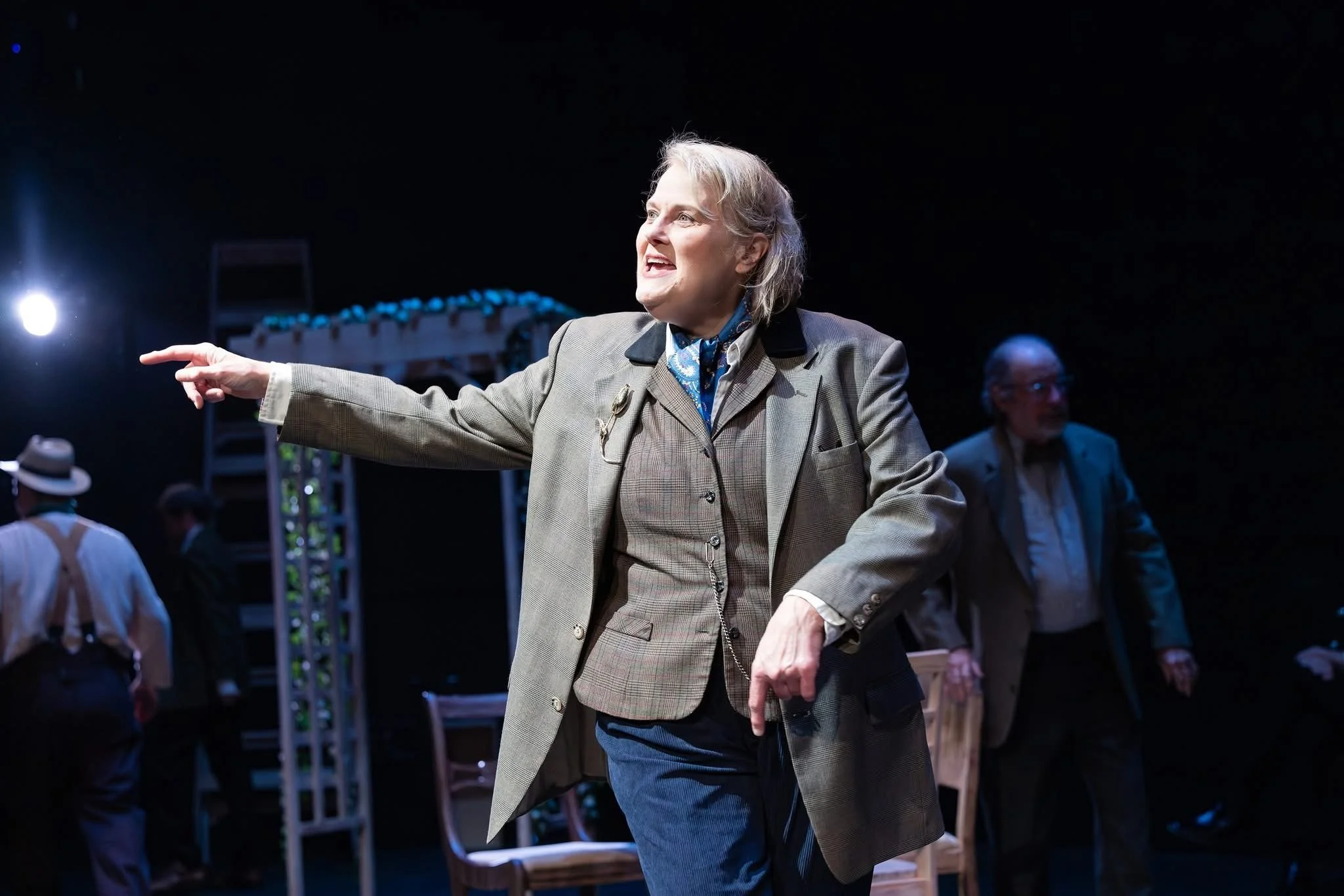
Guiding the audience through that world is Teri Lee Thomas as the Stage Manager, whose omniscient knowledge extends beyond the moment any of the residents currently occupies. Teri Lee is superb, establishing an easy relationship with those watching while maintaining clear command of the storytelling. She introduces people, sets scenes in motion, and moves through time, with the company responding as though she can summon any moment she wishes to share. Some of her most effective work, though, comes after she steps back. Watching from the background, she regards the town with a quiet pride, an affection for these people that encourages the audience to look more closely. It’s quite an engaging performance.
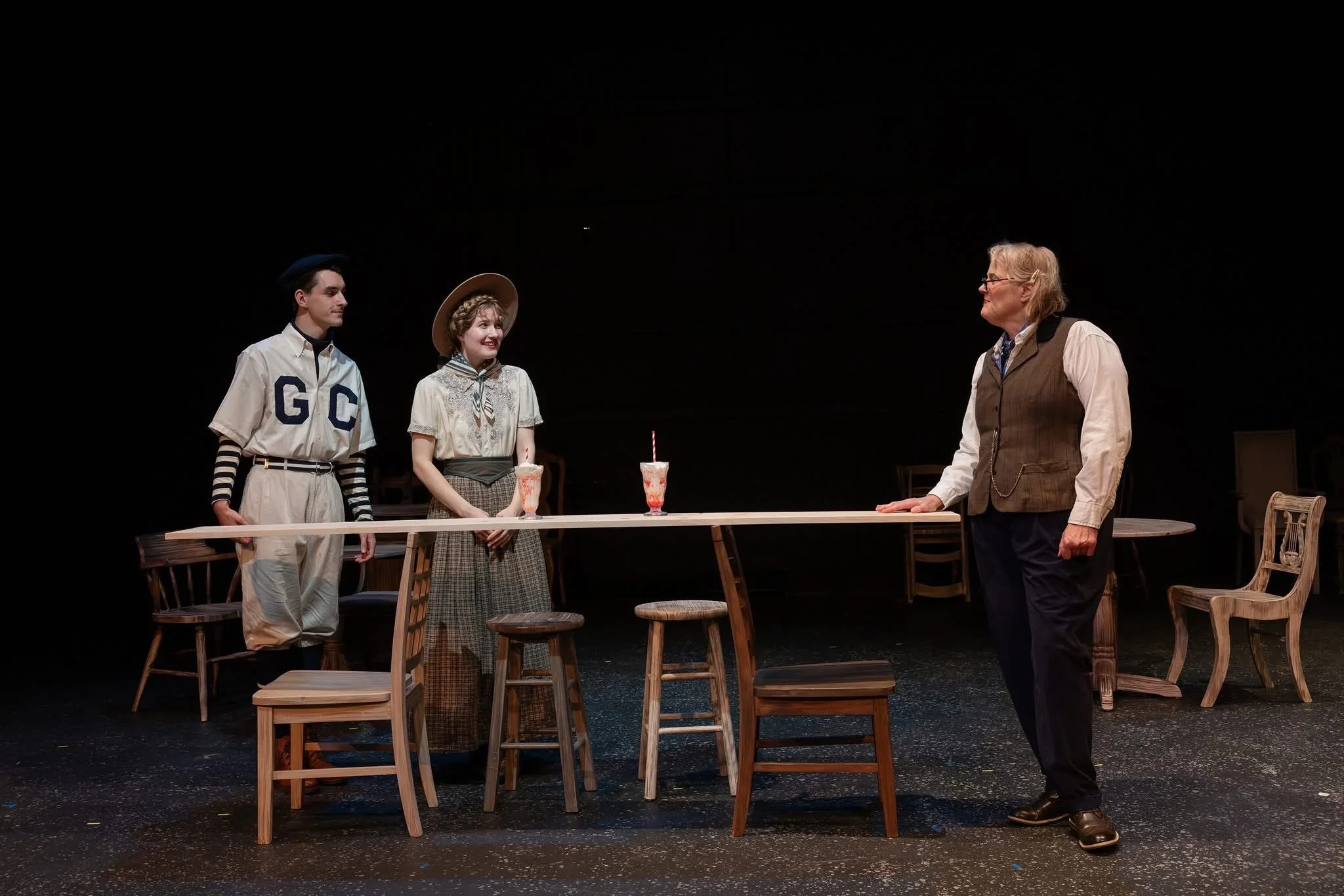
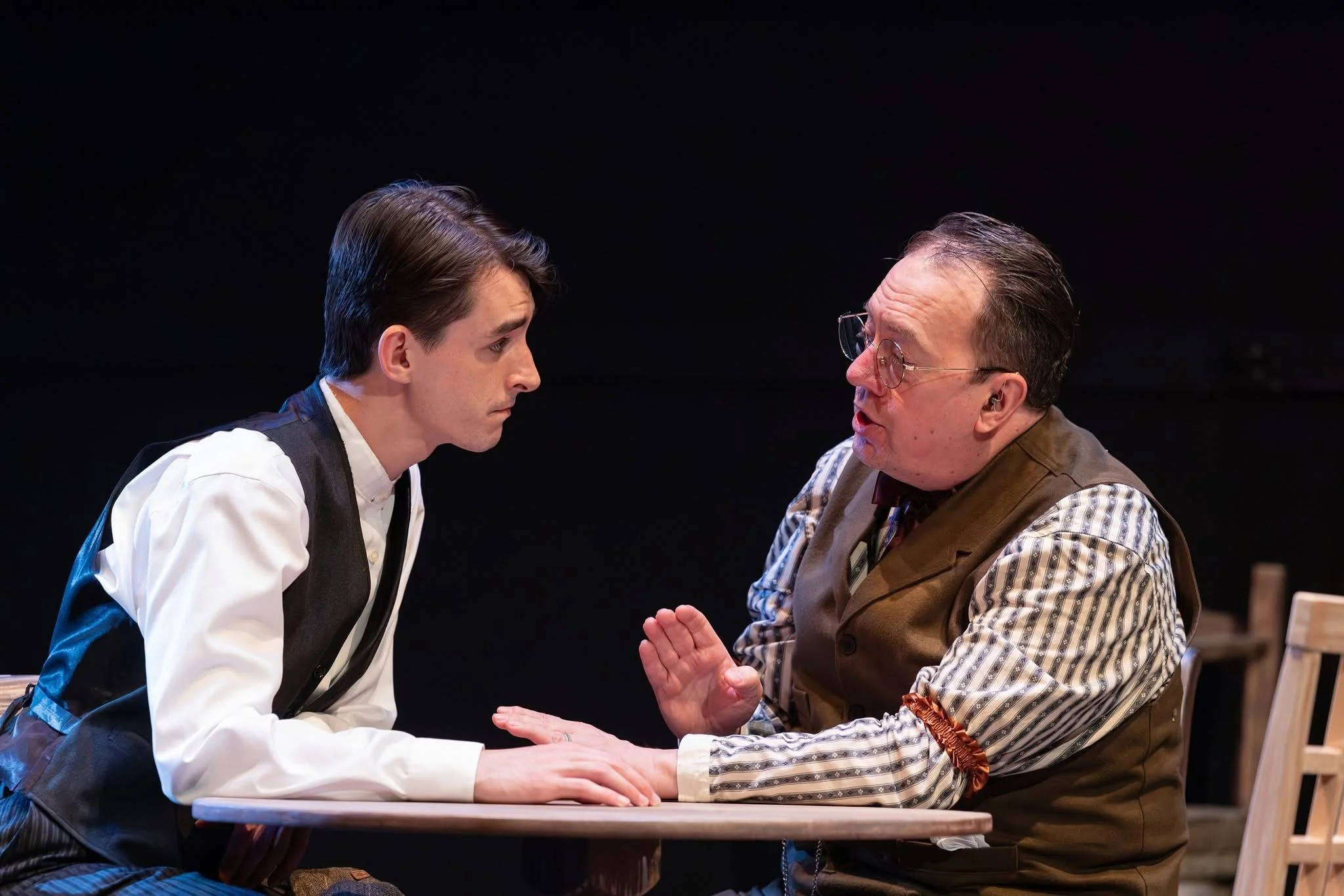
Juliette Jones and Bil Nowicki create an especially beautiful connection as Emily and George. Juliette captures Emily’s youthful insecurity, the uncertainty of someone beginning to understand herself while still seeking reassurance about how others see her. Bil complements her well, and together they make the relationship feel like something growing naturally out of years of proximity and shared experience. Their soda-fountain scene is one of the best scenes here, sweet and innocent, with room for awkwardness, honesty, and discovery. These are two young people beginning to understand what they might mean to one another, and their sincerity gives the relationship an emotional foundation that serves the rest of the play.
Kimberlee Wolfson is another standout as Mrs. Webb. She handles the experience of watching her daughter grow up with sensitivity, balancing the practical business of parenting with the emotional adjustments it requires. There is a convincing sense of an ongoing life around her conversations with Emily, of responsibilities that continue even as their relationship changes. Kimberlee gives her full attention to these exchanges, ones that might otherwise pass as routine, helping establish the importance of this household well before the play asks the audience to look back on it.
There are enjoyable details throughout the supporting performances as well. Russ Holm gives Professor Willard an amusingly academic manner, his voice and bearing working with his goatee and handlebar mustache to create someone thoroughly at home delivering information, and that quality continues for any actor that has a chance to let their voice heard. Across the company, the actors establish the connections that make Grover’s Corners feel inhabited. These people know one another, occupy familiar places within the community, and have histories that seem to extend beyond the scenes being shown. It is that shared understanding that allows a relatively bare stage to feel like a town.
“No curtain. No scenery.” Wilder’s opening stage directions establish the framework of Our Town, but there is still considerable room for a director and design team to make that simplicity their own. Bruce Haasl’s scenic design works effectively within those parameters, with the style of the wooden chairs, the ladders, and the small garden arches providing a cohesive physical vocabulary for the town. Under Aaron’s direction, the performers fill that framework with carefully observed pantomime, making kitchens, household chores, and daily routines tangible without the objects ordinarily associated with them. Kimberlee’s work is particularly effective here, her practiced movements giving Mrs. Webb’s home a convincing life of its own.
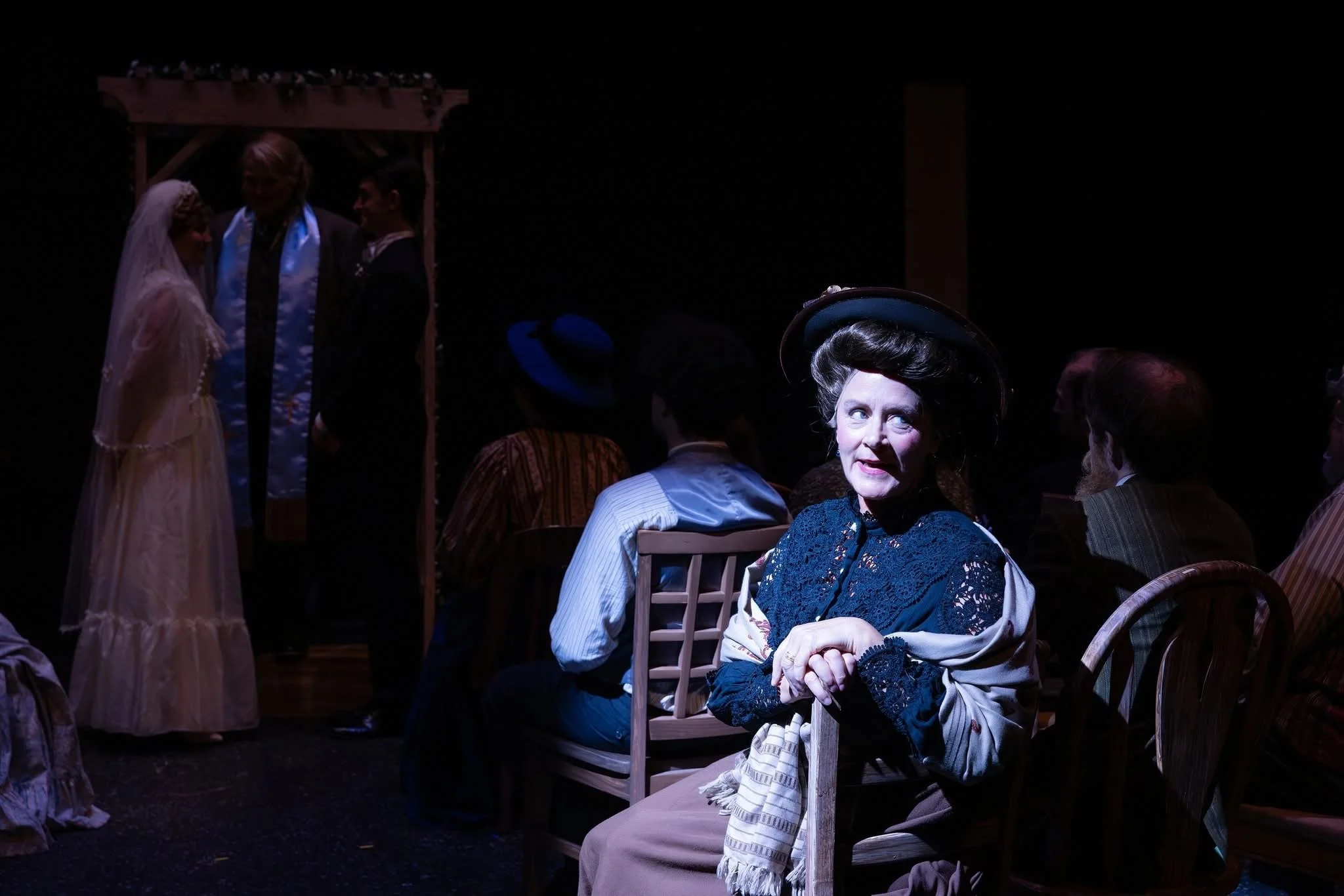
Gretchen Halle’s costume, hair, wig, and makeup designs bring color and individuality to that spare environment, her work excellent across the board. The coordination is thoughtful, extending from clothing to hair color and even earrings, while the women’s exquisite hats complement their costumes and distinguish the people wearing them. Those details establish a community of individuals, making the later image of the dead dressed in white especially striking. The visual unity of that group marks a profound change in how the audience sees people previously known through their everyday lives.
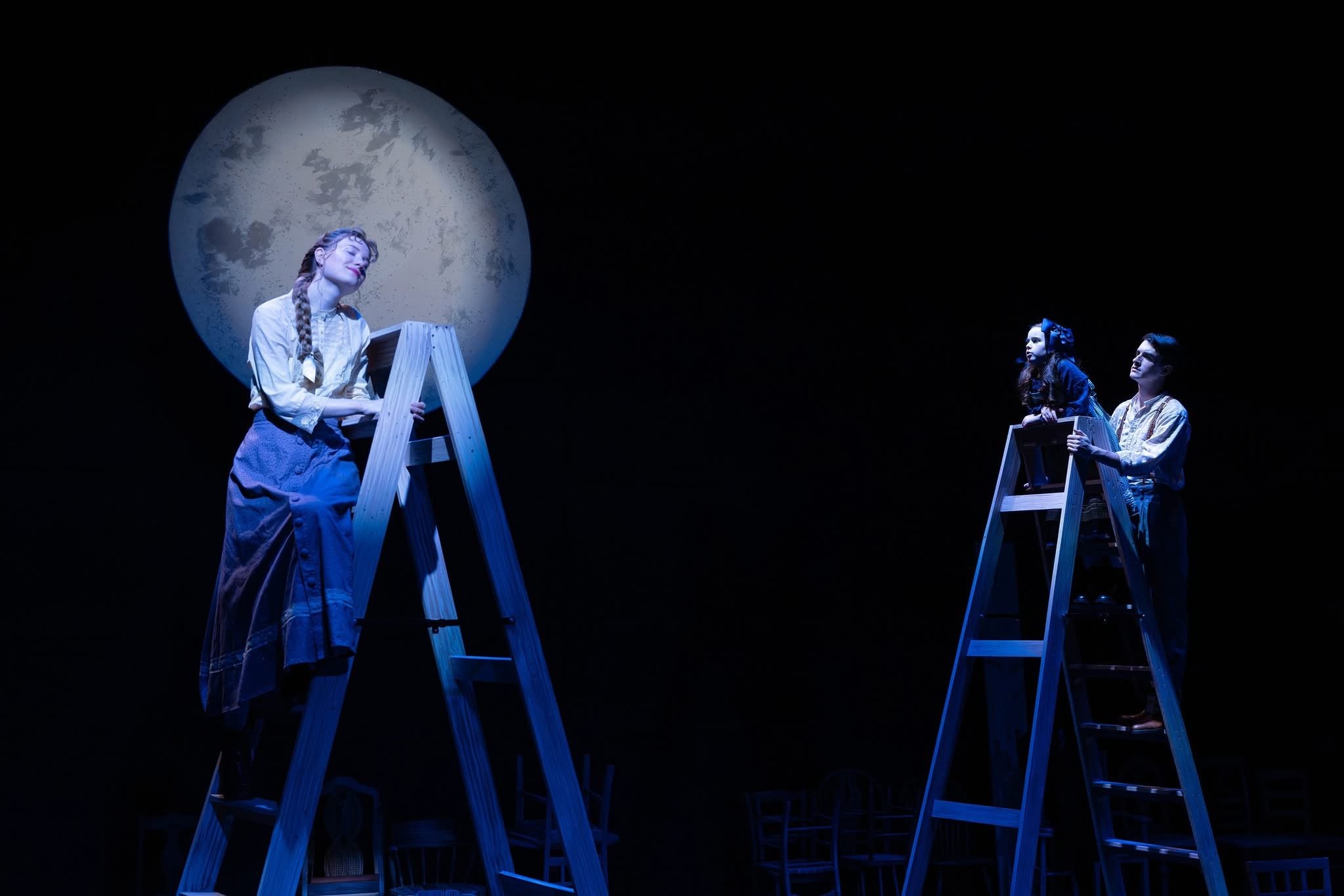
Savannah Van Leuvan’s lighting and Keith Jewell’s sound design further demonstrate how much expressive latitude exists within Wilder’s prescribed simplicity. The nighttime conversation between Emily and George, perched on their ladders with the moon behind them and frogs and crickets filling the air, becomes a lovely, intimate moment within a world that seems to extend beyond the stage. Later, the rain during the funeral and the haunting music accompanying the company’s measured arrival at the beginning of the third act transform that same space. Together, these choices give the production its own atmosphere and emotional texture, showing how Aaron and his design team can honor Wilder’s framework while making its impact distinctly their own.
The third-act opening is among the production’s strongest moments. The actors slowly make their way, one by one, to an orderly arrangement of chairs, with one seat empty. After the activity and conversation that have defined the town, their measured arrival changes the atmosphere. These are familiar faces now, and that recognition gives their gathering its emotional weight. Aaron trusts the image and the performers to hold the audience’s attention, allowing the shift to register before the story continues.
For all the opportunities individual actors have to stand out, this is truly an ensemble piece, and the third act makes the strength of this particular company clear. Their joy, hope, and contentment have made looking in on the life of the town feel comfortable and familiar. Its relationships, births, deaths, and daily concerns are recognizably human. The final act changes the meaning of those earlier moments, revealing how much there was to appreciate in scenes that initially seemed so ordinary.
Emily’s request to revisit a day in her life brings that realization into sharp focus. Looking back means knowing what comes next, and that knowledge changes even the smallest exchange. A routine morning becomes something a person might give anything to experience again. The familiar voices are there, the people are there, and the concerns that once seemed so urgent lose their importance. Juliette’s work carries the personal impact of that discovery, while the company around her gives it a reach that extends far beyond Emily’s experience.
Seeing (and being thoroughly impacted by) this production of Our Town brought me back to the book The Little Prince, and what its protagonist refers to as “matters of consequence,” and how readily those concerns can consume a life. Seen through future eyes, how much of the present would deserve the attention it receives? As little specks on a pale blue dot in a vast universe, people have a brief opportunity to build connections that give their lives significance. Yet so much time goes toward things that contribute little to that meaning, while familiar faces and everyday moments pass scarcely noticed. This production earns that reflection by first making an ordinary day feel so believable.
Harlequin Productions’ Our Town gives its audience compelling reason to consider what their future selves might wish they had noticed today. With thoughtful direction, evocative design, and an ensemble that makes the everyday life of Grover’s Corners feel familiar, this production builds quietly toward a profoundly affecting final act. Running through November 1 at Olympia’s State Theatre, it leaves those watching with the opportunity Emily can only briefly reclaim: to look more closely at the people beside them and appreciate an ordinary day while they are still living it.
Our Town, from Harlequin Productions, runs on stage at the State Theatre in Olympia through November 1. For more information, including ticket availability and sales, visit https://harlequinproductions.org/.
Photo credit: Shanna Paxton Photography