
Stage Review: Ghosts of the Hatchery
Presented By: Sci-Stories Project @ Georgetown Steam Plant Museum - Seattle, WA
Show Run: October 02 - October 11, 2026
Date Reviewed: Sunday, October 11, 2026 (Closing)
Run Time: Approximately 70 minutes
Reviewed By: Sameer Arshad
Science likes to imagine itself as a clean, steady march toward truth. One experiment builds on the last, one generation hands its notebooks to the next, and knowledge accumulates like sediment at the bottom of a river. But who pays for the experiments? Who decides which questions are worth asking, which species are worth saving, and which researchers are welcome in the lab at all? And what happens when the ghosts of every answer we got wrong are still standing around the workbench, watching us try again?
Welcome to the hatchery. In Ghosts of the Hatchery, the dark eco-comedy written and produced by marine scientist and playwright Xochitl Clare with her theatre company, Sci-Stories Project, and directed by Ren Langer, the entire Georgetown Steam Plant Museum, where Clare is currently Artist-in-Residence, becomes an industrial salmon hatchery that has occupied the same patch of land for generations. A young Black researcher arrives to conduct her experiments and finds the place crowded with her ghostly predecessors, along with a few visitors from the future, all of whom have unfinished business with the hatchery.
The science starts before the show does. Outside the performance space, researchers from the University of Washington staffed interactive stations on salmon biology and migration patterns, and at one of them you could actually listen to salmon brain waves. Kids and adults alike were thrilled. By the time we walked into the hatchery, we had all kinds of new perspectives on salmon.
And then we became the salmon. Each audience member is handed a salmon image on a stick, with a QR code on the back that links to the show’s program. Over the course of the evening, we wave our salmon sticks together in solidarity, and slowly we realize what we’ve become. We are the fish in this hatchery, gathered together, swimming around doing whatever salmon do, while the humans on stage argue over our fate. It’s a clever piece of participatory design, and it stings. The solidarity is real, and so is the helplessness. We can wave all we want. The decisions are being made above the waterline, without us, by the creatures that want to keep eating us forever.
The play borrows its haunting machinery from A Christmas Carol, sending in a Ghost of the Past, a Ghost of the Present and a Ghost of the Future, who drift in from all around us through the industrial space. Together they give us a guided tour of science as a profession across the decades. We start in the 1960s, with a hatchery manager so thrilled by his own progressiveness in having women work alongside him that he feels compelled to bring them flowers, a gesture that lands with all the cringing awkwardness you’d expect.
At the center of the play is a debate about whether to take corporate money. The question plays out between the researcher and the ghosts of her field, as science’s long dependence on patrons, from government agencies to corporate sponsors, comes into focus. Then the salmon summon a ghost of their own, a representative of their interests in a room full of humans speaking on their behalf. And it is the salmon who eventually give their blessing to the corporate sponsorship.
That turn is the sobering heart of the play. The salmon’s blessing reads as acceptance of a hard reality: in a capitalist society, the forces causing the most environmental damage are also the ones holding the resources to repair it. Capitalism may be the only available source of relief precisely because it is the main source of the pain. We live in an era that keeps preaching individual environmental responsibility, recycle your yogurt cups and shorten your showers, while Clare’s play points its finger squarely at the corporations. If they hold the money, they need to put it where their mouth is, funding projects that heal and restore ecosystems and championing the shift in economic mindset that ecological conservation actually requires.
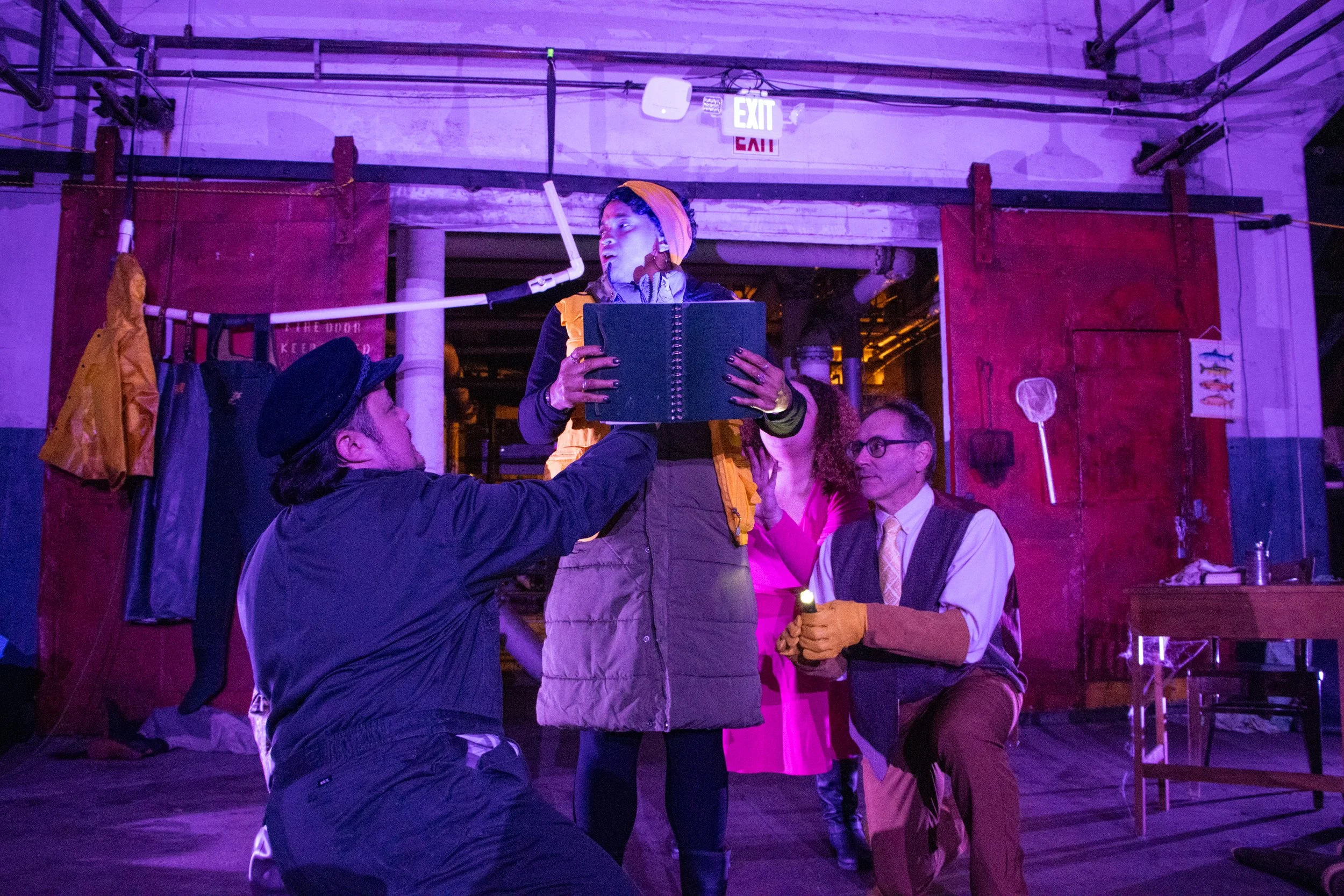
Shana Emile is the beating, beleaguered heart of the show as the young researcher trying to get some actual science done. She presents brilliantly, and her deadpan reactions to being mansplained, interrupted and lectured by people who have been dead for decades are some of the funniest moments of the night. Here is a patient soul already stretched thin by the daily grind of running a hatchery, now forced to manage a parade of ghosts who keep wandering into her workday with opinions. Emile charts a satisfying arc from wide-eyed surprise that these ghosts exist at all to thoroughly fed-up annoyance by the end. She grounds the entire evening for us. She guides us through the emotional beats and the comedic ones, and through the beats where we are just as exasperated as she is, as the ghosts keep throwing their ideas at her, some of which stopped working a long time ago.
Tod Harrick, as the Ghost of the Past, Sgt. Donaldson, is a masterclass in being delightfully easy to be annoyed by. He is so self-righteous, so self-assured and so gloriously all over the place. Donaldson lives in the 1960s, in the post-World War II boom of science and technology, an era that was genuinely exciting and also an era when a lot of white men were finding effortless success in their careers and their economic status. Harrick bounces through the performance space with a bravado and confidence that feel completely out of time. You rarely see that kind of certainty today, even among successful men, because the economic ground has shifted under all of us. And yet Harrick lets us see exactly where Donaldson’s vision cracks and fades, the places where his excitement about his corner of the world can’t survive contact with ours. Watching him, I caught myself thinking, “Yes, I care about the environment, but right now I’d mostly like to pay my rent.” Which is, of course, precisely what capital wants us to think. Keep your eyes on the rent, and leave the rivers to someone else.
Milo Denison, who plays both the Ghost of the Present, Ron, and the Leader of the Actual Salmon, brings an exciting, campy presence that keeps us leaning forward to see what happens next. As the salmon leader, Denison commands the stage in full salmon regalia and becomes our representative, the voice of every fish in the room. He had us smiling, and he had us roaring together as salmon, a whole school of audience members cheering him on: yeah, you tell him, salmon leader.
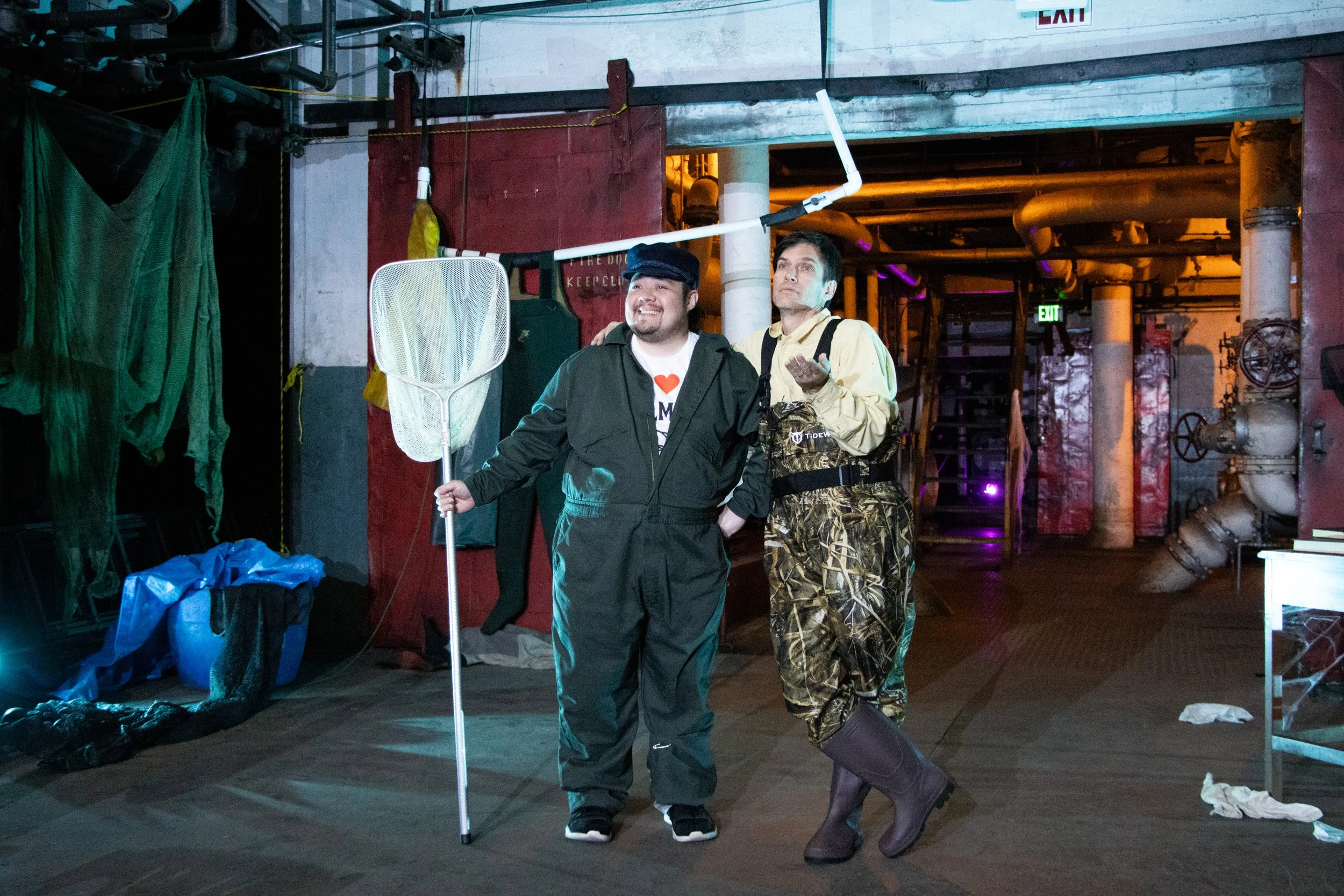
Thomas Clatterbuck, as Sam and, yes, as Salmon Sperm, delivers razor-sharp comedic timing with an unusual purpose. We usually treat comedy as a release valve, a chance to relax. Clatterbuck’s comedy works more like an alarm. It’s funny, and it’s also urgent, a laugh that leaves you thinking, “Hey, we’re all in big trouble,” and pulls your attention right back to the most important thing in the room.
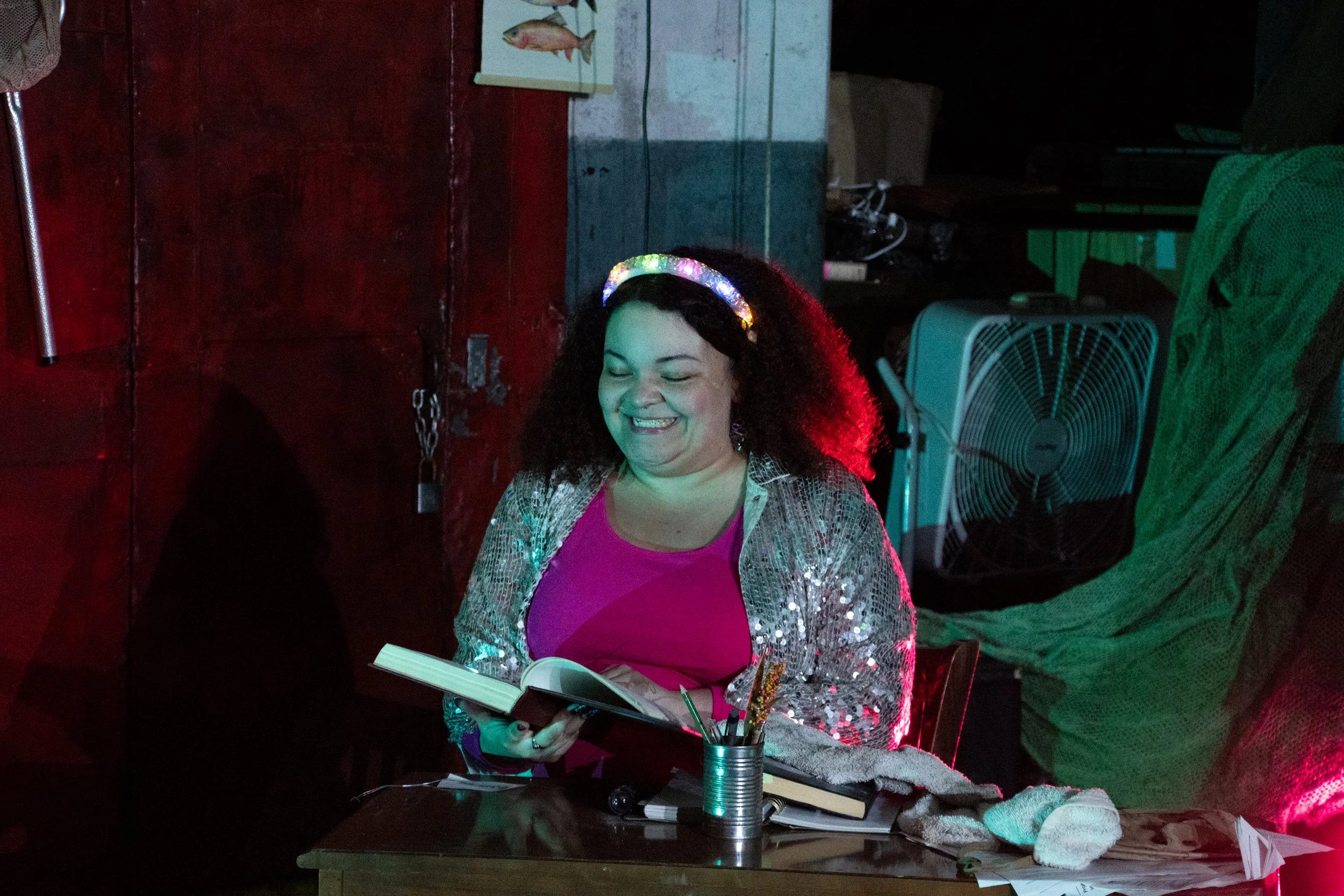
Tiffany Smalls is a sensation as the Ghost of the Future, playing two visitors from two very different tomorrows. From the dark future, she arrives as a Cassandra figure, foreshadowing doom and warning of the era just ahead. From the far future, she bursts in from a bubblegum, campy world where everyone is happy, the damage is long repaired, and humanity looks back on its ecologically destructive past with the gentle pity of people who simply know better now. Smalls could have played this visitor as smug, the know-it-all time traveler telling us to get our shit together. Instead she plays her as gloriously unbothered, a student who has popped back in time mostly to gather material for her book report, because our problems are, for her, a solved historical footnote. To reach her relaxed future, she reminds us, the work still has to be done, and we are the ones who have to do it. Her part of the work is writing the book report about ours. It raises a deliciously uncomfortable question. If we finally fix the world, do we all get to become vapid, shallow and unperturbed? Isn’t that a kind of privilege, the very same carefree privilege we criticize today in people who don’t care about the environment? Maybe that’s the point. Wouldn’t it be nice to live in a world where everyone has that privilege, where everyone feels fulfilled and enjoys their life precisely because the ecological and economic work has been done? Smalls makes the happy future feel shallow and campy and, because it’s so familiar, entirely achievable. It’s rare for an actor to reassure an audience in such a backhanded way, and it’s very smart.
Ethan Jarvik is a delightful Narrator, with all kinds of clever theatrical tricks up his sleeve that kept the many kids in the audience thoroughly engaged. He clearly has a lot of experience handling audiences of all ages, and he carries our attention from concept to concept with ease. Then Jarvik pulls off something genuinely rare as the Tarjay Executive, presenting the corporate patron as both sleazy and vital, a strange and fascinating combination for a figure we’re conditioned to see as the enemy. He is neither a necessary evil nor an antihero. He is an anti-villain: a villain who somehow fails at being a villain, and who may turn out to be exactly what the salmon need. It’s very rare to see an anti-villain on stage, and it’s a lot of fun.
The design team makes the most of a venue no set designer could build from scratch. Evette Noelle’s scenic and props design, with Charles Rogerson, convinces us we are standing inside a working hatchery even though we know full well we are in a steam plant, and the retro industrial bones of the building do the rest, giving the whole evening the perfect October chill. Elizabeth A. Shipman and Anne Rogerson’s bright, playful costumes catch the eye and delight everyone in the room, whether you’re seven or seventy, and the music from Karan Shetty and Ray Wang is excellent throughout.
The lighting from Dean Munroe and Marley Keith, with Riley Werner on sound, is outstanding. Even at a daytime performance, a few far-off sources of light leave most of the plant flooded in industrial shadow, and precise, deliberate pools of light keep us wondering what’s waiting around the next corner. Add fog, and somehow this cavernous steam plant yields cleverly carved pockets of intimacy. But the lighting also makes an argument of its own. It leaves us standing in an industrial facility that has never cared about aesthetics, inside an industrial mindscape that treats beauty as optional. That’s the same mindscape that treats ecology as optional. Utilitarian thinking has long filed the environment under aesthetics, a nice view, a pleasant extra, something with no practical value. The play insists that ecology belongs firmly in the realm of the useful, and that dismissing its usefulness is a huge part of the problem. There’s something sad about that too. In a world run by corporate sponsors, you still have to make the utilitarian case just to convince anyone to protect a river.
Much appreciation as well to stage manager Loki Hamilton, dramaturg El Califf, visual designer Niki Shetty and communications lead Anouk-Belle Janess for bringing the whole ecosystem together.
We would expect that the most terrifying spirit is the silent Ghost of Christmas Yet to Come, but Clare turns that concept on its head. The past is complicated, and the damage is done. The near future looks bleak. What should truly frighten us is our own indifference in the present, because the present is the only place where anything can still be done. We cannot pick and choose which species to save, because every one of them is threaded into ecological systems we depend on without even knowing it.
The ghosts of this hatchery are, in the end, the history of ecological science itself, and the play keeps asking what we can learn from it. Our present will one day be somebody’s book report. The question is what we want it to say. Protecting the salmon is protecting ourselves. The power of right now is all we have, and we cannot afford to waste it.
Ghosts of the Hatchery, from Sci-Stories Project, has closed at the Georgetown Steam Plant Museum. To follow Xochitl Clare and Sci-Stories Project, visit https://dancingbiologist.com/ and https://sci-storiesproject.com/.
Photo credit: The Daily UW / Jessie Cai