
Stage Review - Anthropology (Drama Dock Theatre Company)
Stage Review - Anthropology
Presented By: Drama Dock Theatre Company - Vashon Island, WA
Show Run: May 21 - May 24, 2026
Date Reviewed: Friday, May 22, 2026
Run Time: 90 Minutes (no intermission)
Reviewed by: Greg Heilman
Seeing as much theatre as I do, one would think that nothing can surprise me anymore. But every once in a while, something comes along that completely blindsides me, reminding me just how much exceptional theatre exists throughout our region. I hadn’t previously made the trip to Vashon Island to review a production, but when Drama Dock Theatre Company invited me to see their latest offering, Lauren Gunderson’s Anthropology, I jumped at the opportunity. Running for one weekend only at the Vashon Island High School Theatre through May 24, the production also arrives as part of Drama Dock’s 50th anniversary season, celebrating five decades of bringing theatre to the Vashon Island community. Based on the quality in all aspects of Anthropology, it becomes immediately and abundantly clear why the company has endured for as long as it has.
Anthropology is less traditional entertainment and more intellectual and emotional excavation, though to be clear, it is also deeply engaging and surprisingly entertaining. Gunderson’s script explores mourning, love, isolation, and the ways people attempt to reconstruct fractured relationships, all while framed through a larger conversation about the morality and implications of artificial intelligence. For a playwright already well known for weaving science into her storytelling, Lauren pushes herself even further here, crafting what may very well be her most ambitious and exciting work to date.
Set largely inside the home of Merril, a brilliant but emotionally untethered coder attempting to use artificial intelligence to recreate her deceased sister, the play asks difficult questions about what technology can preserve and what remains fundamentally, painfully human. Steven Sterne’s direction wisely refuses to reduce the play into a simple argument either for or against AI. Instead, Steven keeps the focus centered on grief itself, allowing the larger philosophical questions to emerge naturally through the emotional experiences of the characters. The result is a production that feels deeply personal even while discussing ideas of enormous scale.
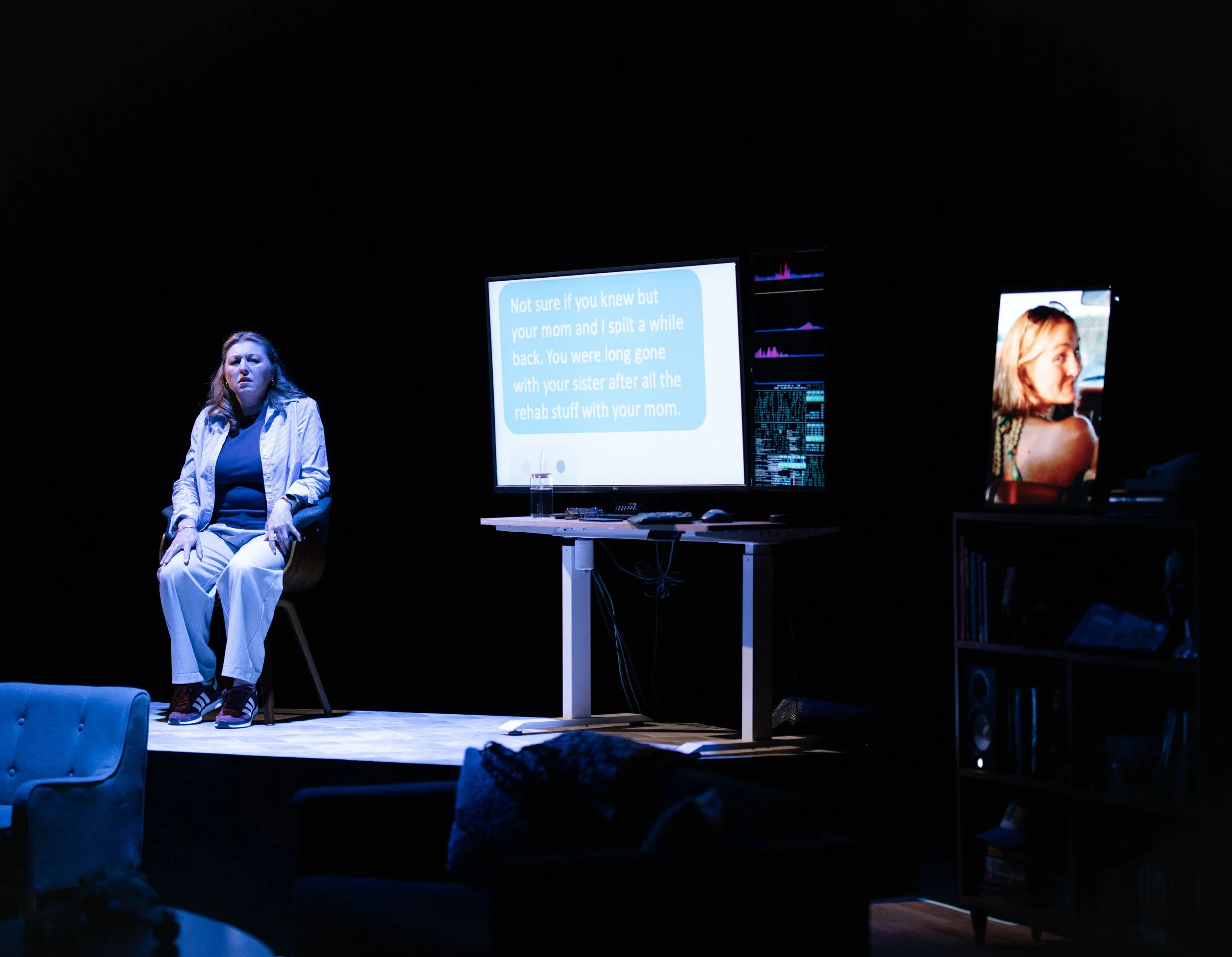
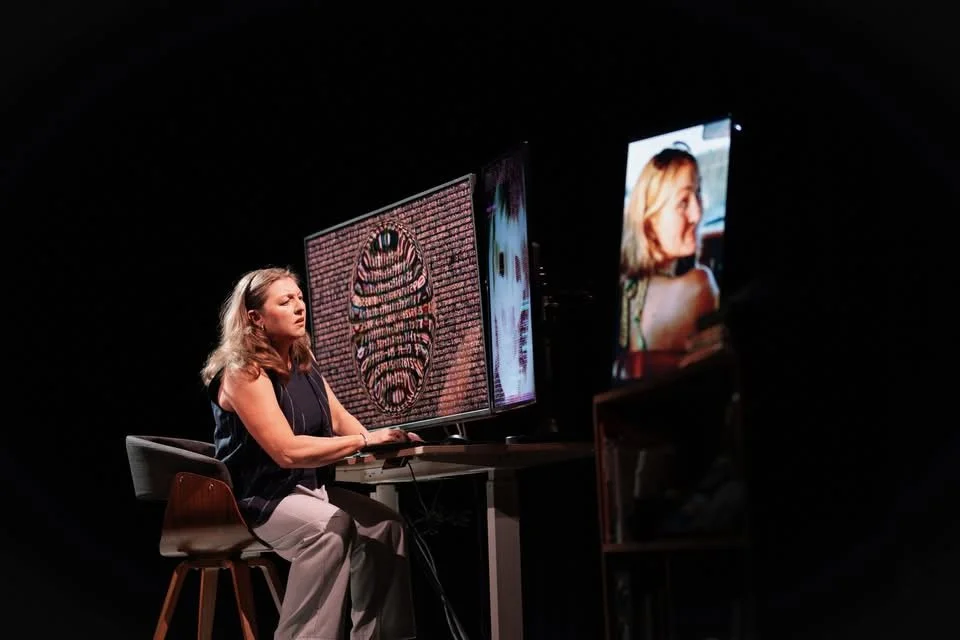
On the design side, Jennifer Matthews’ scenic work provides the framework for the production, and does so with a simplicity that puts the focus on the story and its characters, but it is Danny Powers’ multimedia design that truly elevates the realism of the world being presented. The technological aspects of the production feel authentic rather than theatrical, one example being the use of scrolling code across Merril’s oversized monitor while the AI-generated rendering of her late sister’s voice, and later her image, unfolds in real time. One especially effective touch is the visible audio equalizer that spikes dynamically whenever Merril or “Angie” speak, adding another layer of believability to the illusion. Danny also smartly avoids making the digital recreation too polished. The projected image of “Angie” carries a slight disconnect between the movement of her mouth and the words being spoken, a subtle but important reminder to the audience that the figure on the screen is not truly human, no matter how convincing Merril wants it to be. Complementing all of this is the precision of Jacob Viramontes’ lighting design and the tightly managed sound cues, allowing Merril to seemingly conjure or dismiss “Angie” with nothing more than the wave of a hand. Together, the technical elements create a seamless integration of humanity and technology that becomes essential to the production’s emotional impact.
As Merril, Amy Broomhall carries the immense responsibility of anchoring the production emotionally, intellectually, and dramatically. This is unquestionably Merril’s story, and therefore very much Amy’s show, with the success of the entire production resting squarely on her shoulders. Fortunately, Amy proves more than capable of handling that weight, delivering a performance that is simply superb. Merril is emotionally closed off and deep in mourning, but she is also intensely focused, intellectually driven, and more than a bit of an unapologetic nerd. As she blurs the lines between using artificial intelligence to soften her grief and using it to reconstruct pieces of her fractured family, the character becomes filled with contradictions and internal conflict. Amy navigates all of those layers beautifully, allowing Merril’s vulnerability, intelligence, awkwardness, and desperation to coexist naturally within the performance. She is endlessly compelling to watch. If there is one minor note, it comes in the form of the American accent Amy performs almost flawlessly throughout the production. There are occasional moments where traces of her native Australian accent emerge, but rather than detracting from the performance, those brief slips somehow make Merril feel even more endearing and human.
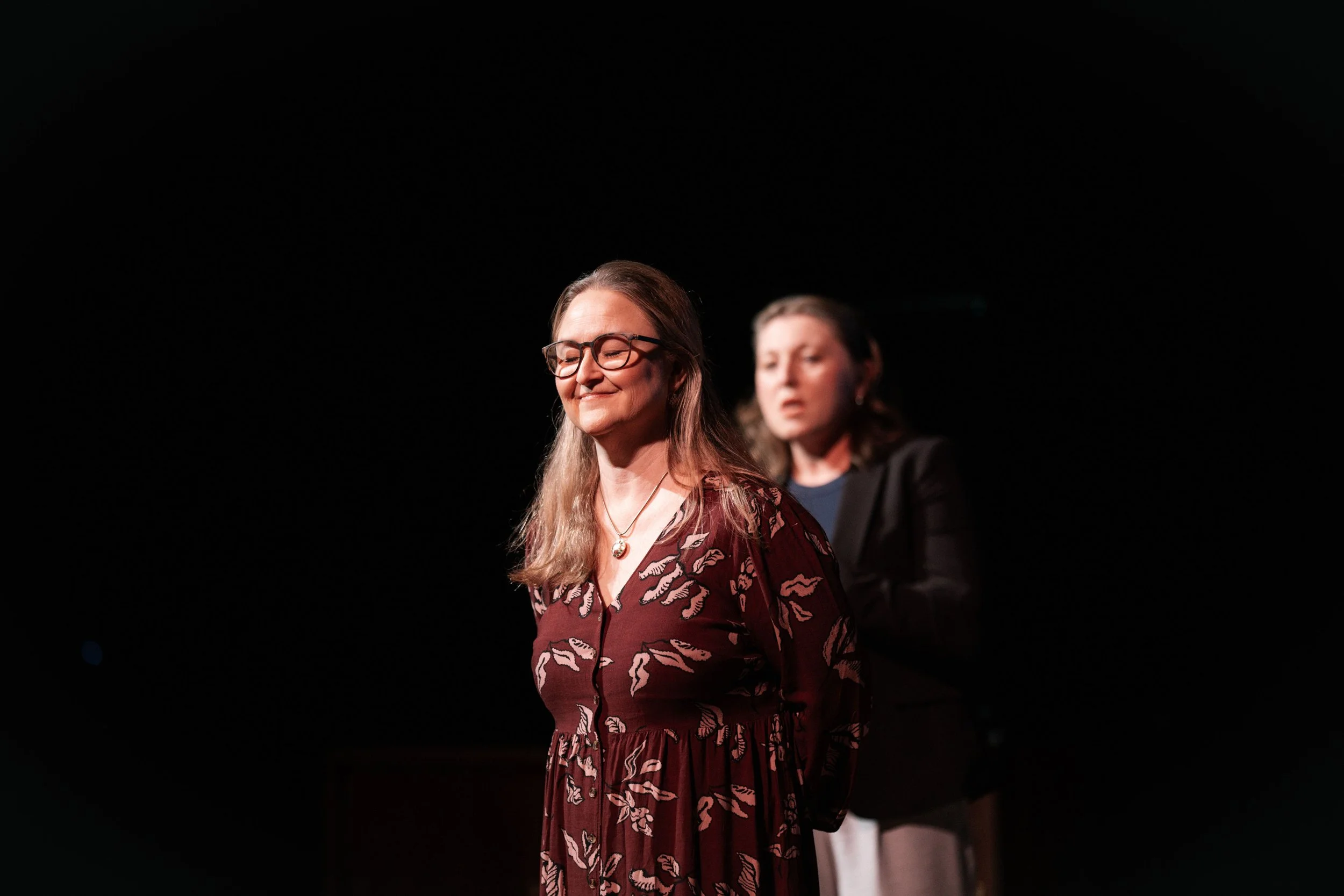
As Angie, and later as “Angie,” Kelly Godell delivers perhaps the most agile performance in the production, tasked not only with portraying a very real, emotionally grounded human being, but also an artificial recreation attempting to imitate that humanity. As the real Angie, Kelly gives an emotionally raw performance, one that at times is genuinely difficult to watch because of how exposed and honest it feels. There is pain underneath so much of what she does, but also exhaustion, love, and frustration, all balanced beautifully in a portrayal that never feels forced.
Then, as the AI-generated version of Merril’s sister, Kelly shifts completely. This “Angie” is joyful, thoughtful, patient, and kind, almost idealized in the way the reconstruction interacts with Merril. Yet what makes the performance so compelling is how the AI evolves over the course of the play. As more information is fed into the system, the replicant edges closer and closer to the real person, and Kelly carefully adjusts the performance to reflect that progression. The differences become subtler, the emotional responses more human, the cadence less artificial. It is an impressively controlled performance that helps clarify one of the play’s most unsettling ideas: that imitation can become convincing enough to blur emotional reality, even when everyone involved understands it is still, ultimately, only a reconstruction.
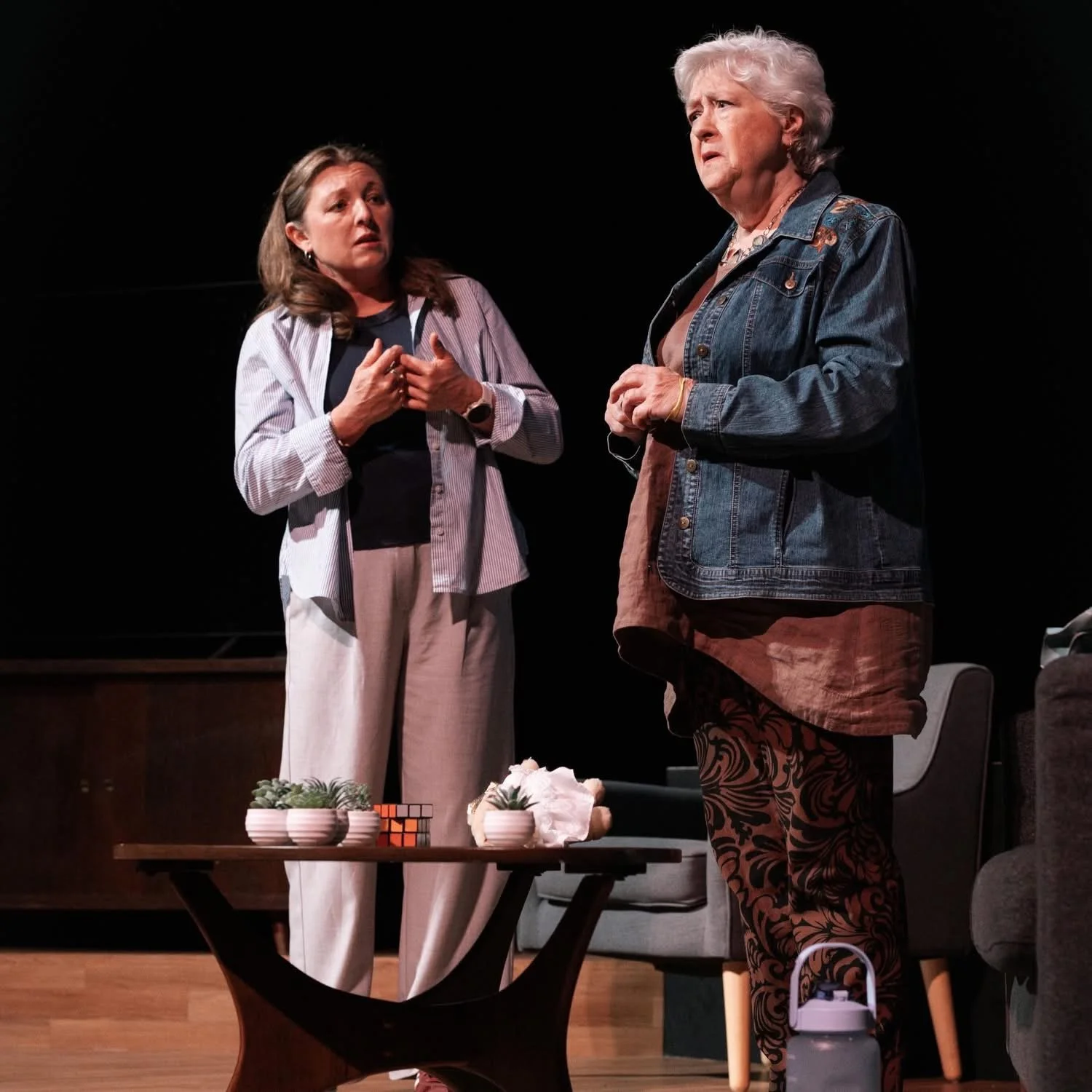
Holly Boaz’s Raquel serves as the intellectual counterpoint to Merril’s increasingly obsessive project, rooting the play’s larger philosophical questions in practical and emotional reality. As Merril’s ex, Raquel continually reminds her that this creation is exactly that, a creation, and that the life Merril appears to be building with what she considers her reconstructed sister is ultimately unsustainable. Holly brings both warmth and firmness to the role, never allowing Raquel to become cold or dismissive, even when challenging Merril’s choices. It is within the conversations between Holly and Amy that Lauren Gunderson’s deeper questions fully emerge, not simply whether artificial intelligence can replicate humanity, but whether emotional dependence on that replication ultimately helps people heal or traps them inside their grief.
As Brin, Merril and Angie’s former addict mother, Trish Cosgrove brings her own emotionally charged performance, portraying a woman desperately trying to distance herself from the failures of her past while slowly realizing that years of neglect cannot simply be undone with a single apology or action. There is a quiet heartbreak in the way Trish approaches the role, understanding that Brin’s attempts at repair come with the painful knowledge that some damage lingers no matter how genuine the effort to heal may be. Trish rounds out this small but mighty ensemble beautifully, a group that genuinely feels like a family on stage. There is a comfort and trust between the performers that allows the production to move with remarkable momentum, never letting its foot off the gas emotionally or intellectually.
One additional observation, and this is directed both toward future audience members and perhaps even those who attended Friday evening’s performance. Theatre is a shared experience between performers and audience, but it is not a one-way conversation. Actors feed off the energy in the room, and each performer in this production delivered moments worthy of applause throughout the evening, only to often be met with silence as scenes transitioned and the actors shifted positions for what came next. I would encourage audiences to allow themselves to react, to let these performers know their work is being felt and appreciated. Actors consider the audience part of the production itself, as essential as any design element or line of dialogue, and we as audience members have a responsibility to participate in that exchange of energy and emotion.
Drama Dock Theatre Company’s production of Anthropology works because it buys in to the play’s humanity. Beneath the conversations about artificial intelligence, data modeling, and digital reconstruction lies a story about grief, loneliness, forgiveness, and the desperate human desire to hold onto the people we love. Lauren Gunderson ultimately frames the play’s central truth through one simple but devastating idea repeated throughout the production: “People are unreplicable.” This cast and creative team understands that truth completely, delivering a production that is emotionally intelligent, technically impressive, and deeply affecting. By the end, Anthropology leaves the audience not thinking about technology, but thinking about the fragile, irreplaceable humanity that technology can imitate, but never truly replace.
The Drama Dock production of Lauren Gunderson’s Anthropology, runs for one weekend only, closing in May 24. For more information, including ticket availability and sales, visit https://www.dramadock.org/.
Photo credit: Rocketkar Photography