
Stage Review - Bedroom Farce (Tacoma Little Theatre)
Stage Review - Bedroom Farce
Presented By: Tacoma Little Theatre - Tacoma, WA
Show Run: July 10 - July 26, 2026
Date Reviewed: Friday, July 10, 2026 (Opening Night)
Run Time: 2 Hours (including at 15-minute intermission)
Reviewed by: Greg Heilman
Comedy as an art form is nothing if not subjective. What sends one audience into uncontrollable laughter may barely elicit a smile from another. Farce, however, operates by a different and unique set of rules. Rather than relying solely on jokes, it depends on precision. Timing becomes choreography, entrances and exits become part of the punchline, and the story builds momentum until the chaos becomes almost impossible to contain. Alan Ayckbourn’s Bedroom Farce, now on stage at Tacoma Little Theatre through July 26 in a production directed by Micheal O’Hara, takes a somewhat different approach. Rather than building its comedy through relentless momentum, it instead relies on recognizable relationships and sharply observed characters, creating a play that is often more interested in human behavior than outright mayhem.
First premiering in 1975, Bedroom Farce is one of more than 90 plays written by British playwright Alan Ayckbourn during a career spanning over six decades. Few dramatists have explored marriage and long-term relationships as extensively as Ayckbourn, whose work consistently finds humor in the misunderstandings, routines, and quiet absurdities of everyday life. While many farces are driven by increasingly outrageous situations, Bedroom Farce blends those familiar conventions with a more thoughtful examination of the people caught inside them. The bedroom itself becomes more than simply a location; it is the place where the couples are at their most comfortable, vulnerable, frustrated, and ultimately, most honest.
Set over the course of a single evening, the play follows four couples whose relationships become unexpectedly intertwined after couple Trevor and Susannah’s troubled marriage reaches what is implied to be another breaking point among a continuous series of them. Unable to cope with one another, the pair spends the night disrupting the homes of Trevor’s parents, Susannah’s friends, and another couple preparing their new home for a housewarming party. As the evening unfolds across three bedrooms, old wounds are reopened, long-established routines are exposed, and each couple is forced to confront what will either keep their own relationship together or pull it apart.
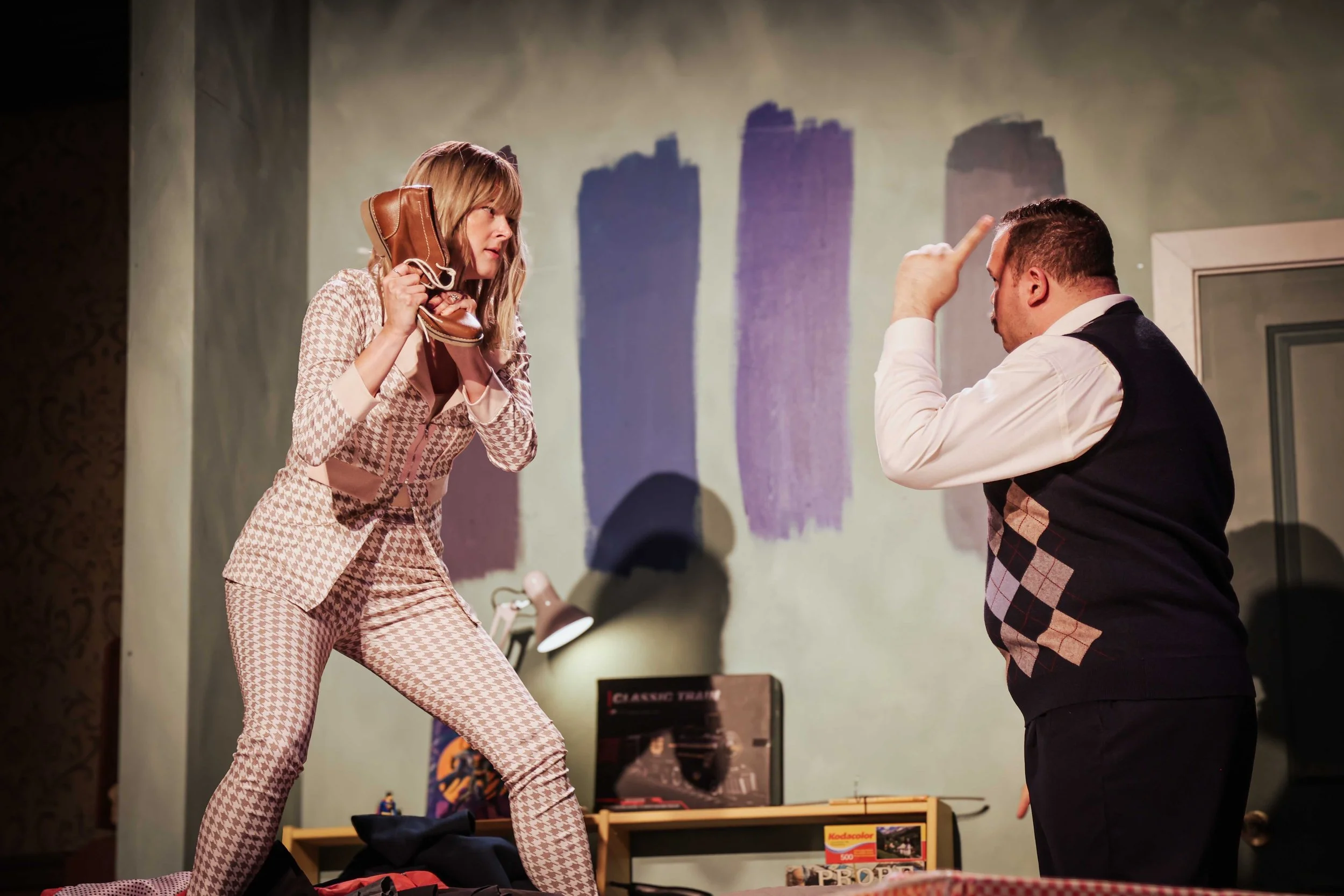
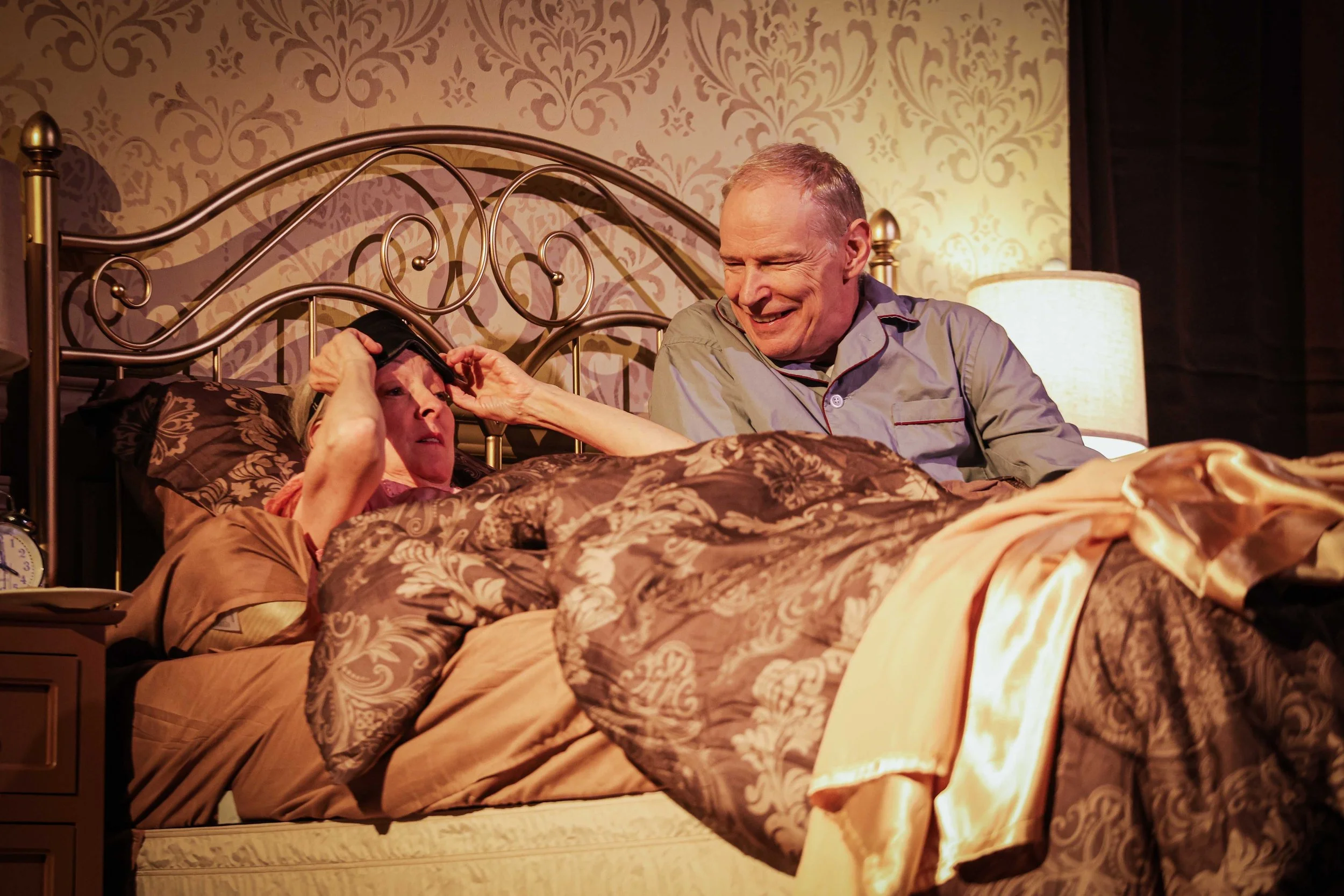
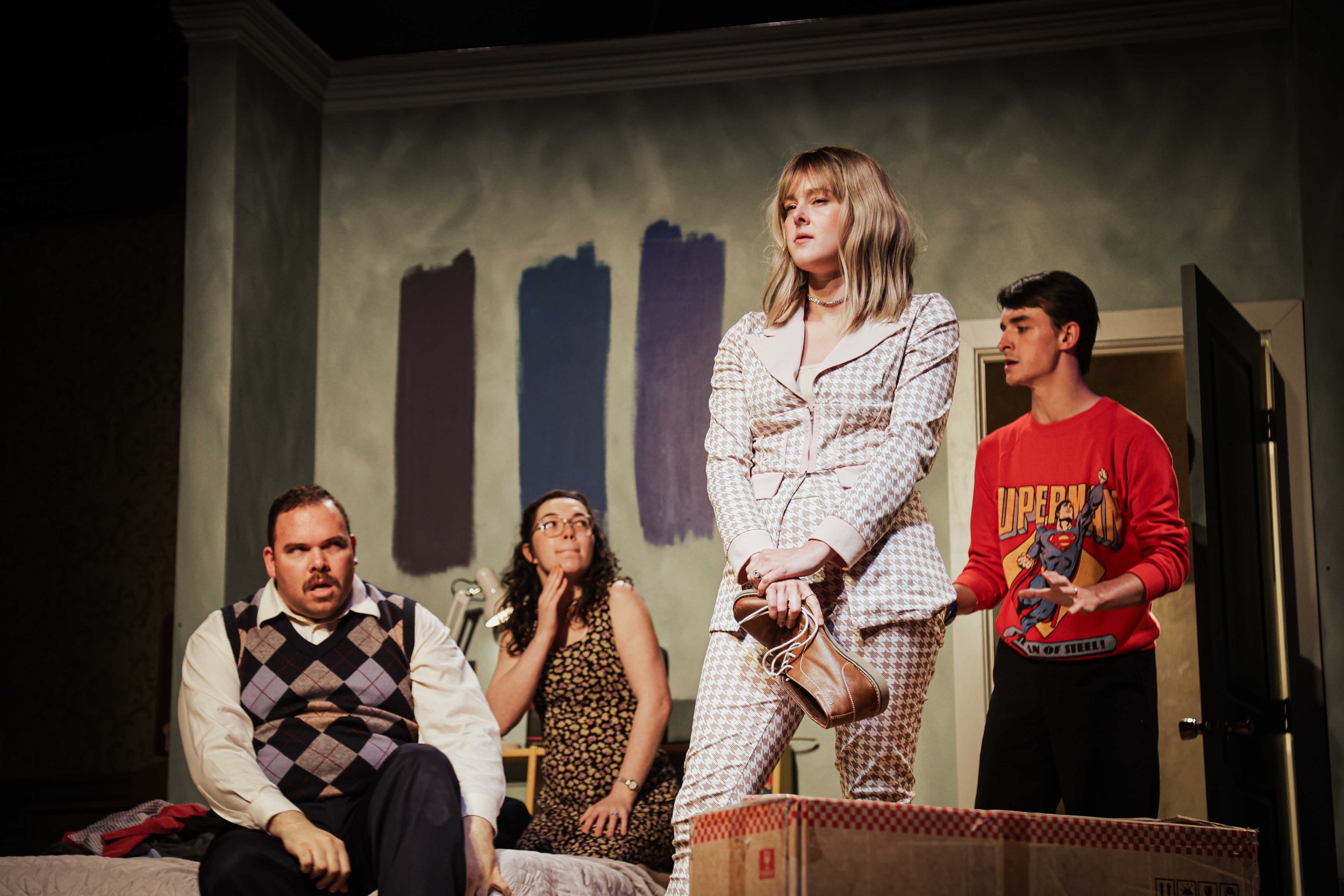
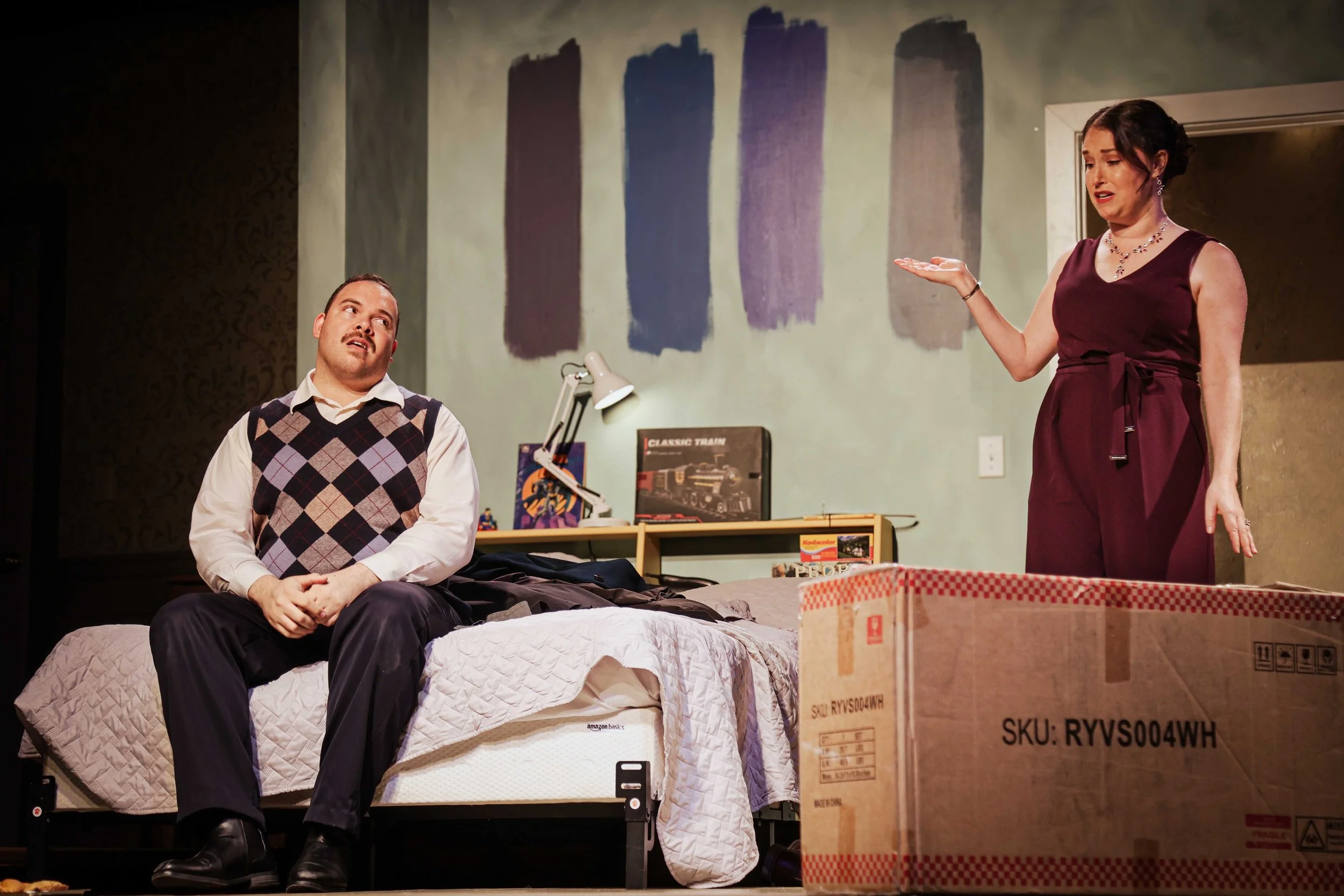
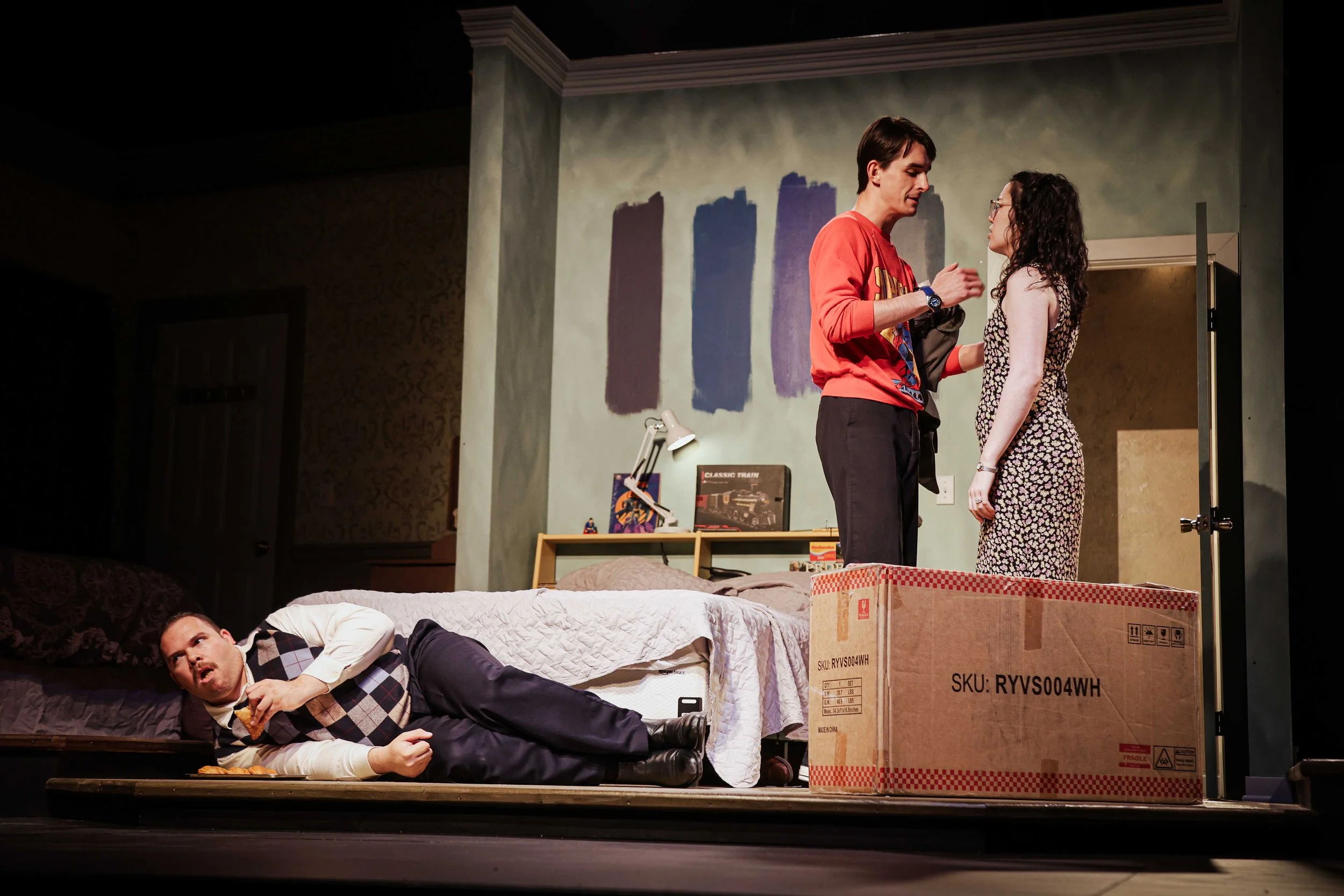
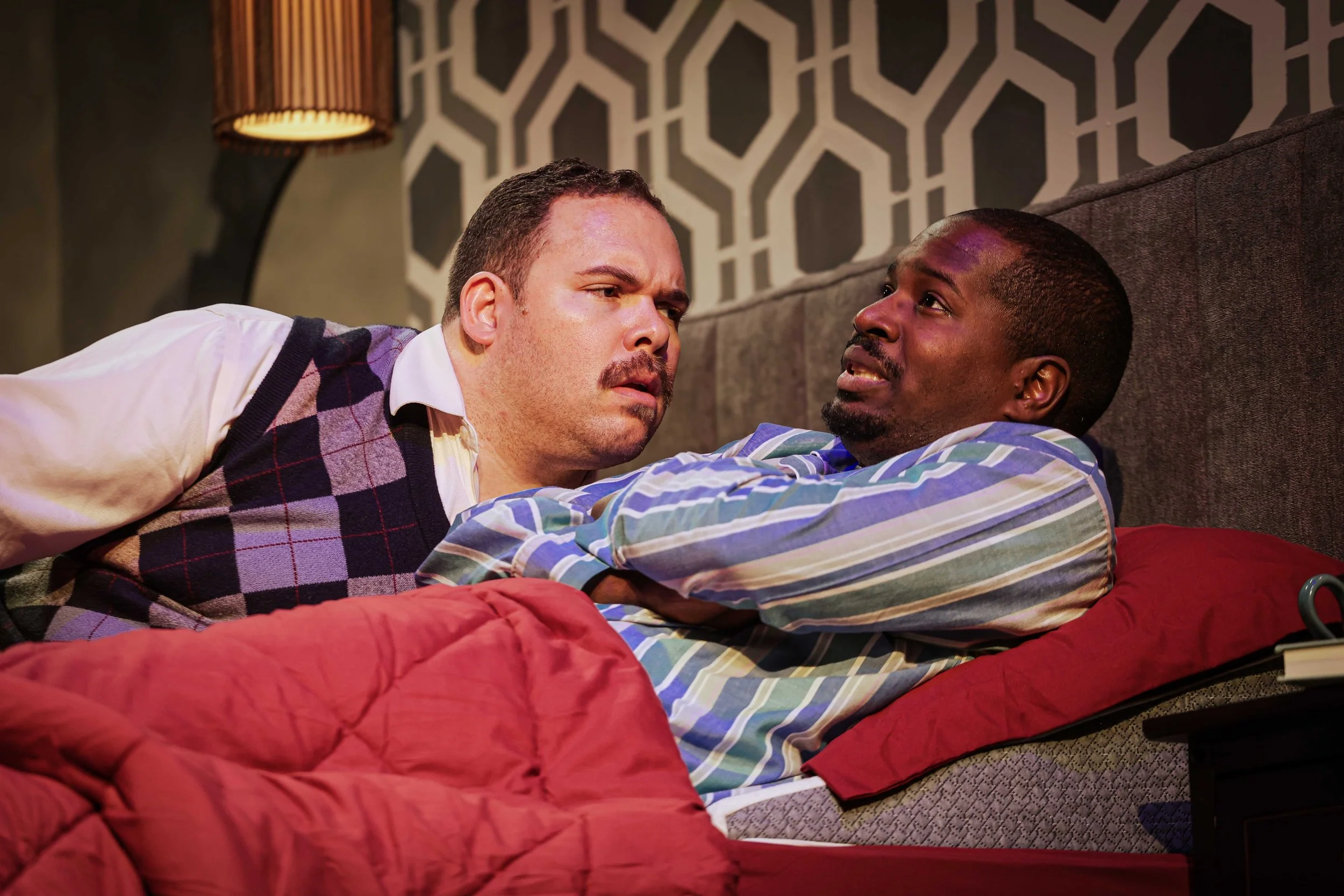
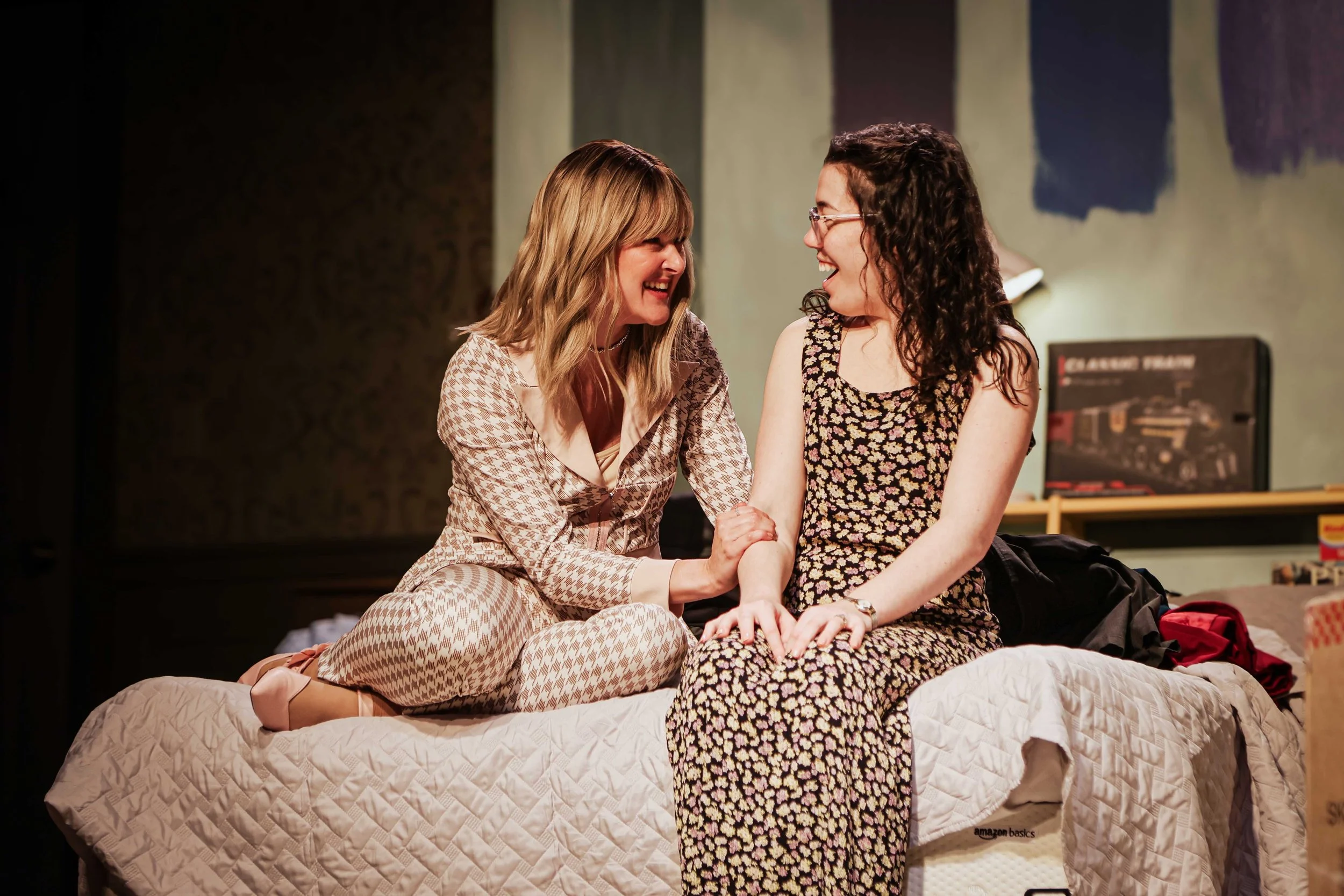
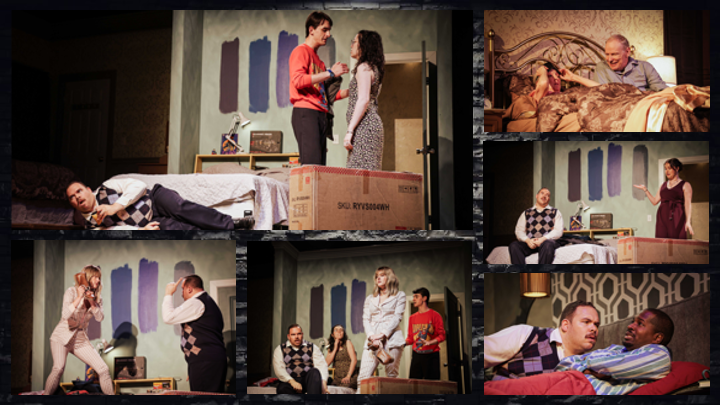
One of the production’s greatest strengths is Blake R. York’s scenic design, which places all three bedrooms on stage simultaneously. Rather than relying on scene changes, Blake allows the audience to watch the action move fluidly from room to room, keeping each location visible throughout the performance. Just as importantly, each bedroom reflects the personalities of the people who live there. Ernest and Delia’s room feels traditional and comfortable, Jan and Nick’s carries a more contemporary aesthetic, while Malcolm and Kate’s bedroom remains noticeably less established, subtly reinforcing where each relationship sits in life. Kristina Pertoni Lutteroth’s lighting design complements the scenic work beautifully, drawing the audience’s eye to the active bedroom while allowing the remaining spaces to quietly exist around it. Together, Blake and Kristina create a staging that makes what could easily become a confusing structure remarkably easy to follow.
Joshua Johnson’s properties deserve recognition as well. In a play where so much of the action depends on characters constantly moving from room to room, preparing for bed, retrieving forgotten items, and disrupting one another’s evenings, Joshua’s work quietly supports the storytelling without ever calling attention to itself. It is another example of a design team whose contributions allow the audience to focus entirely on the characters.
The dialect work is generally very good across the ensemble, with one notable exception. Kate and Malcolm speak without English accents, which in principle isn’t necessarily a bad thing. However, when those characters continue using distinctly British words and phrases while speaking with American accents, it creates an incongruent feeling that occasionally pulls them outside the world established by everyone else. Had the production chosen to localize portions of the dialogue to match that decision, the inconsistency likely would have been far less noticeable, though in truth a good performance without an accent works much better than a poor one with them, and Bil Nowicki and Athena Kalliora do a solid job of making up for their lack of dialects consistent with the others in the ensemble and the location of the play.
Additionally, as far as the cast is concerned, Brett Hunt demonstrates an excellent grasp of the mechanics of farce as Trevor. Brett understands that comedy often comes as much from movement as dialogue, and Trevor’s frantic desperation is conveyed through expressive physicality and confident comic timing. Even as Trevor spends much of the evening on the verge of emotional collapse, Brett ensures the character never becomes exhausting, instead remaining oddly sympathetic despite being the source of nearly everyone’s problems.
Vince Brady delivers one of the production’s strongest performances as Ernest. Much of Ernest’s humor isn’t found in individual punchlines but in the complete confidence with which Vince inhabits the role. His distinctive laugh, the relaxed way he wanders back into a room after forgetting something, and even the manner in which he simply occupies the stage each become consistently funny. These seemingly small choices accumulate into a wonderfully complete characterization that never feels manufactured. Opposite him, Sally Brady provides the perfect counterweight as Delia. Sally’s steadier, less exaggerated performance allows Ernest’s eccentricities to flourish while making their decades-long marriage feel authentic.
If there is a scene-stealer among an exceptionally balanced ensemble, it is Don Anderson II as Nick. Don possesses exceptional comic instincts, finding laughs through posture, facial expressions, perfectly timed reactions, and increasingly exasperated body language. His frustration builds naturally throughout the evening, and nearly every physical choice feels deliberate. It is a performance that understands one of comedy’s simplest truths: sometimes the funniest moments happen without anyone saying a word.
The remainder of the ensemble provides solid support throughout. Gina D. Grosso gives Jan a warmth that makes her one of the evening’s emotional anchors. The aforementioned Bil Nowicki finds several enjoyable moments as Malcolm despite the character’s more reserved demeanor, while Athena Kalliora brings sincerity to her Kate. Together, Bil and Athena effectively portray a couple whose quieter relationship offers a contrast to the turmoil surrounding them. Jordyn Konopaski effectively balances Susannah’s emotional volatility with enough vulnerability to prevent her from becoming simply abrasive. Overall, the ensemble establishes believable relationships that allow the comedy to emerge from recognizable human behavior rather than exaggerated caricature.
All of which brings me to my biggest reservation about Bedroom Farce, a reservation that ultimately lies not with Tacoma Little Theatre’s production but with the play itself. The title naturally creates certain expectations. Bedroom Farce certainly contains many of the elements commonly associated with the genre, but it rarely embraces the escalating chaos that defines the most successful farces. The improbable circumstances never become truly outrageous, mistaken identities exist only briefly rather than serving as the engine of the plot, and perhaps most notably, the pacing favors conversation over relentless motion. The greatest farces resemble perfectly choreographed machines, spinning faster and faster until they threaten to fly apart. Bedroom Farce is considerably more restrained. Ironically, it is the cast that supplies much of the rhythm traditionally associated with farce. Through sharp comic timing, expressive physicality, and a clear understanding of the genre, the performers create momentum that the script itself only occasionally demands. That restraint is not inherently a flaw, rather it appears to be exactly what Ayckbourn intended—but it does create an experience that feels different from what many audiences might anticipate from a play with “Farce” in its title.
Fortunately, Micheal recognizes exactly what kind of play he has and never attempts to force it into becoming something it isn’t. Instead, he trusts the relationships, Ayckbourn’s sharply observed dialogue, and a cast that consistently understands where the comedy lives. Laughter here comes less from impossibly tangled situations than from recognizable people navigating the everyday frustrations of marriage and long-term relationships.
With Bedroom Farce, Tacoma Little Theatre has developed a production that understands the strength of the ensemble, where each actor contributes a distinct piece to the play’s carefully constructed rhythm. And while, despite its name, it feels less a farce than other more well known in the genre, Director Micheal O’Hara has assembled something that reminds us comedy doesn’t always require outrageous situations to be effective. Sometimes the funniest moments come from watching ordinary people, in ordinary bedrooms, simply trying, and often failing, to understand the people they love most.
The Tacoma Little Theatre production of Bedroom Farce runs on stage through July 26. For more information, including ticket availability and sales, visit https://tacomalittletheatre.com/.
Photo credit: Dennis K. Photography