
Stage Review - Continuity (Blue Hour Theatre Group)
Stage Review - Continuity
Presented By: Blue Hour Theatre Group - Seattle, WA
Show Run: May 07 - May 23, 2026
Date Reviewed: Thursday, May 07, 2026 (Preview)
Run Time: 90 Minutes (no intermission)
Reviewed by: Greg Heilman
Continuity from Blue Hour Theatre Group, running on stage at 12th Avenue Arts through May 23 and directed by Greg LoProto, is a play that arrives wrapped in the language of filmmaking but quickly reveals itself to be something much more layered and introspective. Written by Bess Wohl as “a play in six takes,” the production follows a group of filmmakers attempting to create an environmentally conscious movie while simultaneously navigating the complicated realities of their own lives. What begins with an almost intentionally overdramatized approach to climate messaging gradually evolves into something more human, more conflicted, and far more interesting, a work less concerned with providing easy answers than with interrogating the tension between accuracy and entertainment, activism and commerce, and personal truth versus public messaging.
Bess Wohl certainly has a great deal to say, and with Continuity she attempts to pack as much of it as possible into a brisk 90 minutes. Here, she leverages the intersection of her work for both stage and screen to create a piece that examines the film industry’s role in addressing major social issues while simultaneously remaining beholden to corporate interests and shareholder expectations. At the same time, the play wrestles with the tension between truth and entertainment value, not just in cinema, but in storytelling as a whole. There are moments where Wohl perhaps tries to fit one too many ideas into the production, with certain topics feeling slightly shoehorned into the broader narrative, but for the most part she succeeds because the core message never gets lost amid the surrounding distractions. The script itself is sharp and thoughtfully constructed, with dialogue that feels natural and accessible while still engaging with difficult questions in an honest and thought-provoking way. And while the play frequently tempts the audience with optimism through its humor, it ultimately leaves the inevitability, or perhaps the uncertainty, of its conclusion for the audience itself to wrestle with.
One of the more compelling aspects of Wohl’s script is the way each successive “take” builds upon the last. Rather than simply revisiting the same material, the structure creates momentum, slowly peeling away layers from both the production process and the people involved in it. There is an accumulation of emotional weight as the audience begins to understand that every character is carrying something beneath the surface. The environmental themes remain central throughout, but the play wisely avoids reducing itself to a simplistic lecture. Instead, it explores how media shapes public perception, particularly around issues like climate change, and questions what happens when storytelling sacrifices complete accuracy in pursuit of accessibility or mass appeal. There is a fascinating undercurrent throughout about Hollywood itself, about the compromises artists make, the stories studios are willing to tell, and the idea that those who speak the loudest about change are not always the ones most willing to act.
Greg’s direction keeps the production moving with a cinematic rhythm that mirrors the script’s structure. The pacing is sharp, with transitions that maintain forward momentum while allowing the emotional revelations to land cleanly. What works especially well here is the balance between humor and sincerity. The production understands that the script’s comedy is essential, not just as relief, but as a mechanism for exposing the absurdities of the entertainment industry and the contradictions within the characters themselves. Greg allows those comedic moments room to land while at the same time never letting the production lose sight of the more personal struggles unfolding beneath the banter.
Among the cast, Valerie Ryan Miller stands out as Nicole/Eve, delivering a performance that captures both the performative nature of someone operating within Hollywood culture and the vulnerability beneath it. Nicole initially presents with the energy of someone who knows how to command a room, polished, confident, and at times intentionally theatrical, but Valerie gradually reveals the emotional fractures underneath that exterior. There is a purposeful quality to her delivery that works well for the character, particularly as the play begins examining the disconnect between image and authenticity. Her work becomes increasingly compelling as the emotional stakes rise and the façade starts to crack.
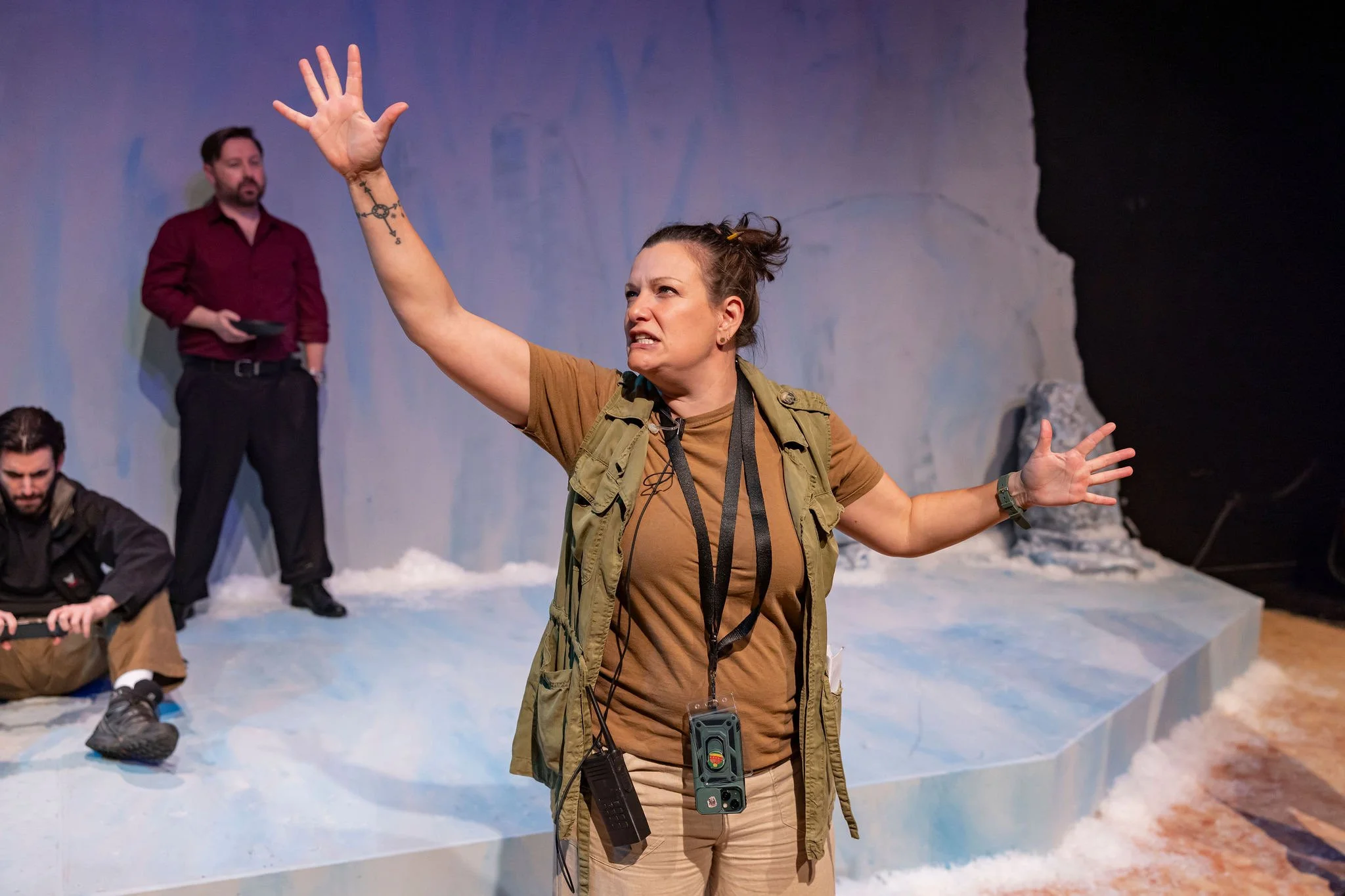
Skye Stafford’s Maria, the film’s director, provides a strong counterbalance to that energy. Maria operates with determination and focus, someone clearly trying to navigate both the machinery of filmmaking and the instability of the personalities around her. Skye gives the character an “all business” exterior that gradually opens into something far more complicated as the play unfolds. Maria is a director wrestling with the conflict between the importance of the messaging she originally wrote into the script and the need to land a blockbuster and the creative freedom doing so would bring her. Skye’s performance carries the weight of someone managing this conflict while also trying to hold both a production and herself together simultaneously, and she handles that progression with an expert hand and steady confidence.
For my money, Jeremy Radick’s David Caxton is the emotional standout of Continuity. David may initially come across as pompous or self-important, but Jeremy smartly avoids leaving the character trapped there. As the story progresses, David becomes surprisingly human, revealing fear, sadness, and vulnerability beneath the intellectual posturing. Jeremy’s work is strongest in those quieter moments where the bravado falls away and the audience gets a glimpse at the emotional cost the character has been carrying. The script gives David some of the production’s more emotionally exposed material, particularly surrounding illness and mortality, and Jeremy handles those shifts effectively, and quite impactfully.
In the category of “no role it too small”, is Bradley Goodwill and his character Larry, the science consultant on the film being made. Larry details what’s at stake in the film, and is on set to provide the perspective of scientific accuracy to the proceedings, but it’s in his observations and through his no nonsense delivery that set the plot, and the film, on its heels. Bradley is so good here, self-confident but easily bruised, mostly as a result of his prior experience and how people usually receive what he has to say. Bradley isn’t on stage as much as some of the other leads, but what he brings to the character is indispensable.
The ensemble cast, including Kevin Phillips, Tenille Manson, Britt Lael, Malik Cantú, Saffron Hefta-Gaub, and Brian Brooks, contributes strongly to the production’s sense of completeness, particularly in the way they operate as a functioning film crew rather than simply a collection of individual performances. There is an ease to the interactions and timing that helps sell the production’s behind-the-scenes environment, while the humor threaded throughout lands naturally because of the cast’s collective rhythm. The production benefits greatly from how well the ensemble understands the cumulative nature of the script, with each scene building upon the last in a way that continually deepens the audience’s understanding of both the story and the people inside it.
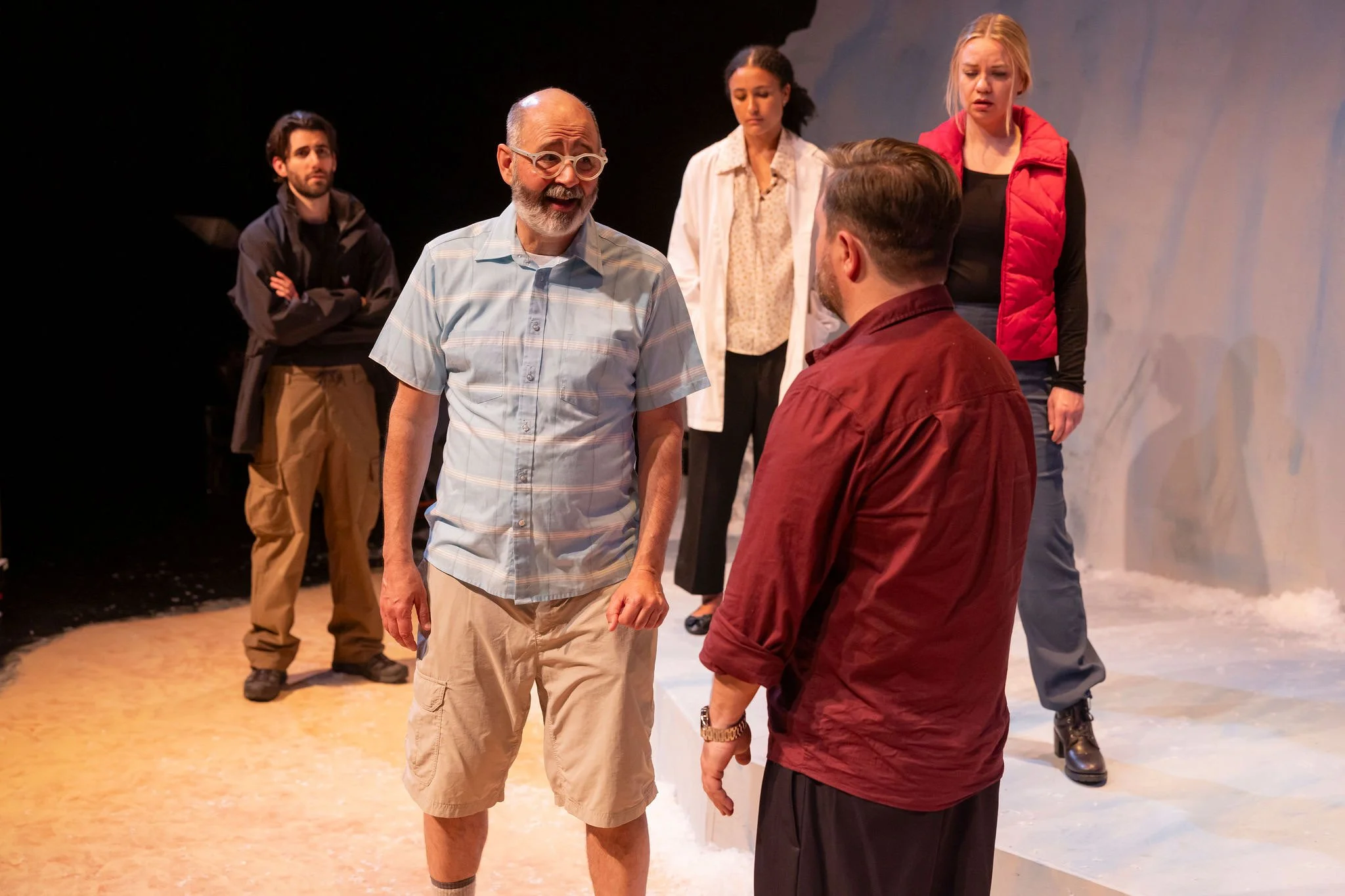
The design work supports the production effectively without overwhelming it. Luna Mock’s ice shelf set design is simply done and acts like a canvas against which the cast and other team members create an environment that weighs the practical realities of filmmaking against the more intimate emotional moments the script requires. Rae Collins’ costume design helps distinguish the personalities and professional identities within the ensemble, while Sequoia Good’s lighting design subtly reinforces the production’s cinematic structure, particularly during transitions between takes. Brian Brooks’ sound design helps ground the world of the play within the mechanics of filmmaking itself, while Cesar Trejo’s property design adds humor and authenticity throughout. Grace Helmcke’s dialect coaching, specifically with Tennille’s Dr. Anna Gerber character, also deserves recognition for maintaining consistency within this performance.
Blue Hour Theatre Group’s Continuity is effective because it resists easy cynicism. The play clearly recognizes the contradictions embedded within Hollywood activism, environmental messaging, and performative allyship, but it also acknowledges the human desire to create stories that matter. Even when the characters fail each other, compromise themselves, or lose sight of the message they claim to champion, the production never entirely dismisses the value of trying. Blue Hour Theatre Group’s production captures that tension well, presenting a work that is thoughtful, funny, occasionally messy by design, and ultimately interested less in perfect answers than in the complicated process of asking difficult questions.
The Blue Hour Theatre Group presentation of Continuity runs on stage at 12th Avenue Arts through May 23. For more information, including ticket availability and sales, visit https://www.bluehourtheatre.com/continuity.
Photo credit: Colin Madison Photography