
Stage Review - Escaped Alone (As If Theatre)
Stage Review – Escaped Alone
Presented By: As If Theatre – Kenmore, WA
Show Run: October 1 – October 18, 2026
Date Reviewed: October 2, 2026
Run Time: 60 minutes (no intermission)
Reviewed by: Anna Tatelman
What is the appropriate response to trauma and tragedy, for both ourselves and those around us? Is it kinder to give people spaceto process and grieve? Or is not speaking a refusal to help those who are suffering, whether they are across the world or right in our backyard? And even if we do speak, does that help anyone, or are we just shouting into a void? As If Theatre’s current production challenges us with these questions and more, but wisely avoids offering any tidy answers. Escaped Aloneexplores how hard humans work to maintain a façade of normalcy even when everything – both their own lives and the world around them – is crumbling. This production invites us into an alternate reality while being unafraid to show us the too-familiar similarities to our own world.
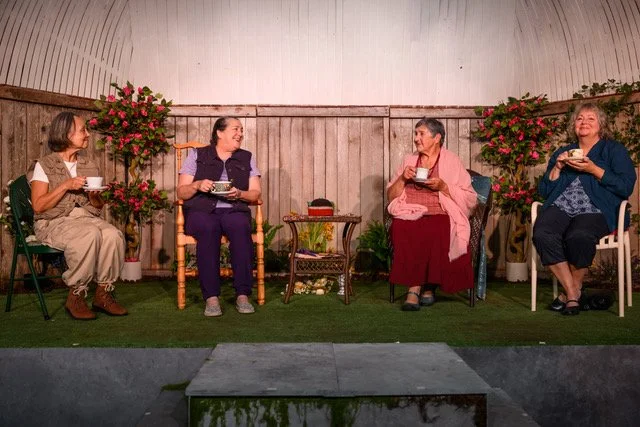
This Caryl Churchill play centers on four ‘women of a certain age’ having a garden tea party. Much of their chatter, at least initially, centers on mundanities: gossip about the neighbors, catalogues of errands, admiration of the flowers. But as the play goes on, the dialogue becomes more barbed, personal, andfraught with personal tensions, from struggles with mental illness to debate about if one of them is a murderer. Although the play has a realistic premise, Churchill’s dialogue often deliberately runs adjacent or parallel to, rather than trying to mimic, the way people talk. The women frequently speak withincomplete sentences or non-sequiturs, for instance, that -- rather than halting the conversation -- allow it to continue flowing.
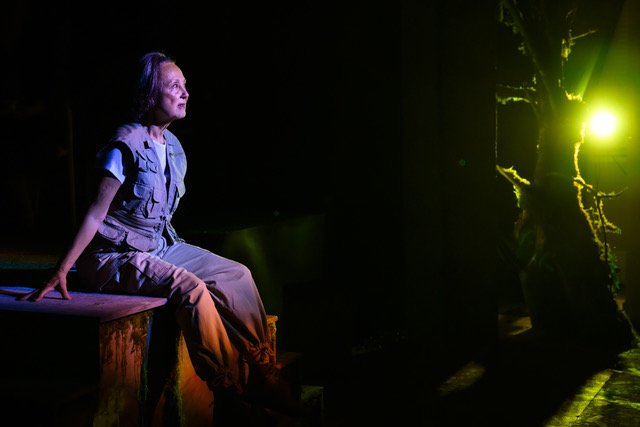
Interspliced with these afternoon tea sessions in the garden are monologues. While all the women get a chance to have their voice heard separate from the party chatter, most of the monologues are delivered by Mrs. Jarrett (played by Morgan Kellock). In careful, lurid detail, Mrs. Jarrett describes various global catastrophes, both man-made and natural, and the chilling repercussions these disasters wreck upon humans: how severed body parts crawl out from debris, or how people slice off fat from their own bodies to sell to those who are starving.
Suffice to say this is a complicated script, but this production team warmly accepts the challenge. Director Shana Bestock does a great job both establishing a rhythm to the unnaturalbanter and finding moments of slippage or rupture. When, for instance, Mrs. Jarrick essentially invites herself into the established friend circle, her own non-sequiturs – though seemingly not any more or less irrelevant than the other’s words – bring to a halt the otherwise seamless chatter. The unfinished thoughts also increase as the play goes on, the women cutting themselves off as if scared to voice the thought aloud (“It’s down now,” for example, or “Why can’t I just”). This is a testament to the strength of the ensemble, too, in their ability to move between talk that flows like a river and moments that shake with the buried fear of words unsaid. And all while doing believable British accents, no less!
Where I struggled a bit to make sense of the production was with the disaster monologues. I couldn’t tell if the disasters were imagined or (within the context of the show) real, if Mrs. Jarrick was greatly embellishing actual news stories in the style of the worst tabloid, or if she was outright making stories up. These monologues are delivered more like fables than news stories, with an edge of playful curiosity, as if trying to scare children into following a morality lesson. If the disasters are real, the monologues could be scarier to emphasize the contrast of the women focusing purely on tea and flowers while the world falls apart just outside the garden wall. If Mrs. Jarrick is imagining or embellishing them, it would have been useful to get a better sense as to why: does imagining the suffering of others make her feel more alive, perhaps, or happily shocked out of her own mundanities?
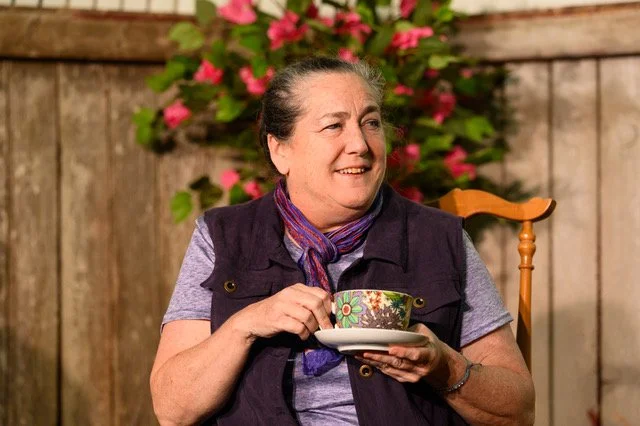
Nonetheless, this is a show with a strong quartet of female actors, and it’s refreshing to see a show that specifically centersa cast of all middle-aged women. Mary Machala plays Sally, our tea party host, and paints a sympathetic portrait of a woman starting to lose her memories without veering into the bathetic. Machala’s monologue is the standout solo moment of the evening. What could be in the wrong hands just a silly rantabout how much Sally hates cats becomes a tour de force filled with nuanced fluctuations between irritation, anger, and fear. It’s a monologue where Machala lets her character’s paranoiaunravel her before our eyes, exposing – beneath her vehement hatred of cats – a fragility that is unexpectedly both funny and heartbreaking in its relatability.
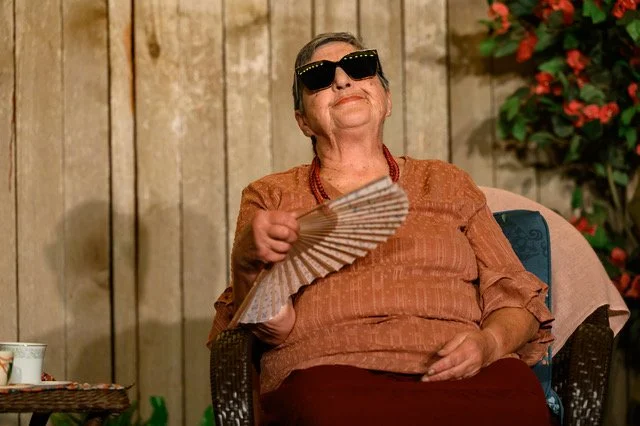
Portraying Vi is Erin Day, a woman who (without getting too far into spoiler territory) was “away” for six years. Day deftly avoids the subject of why she was away for much of the play, chattering lightly instead about needing a respite. When her secret is revealed and casts her in a morally dubious light, Day shows regret over not her actions, but at how it changes Sally’s view of her, a complex and unexpected emotional shift. Jennifer Nielsen plays Lena, the third friend. Like so much in the play, it’s never said explicitly, but Lena struggles with what could be depression, agoraphobia, or some other mental illness. Nielsen shows a woman more fidgety and spacey than the other longtime friends, someone who is more sensitive to the moments when the banter turns angrier and more fraught. Last but not least is Morgan Kellock as Mrs. Jarrett, the initial stranger to the group. Kellock does an admirable job as the interloper disrupting the space – first in obvious ways, such as her exclamations that no one responds to, but then in more subtle ways, as she probes the others to divulge the traumas and pains they otherwise keep buried.
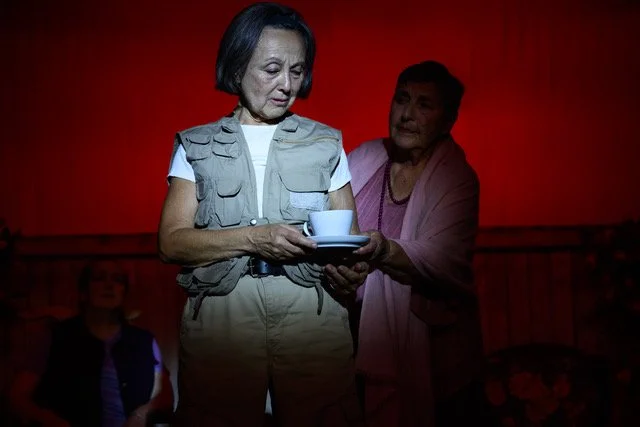
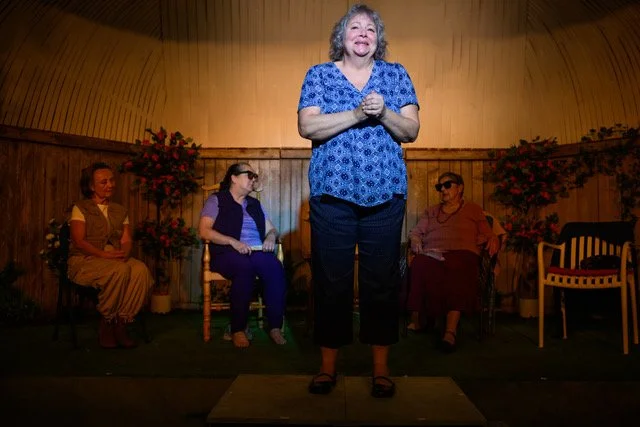
The production design elements smartly enhance the show’s key theme of ordinary life concealing horrible deeds and feelings. The set consists primarily of an idyllic garden rich with flourishing, colorful plants and invitingly cozy chairs, but off to the side sits one bent and withered tree on the verge of rot (set design by Chandria Danielle). Most of the show’s sounds are typical noises you’d expect outdoors, such as bugs buzzing or winds whispering, but eerily ethereal music creeps over the garden soundscape when the women deliver their monologues (sound design and original music by William French). During the banter scenes, the lights warm the stage with yellows. But the lights become more stark, or highlight the performers in hues of green or red, during the unsettling moments (lighting design by Gwyn Skone).
Watching As If Theatre’s Escaped Alone feels like being hugged and being throttled all at once. It’s both comforting to see the intimacy of others’ lives amidst their struggles and terrifying to be reminded of our own complacency to the world falling apart around us. If you’re looking for a show that asks the tough questions while allowing you to assemble the answers, a strong all-female ensemble, and thoughtful direction and design, it’s worth making the trek to Kenmore before this one closes.
Escaped Alone, presented by As If Theatre, runs on stage at Kenmore Community Center through October 18. For more information, including ticket availability and sales, visit https://asiftheatre.com/.
Photo credit: Christine Mitchell