
Stage Review - Fishbowl (BITLab / BPA)
Stage Review - Fishbowl
Presented By: Bainbridge Island Theatre Lab / Bainbridge Performing Arts - Bainbridge Island, WA
Show Run: February 20 - February 22, 2026
Date Reviewed: Thursday, February 19, 2026 (Preview Night)
Run Time: 90 minutes (plus a 15-minute intermission)
Reviewed by: Greg Heilman
New works thrive in spaces that allow them to breathe, and grow organically. The Sears Studio at Bainbridge Performing Arts has increasingly become one of those spaces, and with Fishbowl, a world premiere play by Catherine Rush, that environment proves essential—not just as a venue, but as an extension of the story itself. Directed by Christen Karle Muir and produced by Bainbridge Island Theatre Lab as part of BPA’s Studio Series, the premiere of this engaging and provocative play runs through February 22.
The Studio Series itself has become an increasingly important part of BPA’s programming, offering a platform for smaller, more intimate productions developed in collaboration with local artists and companies. Designed to complement the larger Mainstage offerings, the series provides space, resources, and support for new and emerging work, making it an ideal home for a premiere like Fishbowl. That collaborative spirit is on full display here, and it’s not the first time that BitLAB, as it’s known—a collective dedicated to developing new work by Northwest playwrights—has taken advantage of what BPA and this space has to offer.
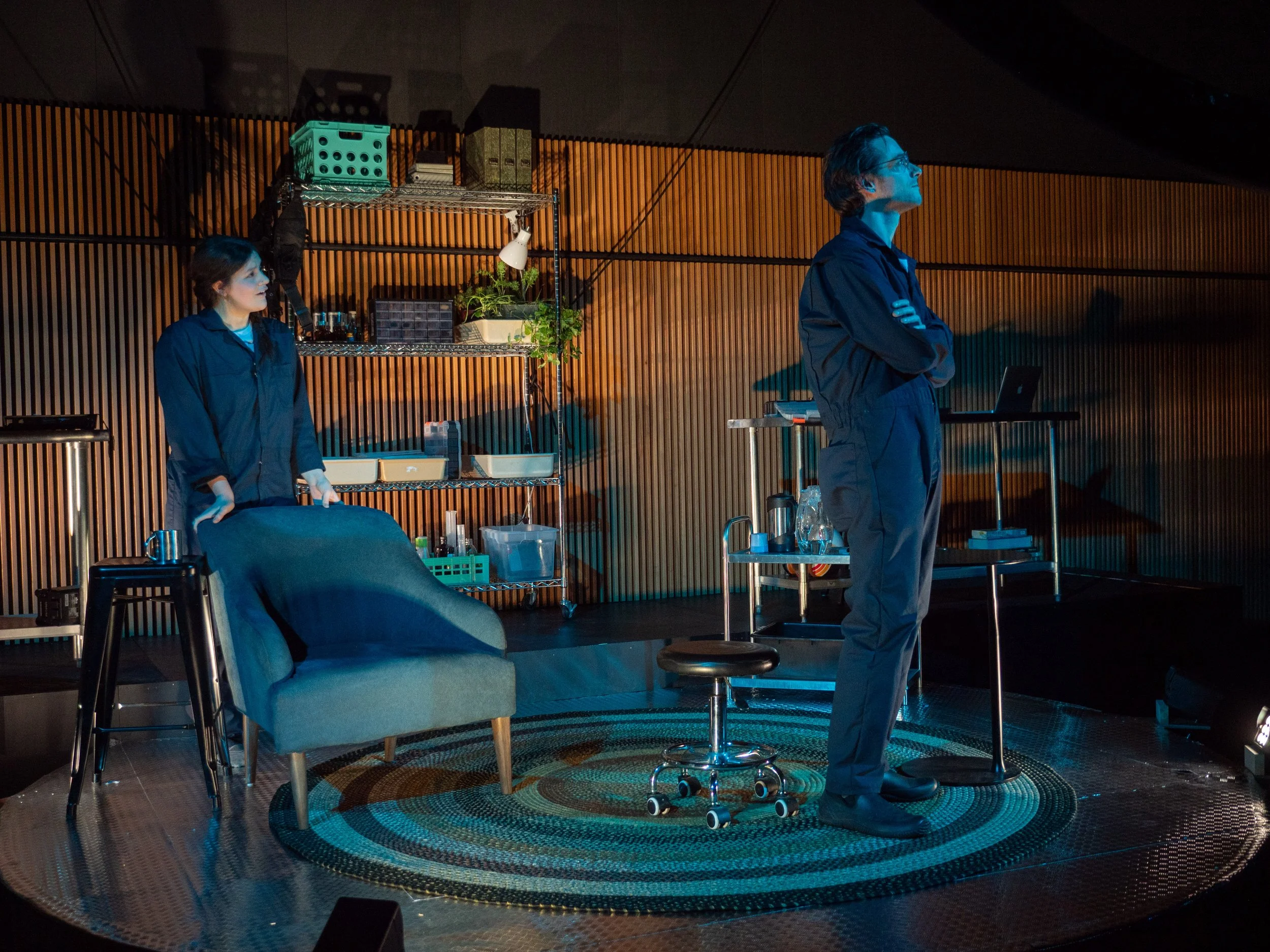
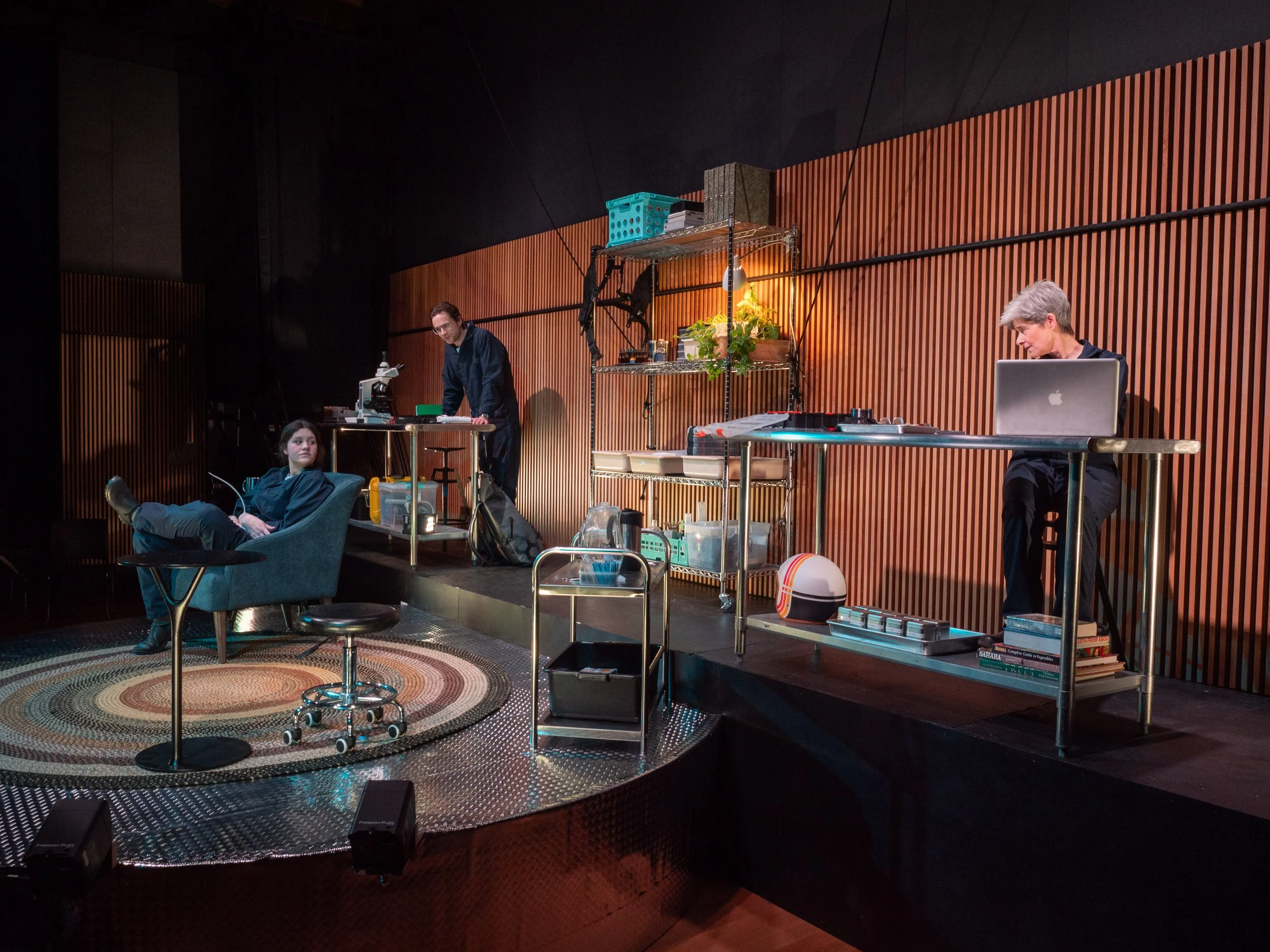
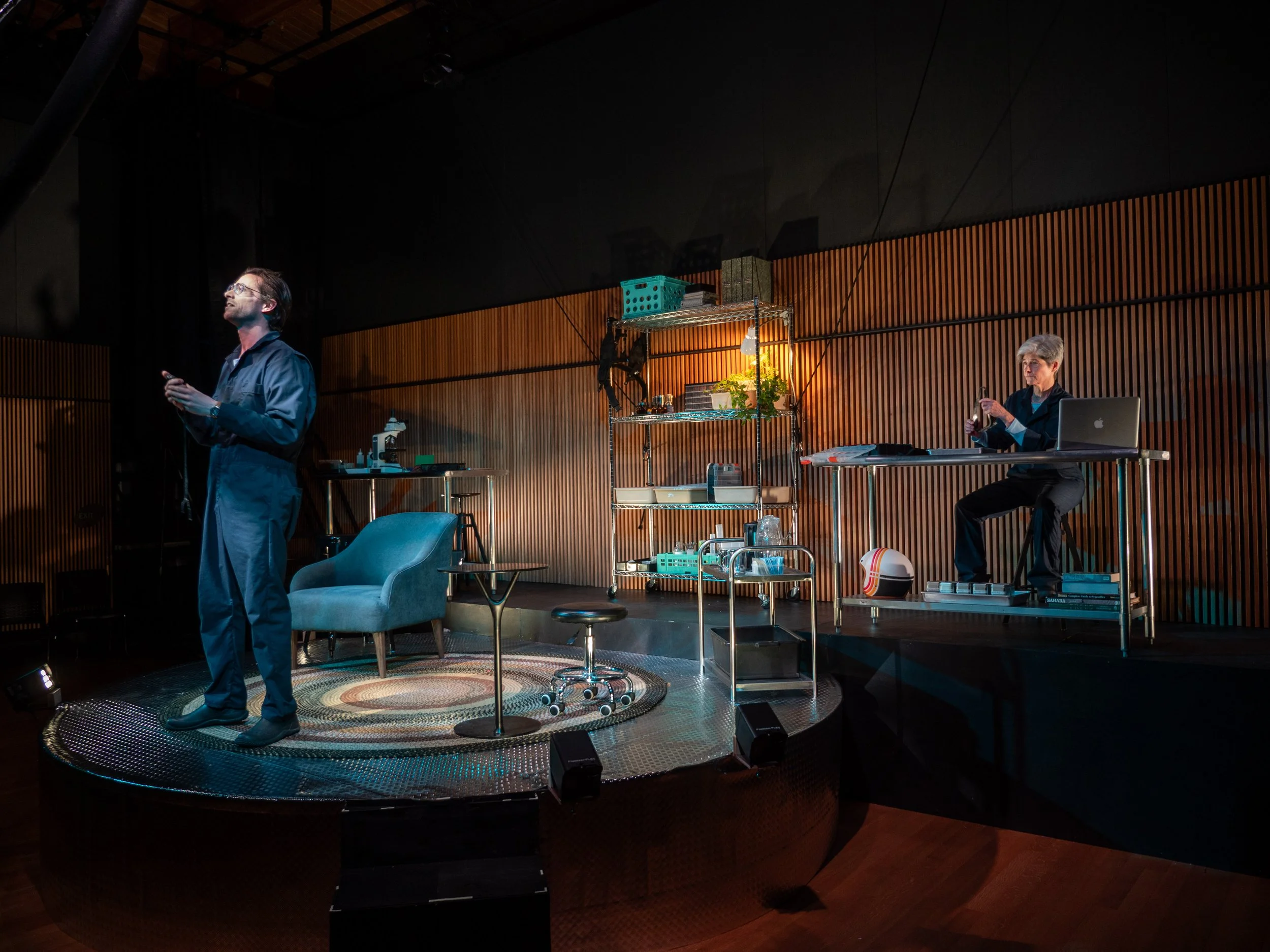
Before a single line of dialogue is spoken in Fishbowl, the world of the play is already in motion. As the audience filters into the Sears Studio, blue light drifts across the space like a slow-moving current, paired with the low hum of aquatic sound. Christen Karle Muir’s scenic design, alongside Eli Backer’s lighting and sound work, transforms the studio into an underwater research facility. It’s immersive in a way that feels both controlled and quietly unsettling, an appropriate tone for a story rooted in science, isolation, and the unknown.
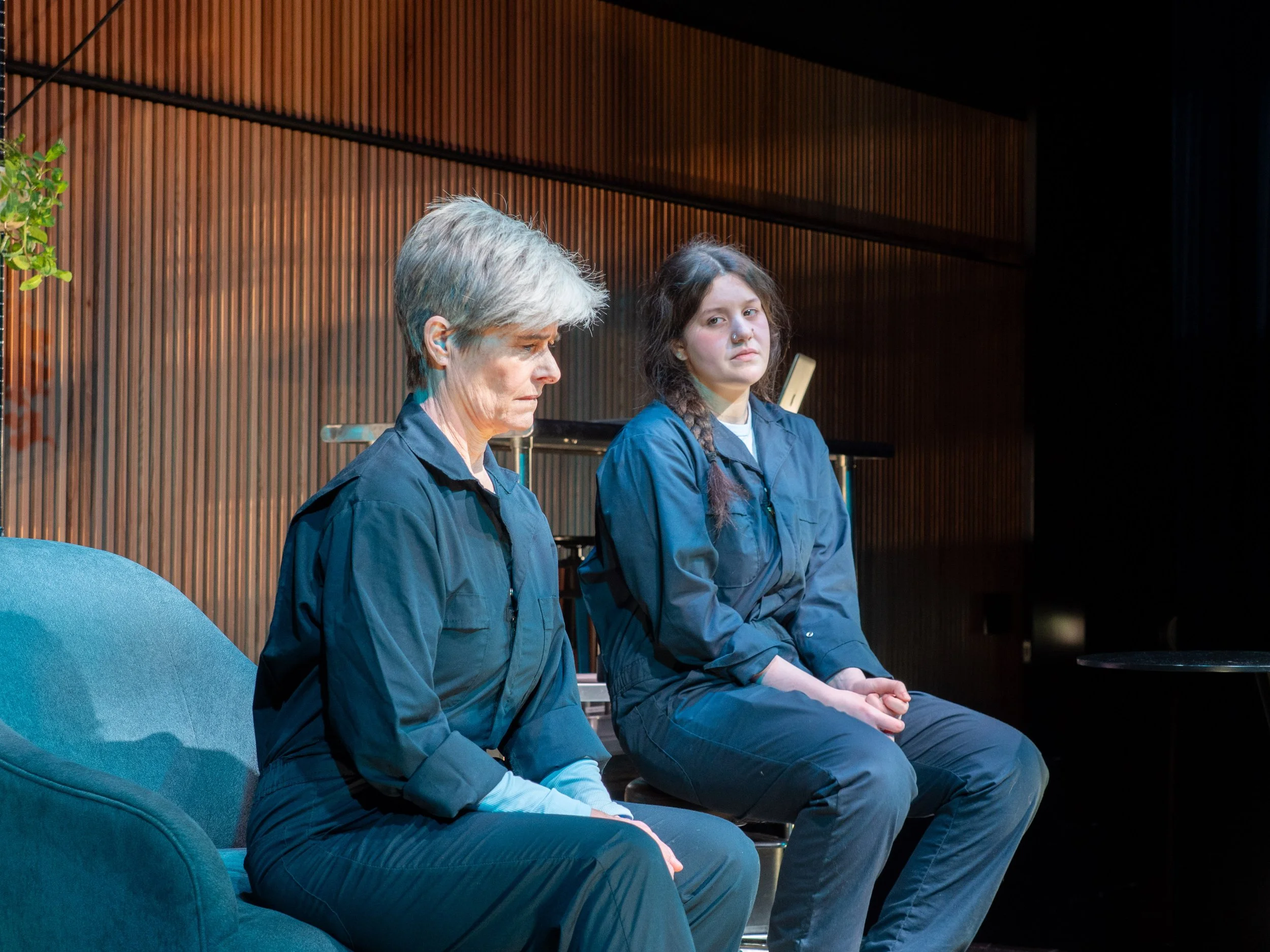
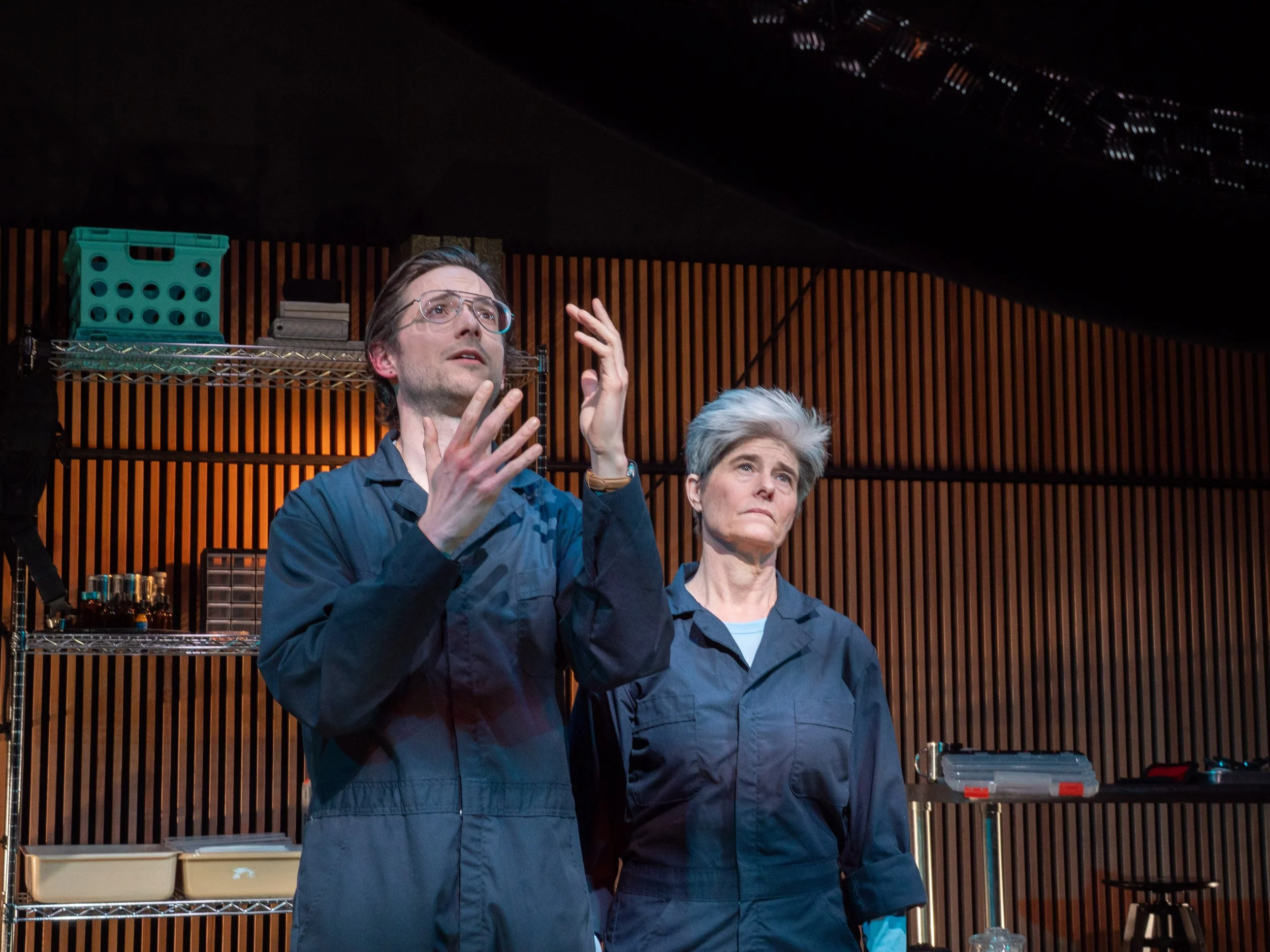
Catherine’s play centers on a team working within Robertson Oceanic Technologies—ROT—observing marine life through a viewing portal known as “The Eye.” At the heart of the story is Dr. Kendra Swope (Catherine Rush, the playwright wearing many hats here), a scientist whose approach to her work is methodical, pragmatic, and at times deeply cynical. Opposite her is Dr. Mike Coleman (Matt Alder), whose curiosity and enthusiasm push him toward something more speculative, even hopeful. When Mike becomes convinced that a fish he’s named Pippi is communicating with him, the divide between empirical science and emotional interpretation becomes the play’s central tension and the interplay between Catherine and Matt drive much of the tension it causes in Act 1.
As the narrative unfolds, complications mount: an ecoterrorist threatens the project, the corporation behind the work tightens its grip, and Kendra is forced to confront not just the limits of science, but the limits of her own understanding of connection and humanity.
That tension extends beyond the lab. The presence of C. Robertson (Ava McCallum), the conflicted and increasingly troubled child of the company’s leader, complicates the narrative in deeply human ways. Ava brings a compelling unpredictability to C, presenting a character that teeters between control and unraveling while maintaining a clear and consistent internal logic. Her performance adds an emotional texture that contrasts effectively with the more clinical environment of the research station.
Mel Carson’s contribution as Daichi Robertson is delivered entirely offstage, his voice serving as a constant presence that reinforces both the corporate authority and emotional distance of the character. Alongside the voice work from Rachel Noll James and Julia Bryce, these elements help expand the world beyond the confines of the station—and the script leans further into those moments to clarify the broader context.
Catherine’s writing brings a strong conceptual framework to Fishbowl, leaning into the intersection of science and humanity while crafting a narrative that asks difficult questions without rushing to answer them. Does scientific rigor inevitably lead to cynicism? Is there room for hope in a field that often confronts the limits of what can be saved? And perhaps most poignantly, how do we define our relationships—to each other, to our work, and to ourselves—when the systems around us begin to fail?
Those questions come into sharper focus in Act 2, where the play finds its strongest footing. A particularly effective sequence uses overlapping dialogue and fractured staging to reflect the unraveling of both the mission and the relationships at its core. The evolving dynamic between C and Kendra culminates in a quietly powerful scene that reveals the emotional undercurrents driving both characters, anchoring the play’s larger themes in something deeply personal.
From a design standpoint, the production is largely successful in supporting that storytelling. The use of lighting and sound to build tension is especially effective, and Meloni Courtway’s costuming—functional jumpsuits bearing the Robertson logo—helps reinforce the corporate uniformity of the environment. There are, however, a few moments where staging and presentation work against visibility. Despite the elevated playing space, sightlines can be a challenge when actors move to the floor level of the station, making it difficult for portions of the audience to fully engage with those moments. Similarly, there are instances where props inadvertently obscure the action; early in Act 2, for example, a laptop placed on the table blocks the view of Mike while he is seated, limiting visibility for some audience members. A small but noticeable detail also emerges in the world-building: BPA’s event materials expand ROT as Robertson Oceananographic Technologies, while the jumpsuits worn onstage read Robertson Oceanic Technologies—an inconsistency that stands out in an otherwise carefully constructed environment.
Still, what lingers most after Fishbowl is not any one design element or performance, but the questions it leaves behind. In a world where the systems we rely on—environmental, scientific, even interpersonal—feel increasingly fragile, Catherine’s play resists easy answers. Instead, it invites us to sit with the uncertainty, to consider whether progress and empathy can coexist, and to ask what it means to truly understand one another. In that way, Fishbowl becomes less about the mysteries beneath the surface of the ocean and more about the ones within ourselves—and whether we are willing to face them.
Fishbowl, the new play from Catherine Rush , is the latest in Bainbridge Performing Arts’ Studio Series, and runs on stage through Sunday, February 22. The run is sold out, but to get more information on BPA, including upcoming shows, visit https://www.bainbridgeperformingarts.org/.
Photo credit: Matt Longmire