
Stage Review - Gaza: The Silence Shouts
Presented By: Dunya Productions - Seattle, WA
Show Run: November 12 - November 21, 2026
Date Reviewed: Friday, November 13, 2026 (Opening Weekend)
Run Time: 80 Minutes (no intermission)
Reviewed by: Greg Heilman
It’s safe to sat that there is nothing quite like Dunya Productions’ Gaza: The Silence Shouts onstage in the area right now. The world premiere of Khaled Alostath’s first published play, directed by Hanna Eady, runs November 12–21 at Cherry Street Village in Seattle. It’s a piece that asks its audiences to spend time with people whose lives most of us encounter only in fragments through news coverage. The stories include a sister in Seattle and her calls with relatives in Gaza who have been repeatedly forced to leave their home, three men who weigh whether to leave during a ceasefire, and other caught trying to navigate their way in a post-occupation world. Some of what the production asks the audience to sit with is hard to watch, and it should be, but it’s also brilliant in how Alostath’s play, stories from the community, live music, and dance give form to the pain, fear, and conflict of those experiences, and to the hope the characters carry through them.
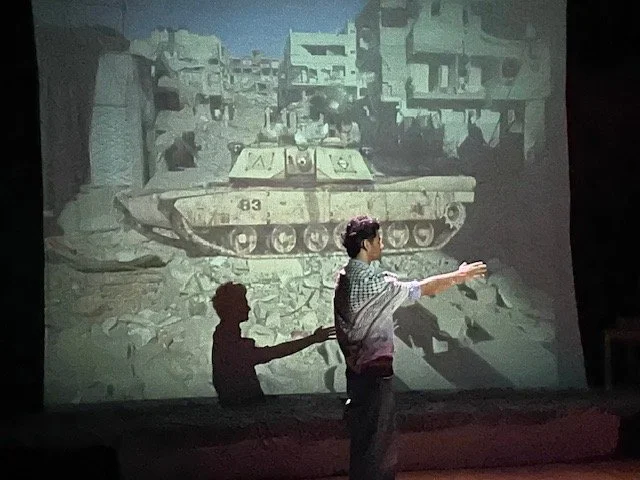
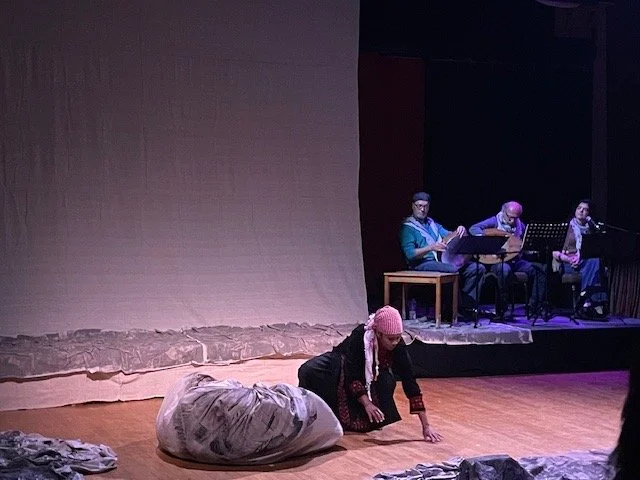
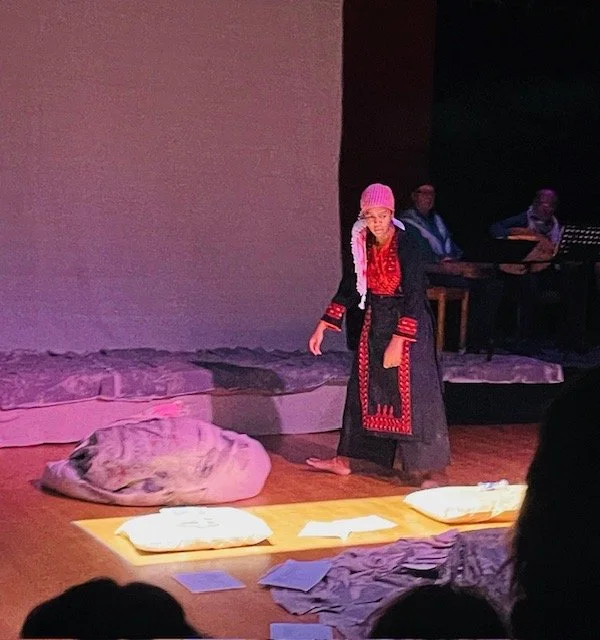
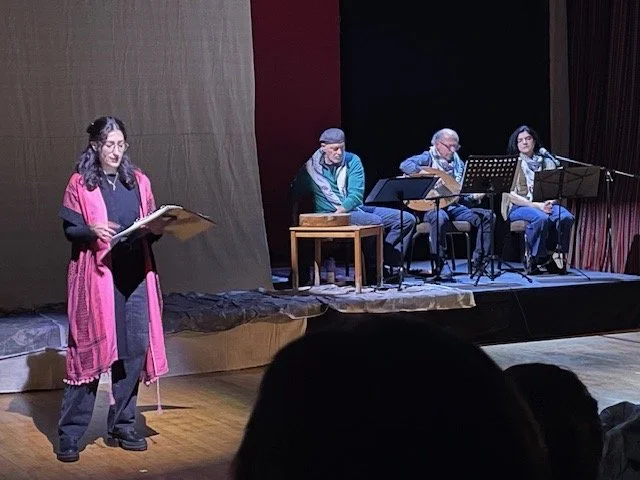
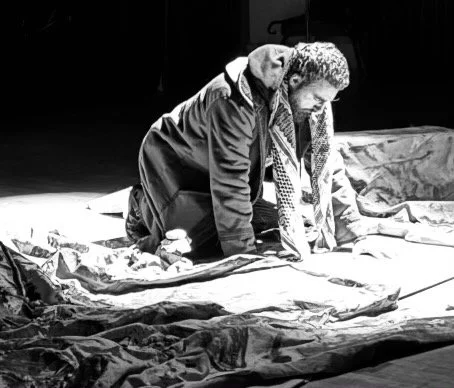
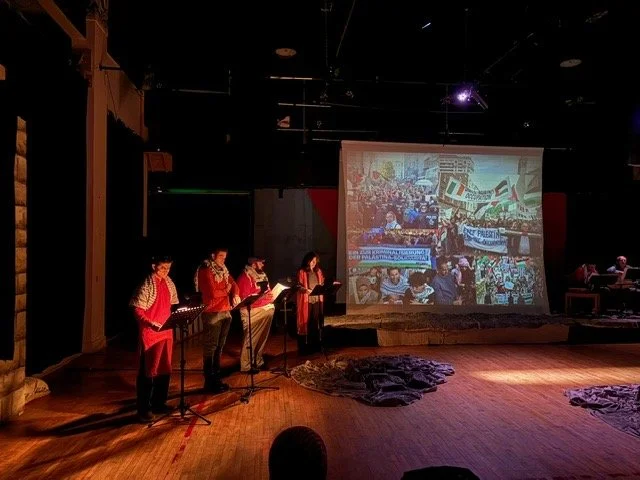
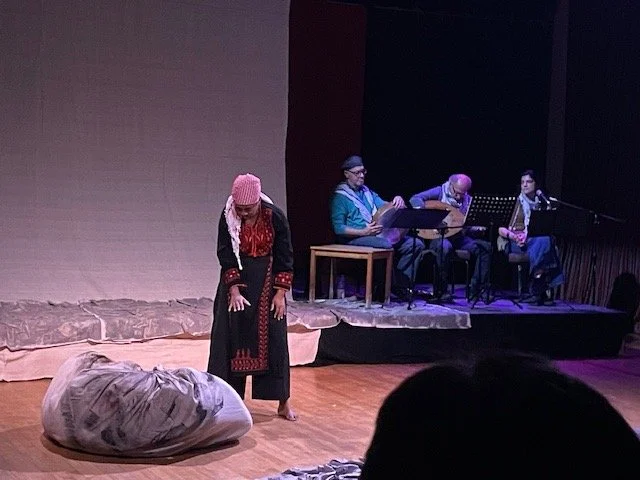
The room itself at Cherry Street Village is intimate enough that the blue-gray blankets spread across the hardwood floor reach nearly to the front row, bringing the audience directly into these stories. Warm bulbs hang among the exposed pipes and lighting instruments overhead, and music stands line either side of the open playing area. At the back, a large off-white cloth hangs above a low platform and serves as the surface for Leo Mayberry’s projections. The rumpled blankets cover pieces of the set that come into use as the story unfolds. Before the audience sees what’s beneath them, a barefoot woman enters carrying a large bag.
Dancer and choreographer Nia-Amina Minor takes pillows from the bag and places objects on them, one at a time. There’s pain in the deliberateness of her movements, in the way she handles each object and gives it a place. Intisaar Jubran’s vocals are beautiful and haunting, and the live music, with Hanna on oud and George Kassis on tablah and riq, gives Nia-Amina’s movement even more context. The bag itself takes on greater significance as the stories unfold. Each time people are told to leave, they have to work out how much of their lives they can physically carry in sacks. What Nia-Amina does in those first minutes gives that calculation a physical weight before the audience hears anyone describe it.
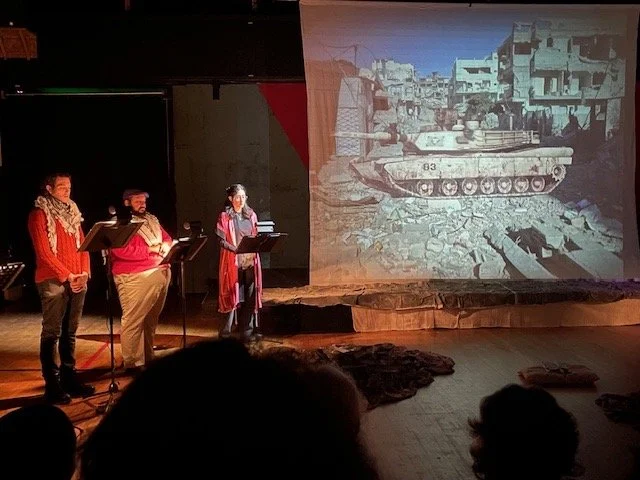
Alostath’s play is joined by texts from other writers in Gaza, arranged by dramaturg Edward Mast. Hanna gives the words a physical life of their own. With eight performers in two groups of four flanking the playing area, he creates what amounts to a choreography of words. A sentence can begin on one side and finish on the other, and the audience follows it across the room even when the actors themselves are standing still. The handoffs are so precisely timed that the thought holds together as its voice changes. When all eight come together on a particularly hard word or phrase, the force of hearing it in unison catches the ear and drives home the emotion behind it. The group performing these stories is multiethnic, including Palestinian and Egyptian actors, and there’s a remarkable sense of how closely these eight listen to one another, work together, and invest together emotionally.
Hanna is equally precise about when to let an image or a sound take over. Tom Wiseley’s lighting directs the eye across the open space, and the sound, operated by stage manager Amy Bogaard, can startle or work quietly beneath a scene. Leo’s projections are timed to the drama, and though each of them are part of a larger set of hard truths, one image in particular has stayed with me. Among the images of soldiers, a tank, and a home that once stood, are children carrying a toy the way they might carry a dead body. The way they hold it tells its own story, a story of a normalized life that no child should ever have to experience.
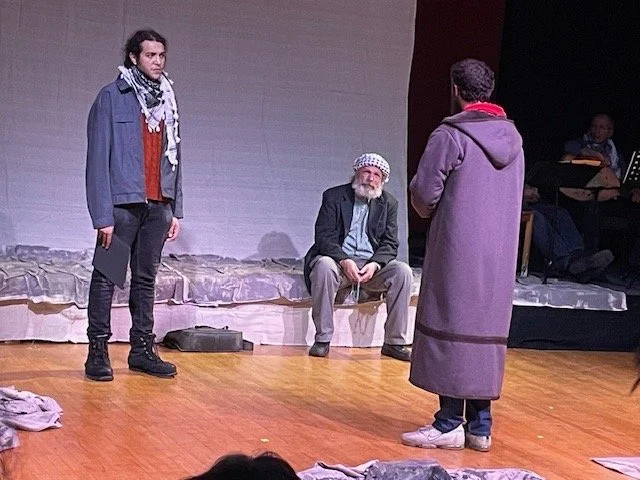
Juju Aldaher, as the sister in Seattle, gives the audience a point of connection to the family making their evacuation walks. Her relatives are told to leave, then they go back, then they have to leave again. Through their calls, the audience follows what happens to their home. It’s whole, then partially knocked down, then completely flattened. There’s a particular dread in hearing about each return, and a particular sadness in hearing how they have to decide what it can carry away each time, and how each return brings them back to less of the home they remember. The hope they carry with them at every turn is even more heart wrenching, and though it’s the fuel that keeps them going, it all seems so fruitless from the viewpoint of the onlooker. The beauty of this piece is in how that is all portrayed here, through each story, each portrayal, and each movement.
The debate over leaving during the ceasefire is especially well played. Yousif Abouzgaya is Nasser, the civil engineer who secures papers for the younger man. Michael Ramquist plays Khalid, a grandfather who wants to hold his grandson, and Yusef Mahmoud is Yousef, who is determined to stay. The three give the discussion the specificity of people trying to make a decision while they still have the chance. There’s hope even in the question of what someone might come back to. Yousif is the emotional standout here and throughout the production. I found myself listening particularly closely when he would take up Alostath’s text or give voice to the community’s feelings about the continued attacks and the way people outside Gaza see them. He brings the same feeling to a conversation among three men as he does to words that have to travel across the room.
In the epilogue, the actors surround the audience with flashlights. The voices the audience has been following from side to side now come from all around the room. The words “When this genocide ends” brings the audience back to that question from the ceasefire scene about what there will be to come home to. But I kept coming back to the bag the woman carries in the opening moments of Gaza: The Silence Shouts. By the end, I found myself thinking about what I would put in it if I had to leave my home, and how many times I could make that choice and still imagine coming back. My fortitude is minimal in comparison, and I think we can all take something away from that, perhaps a call to action, the three R’s from Dunya’s pre-show acknowledgement, recognition that an event is happening (or has happened), resistance against it, and action to use what privilege we have been given to repair the damage.
In Gaza: The Silence Shouts, director Hanna Eady and the company bring such care and feeling to their stories that even the smallest gestures are sure to stay with audiences long after the show ends. There’s pain and fear in what these families are asked to endure, and there’s hope in the things they still talk about doing, like going home or holding a grandson. It’s hard to sit with all of that for eighty minutes, but I’m glad this production asks us to.
Gaza: The Silence Shouts, from Dunya Productions, runs on stage at Cherry Street Village in Seattle through November 21. For more information, including ticket availability a sales, visit https://www.dunyaproductions.org/.
Photo credit: June Rugh