
Stage Review - House Fire (Dukesbay Productions)
Stage Review - House Fire
Presented By: Dukesbay Productions - Tacoma, WA
Show Run: March 13 - March 29, 2026
Date Reviewed: Friday, March 20, 2026
Run Time: 90 Minutes (no intermission)
Reviewed by: Anna Tatelman
Figuring out one’s true self can take a lifetime, but it doesn’t have to end when life does. That’s the driving premise of Dukesbay Productions’ current production of House Fire, a play that offers a heartwarming vision of an afterlife where you can find purpose and learn to express yourself even after time seems up.
This world-premiere production, written by Carol Y. Lee, centers on Laurie, a woman in her late twenties who dies after accidentally setting her house on fire. She’s now in the ‘multipurpose room’ within the spiritual realm and will be stuck there until she completes three tasks. Each task comes delivered by one of her spiritual guides: her grandmother, her fiancé's mother, and someone she had a fleeting yet deep connection with in college. To enter the official afterlife, Laurie and her guides must work together to both complete the literal task and excavate its deeper meaning.
This basic premise of spiritual guides is well-beloved in literature, appearing in everything from the classic A Christmas Carol to the more modern The Five People You Meet In Heaven. House Fire brings to life these familiar elements while infusing it with new life through an interracial lens. Laurie struggled to find herself during life in part because she felt overburdened by her parents, who were first-generation Korean immigrants, to excel in school and her career. Being continually burnt out from these unrealized pressures left Laurie both unable to achieve what her parents wanted for her and unable to find what she wanted for herself.
House Fire smartly refuses to make this interracial aspect quite so binary by having Laurie’s grandmother, who Laurie remembers as being a severe woman who spoke very little English, be a warm and fun-loving presence onstage. Laurie’s grandmother finds the best version of herself within death: someone not free from her cultural identity or racial background, but rather someone who embraces the parts of her heritage that she aligns with and is comfortable expressing those parts that are uniquely her. It’s refreshing to see these complex portrayals of Asian American actors not just on stage, but driving the narrative.
Where the script felt weaker to me was in its moments during the first half of the play where Laurie articulates her feelings of inadequacy, her frustration with herself, and the ideal self she doesn’t know how to be aloud. Since this is the play about self-discovery, it would be more powerful if Laurie was not immediately able to vocalize all this, and instead has to wrestle more with both what she perceives as her past failures and her vision of what her best self could now become. The play, in other words, doesn’t always trust itself or its audience, but this may improve as the script develops.
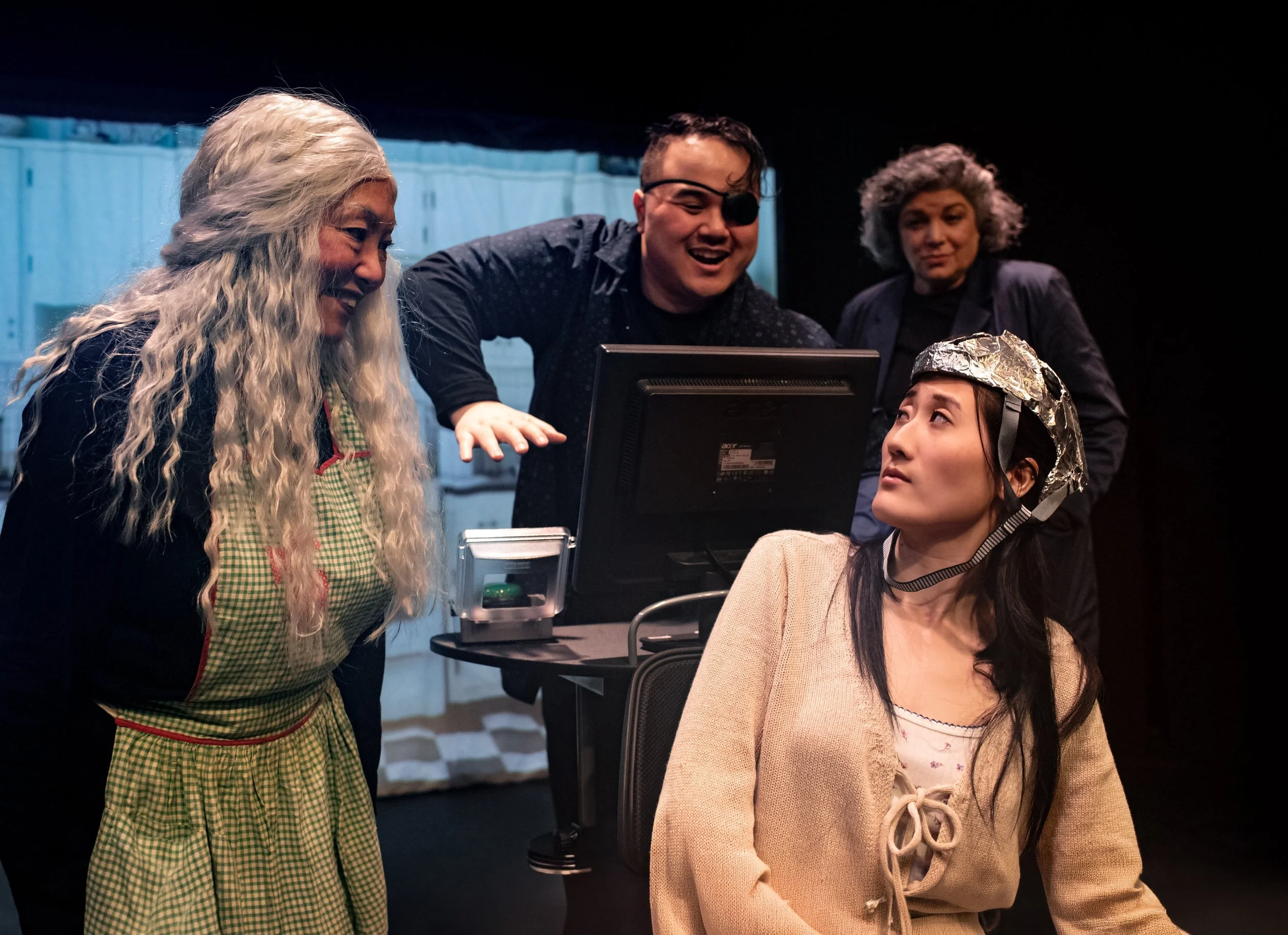
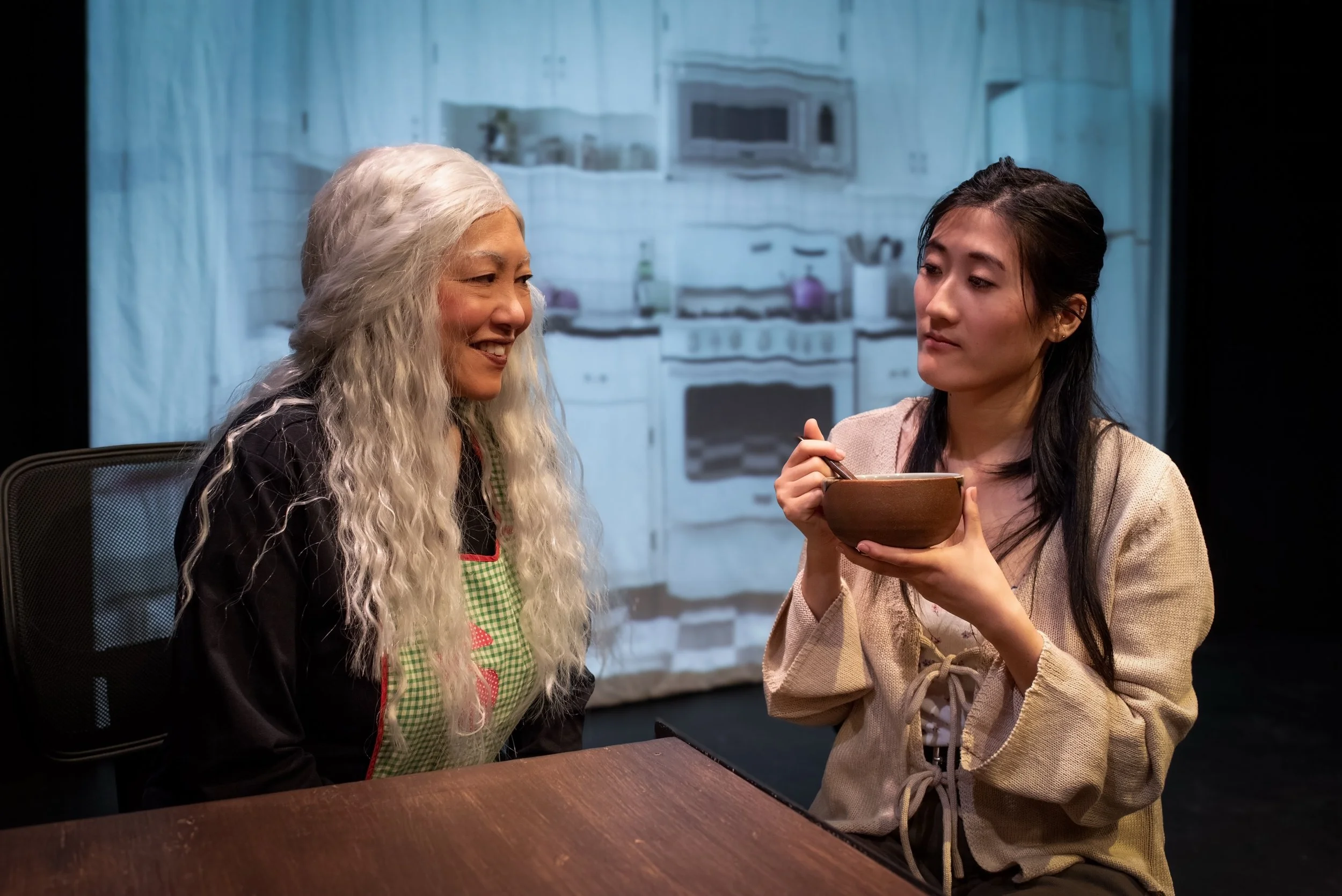
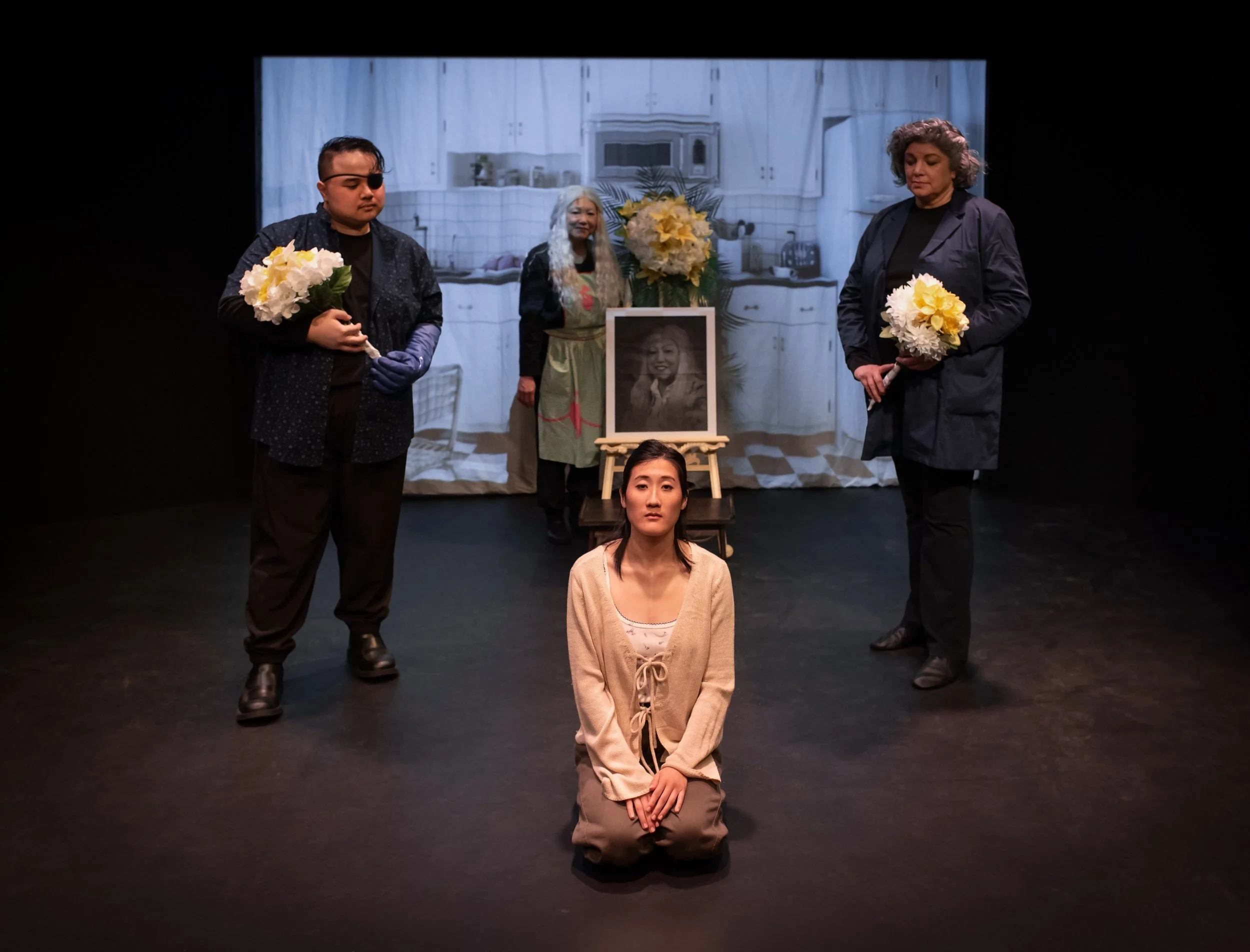
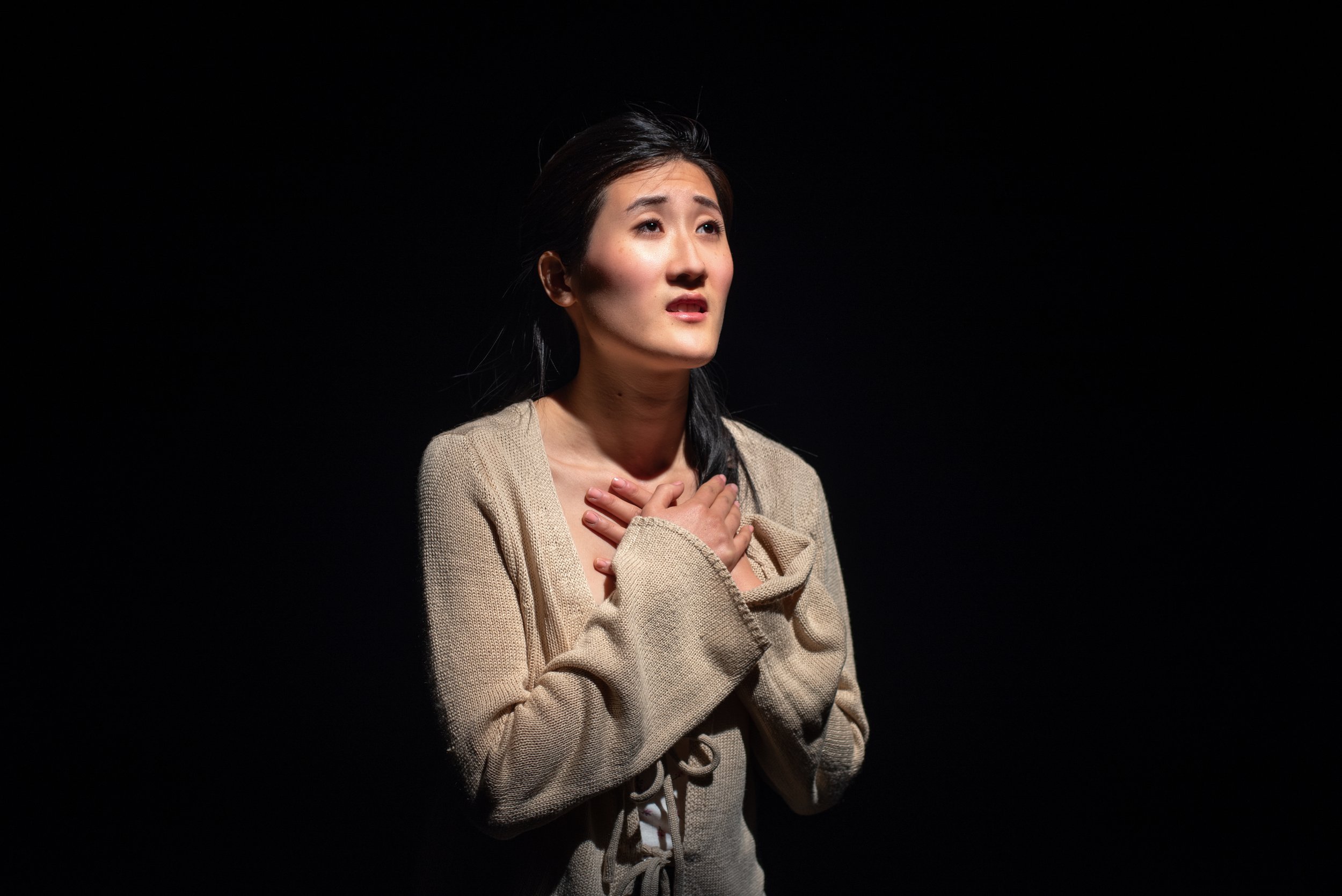
House Fire’s cast of four offers sincere performances that highlight the nuances of each’s character. Jane W. Davie portrays a Laurie caught between multiple forces – death and life, duty and choice, heritage and self-expression, expectations and desires – and ultimately finding the in-betweens. Joy Misako St. Germain as Grandma is patient, affectionate, and funny in ways she was not in life, before she learned to reconcile the dualities within her identity. Jonna Nguyen plays Wallace, someone Laurie knew in college. For reasons I don’t want to spoil, Wallace has an arm that acts without his brain’s permission, pointing or hitting to reveal things he may not be ready to; Nguyen’s portrayal of both his fiercely independent arm and the way his body reacts to these betrayals are priceless. Rounding out the cast is Maria Valenzuela as Doc, the mother of Laurie’s fiancé, a woman who – like Laurie – is a second-generation immigrant, but copes with the pressures by emotionally shutting down and focusing on her career achievements. Although there were times where the performers felt emotionally disconnected from what they were saying – where they focused more on the rhythm of the language than the feeling behind it – they overall brought both heart and humor to the production.
When it comes to production elements, Dukesbay makes the most of its black box resources. Randy Clark’s direction frequently has the four characters chasing each other round the stage, pursuing emotional truths as the others alternately evade or connect. Niclas Olson’s set design mostly uses a projection screen, but the screen draws back at several choice moments to reveal the startingly contrast of the chaotic rubble left behind by Laurie’s house fire. There are also panels that pull out from the walls, which make it easy to perform quick set changes like adding a table or removing a drink cart. The costumes and props are fun too, replete with broken lamps, afterlife headgear, and fake eyeballs (costume and properties design by Jeffery Swiney-Weaver).
Dukesbay Productions’ current production plunges us into a unique vision of an afterlife with nuanced characters learning to embrace what it means to live even after life ends. This world premiere offers actors who deliver on their laughs without losing sight of each character’s genuineness and impressive production design elements that make the most out of a smaller budget. House Fire is a coming of age story that proves you can come of age no matter how old you are.
House Fire runs on stage at Dukesbay through March 29. For more information, including ticket availability and sales, visit https://dukesbay.org/.
Photo credit: Jason Ganwich