
Stage Review - Yoga Play (As If Theatre)
Stage Review - Yoga Play
Presented By: As If Theatre - Kenmore, WA
Show Run: March 19 - April 05, 2026
Date Reviewed: Sunday, March 22, 2026 (Opening Weekend)
Run Time: 2 Hours, 15 Minutes (including a 15-minute intermission)
Reviewed by: Greg Heilman
Sometimes the most insightful theatre comes wrapped in laughter, and Yoga Play by Dipika Guha is a perfect example of that balance. Presented by As If Theatre, directed by Agastya Kohli, and running at the Kenmore Community Center through April 5, this sharp, satirical look at the commercialization of wellness culture manages to be both biting and accessible, asking big questions while keeping the audience consistently entertained.
Set within the sleek, sterile world of Jojomon Corporate Headquarters in Los Angeles, the play centers on a scandal that threatens a yoga brand’s carefully curated image. What unfolds is a collision between corporate damage control and the spiritual roots the company claims to represent. Guha’s script thrives on that tension—between authenticity and profit, enlightenment and branding—and finds humor in the absurdity of trying to package inner peace as a marketable commodity.
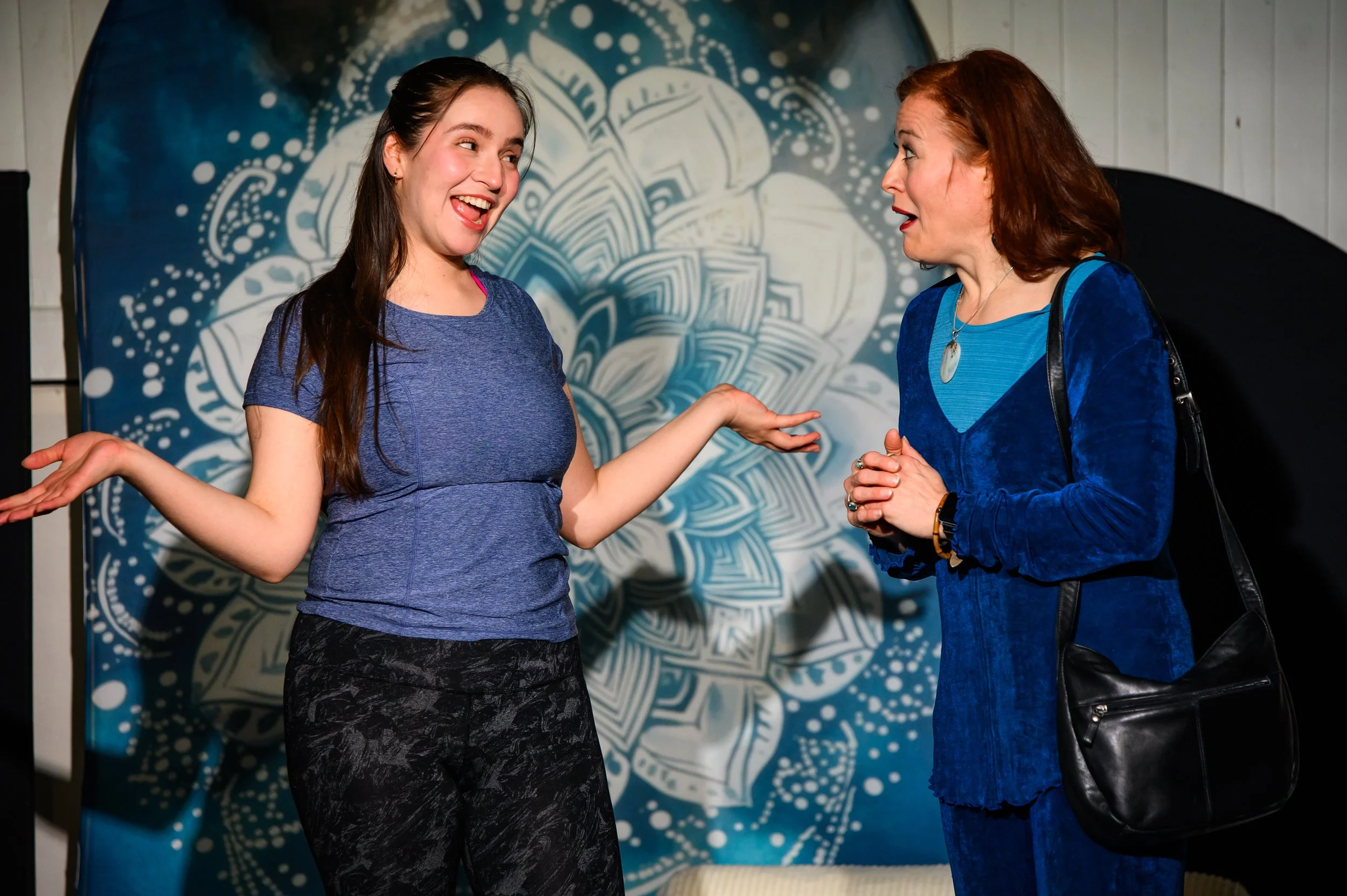
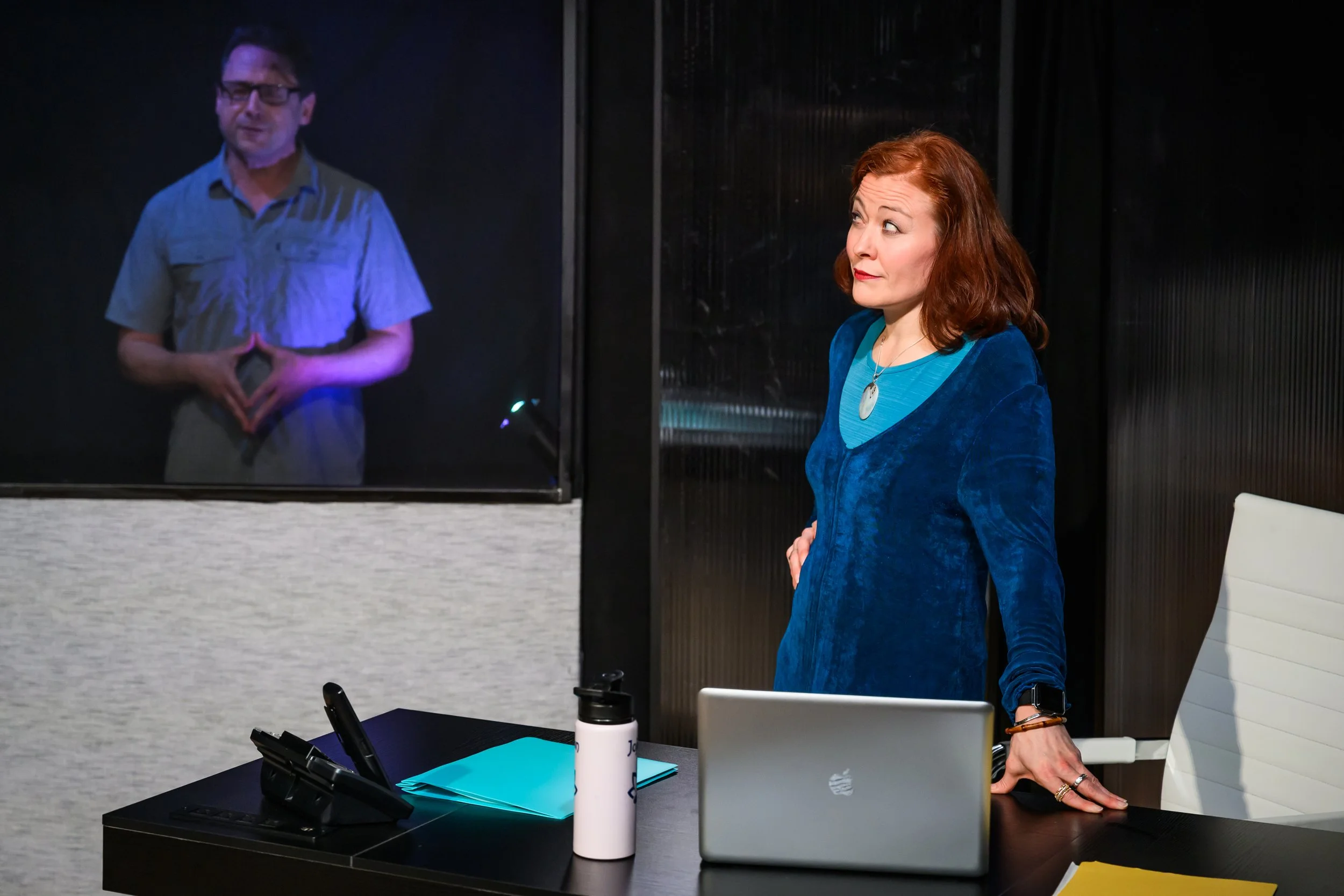
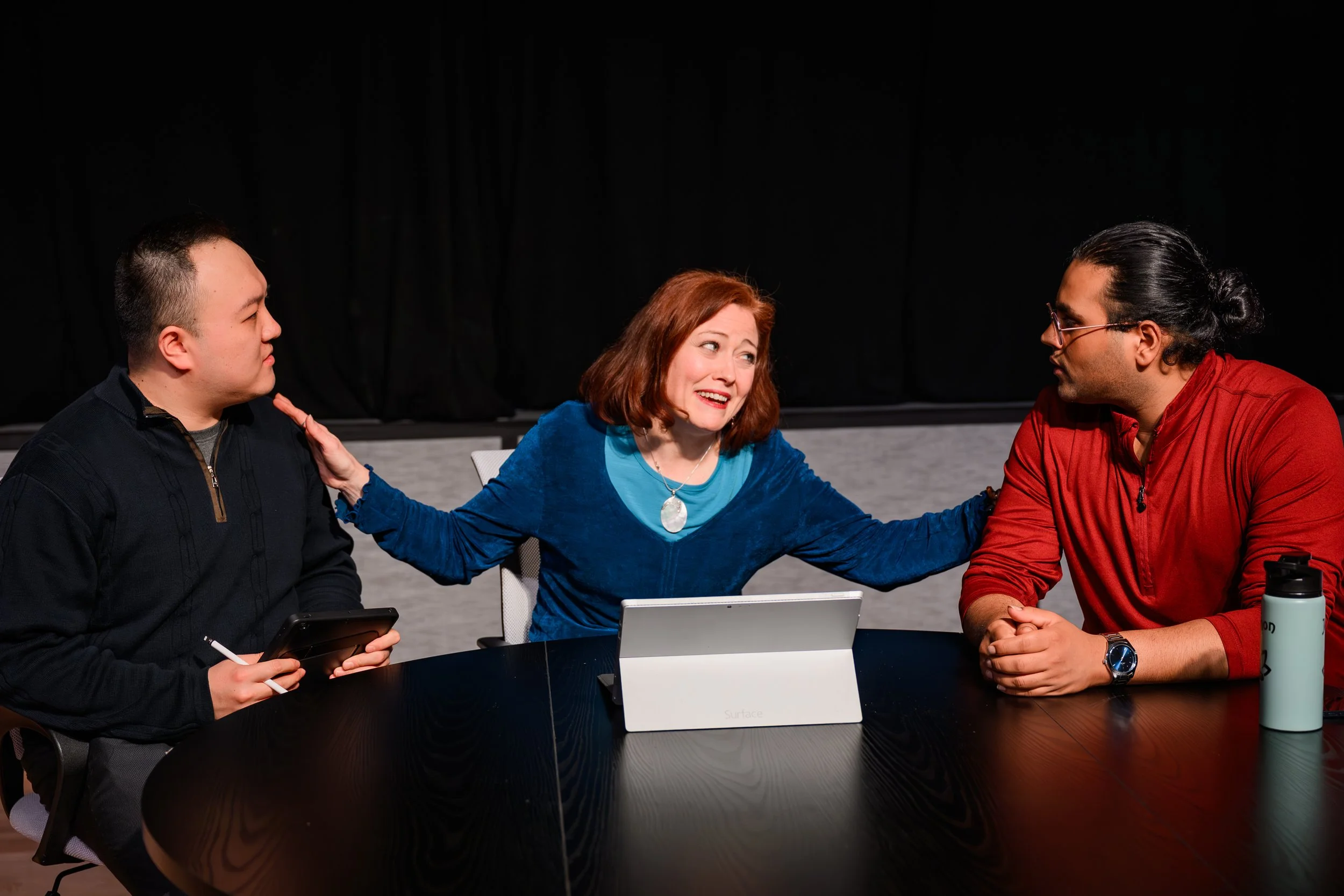
The production establishes its tone immediately through a thoughtfully constructed environment. The primary playing space, designed by Chandria Danelle, is a clear and effective representation of a corporate executive’s office, anchored by a desk and conference table that becomes the focal point for many of the show’s most impactful—and often funniest—moments. It’s around that table where strategy is shaped, where messaging is controlled, and where the cracks in that carefully maintained façade begin to show.
To stage right, a secondary space serves as a common social area, equally well realized and distinctly reflective of a company built around a new-age product. The contrast between the corporate polish and the softer, curated aesthetic reinforces the dual identity at the center of the story. Further upstage, Romola’s yoga studio is revealed only when needed, but its presence expands the world of the play in a meaningful way, offering both visual and thematic distance from the confines of Jojomon headquarters.
One of the more inventive elements of the production is the use of diffusing screens and lighting, credit to Gwyn Skone, whose lighting helps support the storytelling throughout, to represent characters dialing in via video conference. The effect itself is strong, but it’s the actors who make it fully convincing—through precise eye lines, timing, and vocal adjustments that mirror the rhythms of virtual communication. The distributed team dynamic becomes a source of humor in its own right, with Doug Aurbach’s John cycling through a series of all-too-familiar “Zoom tropes” that will resonate with anyone who has spent time in a remote workplace.
Agastya’s direction keeps the pacing tight and the storytelling focused, allowing the satire to land without overstaying its welcome. Scenes move with purpose between corporate urgency and more reflective moments, maintaining momentum throughout. The humor emerges naturally from the characters and situations, and while there are plenty of laugh-out-loud moments, the play uses that humor—at times racial, but never racist—to illuminate the deeper ideas embedded in the writing.
More than anything though, it’s the performances that stand out in this production of Yoga Play. Kimberlee Wolfson delivers a compelling performance as Joan, bringing the energy of someone who has spent her life fighting for recognition in spaces not built for her. Joan becomes the fulcrum of the play’s feminist thread, and when that tension surfaces, it does so with clarity and force. Her monologue on the subject is especially effective—engaging, persuasive, and delivered with just the right level of intensity to land squarely.
Sri Kanduri’s Raj provides a thoughtful counterpoint, his deadpan delivery cutting through the surrounding chaos with precision. Raj’s search for meaning, rather than image, gives the character a quiet weight that grows as the story unfolds. That perspective plays especially well against Hank Tian’s Fred, whose sharp timing and convincing Singaporean accent help define a character navigating both cultural identity and corporate expectation. Their exchanges are among the most enjoyable in the production, building naturally as their differing viewpoints come into focus.
Doug Aurbach proves to be one of the production’s most versatile performers. As John, appearing via Zoom, he balances corporate messaging with personal contradiction, presenting an image of awareness while revealing flaws that undermine it. That tension is established early, particularly in his interactions with Joan, as she pushes for a more inclusive vision of their “family” while he prioritizes optics. Aurbach’s BBC reporter is delivered with a precise accent and strong comedic timing, while his portrayal of Bernard, the yogi, introduces yet another distinct voice and physicality. Across these roles, his accent work remains consistent and clearly defined. Rounding out the cast is Jessica Marvin-Romero, whose Romola is a confident and well-shaped presence, anchoring key moments with clarity and strength. The ensemble as a whole works cohesively, creating a unified world that supports both the humor and the underlying commentary.
That cohesion extends to the production’s vocal work. The dialects across the cast are executed with precision, guided by dialect coach Marianna De Fazio, whose influence is evident throughout. Marianna also serves as the production’s yoga consultant, and that dual contribution can be seen in both the physical and vocal authenticity of the piece.
From a design standpoint, the production supports the storytelling with clarity and intention. William French’s sound design reinforces the modern setting, particularly in its treatment of phone and video interactions and Amy Hockman’s costume design is solid throughout, defining character while allowing performance to remain central, and providing one of the evening’s standout visual gags with the hysterical “Guru Raj” outfit.
Yoga Play resonates in its ability to entertain while engaging with larger ideas. Beneath the humor is a thoughtful examination of how easily meaning can be diluted when filtered through consumerism. The play doesn’t offer easy answers, but it does encourage reflection—on what we value, what we commodify, and what may be lost in the process. As If Theatre’s production delivers on both fronts, offering a show that is consistently funny while remaining intellectually engaged. It’s a production filled with genuine laughter, sharp observation, and a perspective that feels both timely and uncomfortably familiar—in exactly the way good satire should.
The As If Theatre production of Yoga Play runs on stage at the Kenmore Community Center in Kenmore through April 5. For more information, including ticket availability and sales, visit https://asiftheatre.com/.
Photo credit: Christine Mitchell