
Stage Review - Leni’s Last Lament (Intiman Theatre)
Stage Review – Leni’s Last Lament
Presented By: Intiman Theatre – Seattle, WA
Show Run: October 9 – October 18, 2026
Date Reviewed: October 9, 2026
Run Time: 2 hours (inclusive of a 10-minute intermission)
Reviewed by: Anna Tatelman
If someone told me in brief about a new play inspired by Leni Riefenstahl – the German filmmaker most remembered nowadays for her work on multiple Nazi propaganda films – my first guess would likely be that it’s a heavy, dramatic period piece, not a darkly comedic solo show with a cabaret vibe. But that is precisely what Leni’s Last Lament, Intiman Theatre’s current production, is. And much like other works of art that fuse their subjects with genres that at first seem unexpected, such as Hamilton, one you’ve experienced Leni’s Last Lament, it’s hard to envision it being anything else. The spectacle and artistry of this show perfectly befit how Leni herself would want to share – or, rather, continually edit, manipulate, and desperately try to seize control over – her story to a modern audience.
The creative team behind Leni’s Last Lament has developed this show for a bit over five years and toured it around the world for the past few; I was lucky enough to interview them for this review. They are “always tinkering” with the production during or after each run, director Richard Caliban shared, which “is fun” because “it keeps the show fresh.” It’s rare for a playwright, director, and actor to work together on the same show across multiple runs over several years, but all three thoroughly enjoy the process.
Art about WWII and the Holocaust have become more common in the last few years – which makes sense as people try to understand our current socio-political environment – but there are relatively few new works about Nazi artists. When I asked playwright Gil Kofman about his interested in writing specifically about Leni, he shared his fascination with “someone so talented [who] debase[d] themselves for their ambition, and lie[d] about it so expertly.” Solo performer Jodie Markell addedthat there is a focus for all of them on the historical facts, but from there, they “push those facts to the surreal and the absurd.”
That makes sense, given the premise of Leni’s Last Lament is that she is in some sort of purgatory. After Leni enters in a ghostlike sheet, she tells the audience she keeps having this dream where she’s dead but onstage, being watched. But she’s been watching us too, in our modern world, and she knows how we severely misunderstand her – and she knows we’re hypocrites for reviling her while going along with fascist regimes.
I’ll admit here I often struggle with solo shows because I feelthey lack a compelling reason for the performer to share their life with us and end up bogged down in pure exposition rather than plot – but with great prowess, Leni’s Last Lament dodges those pitfalls. Playwright Korman, in collaboration with director Caliban, immediately creates a world that contains rules yet stays malleable and has relentless momentum – just like a film Leni would have made. Whether to escape her dream, be freed from purgatory, or simply to correct what she sees as our unfair interpretation of her, Leni must now present to us the most artfully made version of her life that she can.
The deceptive lengths Leni did and would travel to sustain her art set her up as the ideal unreliable narrator. That unreliability allows the show to offer its audience glimmers of truth through many layers of sparkly clothes, jazzy tunes, and edited stories. Near the start of the show, for instance, Leni tells us about another dream she frequents: one where she walks among rows and rows of Nazis in their black uniforms, while she wears only her white trench coat with nothing underneath. Rather than being intimidated, she whips off her coat, revealing her nudity – along with her dream-gifted “huge, uncircumcised” member – and fornicates with all of them.
Not long after, she breaks into a song where she bemoans “what they did to [her] films,” lamenting how the public and academics ignore the vital contributions she made to the art of film in favor of just condemning her. In less than a few minutes, Leni goes from telling us a story that emphasizes her incredible agency to one about being a victim. She goes from striving to impress us with her ability to control others in an appealing wayto vying for our sympathy at how helpless she is. Leni’s Last Lament strikes an impressive balance between showing us how Leni would want to portray herself to a modern audience while revealing the self-made mess she will never be able to conceal.
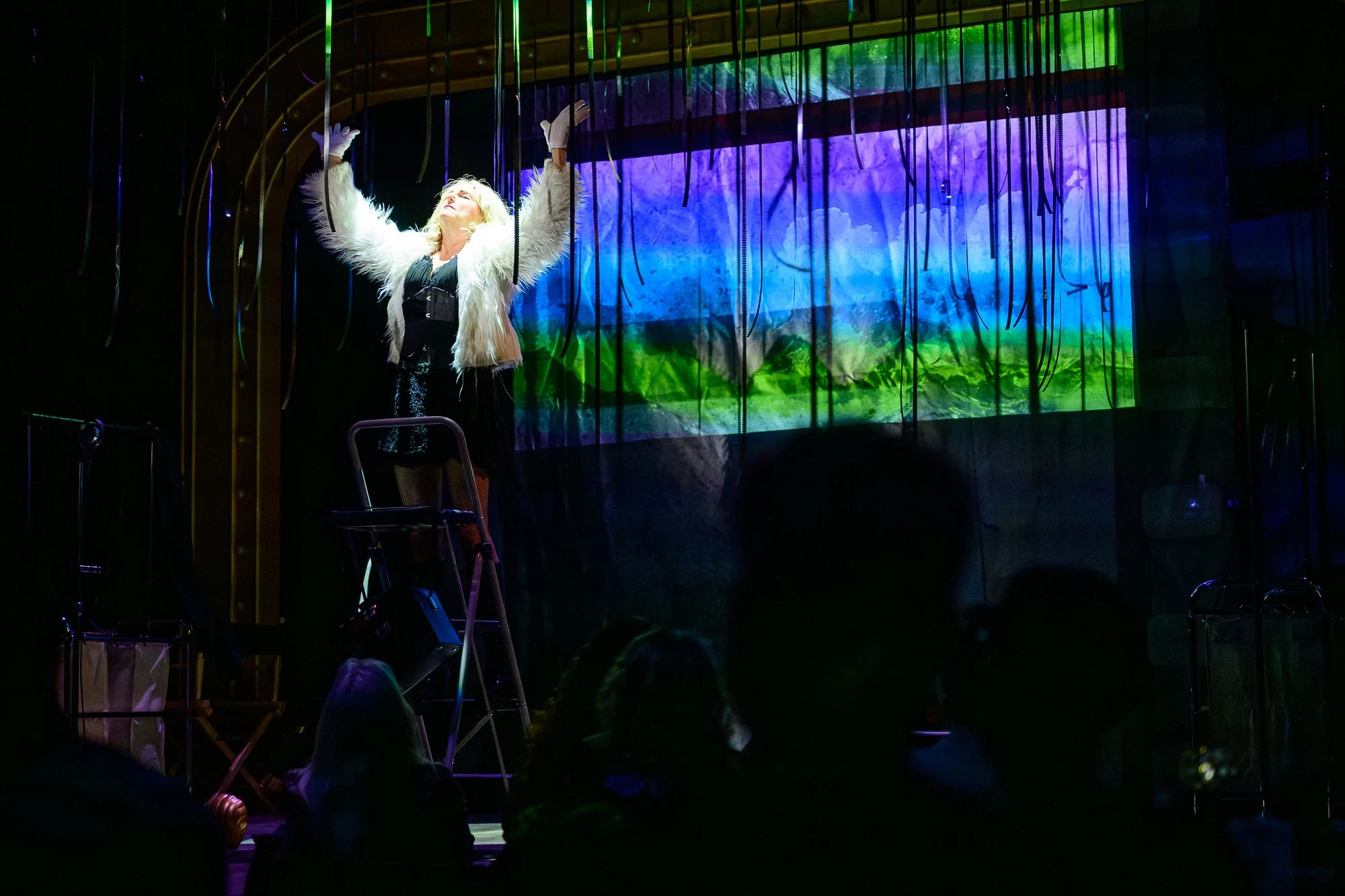
The cabaret setting created by director and composer Richard Caliban further enhances Leni’s ability to deploy all varieties of deception. Sometimes Leni exudes charm and sexuality, dancing through the audience in sparkly sunglasses and knee-high boots. Sometimes she stands atop a multi-step ladder as she berates us for our irrelevance or our double standards, literally looking down her nose at us. Sometimes she pulls props, costume pieces, or film strips from two carts onstage, allowing us purposefully to glimpse her behind-the-scenes artistry and dedication. The original music (also by Caliban) goes hand-in-hand with these diverse manipulation tactics and adds an additional layer of glamour. Most of the songs are lush with 1930s jazz, inviting us into the intimacy of Leni’s feelings while sweeping us away with the danceable beat.
Interestingly, this musical cabaret vibe was not always part of Leni’s Last Lament, and is an element that continues to evolve with each iteration. With this production at Intiman, for instance, the creative team was asked to give the show an intermission for the first time. This meant adding a musical number to lead into the act break. I was shocked to learn this song is brand new, as it was one of my favorite songs of the evening: a song in which Leni reassures us we don’t need to cry over the act break because she “will come back to you.” The music is upbeat and vivacious as she parades about stage, blowing kisses and hurling tissues at audience members. The song is not only hilarious, but a wonderful example of how the show simultaneously charms us with Leni while exposing her manipulative techniques. Even in a moment when she’s trying to empathize with others, she’s not only missing the mark, but exposing both the enormity and fragility of her ego.
Another newer addition to Leni’s Last Lament are the references to the US’s current federal government. Leni occasionally has little slips of the tongue where she names people in the Trump administration, and at one point, while combing through her prop bag, she brings out a MAGA hat. For me personally, these parts got a bit heavy-handed. I feel one of the greatest strengths of this show is how it demands we scrutinize both Leni and ourselves – that, even though Leni presents us with her edited footage, it’s our responsibility to see past her falsehoods, as well as our own. But I recognize I’m likely in the minority here; the Trump jokes got some of the biggest laughs of the evening.
When it comes to humor, there is perhaps value too in giving the audience a few “easy laughs” – moments when they can giggle without restraint – in a show where most of the jokes prompt a more uncomfortable response. As you might expect from a darkly comedic show about a Nazi artist, Leni makes jokes that are both funny and horrifying, such as when she remarks (theoretically in relation to her skills as a film editor), “We Germans are good at selecting.” The moments of biting humor often go by quickly, with performer Jodie Markell already onto the next sentence or anecdote by the time the audience has processed the horror of what she’s said.
This method of not letting the audience dwell too long on Leni’s chilling or anti-Semitic remarks is a strength not just of the writing, but of actor Jodie Markell’s sense of timing and tone. Watching Markell’s performance as Leni is like getting a master class in manipulation as a form of artistry, which I think Leni herself would be both impressed with and irritated by. Markell knows Leni is trying to spin webs of deception around us with all her chatter and song, and artfully displays that while letting glimmers of Leni’s cruelty, self-delusion, and ruthlessness leak through.
Sometimes Markell lets Leni’s weaknesses leak through, too, but even this often has an edge of deliberation as Leni bids for our sympathy. When Leni does a supposed re-enactment of Hitler asking her to direct Triumph of the Will, Markell portrays Hitler as intimidating her both verbally and physically, and Leni as someone cowed into accepting. Yet her re-enactment feels off, her high-pitched tone and damsel-in-distress posture emulating the idea of fear rather than feeling its reality. This scene is an example of how Markell deftly shows us hints of the truth Leni won’t tell us, leaving us feeling both charmed and unsettled by Leni’s many layers of stage persona.
Markell’s evolving, nuanced relationship to her audience is central to Leni’s Last Lament. She alternates between an array of tactics, from seducing us with song to presenting compelling arguments as if we were a jury. She finds ways to make herself more sympathetic, such as by staggering about stage when her physical pain increases while refusing to give herself morphine– for our sake, she claims, so she can continue the show. As Markell herself observed, Leni ultimately was a “waste of a brilliant artist who unfortunately made some kind of deal with the devil and lived the rest of her life in delusion and denial.” The brilliance of Markell’s performance is in her ability to capture both the artistry and the delusion in one swoop.
Although a solo show, Leni’s Last Lament has many moving parts. While some of the music is pre-recorded, musician Adam Hendricks provides the immersive feel of being in a nightclub with his accordion playing. The set is relatively sparse, but features posters of Leni’s films and black streamers (which nicely double as props of film strips) dangling above the stage. Leni’s costume toes the line between lingerie and something she could wear for a modern night on the town, replete with fishnets, high-heeled boots, and lots of sparkles (costume and set design by the creative team).
There’s also a projection screen that can both show recorded footage, primarily of Leni’s films, and what seems to be actual live camera footage of Markell. This footage depicts her from an angle as if the camera is on the ground looking up at her, so we see her profile as if from the perspective of a small child(projection design by Joey Moro). This is a clever nod to Leni’s relationship as a filmmaker with capturing shots from up high, but in reverse: rather than filming from up high, instead she’sbeing seen from on high via film, emphasizing the audience’s smallness. Unfortunately the night I was there, there were tech issues with the projection, lights, and recorded sounds that caused all to stop for a time. But Markell, impressively, barely blinked throughout this chaos, and I’m sure the creative team will have these issues resolved shortly.
Was Leni Riefenstahl a victim caught within socio-political forces beyond her control or an artistic trailblazer creating her own destiny? In Leni’s Last Lament, she continually edits herself to be whichever version she thinks will speak to us most in that moment – and she’s not entirely wrong when she points out how we do the same. Through a distorted mirror of respliced film footage, catchy tunes, and sparkly outfits, Leni reflects both herself and a world that, no matter the era, enjoys jazzing up its own ugliness. Intiman Theatre’s current production is both a biting indictment of and a perversely fun escape from the ways in which we edit our lives to justify our actions, our passions, or simply our most convenient options.
Leni’s Last Lament runs on stage at Intiman Theatre through October 18. For more information, including ticket availability and sales, visit intiman.org/
Photo credit: Quinlan Corbett