
Stage Review - The Musical Comedy Murders of 1940 (Phoenix Theatre)
Stage Review - The Musical Comedy Murders of 1940
Presented By: Phoenix Theatre - Edmonds, WA
Show Run: October 02 - October 25, 2026
Date Reviewed: Sunday, October 11 2026
Run Time: 2 Hours, 20 Minutes (including a 15-minute intermission)
Reviewed by: Greg Heilman
If there’s one way that Phoenix Theatre differentiates itself, it’s surely their ability to deliver ensemble focused comedy, and doing this by bringing together a cast that understands precisely what kind of comedy it is performing. Whether the material calls for rapid-fire dialogue, exaggerated personalities, physical comedy, or the sort of ridiculous circumstances that would collapse under even the slightest application of logic, the company has a knack for finding performers willing to commit completely to the absurdity. That quality is on full display in John Bishop's The Musical Comedy Murders of 1940, directed by Keith Dahlgren and running through October 25 in Edmonds. It's a production that proves once again that a tight ensemble, impeccable timing, and a shared understanding of the material can make for a thoroughly entertaining comedic production.
Set in December 1940, the play brings together a collection of Broadway hopefuls and theatrical personalities at the mansion of wealthy financier Elsa Von Grossenknueten, ostensibly to audition for a new musical. But there is more going on than meets the eye, including a series of murders, suspicious characters, and the lingering mystery of a killer known as the Stage Door Slasher. Before long, everyone is a suspect, nobody is quite who they appear to be, and the mansion's collection of secret passages and hidden rooms becomes increasingly important to the proceedings. It's a premise that owes more to the madcap antics of Clue than the intricate mysteries of Agatha Christie, and while the script isn't necessarily the cleverest example of the genre, it doesn't need to be. The fun is in watching a group of eccentric characters navigate an increasingly preposterous situation, and in seeing how much comedy can be wrung from their collective confusion.
The show opens with a scene that immediately establishes the tone, as a murder proves considerably easier to commit than to conceal. The increasingly frantic efforts to dispose of the evidence set the stage for the chaos that follows, and Keith keeps the action moving at a pace that allows the humor to develop without lingering too long on any particular joke. It's an important distinction in a show like this, where the temptation might be to push every gag as far as possible. Instead, the cast generally trusts the material, delivering its one-liners with precision and allowing the escalating absurdity to do much of the work.
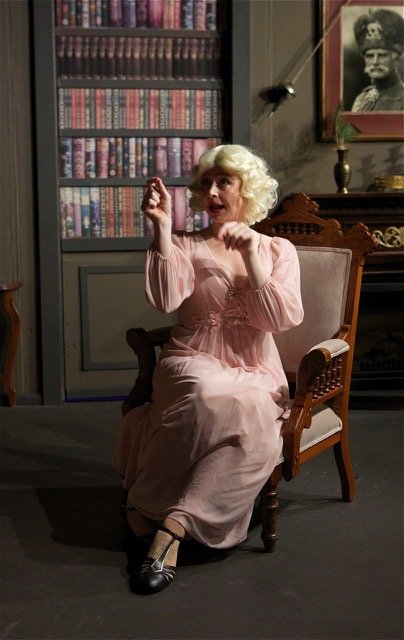
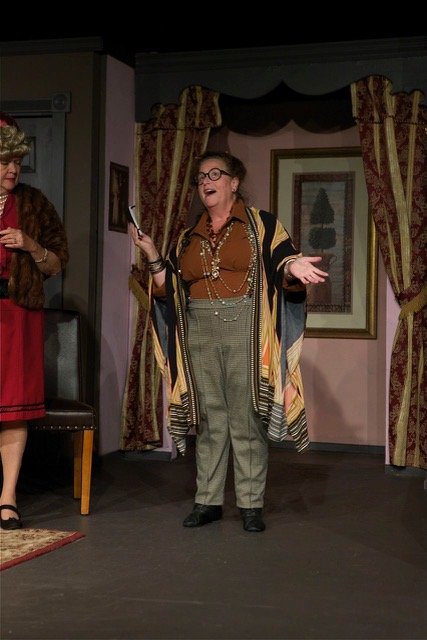
Melanie Calderwood is especially enjoyable as Elsa, the wealthy Broadway financier whose mansion serves as the setting for the evening's mayhem. Melanie brings a wonderfully understated deadpan quality (seemingly her trademark) to the character, at times seeming almost delighted by the murders occurring around her, and at others appearing remarkably oblivious to the urgency of the situation. It's a particularly effective approach because Elsa's composure provides such a delightful contrast to the increasingly frantic behavior of those around her. Where other characters are scrambling to understand what is happening, Elsa often seems content to observe the proceedings as though they were merely another inconvenience associated with producing a Broadway show.
Eric Hartley, as Michael Kelly, is another important contributor to the evening's comedy, particularly in his scenes with Melanie. The two characters are in cahoots, but when their plans begin to unravel, their attempts to communicate without revealing their intentions lead to one of the funniest sequences in the production. Unable to speak openly, they resort to a silent exchange that resembles an increasingly desperate game of charades. It's a wonderfully executed bit of physical comedy, with gestures and expressions taking the place of dialogue as the two attempt to make themselves understood. Not a word is spoken, yet the scene is among the show's funniest, a testament to both performers' comedic instincts and the precision of their timing.
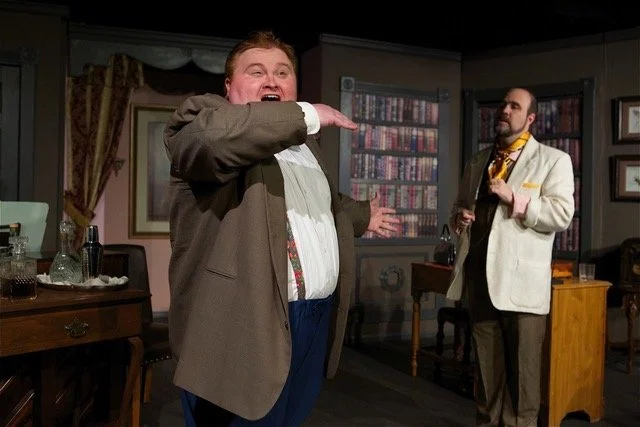
James Lynch is another standout as Eddie McCuen, bringing a terrific sense of old Hollywood comedy to his performance. His rapid-fire delivery recalls the great screwball comedies of the 1930s and 1940s, when dialogue could come so quickly that audiences barely had time to register one joke before the next arrived. James handles that style particularly well, navigating the script's alliteration and verbal gymnastics with remarkable accuracy and precision. There's an almost musical quality to the way he delivers his lines, with the rhythm of the language becoming part of the joke itself. But James is equally effective when the comedy turns physical, demonstrating that his talents extend well beyond the spoken word. His work is among the most consistently entertaining of the evening.
Another performance highlight (among many in this group) is Hilary Eliandson’s, whose is equally well suited to the period as Nikki Crandall, an actress whose credentials are perhaps a bit more flexible than her confidence would suggest. Hilary captures the exaggerated mannerisms and affected sophistication of a golden-age Hollywood performer beautifully, creating a character who seems to have stepped directly out of a 1940s film. There's something wonderfully artificial about Nikki's presentation, and Hilary understands how to make that artificiality funny without allowing it to overwhelm the character. It's a performance that fits perfectly within the heightened world of the play.
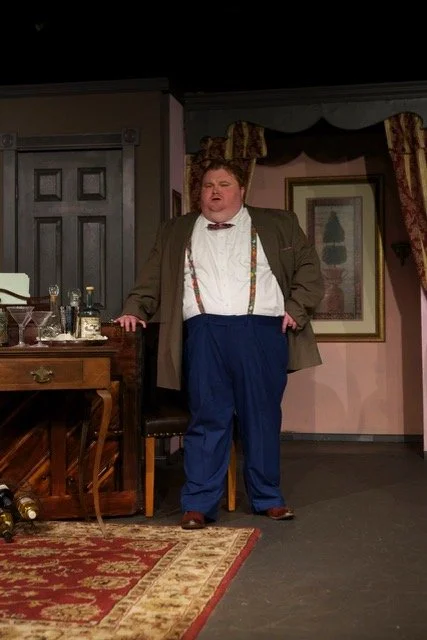
As director Ken De La Maize, Brandon Jepson leans into another familiar Hollywood personality, the self-important filmmaker whose enthusiasm for his own accomplishments far exceeds his actual success. With a voice reminiscent of Thurston Howell III from Gilligan's Island, Brandon makes Ken's constant name-dropping and inflated sense of importance a running source of amusement. One particularly funny recurring joke involves people assuring Ken that they've seen his films, only for the audience to learn that those pictures haven't actually been released. Brandon plays the character's pretensions with just the right amount of conviction, allowing Ken's ridiculousness to emerge naturally.
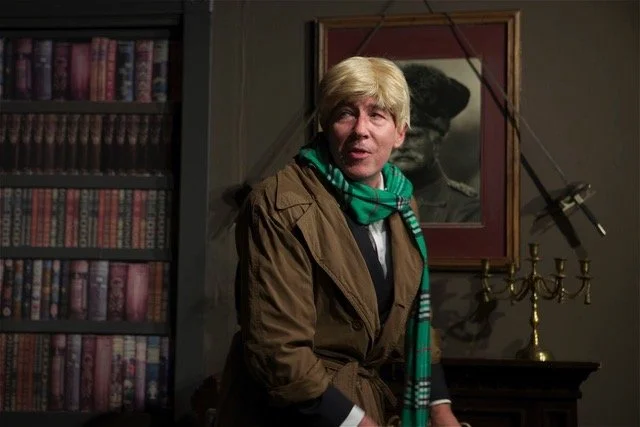
Jag brings considerable energy to Patrick O'Reilly, beginning with a strong Irish accent before demonstrating an ability to navigate multiple accents as the story unfolds. Whether every accent is technically perfect is beside the point (honestly, if they’re not, they’re pretty darn close), the fact that they're entertaining, and Jag's commitment to each one are what makes the character's various turns all the more enjoyable. Doug Knopp, meanwhile, gives Roger Hopewell an occasionally unsettling quality, particularly when Roger launches into his more elaborate vocabulary. Doug has a way of making even an otherwise ordinary line sound a little creepy, adding another layer of eccentricity to an already peculiar collection of characters.
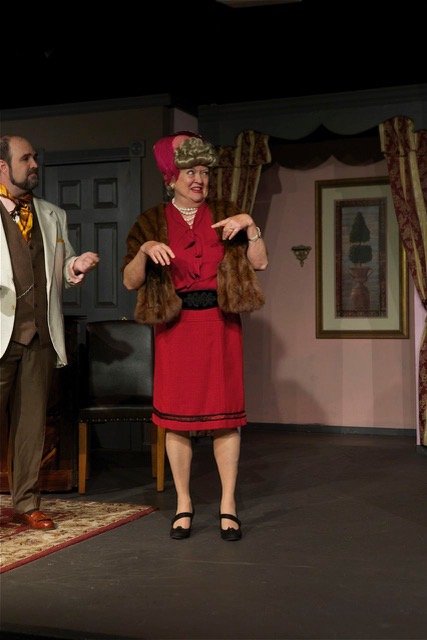
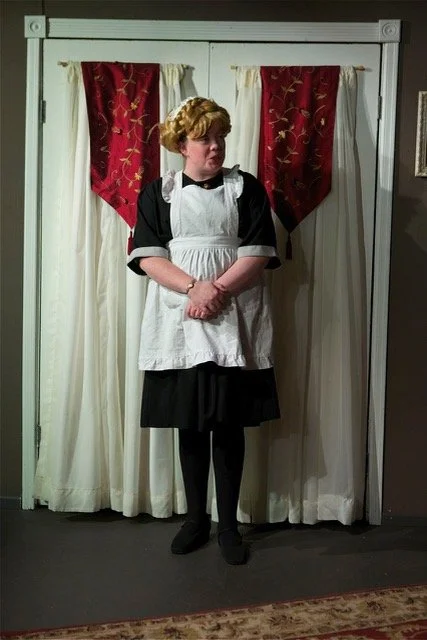
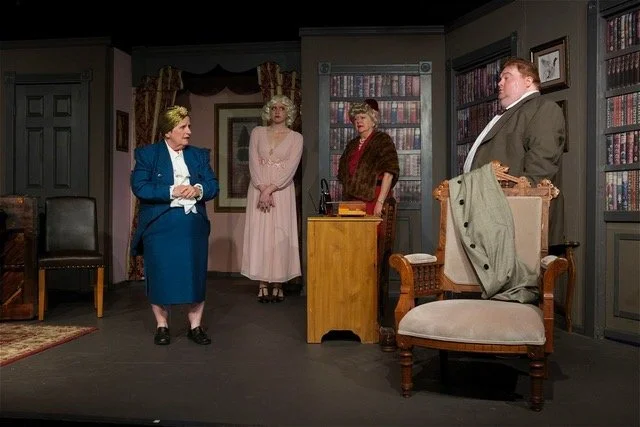
Elizabeth Shipman makes Bernice Roth a delightfully boozy presence, leaning into the character's inebriation without losing her place in the proceedings. Susan Connors, as Marjorie Baverstock, and Megan McDermott, as the German maid Helsa Wenzel, round out an ensemble in which every character has a distinct personality and a particular contribution to the chaos. Megan's portrayal adds another period-specific character type to the mix, while the collective commitment of the cast ensures that even the more outrageous developments remain consistent with the world Keith has established.
The second act is especially entertaining as the characters attempt to sort through the growing collection of murders, motives, and mistaken assumptions. By this point, the plot has become so tangled that the process of trying to figure out what happened is itself a source of comedy. The script throws out an abundance of one-liners, and the cast delivers them with the kind of accuracy and precision that makes this style of theatre work. It's not simply a matter of speaking quickly or making exaggerated gestures. Good comedy requires an understanding of when to accelerate, when to hold for a reaction, and when to allow another performer to take control of a moment. Keith's ensemble demonstrates that understanding throughout the evening.
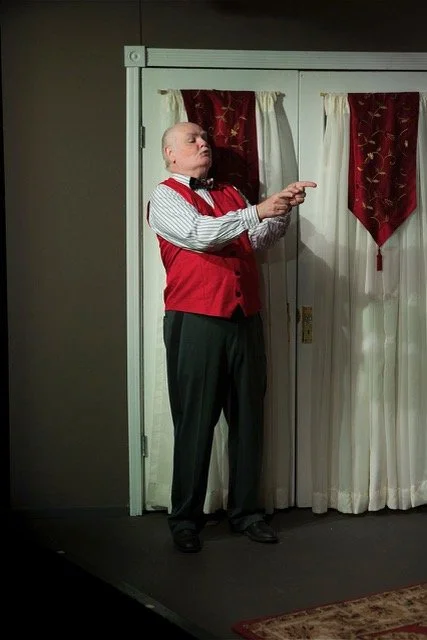
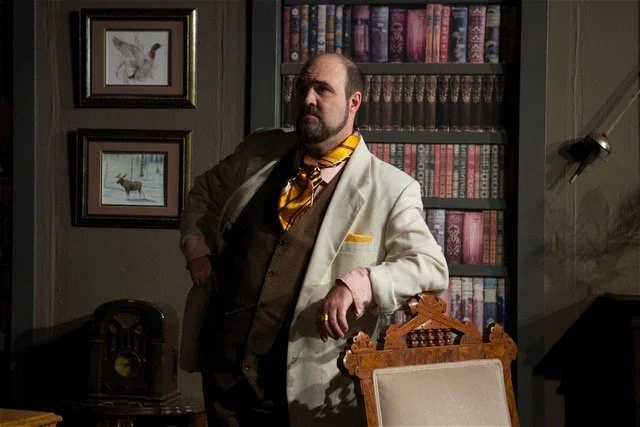
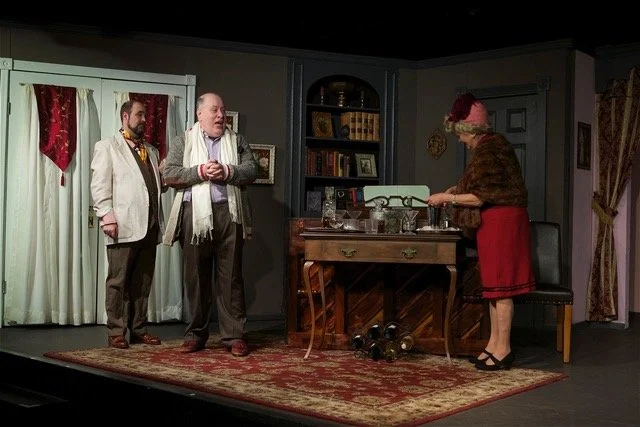
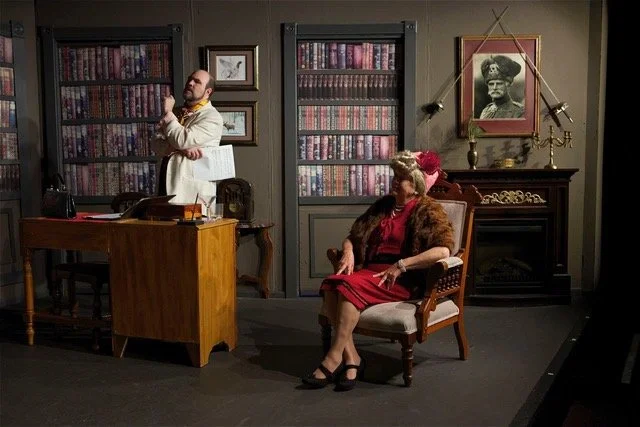
The physical environment is another important part of the production's success. The mansion's library is an attractive and appropriately appointed setting, with a writing desk, piano, and a table stocked with liquor among its furnishings. There's a comfortable sense of period elegance to the room, but the real fun comes from the creative use of secret passages and trap doors that allow characters to appear, disappear, and move about the mansion in unexpected ways. The scenic work of Susan and Kris Helland provides more than an appealing backdrop, it gives the cast a playground in which to carry out the increasingly elaborate comedy. Elizabeth's costumes are similarly effective, capturing the styles and personalities of the period while helping establish the distinct identities of the characters.
What makes The Musical Comedy Murders of 1940 so enjoyable isn't the sophistication of its mystery or the ingenuity of its revelations. The play is frequently silly, occasionally predictable, and far more interested in making its audience laugh than in challenging anyone to solve a particularly difficult puzzle. But that is also part of its charm. There is an appealing throwback quality to the material, recalling an era of Hollywood entertainment built around colorful personalities, verbal dexterity, physical comedy, and the willingness to embrace the ridiculous without apology.
And that is where the Phoenix Theatre excels. Keith Dahlgren has assembled a cast that understands the demands of this particular brand of comedy, and the performers approach it with the pace, energy, and commitment necessary to make it successful. James Lynch's rapid-fire delivery and physical comedy, Hilary Eliandson's wonderfully affected Hollywood persona, Melanie Calderwood's impeccable deadpan, and the delightful wordless exchange between Calderwood and Eric Hartley are among the production's highlights.
As is so often the case at the Phoenix, the greatest strength lies in the ensemble as a whole, a group of performers who understand that the success of a comedy depends as much on how they work together as on what any one of them does individually. The Musical Comedy Murders of 1940 may not be the cleverest murder mystery you'll encounter, but it is a thoroughly enjoyable one, and a fine reminder that when a cast knows exactly how to play the comedy, sometimes the simplest goal of making an audience laugh is more than enough.
The Musical Comedy Murders of 1940 runs on stage at Phoenix Theatre in Edmonds through October 25. For more information, including ticket availability and sales, visit https://www.tptedmonds.org/.
Photo credit: Jim Sipes