
Stage Review - Les Misérables (Tacoma Musical Playhouse)
Stage Review - Les Misérables
Presented By: Tacoma Musical Playhouse - Tacoma, WA
Show Run: September 11 - October 04, 2026
Date Reviewed: Friday, September 18, 2026
Run Time: 3 Hours (including at 15-minute intermission)
Reviewed by: Greg Heilman
It would be tempting to attribute the extraordinary quality of Tacoma Musical Playhouse’s Les Misérables to divine intervention. According to the director’s program notes, this was the final production selected by TMP founder and artistic director Jon Douglas Rake before his passing, and whether Jon’s influence came from somewhere beyond the theatre, how firmly he remained in the minds of the cast and creative team, or perhaps from a little of both, the result is by far the finest production I have seen on the Tacoma Musical Playhouse stage. More to the point, there is not a single aspect of this Les Misérables that is anything less than exceptional.
With music by Claude-Michel Schönberg, lyrics by Herbert Kretzmer, and a book by Schönberg and Alain Boublil, Les Misérables is based on Victor Hugo’s sprawling novel about injustice, sacrifice, redemption and revolution in 19th-century France. At its center is Jean Valjean, a man imprisoned for stealing bread who attempts to rebuild his life after an act of compassion offers him a second chance. He remains pursued by the uncompromising Inspector Javert, whose faith in the law leaves little room for mercy. Around them are Fantine and her daughter Cosette, the revolutionary students preparing to take to the barricades, and a collection of people whose lives become connected through love, poverty and political unrest. Directed and choreographed by Harry Turpin, Tacoma Musical Playhouse’s production is on stage in Tacoma through October 4.
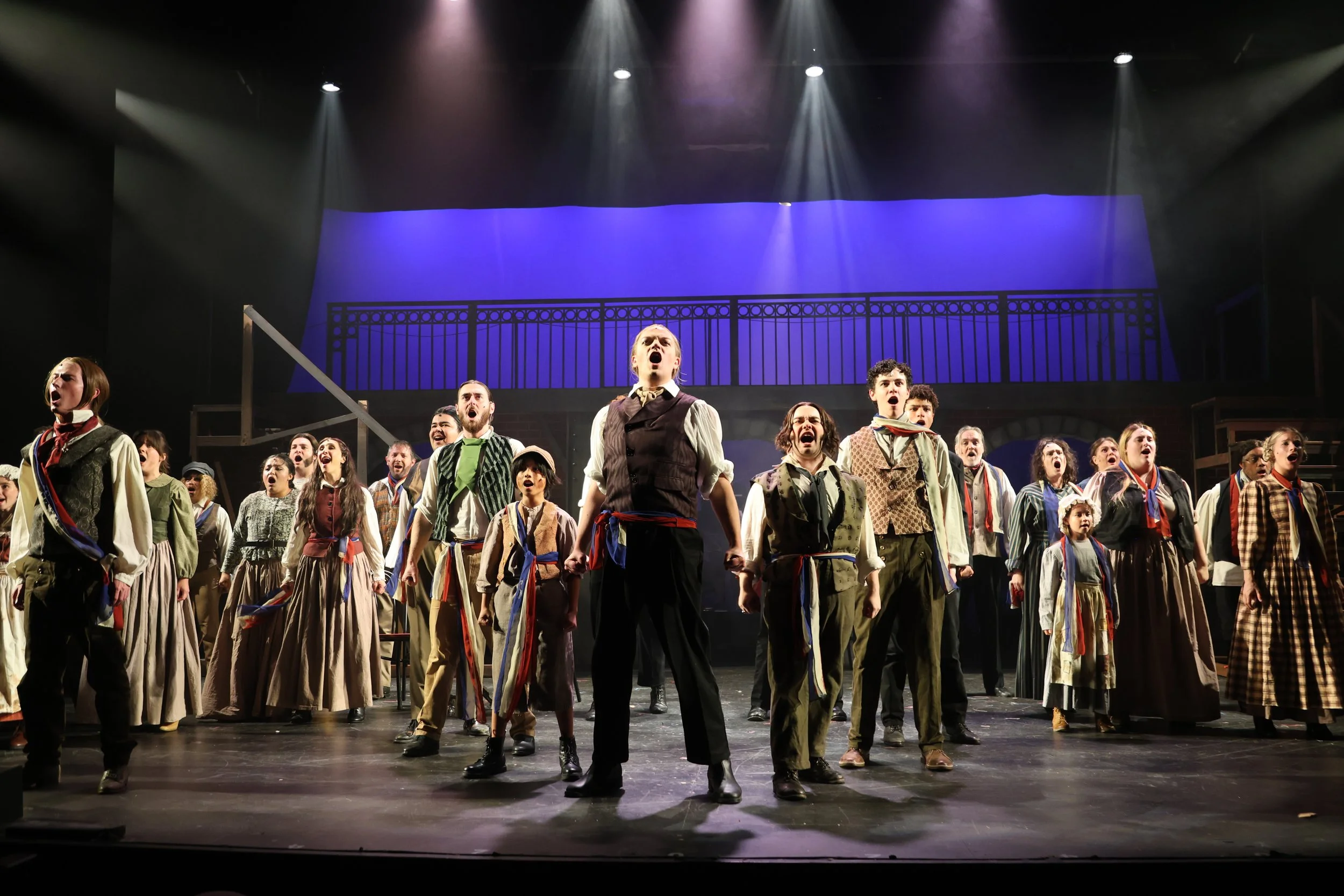
Much of the credit belongs to Harry, who has assembled a cast capable of singing, acting and dancing with equal confidence. His greatest achievement, however, may be the vocal casting. Every performer brings power, sustain, emotional depth and an extraordinary degree of comfort throughout their range. More importantly, everyone is fully invested in the material, their passion for the story and this production is unmistakable, and not one actor takes a single moment off, whether standing at the center of the action or helping populate the world around it.
That commitment is apparent from the opening notes of “Look Down,” which immediately establishes the quality of what is to follow. Harry’s movement fills the stage without allowing it to become chaotic, and the ensemble performs with tremendous vocal strength and clarity. “At the End of the Day” is a particularly impressive ensemble number, combining excellent vocals with purposeful movement before transitioning seamlessly into “I Dreamed a Dream.” Later, the voices come together beautifully in “One Day More,” with their differing vocal qualities creating layers without sacrificing balance or intelligibility, an outstanding sendoff from Act 1 into intermission.
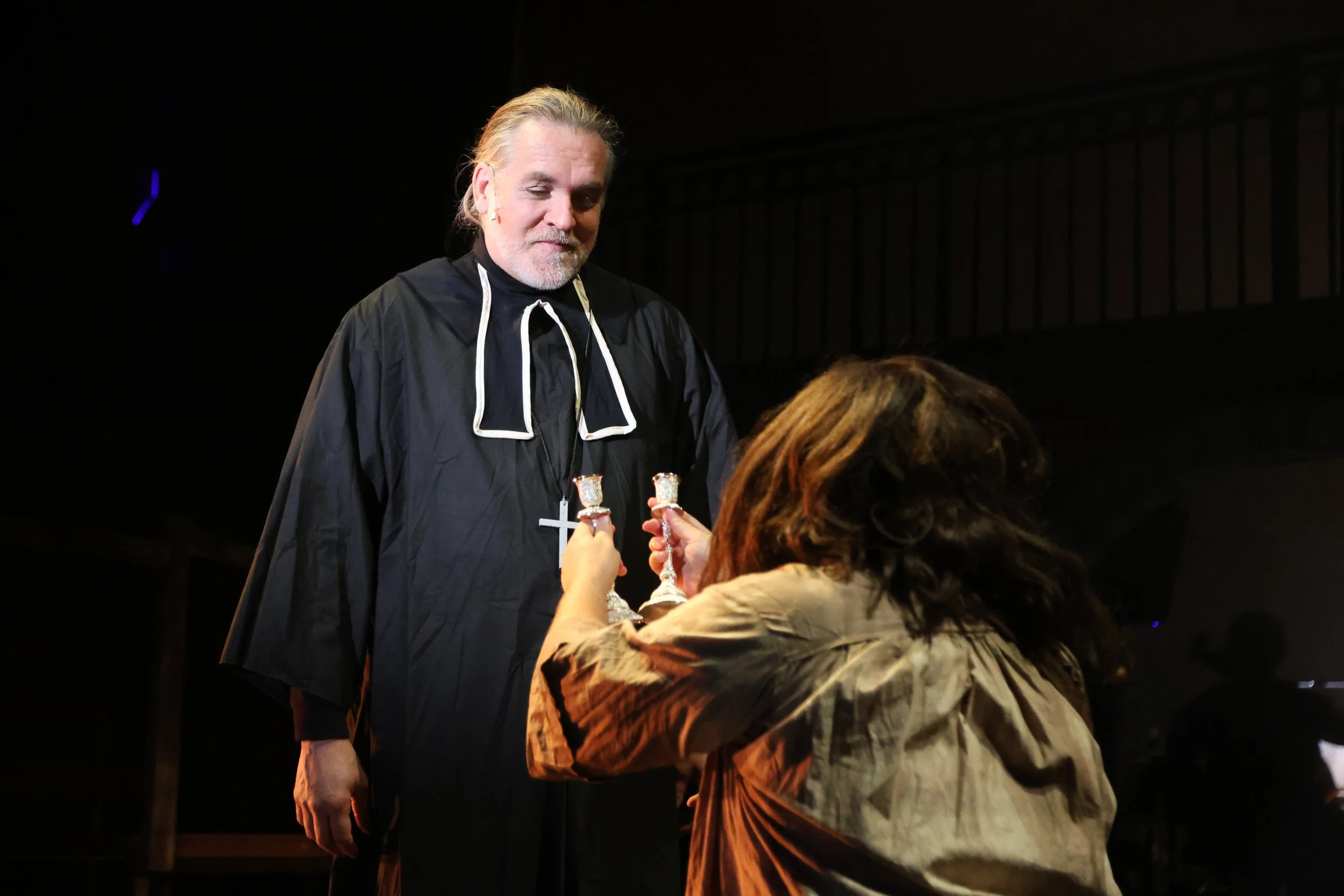
At the center of it all is Jerod Nace as Jean Valjean, whose smooth voice combines power with control and allows him to sustain the score’s most demanding passages without sounding strained. He carries himself with a posture and physical presence that establish Valjean’s strength while still making room for the compassion and vulnerability at the character’s core. “Bring Him Home” is staged as thoughtfully as it is sung, with the positioning of those around Jerod strengthening the intimacy and prayerful quality of the number. Krista Lofgren’s costumes and Jeffery Swiney-Weaver’s wig design also help trace Valjean’s passage through the years, convincingly aging Jerod as the story progresses. In fact, costumes, hair and wigs, and makeup provide a depth to the level of quality in this production that stretches well beyond Valjean.
Valjean’s journey is defined in part by the people whose lives he changes, beginning with Fantine. April Santo Domingo’s performance of “I Dreamed a Dream” showcases range, power, emotional control and beautifully sustained notes, but its impact comes from more than vocal ability. April makes Fantine’s despair deeply personal, carrying the emotion through her tone and expressions without allowing it to overwhelm the music. Her final scene with Valjean becomes a gentle duet, with April and Jerod’s clean vocals and soft harmonies bringing tenderness to one of the story’s most heartbreaking moments.
Standing in opposition to Valjean’s growing capacity for mercy is Jake Atwood’s Inspector Javert. His rendition of “Stars” is both commanding and emotional, revealing the certainty that governs Javert’s life while hinting at the fragility beneath it. That conflict reaches its culmination in Javert’s suicide, where Jake communicates profound pain and confusion as the character’s rigid understanding of justice collapses around him. It is a powerful performance because Jake does not reduce Javert to a simple antagonist. Instead, he allows the audience to see a man destroyed when the principles defining his identity no longer make sense.
The production’s younger characters carry their own variations on love, sacrifice and loss. As Éponine, Rachel Roetcisoender captures the heartbreak and anguish of “On My Own” through both her voice and expressions, bringing tremendous power to the number while maintaining complete control. Her performance with Kaden Stanford’s Marius in “A Little Fall of Rain” is tender and beautifully measured. Kaden possesses an excellent voice and gives Marius a warmth that makes the character’s youthful idealism believable. That warmth is replaced by devastating grief in “Empty Chairs at Empty Tables,” where he conveys such pain that the song feels less like a performance and more like a man trying to understand why he survived when his friends did not.
Completing that relationship is Morgan Roberts as Cosette, whose lovely soprano creates a clear vocal contrast with Rachel’s fuller and more emotionally wounded Éponine. Morgan and Kaden share an appealing sweetness, particularly during “A Heart Full of Love,” without losing sight of the urgency surrounding their relationship.
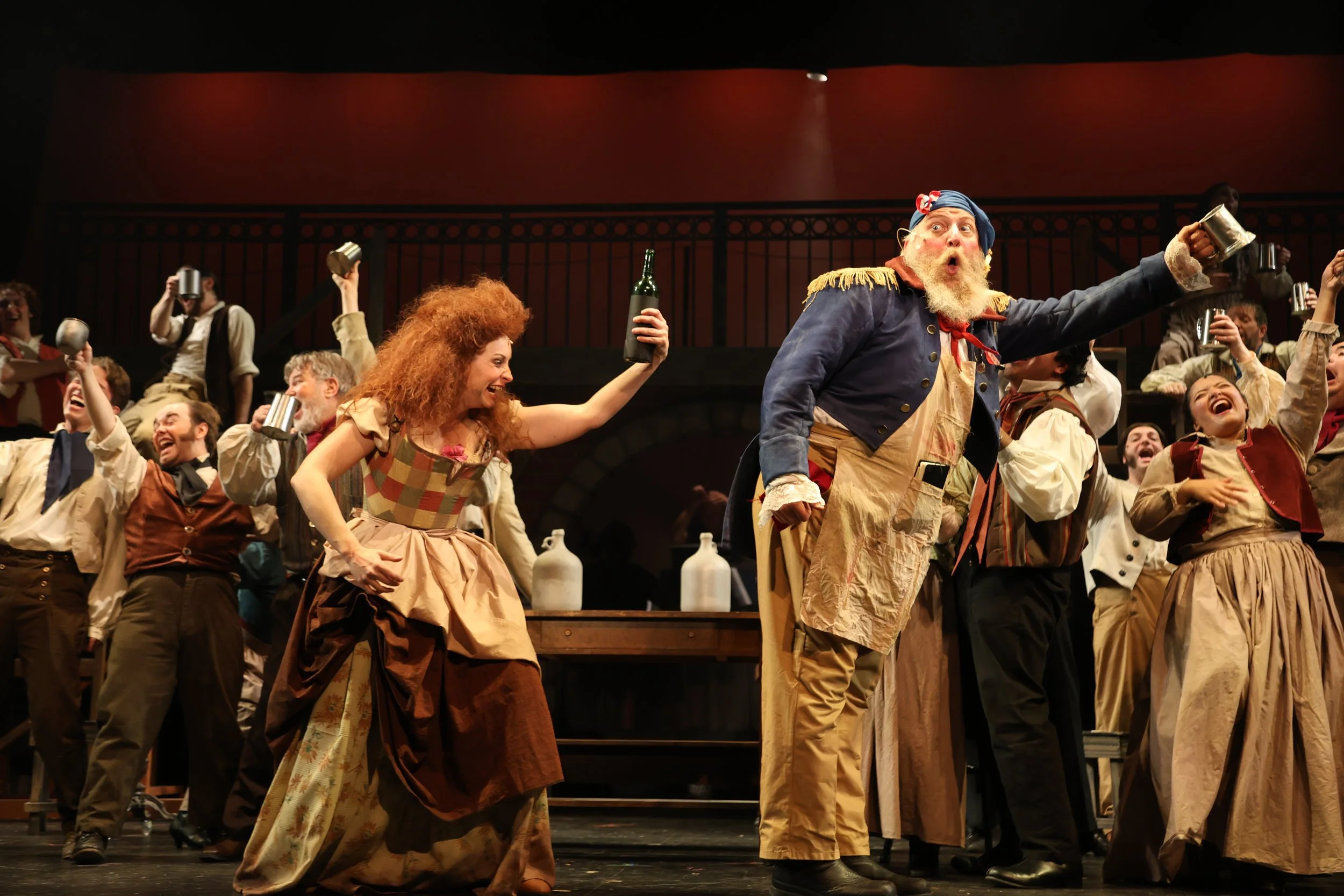
Amid so much suffering, there is some comic relief with the opportunistic Thénardiers. Tracy Perry and Rachel Blackwelder Gardner make a wonderfully entertaining pair as Thénardier and Madame Thénardier, each looking completely at home within the characters’ disreputable world. Tracy immediately establishes a relationship with the audience through his personality, gestures and comic timing, while Rachel matches his energy at every turn. Together, they deliver one of the most entertaining renditions of “Master of the House” I have seen, finding room for broad comedy without making the characters feel as though they have wandered in from a different show.
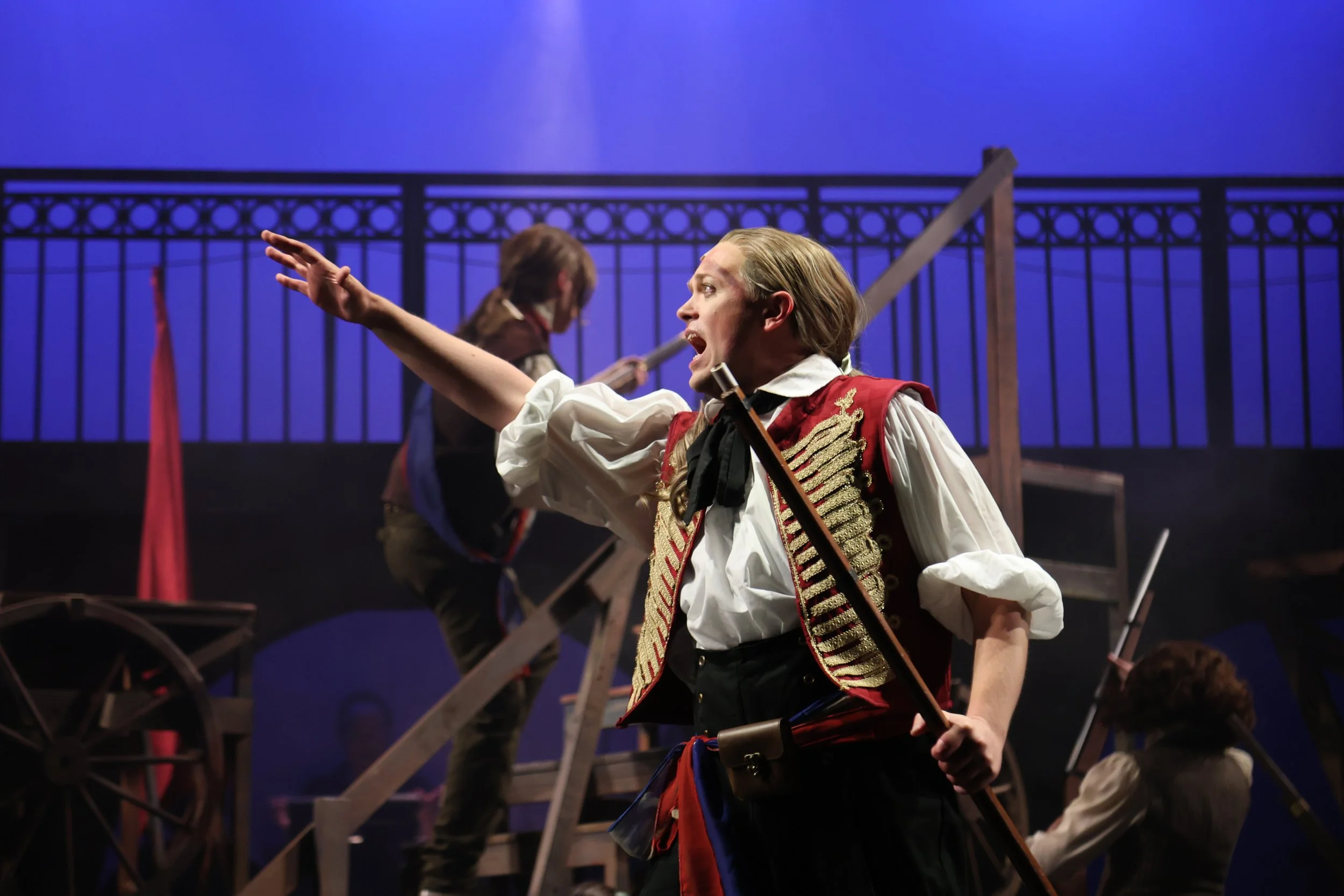
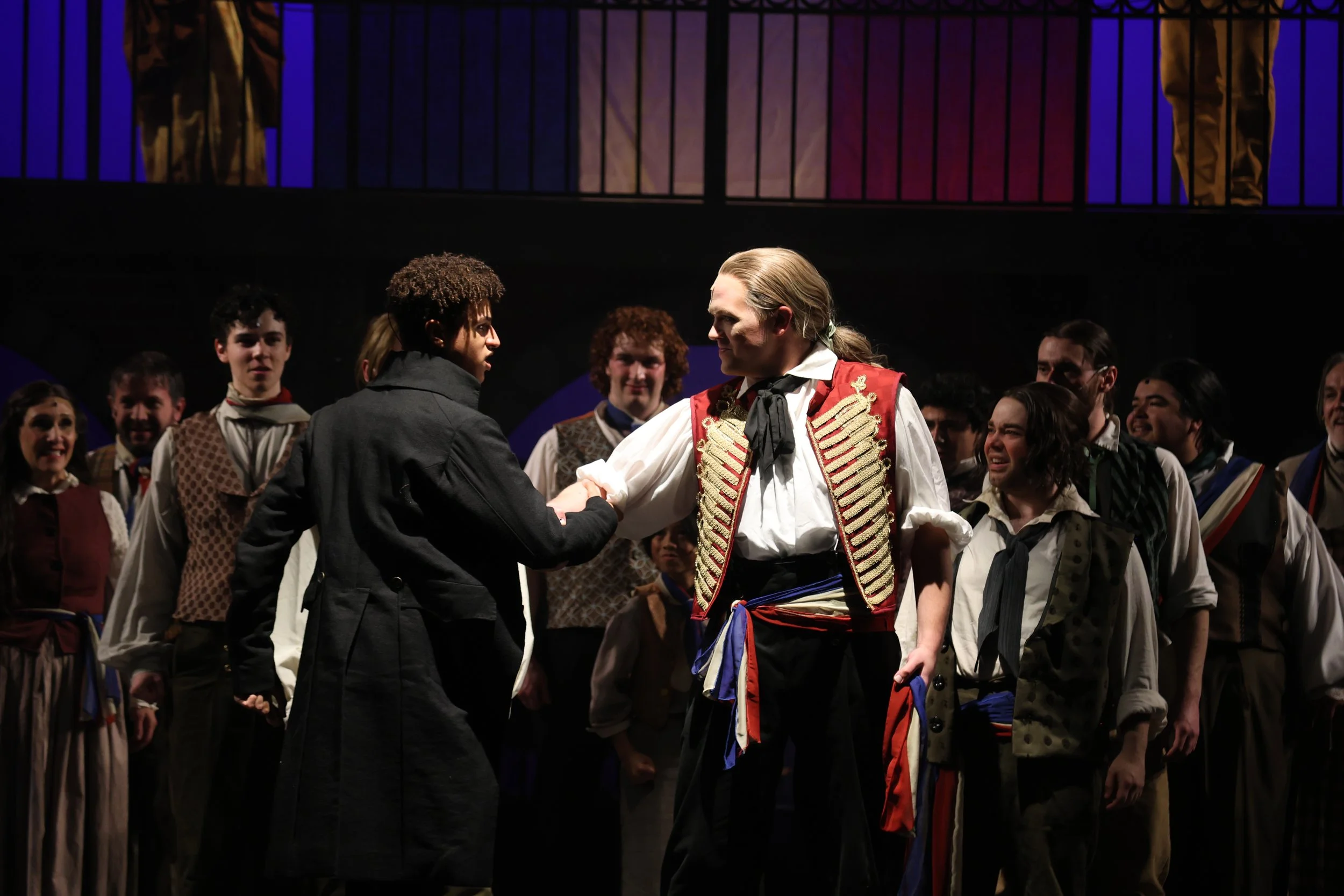
The story’s revolutionary spirit is carried by Jacob Axelson, who gives Enjolras the presence needed to lead the student uprising. The performers surrounding him create a group whose passion extends well beyond the musical’s larger ensemble numbers. Nick Bourgault as Feuilly, Jason Bullock as Brujon, Joseph “Jojo” Flores as Joly, Joaquin Makinster as Courfeyrac, Riley Stowell as Combeferre, Haunz Stroschein as Lesgles, Jacob Vallie as Grantaire, Spencer Weidmann as Claquesous and Tyler Weston as Jean Prouvaire help make the rebellion feel populated by individuals rather than interchangeable background figures. “Drink with Me” is especially effective, with strong harmonies and moments of uncertainty that remind us these revolutionaries are young people confronting the likelihood that they will not survive what comes next.
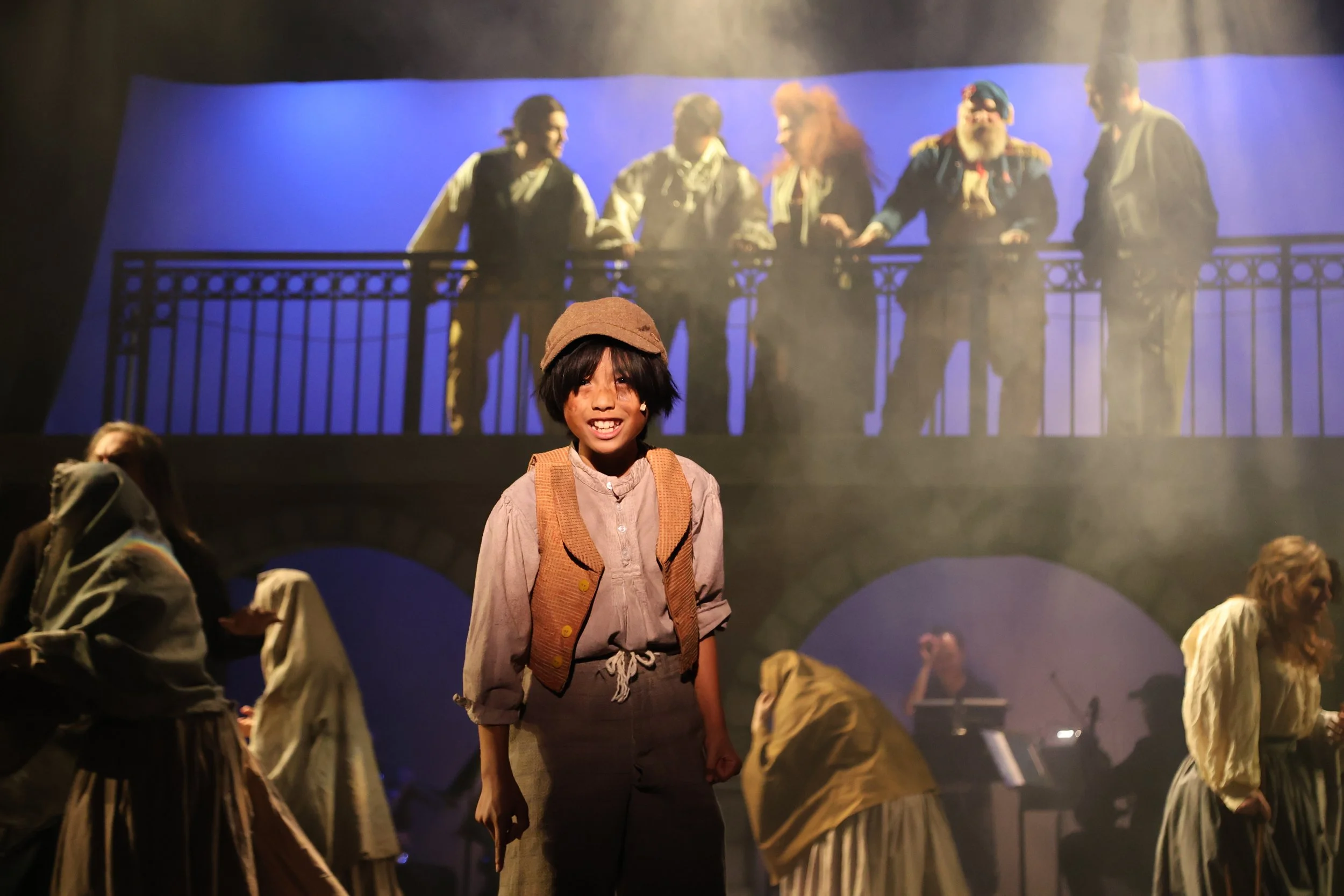
That uprising also introduces Adrian Santo Domingo’s confident and spirited Gavroche. Along with Hazel Muñoz and Violet Brotherston, who share the roles of Young Cosette and Young Éponine, Adrian demonstrates that the production’s younger performers can stand comfortably alongside the adult company. Their work never feels tentative or out of place, and the children’s performances are among the production’s many strengths.
Throughout the evening, Emma Jade DeLoye, McKenna Hansen, Bruce Hassl, Coral Horton, Kat McFadden, Jim Mendoza, Christina Naficy, Kyla Rivera and Finn Sharp help create the larger world surrounding these central characters. Factory workers, prisoners, inn guests, impoverished citizens and revolutionaries emerge with individual lives and purposes. The ensemble is vocally excellent, but its greatest strength is the consistency of its acting. Even performers outside the immediate focus remain engaged with the action, reinforcing the sense that the events onstage affect an entire community.
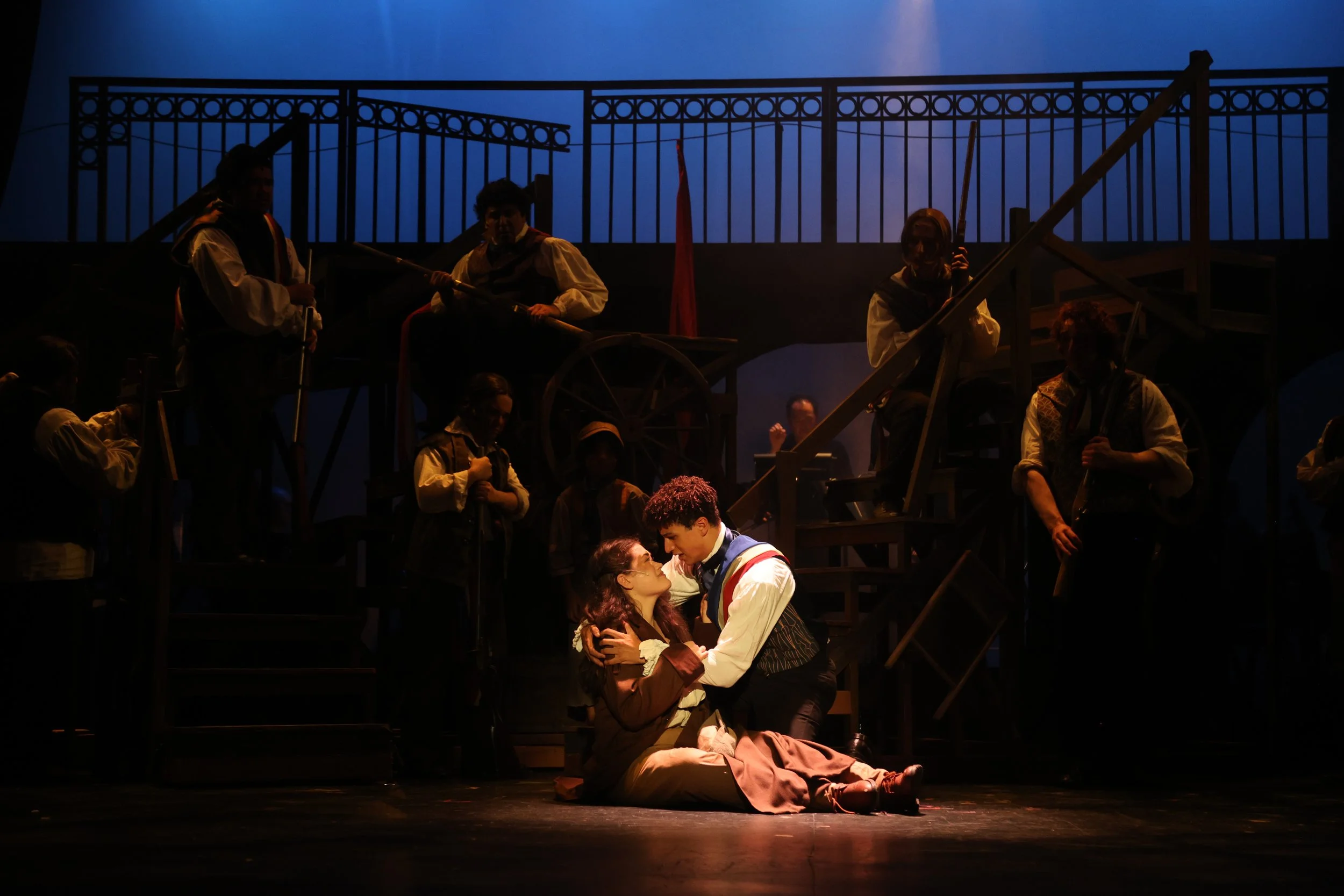
Harry’s staging demonstrates the same exceptional attention to detail. Performers are moved and positioned with purpose, including during moments when they are not the immediate focus, ensuring that the stage never feels static or carelessly populated. The modular set designed by Harry and Dennis Kurtz supports that movement beautifully. Its pieces become part of the production’s choreography, and the scenic angility allows scenes and locations to change fluidly without disrupting the musical’s momentum. The barricade is especially effective, both as a striking visual centerpiece and as a functional part of the action. Even the set changes contribute to the production’s flow, which never lets up.
The orchestra, led by music director and conductor R.J. Tancioco, is incorporated visibly into the setting, an especially fitting decision for a musical whose score is nearly continuous. Rather than feeling separated from the production, violinist Jeremy Lynch, violist Brenden Smith, cellists Kaitlynn Turner and Erika Feibig, reed players Kate Johnson, Elizabeth Jolly, Bruce Carpenter, Cody Clark and Cameron Stedman, trumpeter Kevin Slota, horn players Mark Willis and Bradley Leavens, trombonist Nick Bischoff, keyboardists Brian Soushek, Paul Stovall and Frances Vonada, bassists Ethan Sobotta and Amelia Matsumoto, and percussionist Dylan Thomas become part of its visual and emotional architecture. R.J. guides them through Schönberg’s demanding score with the necessary size and urgency while maintaining an excellent balance between the orchestra and singers. Their presence onstage also reinforces just how integral the music is to every moment of the story.
Some of the production’s most memorable moments are a result of the work of Harry’s creative team, none more than lighting designer Jacob Viramontes. When Valjean resolves to change his life, light resembling the rising sun pours in from stage right, visually marking his transformation. Later, yellow light from behind the barricade establishes the arrival of dawn, while the rear screen is illuminated in red as the uprising reaches its tragic conclusion. The deaths at the barricade are staged in slow motion, with Harry’s direction and Jacob’s lighting combining to transform the violence into a haunting theatrical image. During “Empty Chairs at Empty Tables,” a spotlight isolates Marius while silhouettes of the fallen appear above him, making his grief feel populated by the very people whose absence he mourns. These are just a few examples of an outstanding lighting design.
Supporting all of this is Devon Brown’s sound design, which provides the necessary volume without sacrificing balance between the performers and orchestra. Aside from a very small number of microphone glitches, the sound remains clear and controlled, allowing the vocal detail, harmonies and emotional weight of the score to come through. Krista’s costumes, Jeffery’s wigs and Emma Peters’ properties further support the period and the production’s visual detail, tying into an overarching scenic design that doesn’t just fit the story, it lifts it up.
Les Misérables asks whether compassion can overcome injustice and whether love can transform a life. Tacoma Musical Playhouse’s production understands that those questions matter only when the audience believes completely in the people asking them. This cast and creative team accomplish that through exceptional voices, fully committed acting and a production in which every technical and artistic element works toward the same purpose. If this was Jon Douglas Rake’s final selection for the theatre he founded, it is difficult to imagine a more fitting tribute. This Les Misérables is not merely one of Tacoma Musical Playhouse’s strongest productions; it is the finest work I have seen on its stage.
The Tacoma Musical Playhouse production of Les Misérables runs on stage in Tacoma through October 4. For more information, including ticket availability and sales, visit https://www.tmp.org/lesmiserables.
Photo credit: Dennis Kurtz