
Stage Review - What the Constitution Means to Me (Vashon Repertory Theatre)
Stage Review - What the Constitution Means to Me
Presented By: Vashon Repertory Theatre - Vashon Island, WA
Show Run: September 10 - September 13, 2026
Date Reviewed: Saturday, September 12, 2026
Run Time: 2 Hours (including a 15-minute intermission)
Reviewed by: Greg Heilman
What the Constitution means to any one person is inevitably shaped by what that person has asked of it. For playwright Heidi Schreck, that relationship began when she was a teenager, traveling to American Legion halls and earning money for college by delivering speeches about the document. Decades later, those competitions became the foundation for What the Constitution Means to Me, a play that starts as something resembling an unconventional civics lesson before becoming much more personal, examining what the Constitution has meant for generations of women and asking whether the protections promised on paper have always existed in practice.
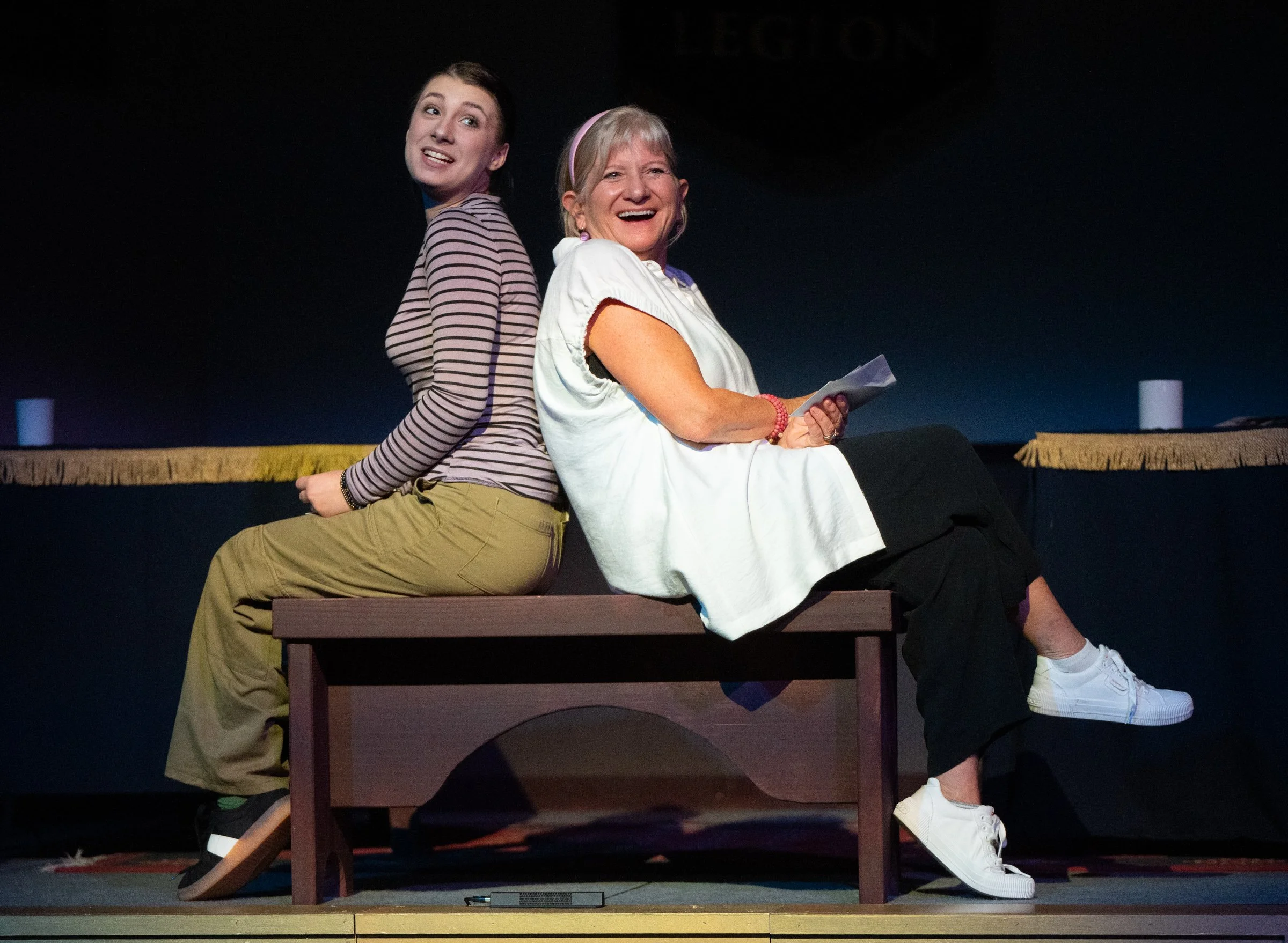
Vashon Repertory Theatre brings Schreck’s Pulitzer Prize finalist and Tony-nominated play to Open Space for Arts & Community, where it ran September 10 through 13 under the direction of Charlotte Tiencken, with Lisa Peretti serving as co-director. The production stars Mik Kuhlman as Heidi, Reed Harvey as the Legionnaire and Mike, and Ari “Reggie” Anderson as the Debater.
The premise initially transports the audience back to Heidi’s teenage years, when she competed in American Legion oratorical contests. As an adult, Heidi attempts to recreate one of those competitions, complete with a Legionnaire keeping time and enforcing the rules, while slipping back into her 15-year-old self. What begins with the optimism and certainty of a teenager fascinated by the Constitution gradually changes as the adult Heidi begins interrupting the recreation. The Constitution she understood as a teenager becomes considerably more complicated when viewed through her own experiences and those of the women in her family.
That transition is one of the things that makes Schreck’s script so effective. What the Constitution Means to Me isn’t simply a lecture about constitutional law, although the Ninth and Fourteenth Amendments receive particular attention. It connects those ideas to women’s rights, immigration, domestic violence and the ways constitutional protections have been interpreted and applied throughout American history. The result is something considerably more personal than its title might suggest. Schreck isn’t merely asking what the Constitution says, rather she’s asking who has historically been able to rely on what it promises.
Mik has an enormous amount to carry as Heidi, both in the sheer quantity of material and in the emotional distance she has to travel with it. She needs to convincingly inhabit the enthusiasm of the teenage competitor without turning her into a caricature, then gradually allow the adult woman underneath that recreation to take control. Those two versions of Heidi begin almost as separate people before the boundaries between them increasingly disappear. Mik handles that evolution well, allowing the humor and intellectual curiosity of the early portions of the play to give way naturally to something considerably more vulnerable.
That vulnerability becomes especially important when Heidi moves away from constitutional theory and begins talking about the women in her own family. The storytelling becomes less performative and more reflective, and Mik doesn’t force those transitions. There is an intimacy to the way she communicates directly with the audience that makes it feel less like watching a character deliver a monologue and more like listening to someone work through what these ideas mean to her in real time. There is no understating the amount of dialogue that Mik needs to recite in this play, and yes, there were less than a handful of times on Saturday when she had to call for a “line”, but while that ordinarily might interrupt the flow, it’s allowable here, for a few reasons. First, all Mik needed was a prompt, upon receiving that she proceeded to move forward like she hadn’t missed a beat. More importantly, though, I’d rather have an actor in a play like this ask for a line to keep her train of thought on track than to stammer or pause, risking misplacing a line here or there and thus altering the context of the conversation.
Reed provides an excellent counterbalance as the Legionnaire. He is very good during his spoken material, but some of his most effective work comes when he isn’t speaking at all. Reed understands how to become almost completely still while Heidi has control of the room, remaining present without pulling focus, then activating immediately when the script requires him again. It’s a subtle skill, particularly in a production this intimate, and Reed’s restraint helps keep the focus precisely where it needs to be.
The physical production wisely avoids competing with the text. Erik Furuheim’s straightforward set establishes the American Legion hall with antlers and a mounted fish decorating the walls, photographs of former members looking down over the proceedings, and little more than a podium and table occupying the playing space. It immediately establishes the kind of room in which teenage Heidi would have delivered these speeches, while leaving enough visual simplicity for the play to move beyond that memory.
Chris Lubitz’s lighting becomes particularly effective as that transformation occurs. The brighter illumination of the Legion hall supports the public, performative quality of Heidi’s competition speech, while softer and more focused lighting accompanies the moments when she steps outside the competition and reflects on something more serious or emotional. Rather than announcing those shifts, Chris allows the lighting to quietly help focus the audience’s attention and change the emotional temperature of the room.
The production eventually abandons the recreation altogether. Heidi’s examination of a document written centuries ago gives way to an actual debate about what should happen to it now, bringing Ari into the production as the teenage Debater. It’s an important structural choice in Schreck’s play, after spending so much time examining what previous generations created and how those decisions affected the generations that followed, the final argument belongs to someone from the generation that will inherit it.
That makes What the Constitution Means to Me less interested in supplying an answer than in creating a conversation, a refreshing idea in a world where there is so little of that happening. The Constitution can simultaneously represent an extraordinary expansion of individual rights and a document whose protections have not historically been experienced equally by everyone. Schreck allows those ideas to exist alongside one another, asking the audience to wrestle with that contradiction rather than resolving it for them.
Vashon Repertory Theatre’s production understands that the most effective way to make that argument isn’t by overwhelming the audience with theatricality. Directors Charlotte Tiencken and Lisa Peretti keep the storytelling direct, allowing the actors to make something written about constitutional amendments feel distinctly human. In doing so, the production returns repeatedly to the question contained in the title. What the Constitution means isn’t necessarily the same thing to everyone, and perhaps the most important part of the question is continuing to ask it.
The Vashon Repertory production of What the Constitution Means to Me has closed, but the learn more about the organization, including upcoming productions, visit https://www.vashonrepertorytheatre.org/.
Photo credit: Michelle Bates