
Stage Review - Murder on the Nile (Valley Center Stage)
Stage Review - Murder on the Nile
Presented By: Valley Center Stage - North Bend, WA
Show Run: June 12 - June 28, 2026
Date Reviewed: Sunday, June 28, 2026 (Closing)
Run Time: 2 Hours, 30 Minutes (including at 15-minute intermission)
Reviewed by: Greg Heilman
Mysteries are often remembered for their solutions, but the best of the genre are remembered even more so for their suspects. Long after the identity of the killer has faded from memory, audiences recall the colorful personalities, hidden motives, and uneasy relationships that kept them guessing. That’s the challenge (and opportunity) of staging an Agatha Christie mystery. The crime may set the story in motion, but it’s the characters who sustain the intrigue. If they fail to distinguish themselves, the mystery loses much of its appeal. Valley Center Stage’s production of Murder on the Nile, which concluded its run on June 28, understood that assignment well, presenting a cast that embraced Christie’s heightened style while allowing each character to occupy a unique place within the ensemble.
Adapted by Agatha Christie from her novel Death on the Nile, Murder on the Nile relocates the famous mystery to a paddle steamer traveling the Nile River. Newlyweds Kay Mostyn and Simon Mostyn hope their honeymoon will provide a fresh start, but old romances, jealousies, financial interests, and long-held resentments soon catch up with them. Before long, murder interrupts the voyage, leaving Clergyman Canon Pennyfather to sort through an increasingly tangled web of motives before another life is claimed.
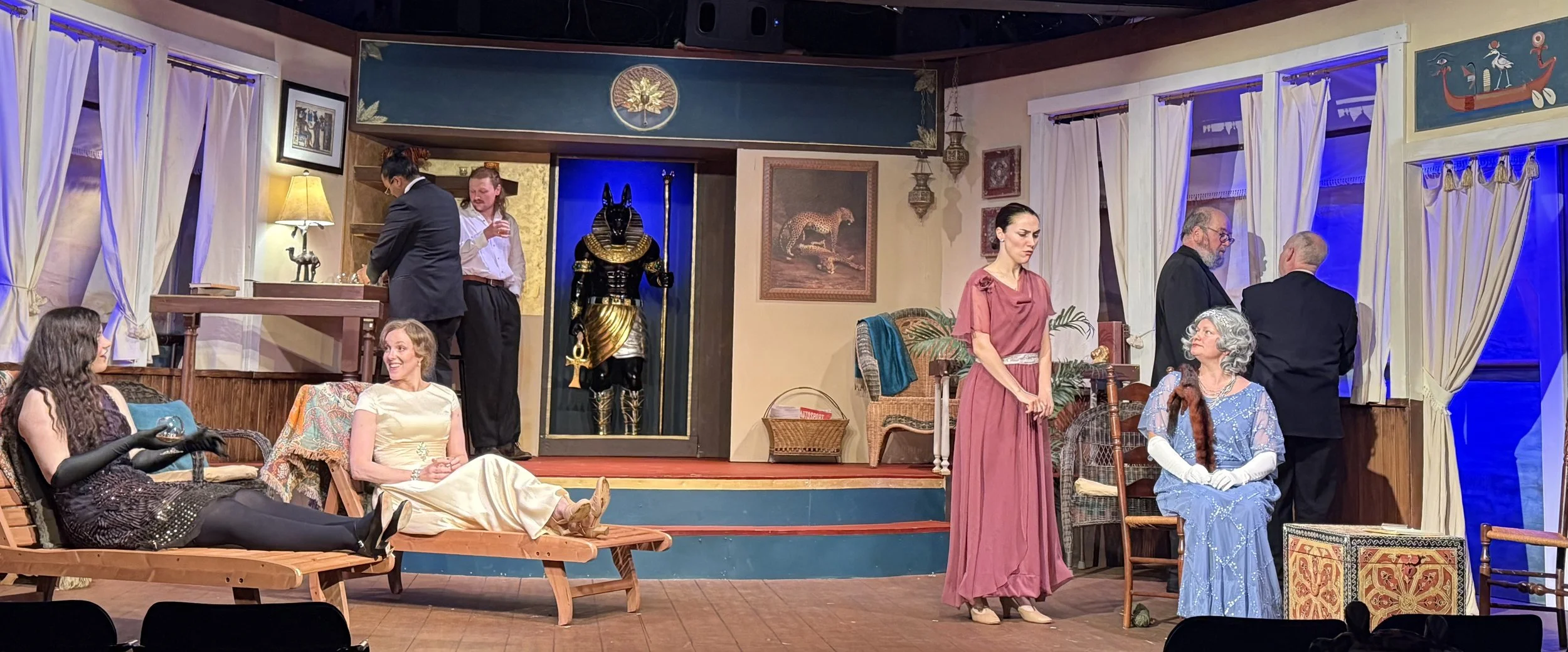
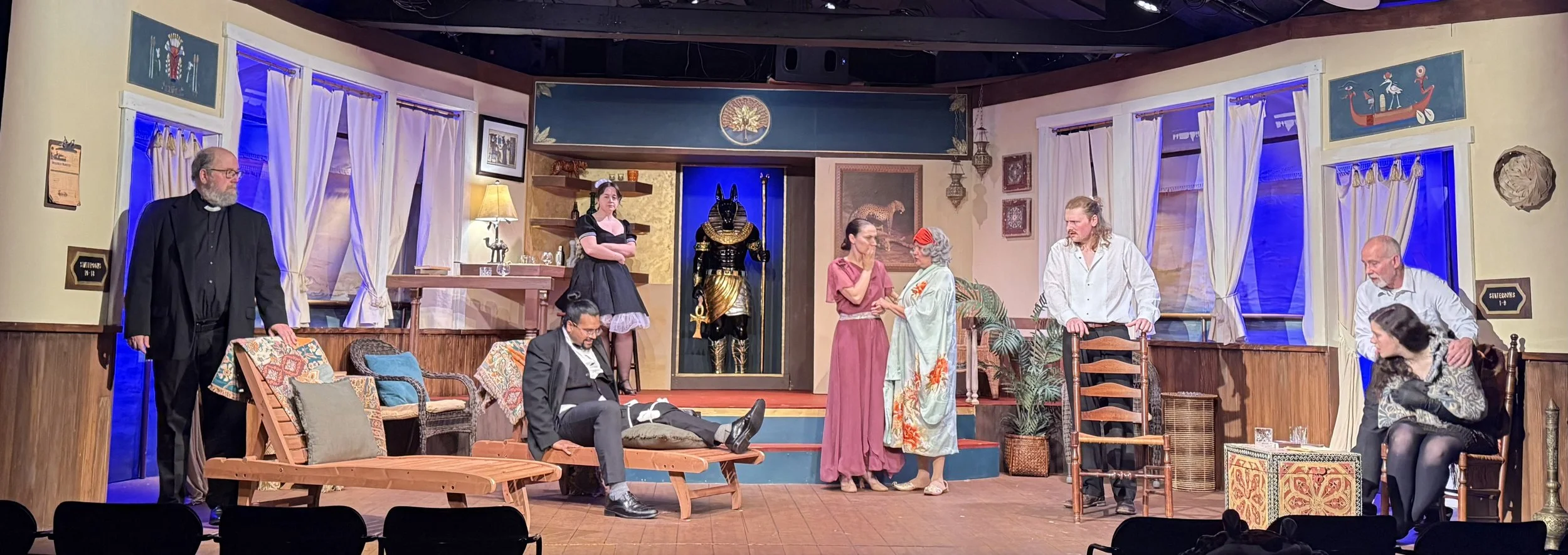
By far, the production’s greatest strength is the company itself. Christie mysteries demand an ensemble capable of creating fully realized characters while constantly reacting to one another, and this cast consistently meets that challenge. Every performer understands both the humor and the tension that exist within Christie’s world, allowing scenes to breathe naturally while maintaining the momentum of the investigation.
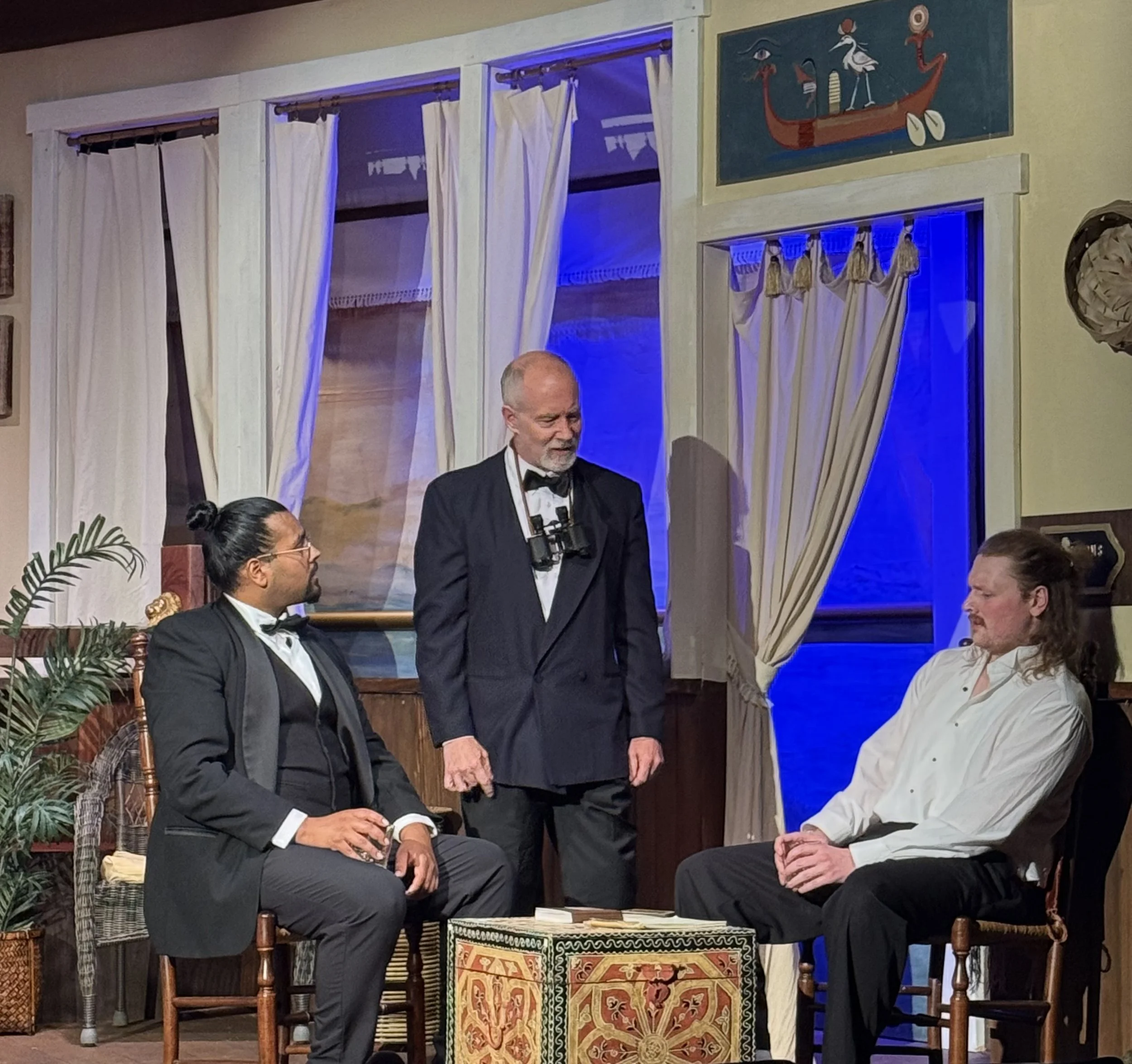
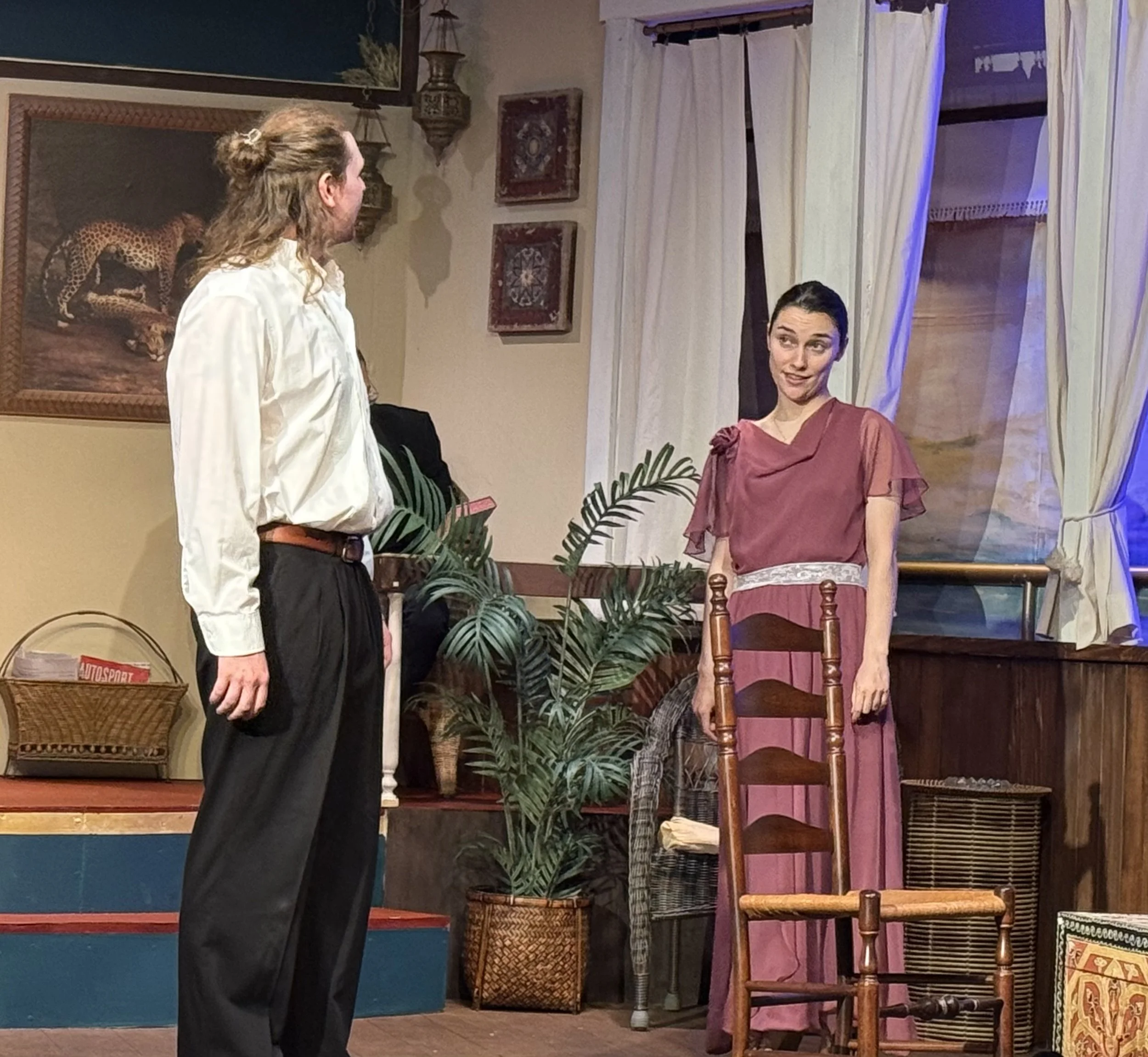
One of the audience’s earliest introductions is Galen Eames’ William Smith, and it’s immediately clear that there is more beneath the surface than he is willing to reveal. Openly dismissive of authority and skeptical of the clergy, William establishes himself as someone unwilling to conform to social expectations. Yet, as with nearly every Agatha Christie character, his true agenda remains carefully concealed. Galen embraces that uncertainty, creating a character whose motivations continually invite suspicion while never fully revealing what secrets he may be carrying.
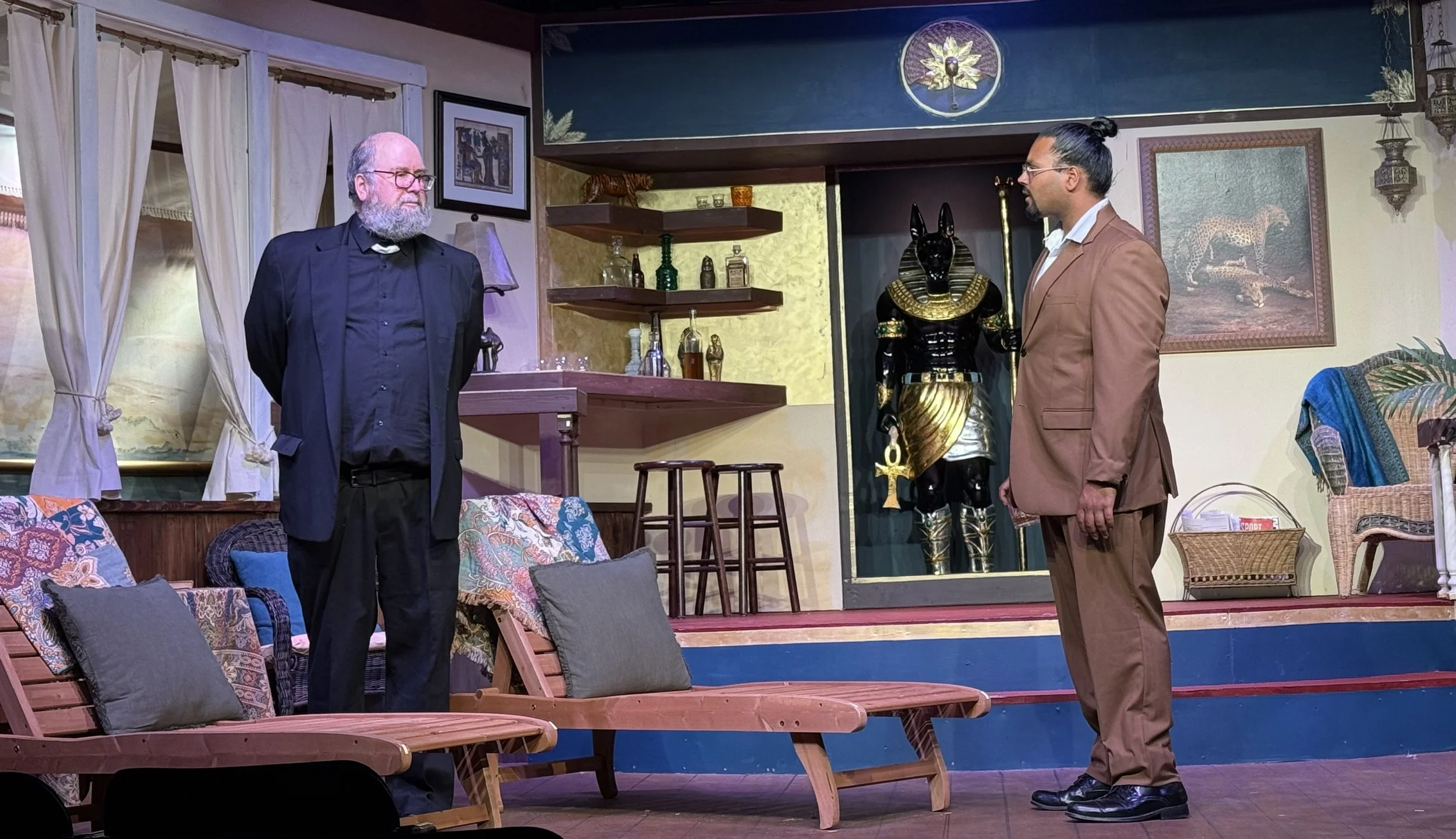
As Kay Mostyn, one half of the paddle steamer’s resident power couple, Tenesia Knudsen effectively captures the entitlement and self-centered nature that drives much of the story’s conflict. Everything in Kay’s world revolves around Kay, and Tenesia embraces that perspective without making the character one-dimensional. Her use of pauses and deliberate emphasis gives many of her exchanges added weight while reinforcing the social status that Kay so desperately clings to. As Kay’s husband Simon Mostyn, Sri Kanduri delivers a performance built less on grand emotion than on precision. His portrayal is defined by the rhythm of his delivery, the carefully chosen pauses, subtle turns, and the measured way he engages with the other passengers. Those choices give Simon an air of calculation that keeps the audience questioning his intentions. An early conversation between Simon and Canon Pennyfather, in which he recounts the history of his relationship with Kay, becomes one of the production’s most effective exchanges. Rather than simply providing exposition, Sri uses the scene to reveal layers of Simon’s personality, allowing every pause and shift in tone to hint that there may be more beneath the surface than he’s willing to admit.
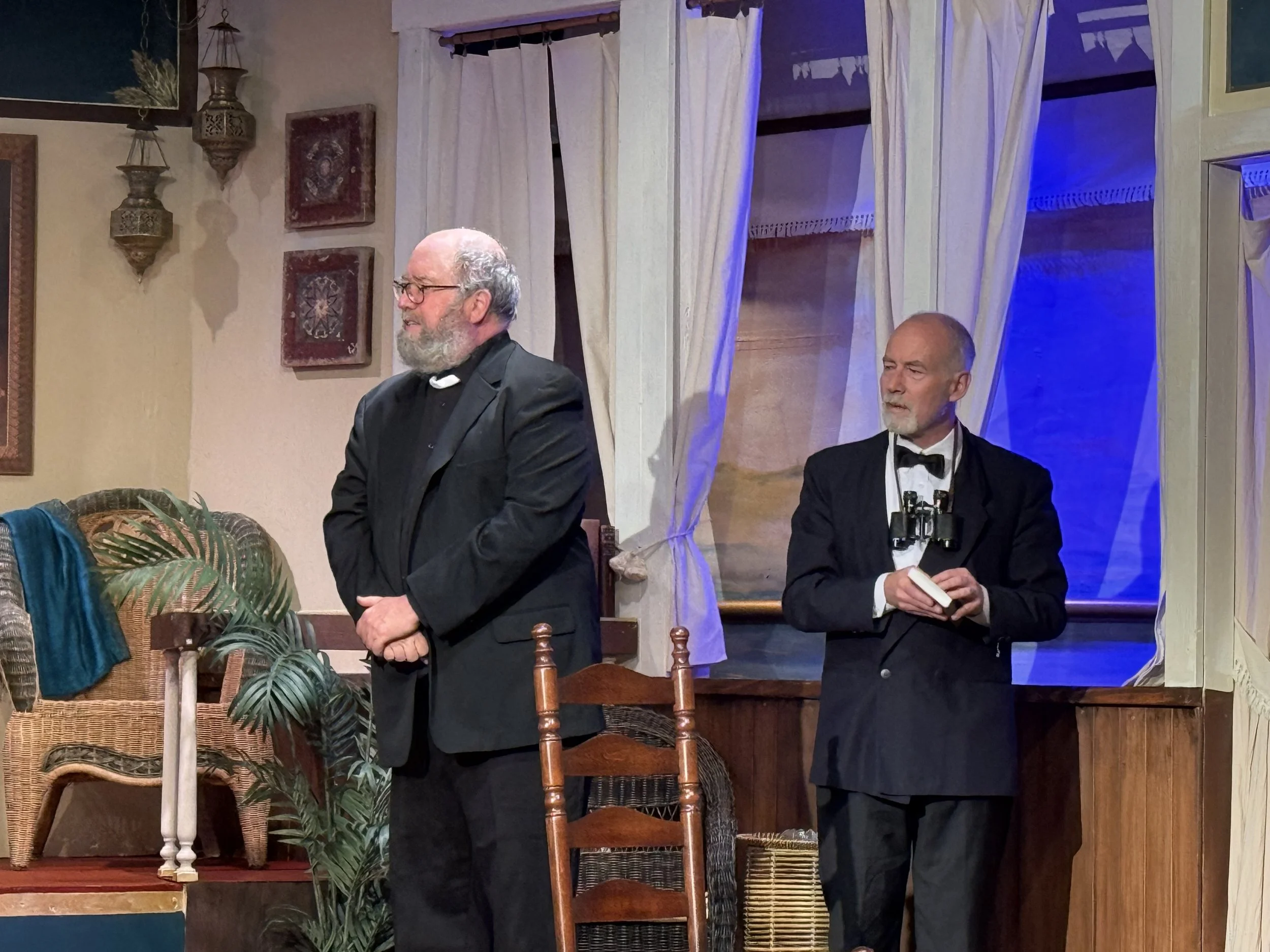
Canon Pennyfather assumes the role occupied by Hercule Poirot in the literary version of this story; Christie often made this adjustment when adapting her work for the stage, allowing another character to become the de facto investigator through circumstance rather than introducing her famous detective. Terry Boyd embraces that responsibility with an understated confidence. Early scenes find Pennyfather observing more than participating, approaching situations with skepticism, dry wit, and just enough curmudgeonly charm to make his commentary consistently entertaining. As the investigation unfolds, Terry smoothly transitions into the production’s central detective, his comic timing—often accentuated by a well-timed pause—giving way to a more focused determination as the mystery begins to unravel.
Opposite them, Ava McCallum crafts a wonderfully unsettling Jacqueline de Severac. From her very first appearance, Jacqueline feels just slightly “off,” an uneasiness that steadily grows as the evening progresses. Rather than immediately descending into madness, Ava carefully allows Jacqueline’s emotional stability to deteriorate scene by scene until the obsession consuming her becomes impossible to ignore. It’s performances like this that make familiar stories feel fresh. Audiences may know Christie’s plot, or have become familiar with her characters through books and film, but actors like Ava create interpretations that become uniquely their own, distinguishing this production from countless other tellings.
Skye Stafford provides much of the evening’s comic relief as the eccentric Miss ffoliot-ffoulkes, Kay’s Aunt Helen, delivering a performance filled with personality and impeccable timing. Skye has an undeniable stage presence, finding humor without ever feeling disconnected from the larger mystery unfolding around her. Jag delivers a convincing Central European accent as Dr. Bessner, whose fascination with Egyptian culture is evident from the moment he appears. While the portrayal occasionally borders on caricature, that heightened approach generally fits the style of the production. There are moments during the story’s more serious developments where a slightly more restrained portrayal might have strengthened the dramatic tension, but the performance remains an entertaining addition to the ensemble. Ed Benson makes the most of comparatively limited stage time as Captain McNaught. While his role isn’t as expansive as many of the other suspects, Ed provides exactly the grounded presence the story requires whenever the captain enters the action.
Rounding out the cast is Jillian Faulk, who is excellent as Kay’s maid, Louise. Jillian avoids turning the role into broad comedy, instead presenting a character who is both charming and quietly enigmatic. Like so many of Christie’s creations, Louise always seems to know more than she is willing to reveal, and Jillian maintains that mystery throughout the performance.
Co-directors Chris Clark and Mary Guthrie clearly understand that Christie mysteries aren’t driven by plot twists alone—they’re driven by the audience’s evolving suspicions of every character on stage. They embrace the theatricality that makes Agatha Christie mysteries so enjoyable. The production never attempts gritty realism, instead leaning into the heightened world Christie created without tipping into parody. Just as impressive is the way they’ve shaped the ensemble’s physical storytelling. The movement becomes every bit as important as the dialogue itself. Whether it’s the precise timing of an actor pausing to take a drink, a carefully choreographed seat that punctuates an awkward silence, or the controlled chaos that erupts following the murder, the staging continually reinforces both the comedy and the mystery. Every gesture feels purposeful, and the ensemble executes this choreography with remarkable precision. In a Christie whodunit, the strength of the ensemble is paramount. Every performer must not only create a distinct character but also function as part of the larger machine that keeps the audience questioning every interaction, and Chris and Mary have assembled and guided a company that does exactly that.
Their finest work, however, comes during the play’s climactic reenactment of the murder, that signature Agatha Christie sequence in which the investigator gathers the suspects and meticulously reconstructs the events leading to the crime. It is a scene that audiences familiar with Christie anticipate, and one that can easily become static if treated simply as exposition. Here, it becomes theatrical. The choreography of the performers, the deliberate movement through the space, and the carefully timed lighting cues combine to create a sequence that is both visually striking and dramatically gripping. Having seen a considerable number of Christie adaptations over the years, I found this to be one of the most memorable stagings of that iconic scene that I’ve experienced, a fitting culmination of the directors’ careful attention to movement and ensemble throughout the evening.
The production is equally supported by a strong technical team. Scarlett Jonas’ scenic design immediately evokes Egypt, creating an attractive visual environment filled with architectural detail and atmosphere. While the setting beautifully captures its Egyptian locale, it never quite convinces as the deck of a riverboat. Pam Lewis’ costumes do an excellent job distinguishing personalities while reinforcing social standing, with particularly effective visual contrast between Kay and Jacqueline. Chris Clark’s projection design establishes both the Egyptian setting and the mysterious atmosphere from the opening moments, while his original music and sound design reinforce the production’s sense of intrigue throughout the evening, especially during scene changes. Sam Saulnier’s lighting contributes several memorable moments, especially during the climactic reenactment and the production’s final revelations.
Finally, almost a character unto itself, Grace Heincke’s dialect coaching deserves special recognition, as the consistency of the various accents across the company adds considerably to the production’s authenticity. The accents and dialects are extremely strong and never waver from beginning to end. Extremely well done here.
If mysteries are remembered for their suspects more than their solutions, then Valley Center Stage’s Murder on the Nile is exceedingly memorable because of the its focus on the story’s characters. By the time Canon Pennyfather pieces together the truth, the audience has spent two enjoyable hours not simply solving a puzzle, but getting to know the fascinating personalities who populate it. Through a confident ensemble, thoughtful co-direction from Chris Clark and Mary Guthrie, and technical elements that support the mystery without overshadowing it, this production reminds us that while audiences may arrive hoping to discover who committed the murder, they leave remembering the people who made uncovering the answer so enjoyable.
The Valley Center Stage production of Murder on the Nile has closed, but if you would like to know more about the organization and its upcoming shows or programs, visit https://valleycenterstage.org/.
Photo credit: Scarlett Jonas