
Stage Review - Next Exit (Annex Theatre)
Stage Review - Next Exit
Presented By: Annex Theatre - Seattle, WA
Show Run: February 06 - February 21, 2026
Date Reviewed: Thursday, February 12, 2026
Run Time: 80 minutes (no intermission)
Reviewed by: Greg Heilman
Nothing speaks to the strength of the talent within the Seattle theatre scene like taking in new works by local playwrights. I’ve said before that some of the best work being done in the region happens in the most nondescript, seemingly out-of-the-way places, and as I followed my directions to Annex Theatre on Thursday evening, smack in the middle of Capitol Hill, I knew it was one of those places—and frankly, one of those organizations—the kind that prides itself on incubating new works by some of the best up-and-coming playwrights in Seattle. The latest example of this is running on stage through February 21, with the premiere of j. chavez’s new piece Next Exit, a play that fits squarely in the wheelhouse of this organization. Directed by Max Koh, Next Exit is a natural extension of Annex Theatre’s mission to develop bold, original work and amplify emerging voices, often embracing the unconventional and the unexpected. That ethos is immediately apparent in both the structure and tone of this premiere.
Set on the shoulder of I-5 during a record-breaking heatwave, though in all honesty it could take place on the side of any road, the play introduces us to Miguel (Kevin Masayuki Tanner), a man stranded after his car breaks down, with little more than time and circumstance—along with an unexpected companion in Orlando, a dead possum (Kendra Tamár Budd). What begins as an absurd premise quickly unfolds into something far more contemplative. As Miguel and Orlando pass the time in conversation, the play begins to unpack questions not just of existence, but of what it means to live, to die, and to find meaning somewhere in between.
From the outset, the play establishes a rhythm built on dialogue—quick exchanges that move fluidly between humor and philosophy. Orlando, despite (or perhaps because of) being dead, becomes a surprisingly effective conversational foil. Through these exchanges, the play begins to explore death in a way that is at once casual and profound—stripping it of some of its mystery while still acknowledging its weight. The humor often lives in the pauses, the looks, and the timing, allowing the audience to sit in both the absurdity and the discomfort of those conversations.
Kendra Tamár Budd’s is the standout performance. As a “dead but chatty” possum, Kendra walks a careful line between irreverence and insight, delivering lines with an ease that makes even the more philosophical musings feel accessible. Orlando often serves as a voice of reason within the play, challenging Miguel’s assumptions and gently pushing him toward a deeper understanding—not just of death, but of how he has been living. Opposite Kendra, Kevin Masayuki Tanner’s Miguel is the emotional anchor of the piece, presenting a character searching for answers, wrestling with relationships and his own sense of worth. There’s a quiet restlessness in his performance that builds over time, particularly as the play leans into the idea that care and connection aren’t always easily measured. Miguel’s journey becomes one of grappling with that uncertainty, and Kevin handles those shifts with a natural sincerity.
While Orlando initiates many of the conversations around death, it is in Miguel’s encounters with Scarlet the Stag, played by Karissa Chin, where the play most directly confronts the meaning of life itself. Karissa brings a grounded yet otherworldly presence to Scarlet, and the exchanges between Scarlet and Miguel carry a different weight—less conversational and more confrontational, almost mythic in tone. These moments push Miguel beyond observation and into reflection, forcing him to consider not just why things happen, but how he chooses to respond to them. It’s in these scenes that the play’s central ideas about life, death, and purpose come into their sharpest focus.
Kenzie Wells delivers two distinct performances in Aurora the Baker and The Lady in Yellow. As Aurora, Kenzie brings a warmth and familiarity that feels rooted in the everyday world—someone who reflects the kinds of relationships Miguel is trying to understand and hold onto. In contrast, The Lady in Yellow carries a more enigmatic, almost symbolic presence. Kenzie shifts effectively between these roles, giving each a clear identity while allowing both to contribute meaningfully to the play’s exploration of connection, perception, and meaning. Additionally, William Eames’ Cody and Steph Couturier’s dual roles round out the world, providing texture and grounding that keeps the more philosophical aspects from drifting too far. Together, the ensemble creates a balance between the tangible and the abstract, allowing the play to move fluidly between both.
Design elements contribute effectively to the storytelling. Lena Pulve’s props help establish the roadside setting with specificity, including visual cues that suggest the aftermath of the road and its hazards. Richard Klem’s lighting design subtly shifts the tone between realism and something more otherworldly, while Benny Hough’s costumes support the character distinctions without distraction. Max Koh’s sound design underscores the isolation of the setting, reinforcing the sense that this stretch of road exists slightly outside of time.
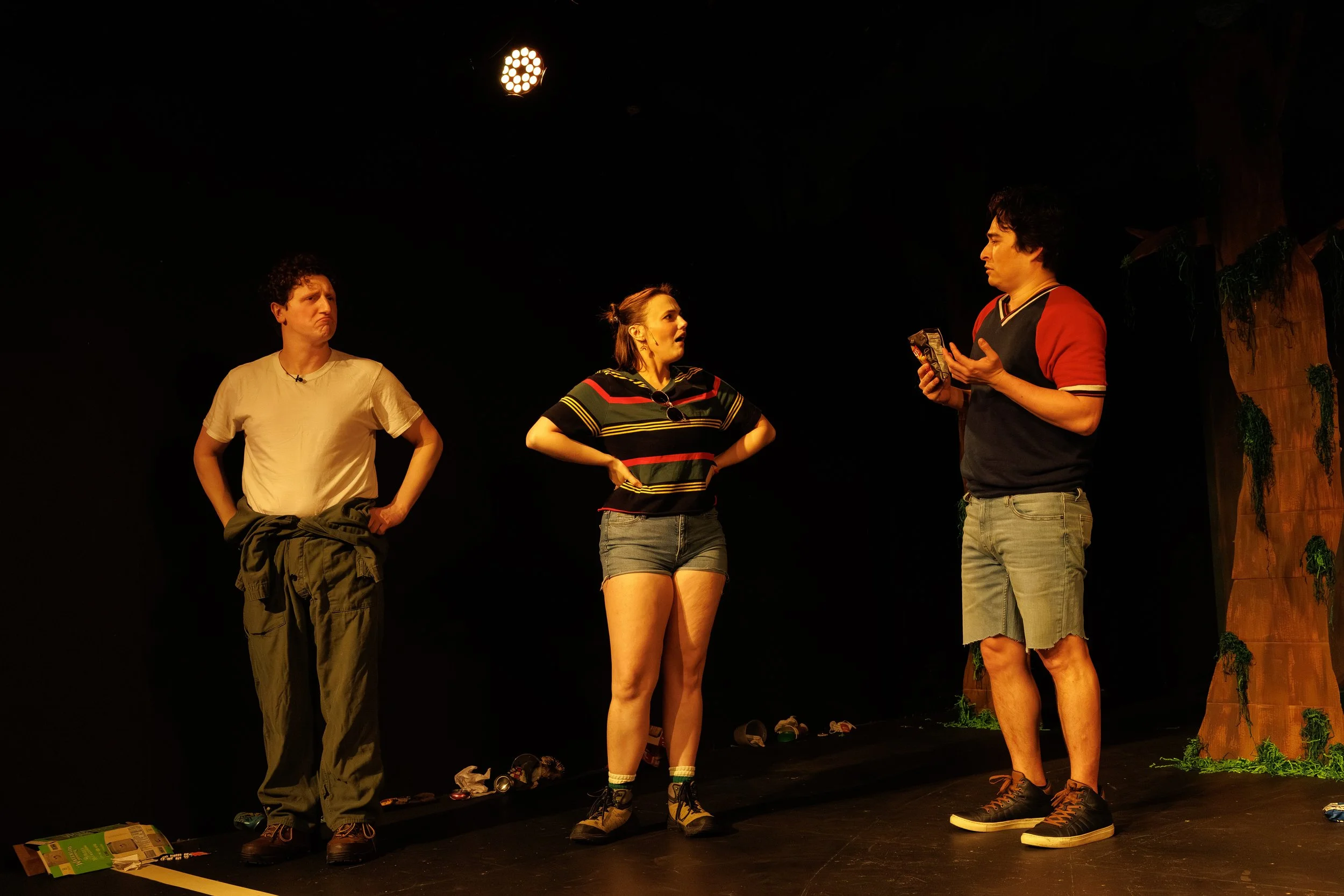
What stands out most in Next Exit is its willingness to sit with big questions without insisting on clear answers. The play threads conversations about death through Miguel’s interactions with Orlando, while its deeper examination of life—how we live it, how we value it, and how we connect within it—emerges most strongly in his encounters with Scarlet and the others he meets along the way. There’s a particularly resonant idea that you cannot always judge how much someone cares, and that meaning is not something that can be neatly measured or defined. One of the more memorable moments, one that shows the strength and humor in the writing involves the majority of the cast, Steph’s “Tow Truck Man” on the phone with Kevin’s Miguel, while William and Kenzie’s characters engage in a diverting conversation that goes off the rails while they’re trying to figure out what exit they’re all near. It’s smartly written, and expertly delivered.
Annex Theatre has long been a home for new and unconventional work, and Next Exit is a clear continuation of that mission. It’s a play that doesn’t aim to provide easy answers, but instead invites the audience into an ongoing conversation—sometimes humorous, sometimes reflective—about how we navigate uncertainty, mortality, and connection. In the end, Next Exit suggests that while we may search endlessly for reasons and clarity—about both life and death—the truth may be both simpler and more complex: things don’t always happen for a reason, but they do happen. And it’s what we make of those moments, how we choose to live within them, and how we connect with others along the way, that ultimately defines the journey.
The world premiere of Next Exit, the new play from j. chavez, runs on stage at Annex Theatre in Seattle through February 21. For more information, including ticket availability and sales, visit https://www.annextheatre.org/.
Photo credit: Sayed Alamy