
Stage Review - The Humans (Bremerton Community Theatre)
Stage Review - The Humans
Presented By: Bremerton Community Theatre - Bremerton, WA
Show Run: February 06 - March 01, 2026
Date Reviewed: Friday, February 06, 2026 (Opening Night)
Run Time: 2 Hours (including a 15 minute intermission)
Reviewed by: Breanne Jensen
On Friday, February 6, 2026, I had the pleasure of attending the opening night performance of “The Humans,” presented by Bremerton Community Theatre (BCT). The show opened on Broadway in 2016 and took home the Tony Award for Best Play that year as well. Leaving audiences captivated, I now count myself among the captivated masses after attending BCT’s production.
“The Humans” takes place post-September 11, 2001, in a New York City Chinatown apartment complex. Inside the apartment, the audience is introduced to the Blake family, who on the outside present like any “normal” family gathering at their daughter/sister’s (not-so-“nice”) new digs for Thanksgiving dinner. As the day and evening unfold, so do the dynamics, the secrets, the outbursts, the drama, and the dysfunction. Each character, enduring their own complex life, reveals bits and pieces of themselves starting at the edges, until those closest to them expose the rest of the puzzle and they must face the reality of their shortcomings.
In Act One, the focus is on relationships. We, the audience, feel the conflict begin to build in every snarky remark or below-the-belt “joke.” In Act Two, the audience discovers why each relationship is the way it currently is, and all the tension, anger, and resentment come to a head. While reading the director’s bio, something that stood out to me was that the playwright wrote this piece around “what keeps him up at night.” As human beings, I think we can all relate to the human duties and fears that weigh on us as we grow older.
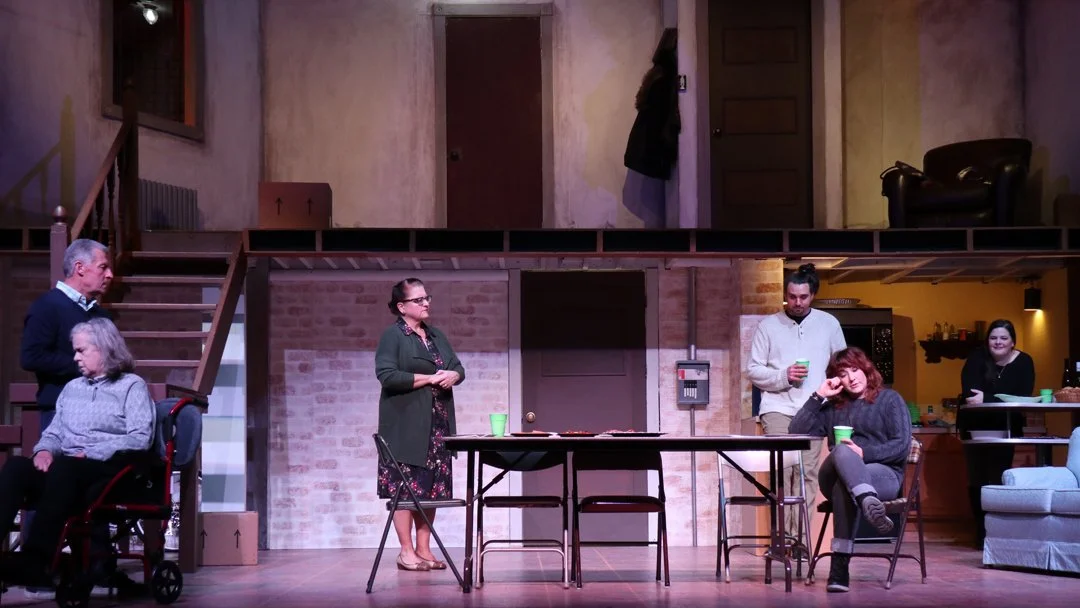
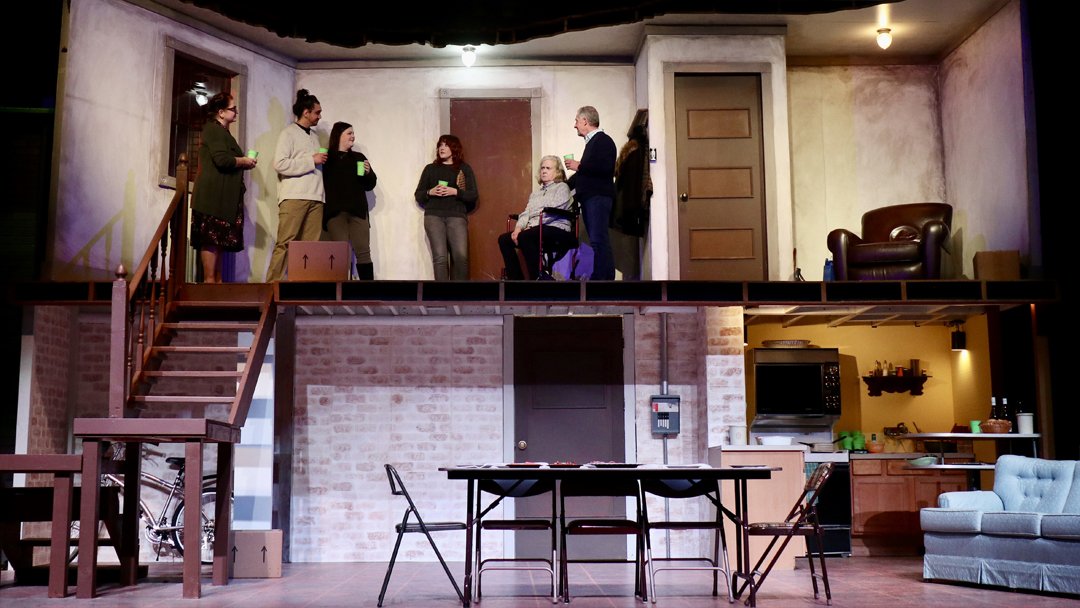
The set is designed, dressed, and constructed by many and led by Rana Teresa Tan, who also stars as the mother of the Blake family, Deidre. Tan’s design gives a dollhouse-view effect into the apartment. Every detail—from the floor to the two-story structure, staircase, kitchen, doors, bathroom, window, and fire escape—is meticulously thought out, and the passion behind Tan’s work is evident. One of the standout elements is the scalloped rooftop that presents as burnt, like a torn book page or possibly even a crumbling foundation. A second element within the set that stood out to me is the front door, which opened and closed without explanation, leading to many interpretations regarding the father of the family, Erik Blake.
The lighting and sound design are perfectly placed and executed. Between the performances and the technical aspects, the show had me forgetting that I was in a theater watching a production and instead feeling as if I were a random cousin sitting in the corner, awkwardly hoping no one would bring me into the conflict and just let me eat my pie. The team behind “The Humans” is stacked with both technical and onstage talent.
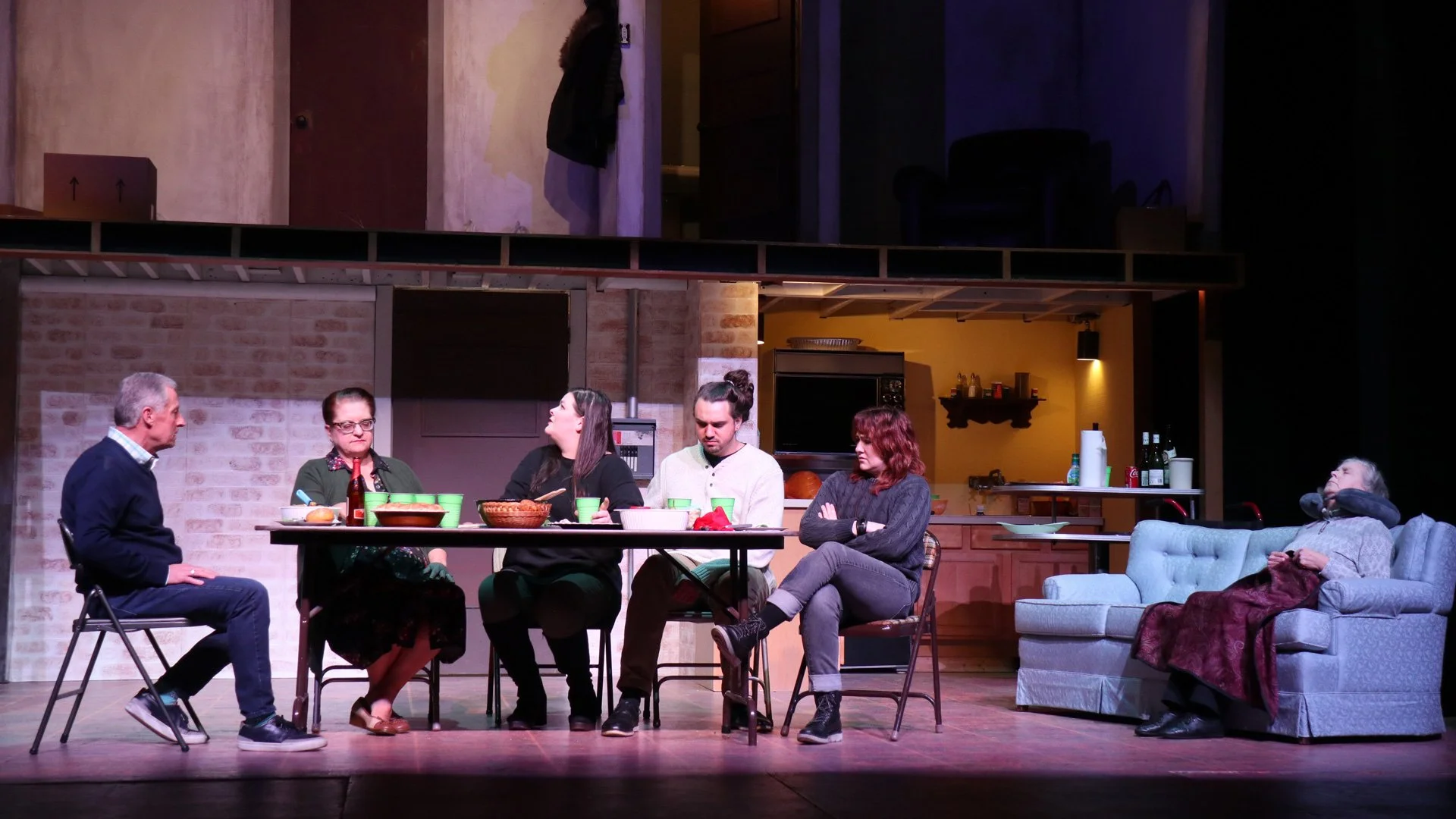
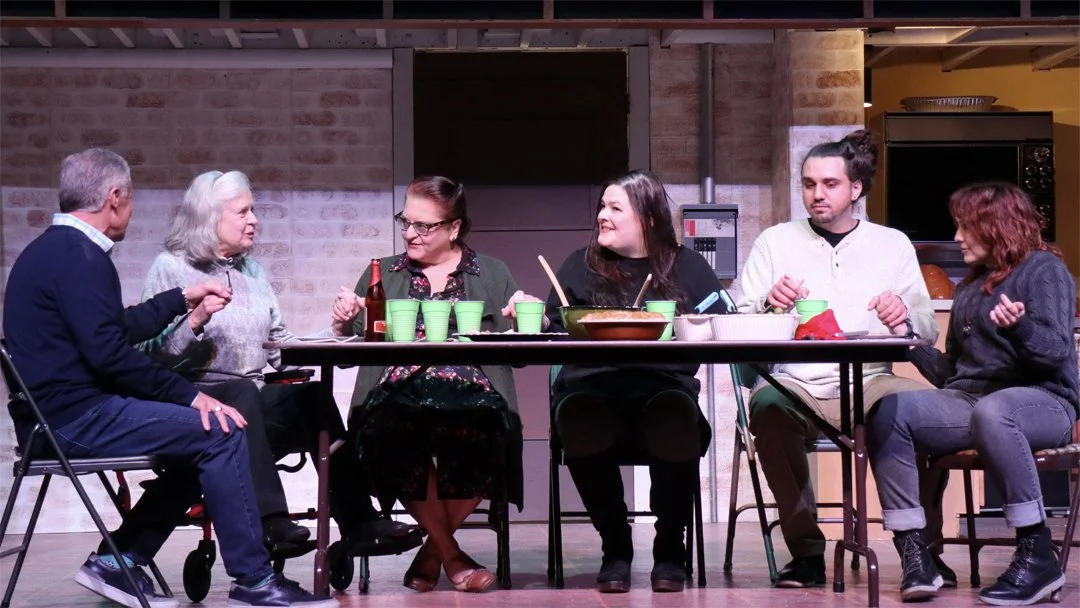
The cast is comprised of six—yes, only six—members whose dialogue is written in a way that often has them speaking over one another, which is a tremendous feat. The cast must work entirely as an ensemble, and that they do. Erik Blake, the father of the family, is played by Ashley Hurd. Hurd personifies the father who just wants the best for his kids while also battling his own trauma post-9/11. His tender moments are outweighed by his harsher ones toward his daughters and wife; however, both are executed poignantly, and the role suits his talents. The mother, Deidre Blake, is played by Rana Teresa Tan. Tan embodies everyone’s favorite nagging mom, whose heartfelt concerns, informative emails, hope for grandchildren, and desire for her children to have some type of faith in their lives are all pushed aside by her family. Underappreciated, underpaid, undervalued, unseen, and unheard—as many women and mothers often are—Tan evokes vulnerability, heartbreak, self-loathing, and the natural desire to love and be loved in return. She will make you laugh and make you cry, both of which feel quite human to me.
The most challenging role in the show, in my opinion, is that of Fiona Blake, aka “Momo,” the grandmother of the Blake family and Erik’s mother. Fiona, played by Elizabeth Booth, is being cared for full-time by her son and daughter-in-law as she navigates the later stages of dementia. Booth has the daunting challenge of portraying a disease known and feared by many, along with all that comes with it. She completely abandons parts of herself to step into Fiona’s shoes and does so in a way that leaves the audience wanting nothing more as she gives everything she has on stage. Brava, truly.
The daughters, Brigid (played by Ruthann Saunders) and Aimee (played by Skye Campbell), are written to show a true give-and-take sibling relationship. Campbell and Saunders are both strong in their individual performances and, together, become unbreakable. These two actors create a believable space with one another that feels safe and natural, leaving the audience understanding why each character reacts, moves, speaks, and cries the way they do.
Brigid’s partner, Richard Saad (played by Miah Campbell), serves as comedic relief, as he is the only character not related to the Blake family. Throughout the show, Richard—“Rich”—is put through the gauntlet of in-laws at Thanksgiving dinner: Momo’s escape, screaming and fighting, belittling of salaries and dreams, and relationship squabbles, just to name a few. Campbell portrays Rich as calm, levelheaded, nurturing, accepting, and the breath of fresh air the family needs.
The most masterful thing about this show is that no matter one’s age, gender, marital status, or family dynamic, everyone can find a bit of themselves in each character. The writing, the direction, and the acting are all deeply relatable. The costs of caregiving, the loss of innocence, betrayal, resentment, devastation, aging, trauma, and tragedy are all aspects of being alive; it is the price we pay.
Here are a few things I learned while watching “The Humans”: Brigid is right that we are told pursuing our passions is a privilege, not a right—but it is a right worth fighting for. Erik Blake is also correct; it should cost less to be alive, both financially and emotionally. However, Momo makes a powerful point as well: nothing in life should be worth getting so worked up about, because in the end, it is the good we remember. Just like Momo, Aimee reminds us that no matter how “crappy” life may be, we can always find the light. Lastly, I learned the most from Rich, who shares the perspective of what is scary to mythical monsters. To monsters, what is frightening are those who hunt them with stakes, pitchforks, judgment, and shame. Who are the monsters afraid of? Us. Humans are the monsters.
We are all human. We are all different. We are all the same. We all experience hurt, fear, love, joy, pain, regret, and ambition. Sometimes we experience life at the top, and sometimes we experience it at the bottom. But when we are gone, what remains is who we were—flesh, bones, blood, scars, and the impact we left behind. So don’t sweat the small stuff. Enjoy it, because you are only human. Bremerton Community Theatre has a gem of a production on its hands that I encourage everyone to experience. This show runs until Sunday, March 1, 2026—grab tickets before they sell out.
The Humans runs on stage at Bremerton Community Theatre through March 1. For more information, including ticket availability and sales, visit https://www.bctshows.com/.
Photo credit: Kathy Berg