
Stage Review - Red
Presented By: Bainbridge Performing Arts - Bainbridge Island, WA
Show Run: November 13 - November 15, 2026
Date Reviewed: Saturday, November 14, 2026
Run Time: 85 Minutes (no intermission)
Reviewed by: Greg Heilman
Art invites interpretation, but the artist doesn’t always welcome what someone else sees. That tension sits at the center of John Logan’s Red, which Bainbridge Performing Arts presented this past weekend as this year’s season opener in its Studio Series. Directed by Laurel Marlantes, the play brings the audience into the studio of painter Mark Rothko, where discussions about color, creation, and artistic responsibility become an increasingly personal examination of the man holding the brush. It’s an intimate production, both in its physical arrangement and in the relationship it explores, with its strongest moments coming as the balance between teacher and student begins to shift.
There’s an interesting relationship between the intimacy of visual art and that of theatre. A performance brings together the work of many people for interpretation by the one, the individual audience member, who receives it through the lens of personal experience. A painting reverses that relationship, with the work of one person opening itself to interpretation by the many. Red places those processes inside one another, asking a collaborative art form to communicate the deeply individual experience of creating a painting. That isn’t an easy thing to pull off, but this production does, and very well. Laurel and the creative team behind this create the space for that individuality to emerge, bringing the audience close to the work while allowing each person looking in to consider what it means. The intimacy comes from that proximity, both to the paintings and to the people whose very different experiences inform what they see.
Set in the late 1950s, the story follows Rothko as he works on a substantial commission with the help of his young assistant, Ken. For Ken, the position offers an opportunity to learn from an established artist, although Rothko makes it clear that employment doesn’t automatically entitle him to mentorship, friendship, or even an opinion. There is work to do, and there are lectures to absorb. Over time, though, Ken becomes more willing to question the pronouncements of a man whose certainty about art doesn’t necessarily extend to his own place in its future.
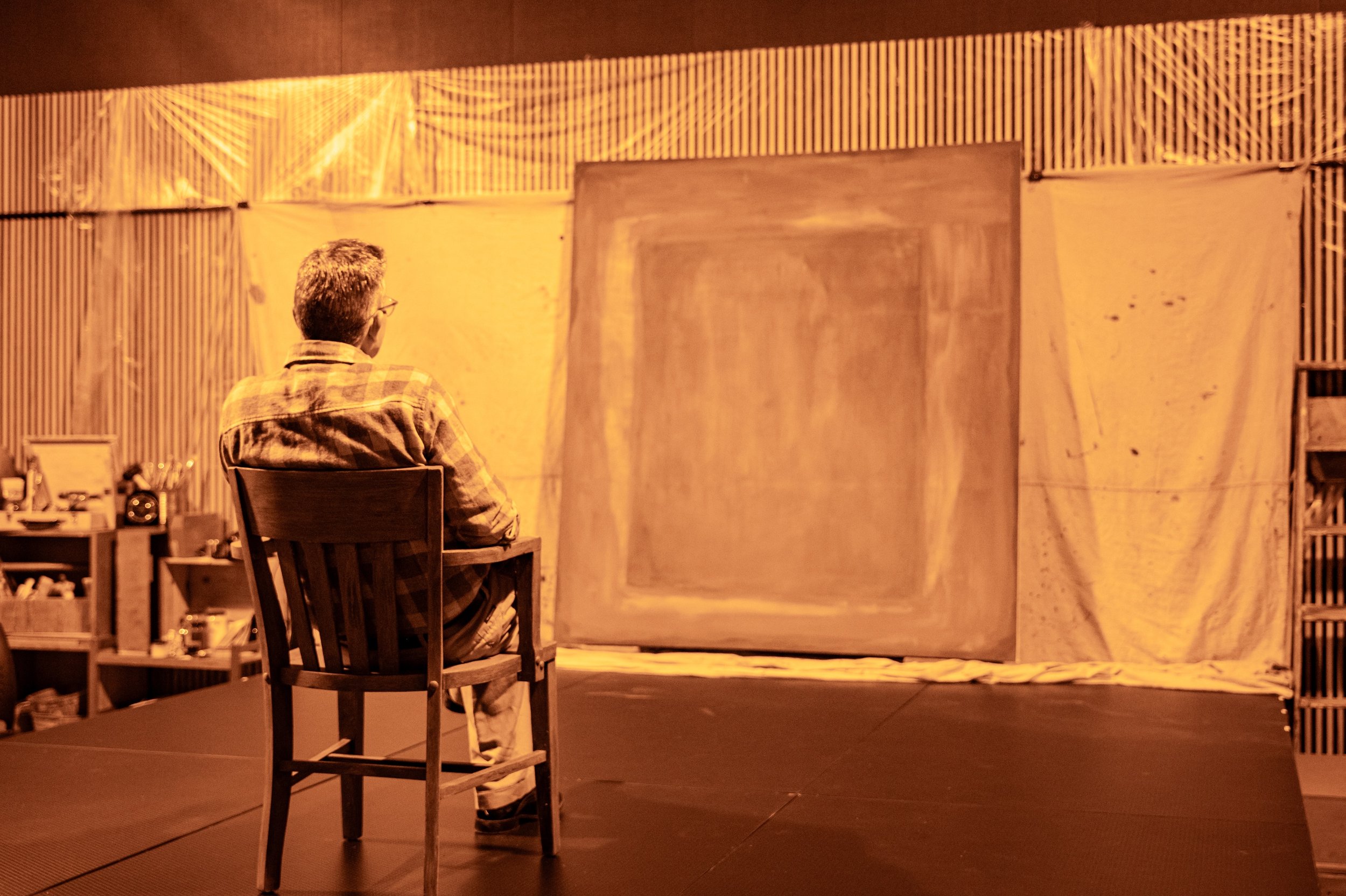
Laurel, who also serves as scenic designer, places the action on a raised platform, with a single chair near the center and canvases arranged along the back wall. The studio’s seating configuration makes the audience feel as though it sits within the artist’s workspace, close enough to observe both the labor and the friction that happen there. It’s an effective arrangement for a play so concerned with looking closely. The paintings are part of the environment, but so are the people studying them, and the proximity gives their exchanges an appropriately immediate quality.
That scenic work and Meloni Courtway’s props give the space the feel of a working studio. Period pieces and the practical materials of painting help establish a place where things are made, handled, and reconsidered. There is a useful sense of activity here, of a room that exists for work rather than display. Whether an artistic choice or not, even the platform’s floor squeaking brings a sense of realism to the procedings.
As Rothko, Mel Carson captures the artist’s self-centeredness and the intimidating certainty with which he approaches conversation. His Rothko is accustomed to occupying the intellectual center of the room, setting the terms of a discussion and deciding whether another person’s contribution even deserves consideration. Mel communicates that authority clearly, along with the frustration that surfaces when Ken fails to provide the response Rothko expects. It’s a demanding role, loaded with dialogue that must function as argument, instruction, and self-revelation, and Mel handles that substantial verbal responsibility incredibly well.
Alongside Mel, Reed Viydo gives Ken an effective progression from an eager employee to someone capable of challenging the man he initially approaches with deference. Early on, Reed makes the desire to learn apparent. There is an openness in his performance, an excitement about the opportunity, and a visible hurt when Rothko turns an exchange into a reprimand. That combination gives Ken somewhere to grow. His eventual resistance develops from the accumulated experience of listening to a man who demands serious thought while frequently discouraging independent thinking.
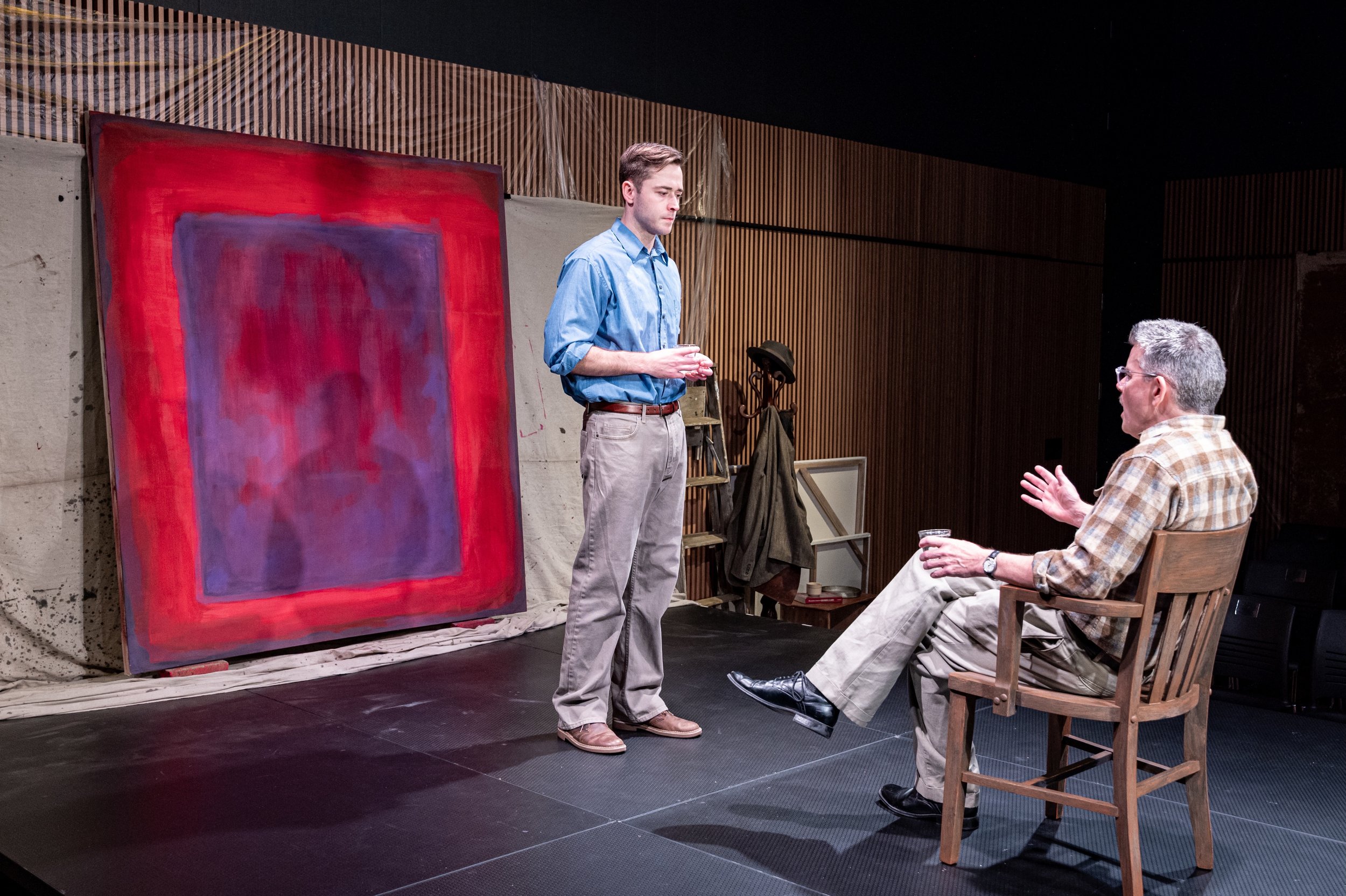
Reed is especially strong when Ken recounts the murder of his parents and explains the association that red carries for him. Here, the conversation about color becomes painfully specific. Reed gives the memory emotional clarity, making apparent how differently two people can experience the same thing. Rothko can insist on the significance he finds in a painting, but Ken’s history exists beyond the reach of that authority.
When Ken finally stands up to Rothko, Reed delivers an excellent release of the emotion that has been building through their exchanges. The force of his performance changes the relationship. Ken is no longer simply receiving Rothko’s ideas; he is asking the artist to live up to them.
The two performances find their strength in different kinds of movement. Reed gives Ken the broader emotional journey, moving from eagerness and the hurt of reprimand through painful recollection to the confidence necessary to challenge his employer. Mel’s transformation is subtler. Rothko’s viewpoints and attitudes soften a little in response to Ken’s challenges, and the beauty of Mel’s performance is in the nuance of those adjustments, the small concessions within a man so accustomed to certainty. While I would still like greater vocal depth and volatility in his angrier moments, that quieter progression is effective. The chemistry between the actors allows both arcs to work together, with Reed’s emotional breadth and Mel’s gradual shifts making apparent how these men change through their time with one another.
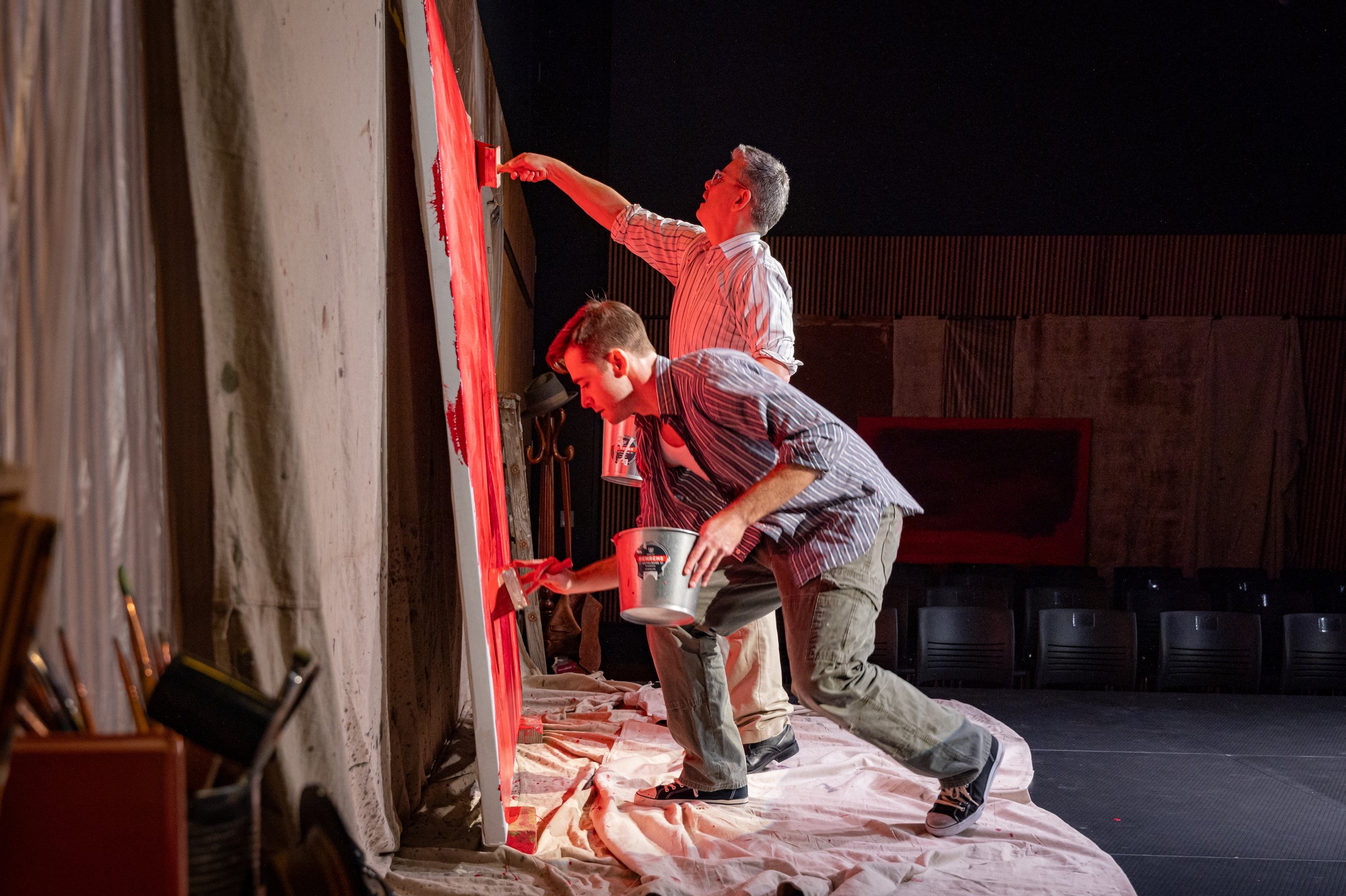
One of the production’s most effective sequences comes when the pair prime a canvas together. Accompanied by orchestral music, their painting takes on a rhythm that echoes the rapid movement of the violins and the sweep of the chords. There is style in the execution, but also a sense of shared purpose. For a moment, the arguments give way to the physical act of making something, and the relationship becomes visible through the work itself.
Bainbridge Performing Arts’ Red finds its greatest strength in that connection between artistic ideas and personal experience. Laurel Marlantes creates an intimate setting in which admiration can develop into disagreement, and disagreement can become an essential part of learning. Through the collaborative work of theatre, the production opens a window into the solitary convictions of a painter, while giving equal weight to the young man discovering his own. What emerges is a compelling examination of how much of themselves people put into art, both in its creation and in what they see when they stand before it.
The Bainbridge Performing Arts production of Red ran on stage from November 13 through November 15 at their Sears Studio space. For more information on BPA, including their upcoming shows and other programming, head to https://www.bainbridgeperformingarts.org/.
Photo credit: Adam Othman