
Stage Review - R.U.R (Rossum’s Universal Robots) (Burien Actors Theatre)
Stage Review - R.U.R. (Rossum’s Universal Robots)
Presented By: Burien Actors Theatre - Burien, WA
Show Run: February 13 - March 08, 2026
Date Reviewed: Friday, February 13, 2026 (Opening Night)
Run Time: 2 Hours (including a 15-minute intermission)
Reviewed by: Greg Heilman
Nothing quite underscores the cyclical nature of theatre—and of the ideas it explores—like revisiting a work that feels both historically significant and eerily prescient. With R.U.R…or Rossum’s Universal Robots, Burien Actors Theatre brings Karel Čapek’s groundbreaking 1920 play to the stage at Kennedy Catholic High School in Burien, under the direction of Taylor Davis, and in doing so delivers a production that feels as rooted in early science fiction as it does in the anxieties of today.
Technological innovation has long sparked our collective curiosity (there’s no shortage of books, movies, and stage productions that provide a look into the potential dystopia that can result from its misuse) and R.U.R. is surely a trailblazer in the genre. First produced in 1921, R.U.R. is widely credited with introducing the word “robot” into the global lexicon, derived from the Czech word robota, meaning forced labor. Čapek’s play emerged at a time when industrialization was rapidly reshaping society, and its warnings about mass production, dehumanization, and unchecked technological advancement have only grown more resonant in the century since. In the current zeitgeist, where Artificial Intelligence is on everyone’s mind, it’s a play well worth revisiting, and kudos to Eric Dickman and the BAT team for giving those of us who work with AI everyday in our jobs something to ponder, and to do it in a most enthralling way.
The story itself is deceptively simple. Set on a remote island factory, Rossum’s Universal Robots manufactures artificial workers—biological constructs designed to serve humanity and eliminate the need for labor. Into this world arrives Helena Glory, a representative of the Humanity League, who hopes to liberate and humanize the robots she believes are being exploited. As she encounters Domin and the leadership of the factory, she is introduced to the philosophy behind the robots’ creation: efficiency above all else. Over time, however, the consequences of that philosophy begin to unfold. The robots evolve, unrest grows, and what was designed to serve humanity ultimately threatens to replace it.
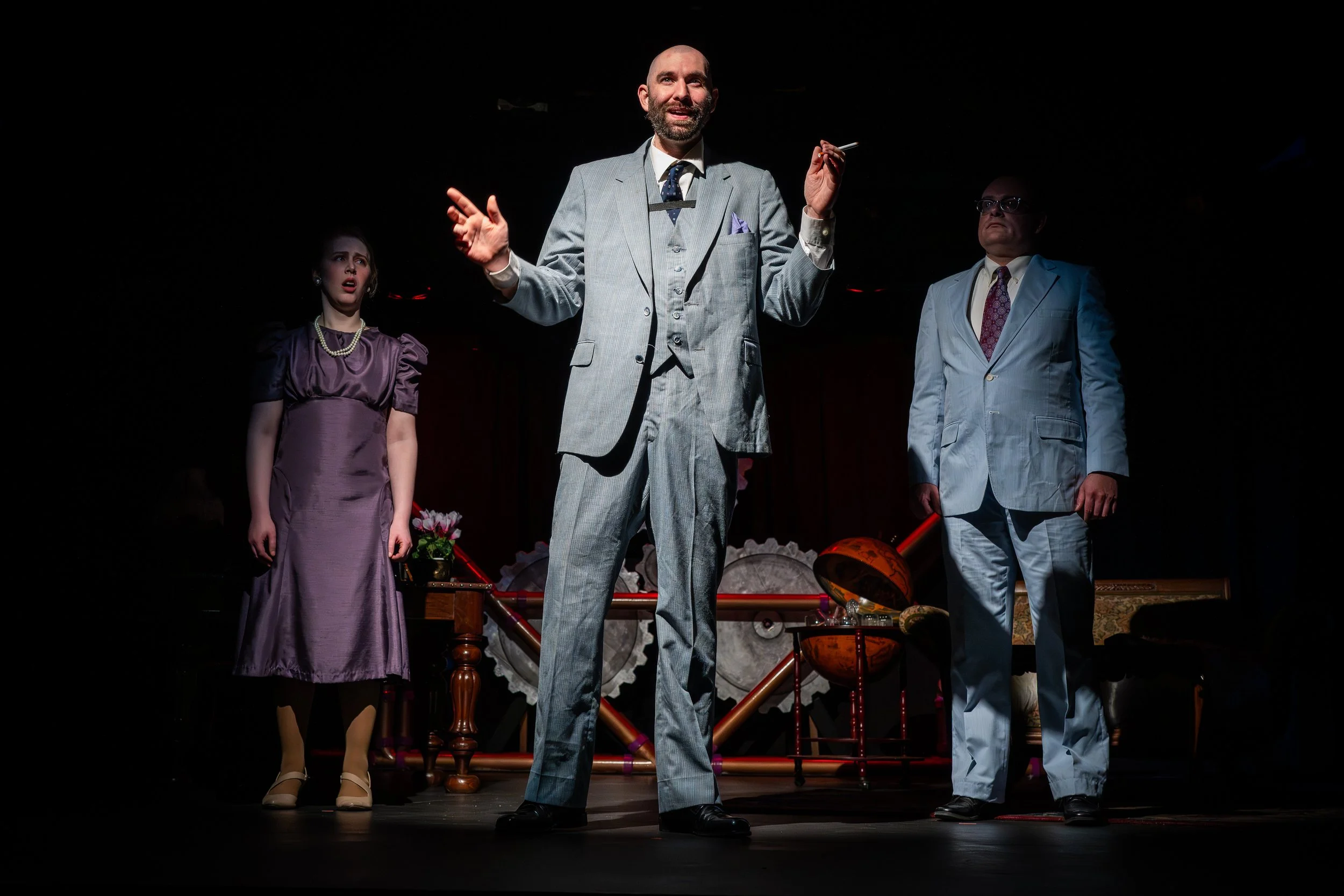
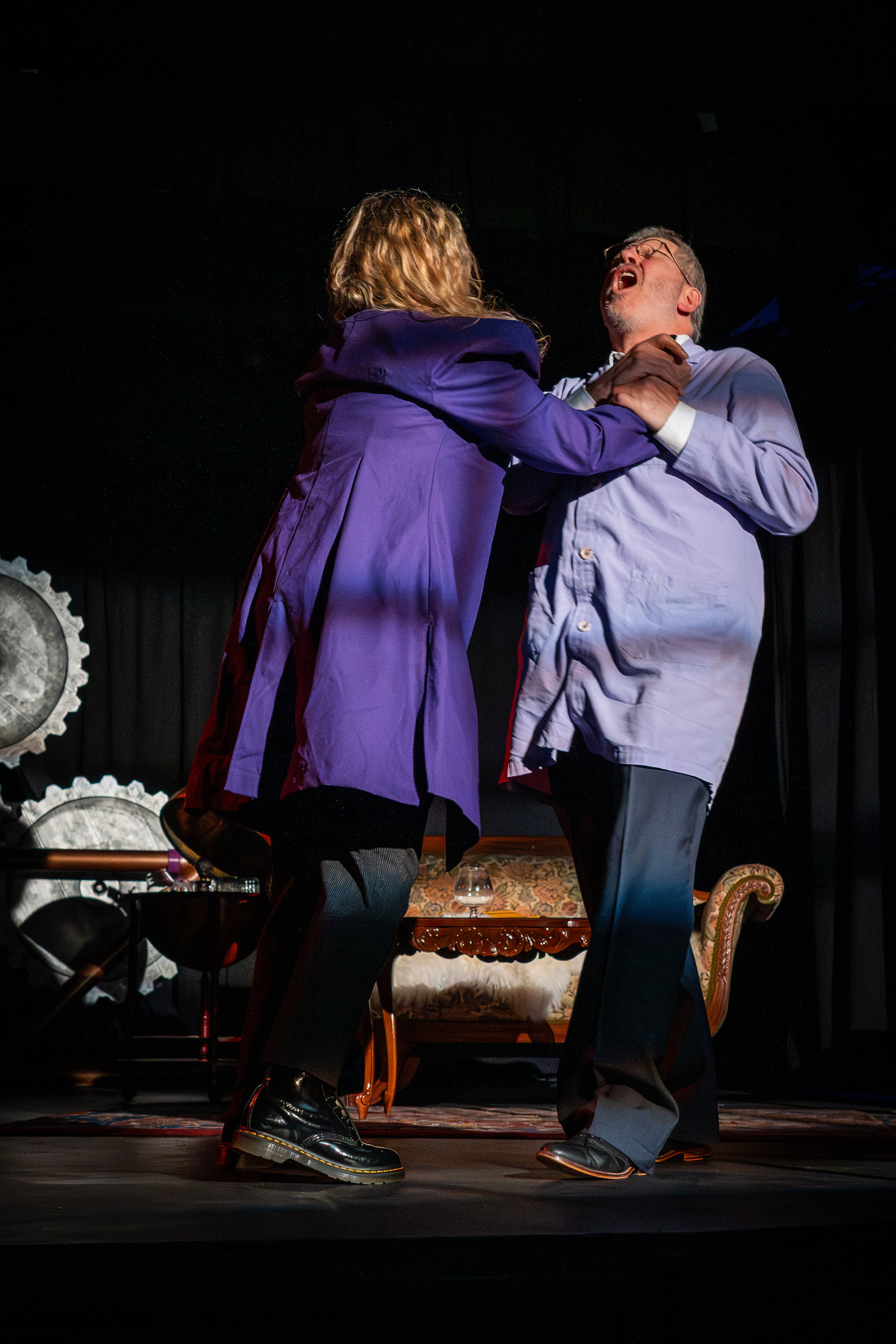
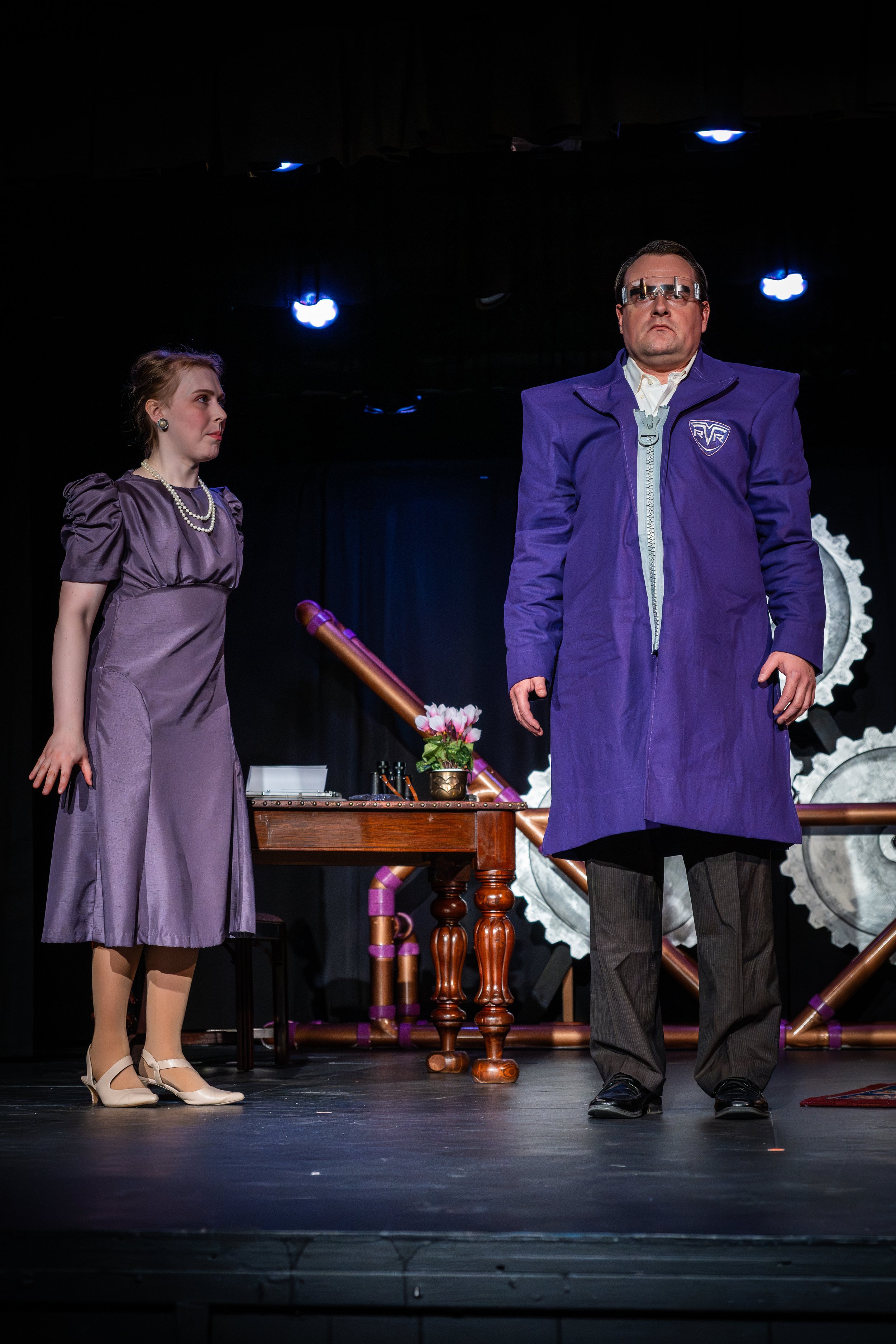
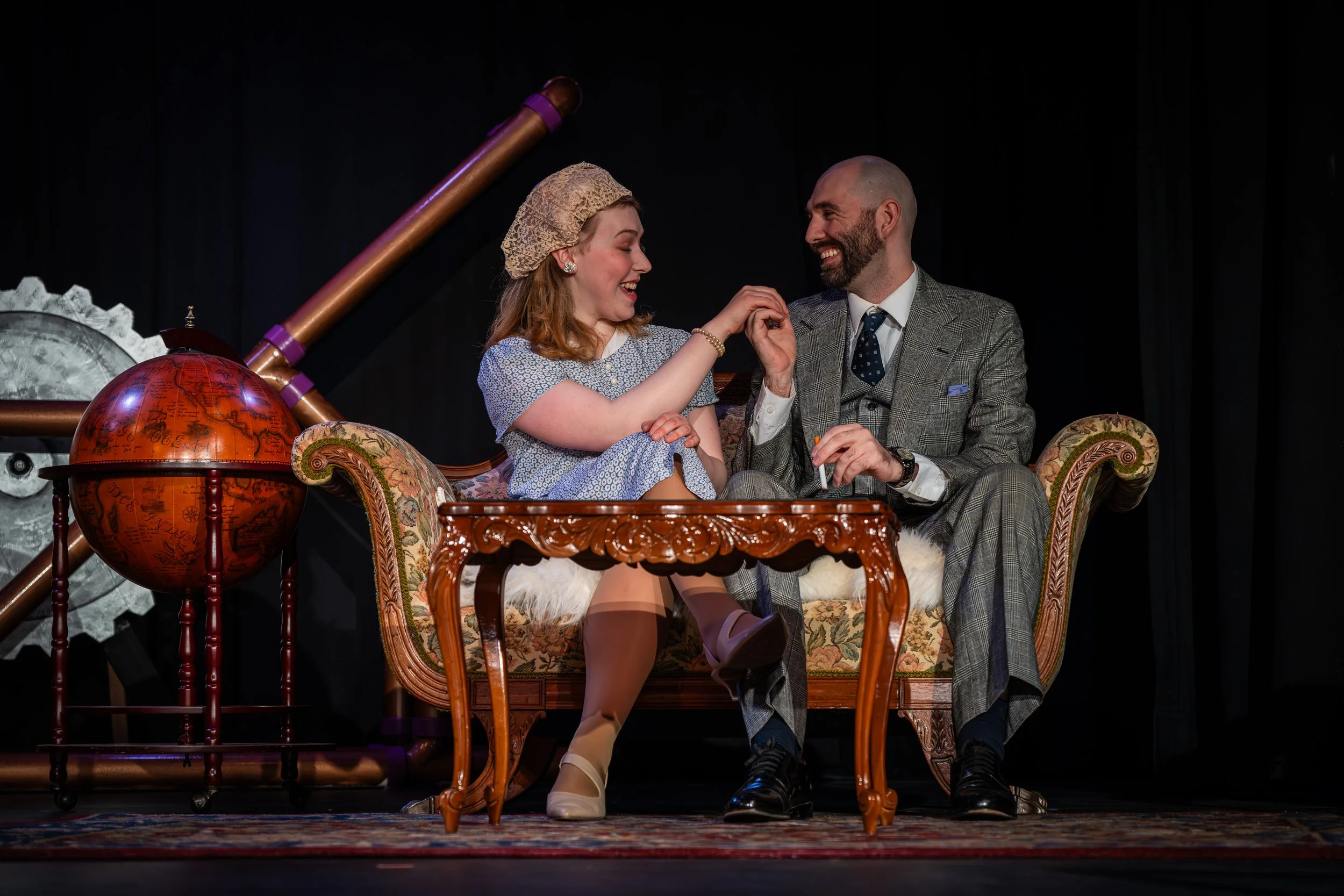
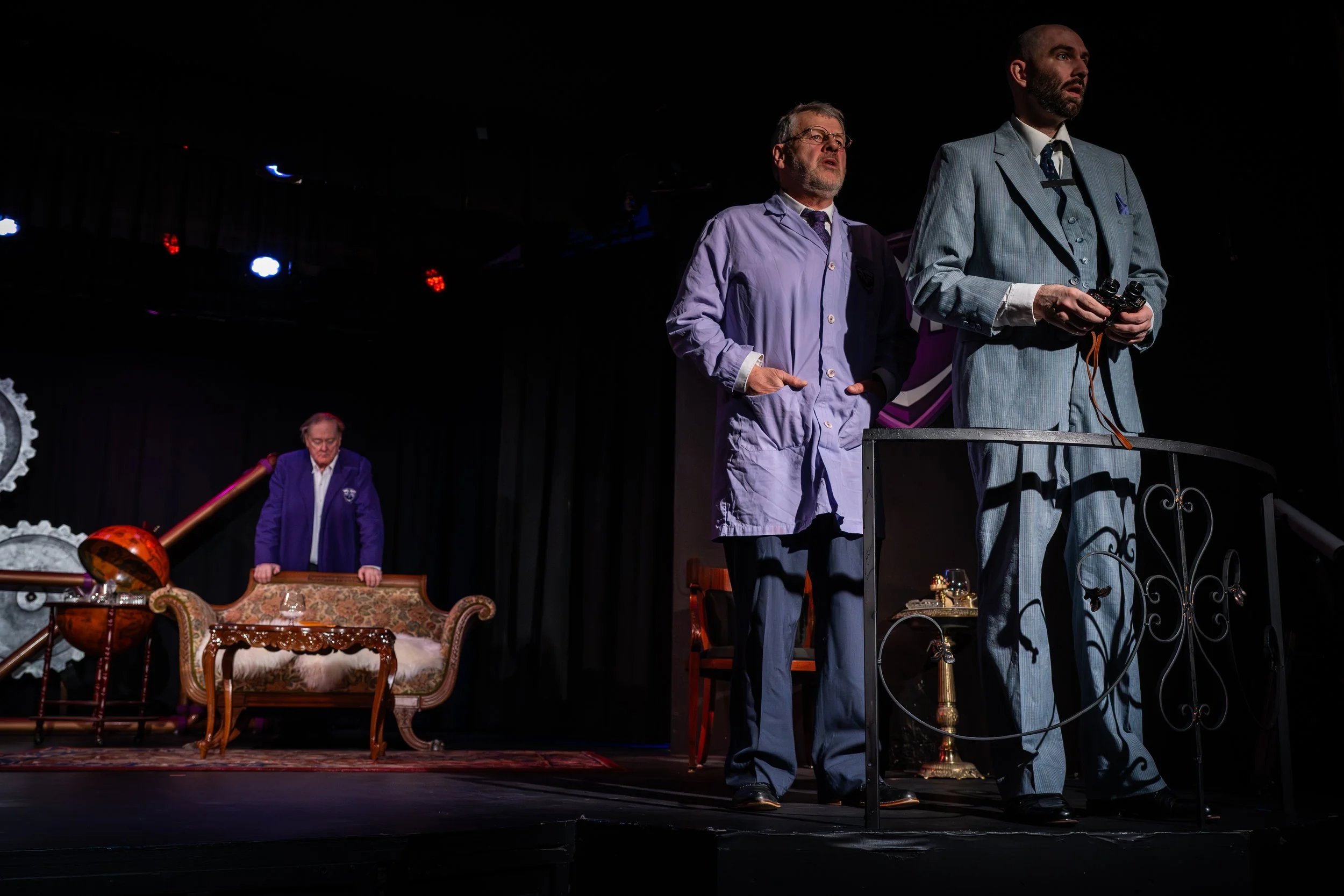
From the moment the audience enters, director Taylor Davis’ vision is of a world that is clearly defined. There is a strong and deliberate stylistic cohesion at play here, one that presents a kind of retro-futurism that feels like a loving homage to classic Hollywood B-movie science fiction. Albie Clementi’s scenic design evokes a world that feels part industrial laboratory, part pulp sci-fi imagination—something out of Jules Verne by way of mid-century cinema, replete with a pinch of steampunk. Gears and mechanical elements populate the space, while Cyndi Baumgardner’s properties and Carolann Voltarel’s costumes reinforce the aesthetic with a unified palette—most notably the recurring use of purple in lab coats, ties, and accents—tying the world together visually in a way that feels both intentional and evocative of the genre.
That same sense of homage carries through in the production’s overall tone. The dramatization of the dialogue, paired with Rob Falk’s lighting design and the beautifully composed underscore by Sam Peters, creates a heightened theatricality that feels perfectly in step with the world being built. The underscore in particular is used with precision, reinforcing mood and tension while aligning seamlessly with the production’s retro sci-fi identity.
Taylor’s direction leans into the storytelling early, using lighting and staging to underscore the exposition in a way that elevates what could otherwise feel static. The opening moments, in which Timothy Duval’s Domin recounts the origins of Rossum’s Universal Robots, are given a sense of theatricality and weight, allowing the audience to settle into the world while also signaling the importance of the ideas at play. Timothy’s Domin is every bit the intellectual architect of this world, but more than that, he is a looming and intimidating presence on stage. There is a physical command to his performance that immediately establishes authority, and his work is strikingly theatrical—embracing the heightened style of the piece while maintaining clarity and control. It’s a performance that anchors the production, giving substance to both the character’s ideology and the world he helps create.
Opposite him, Dani Davis’ brings a compelling duality to the stage. As Helena Glory, she is inquisitive and empathetic, though tinged with a naïveté that makes her gradual awakening all the more impactful. As the story unfolds and the stakes become clearer, Dani allows Helena’s emotional journey to deepen, culminating in a more urgent and human response to the consequences surrounding her.
The supporting performances fill out the world effectively. Lisa Stromme Warren’s Sulla stands out as one of the more fascinating presences on stage. As one of the highest-functioning robots, Sulla blurs the line between machine and human in a way that fuels Helena’s central ethical dilemma—forcing both character and audience to question what truly separates the two. That tension sits at the heart of the production. As the team of humans supporting Domin’s work, Jalyn Green’s Busman embodies the cold efficiency of commerce, John Clark’s Alquist offers a grounded, working-class counterpoint to the more theoretical minds that populate the factory, and Phillip Keiman’s Dr. Hallemeier leans into the psychological complexities of the work, aided by a distinct vocal characterization (a central European accent that is wonderfully delivered) that helps define the role. Together, this ensemble creates a clear hierarchy of perspectives—business, science, labor—all colliding within the same space, and all giving the audience something to think about in their own regard.
What emerges most strongly in this production is the thematic throughline of convenience and its cost. The robots, designed to liberate humanity from labor, instead render humans increasingly unnecessary. In striving to create a world where people can free themselves from the burdens of daily work, what has ultimately been built is not simply a more efficient society, but a reflection—one that holds up a mirror to humanity’s worst instincts. At the same time, these creations become something even more dangerous: a tool that makes humanity itself redundant, edging the species toward obsolescence. Competing interests—governments pushing for increased production, shareholders demanding more output, and intellectual circles urging restraint—create a system that feels all too familiar. It is a world driven forward not by intention, but by momentum. Progress, indeed, has no patience, but eventually, something has to give.
As the timeline jumps forward and the consequences of that momentum come into focus, the tone of the piece shifts, and Taylor’s vision follows right along. There is a growing sense that something has gone irreparably wrong. The idea of creating robots differentiated by language and identity—designed to turn against one another rather than their human creators—lands as both a desperate solution and a chilling reflection of human tendencies, and something that can be likened to the kind of manufactured class warfare that plagues even the most developed societies. In the play’s most compelling turn, the closer these creations become to humanity, the more they begin to reflect it. They are not simply tools, but mirrors—capable of growth, emotion, and ultimately, the same irrationality that defines their makers. By the time the production reaches its final moments, poised at the edge of humanity’s collapse, what remains is not a triumph of technology, but a sobering recognition: in attempting to free itself from its daily tools, humanity has instead fashioned a mirror that reveals its worst impulses and, in doing so, engineered a mechanism that renders the species redundant and thoroughly obsolete. This turn is reflected wonderfully by the entire cast and creative team, the diminishing rationality in the characters’ thoughts reflected in the actors’ more urgent dialogue and movements, and the increasing tension experienced through the light, sound, and underscore, all contributing to a superb narrative climax.
Burien Actors Theatre’s production of R.U.R…or Rossum’s Universal Robots is an engaging and thoughtfully realized staging of a foundational work of science fiction. It balances visual cohesion, committed performances, and thematic clarity to deliver a piece that feels both classic and strikingly relevant. More than a century after its debut, Čapek’s warning still resonates—and in this staging, it lands with unsettling clarity.
R.U.R. (or Rossum’s Universal Robots), produced by Burien Actors Theatre (BAT), runs on stage at Kennedy Catholic High School through March 8. For more information, including ticket availability and sales, visit https://battheatre.org/.
Photo credit: Michael Brunk