
Stage Review - Don’t Call It a Journey (eSe Teatro)
Stage Review - Don’t Call It a Journey
Presented By: eSe Teatro - Seatle, WA
Show Run: September 19 - December 05, 2026
Date Reviewed: Wednesday, October 7, 2026
Run Time: 85 Minutes (no intermission)
Reviewed by: Greg Heilman
Anyone who has experienced grief knows a few things about it. First, it is an intensely personal experience. Everyone grieves differently. Some do so quietly, others loudly, and still others struggle to process their grief at all. It is also anything but linear. Moments of unexpected humor can break through the sadness, only to be followed by an overwhelming sense of loss that feels as though it might never go away. There are highs and lows, often arriving without warning and in no particular order, and just when it seems that the worst might be over, something can bring it all rushing back. Grief is also exhausting, taking its toll both emotionally and physically. And the person who emerges on the other side, assuming there really is another side, is rarely the same person who entered.
In many ways, Don't Call It a Journey, presented by eSe Teatro and running through December 5 at The Auditorium at University Heights in Seattle, is grief brought to life on stage. Co-created, written, and directed by Julieta Vitullo, and co-created and performed by Iveliz Martel, this world premiere is a deeply personal exploration of love, illness, and loss, drawn from Julieta's experience of caring for her husband through pancreatic cancer. The play grew out of a friendship between the two artists, who were collaborating on another project when Julieta's husband was diagnosed, around the same time that Iveliz's father and brother were also facing cancer diagnoses. Their conversations about treatments, caregiving, and the challenges confronting their families eventually became the foundation for this collaboration.
Told from the perspective of La Mujer (The Woman), portrayed by Iveliz, the story follows her relationship with her husband, El Hombre (The Man), beginning with a chance meeting made possible by Amtrak. From there, the audience is introduced to their life together, their children, and the memories that define their relationship. These moments establish the love and life that existed before cancer entered the picture, setting the stage for El Hombre's illness, the treatments that follow, and the devastating reality of watching someone you love confront a disease that offers no guarantees. The earlier stories give meaning to everything that comes afterward, reminding us that cancer doesn't simply affect a patient, but interrupts an entire life and the lives of everyone connected to it.
And then there's that word, journey. It's become almost impossible to discuss cancer without someone referring to a person's "cancer journey," as though attaching a relatively benign word to something so devastating might make it easier to understand. But a journey suggests movement toward a destination, perhaps even the promise of discovery or adventure. It implies a certain amount of choice, a path to follow, and some expectation of what awaits at the end. Cancer offers none of those assurances. There is no itinerary, no guarantee that the next step will bring progress, and certainly no promise of a happy arrival. For the person enduring the treatments, and those forced to watch someone they love suffer, the word can feel absurdly inadequate. Don't Call It a Journey challenges our tendency to reduce an experience of extraordinary complexity and suffering to a single, deceptively comforting word.
Like grief itself, the production is deeply personal, decidedly non-linear, and at times difficult to make sense of as it unfolds. There are moments of humor alongside profound sadness, seemingly unrelated stories that interrupt one another, and emotional shifts that arrive without warning. Yet, as the performance progresses, those disparate pieces gradually come together, revealing connections that weren't immediately apparent and creating something greater than their individual parts.
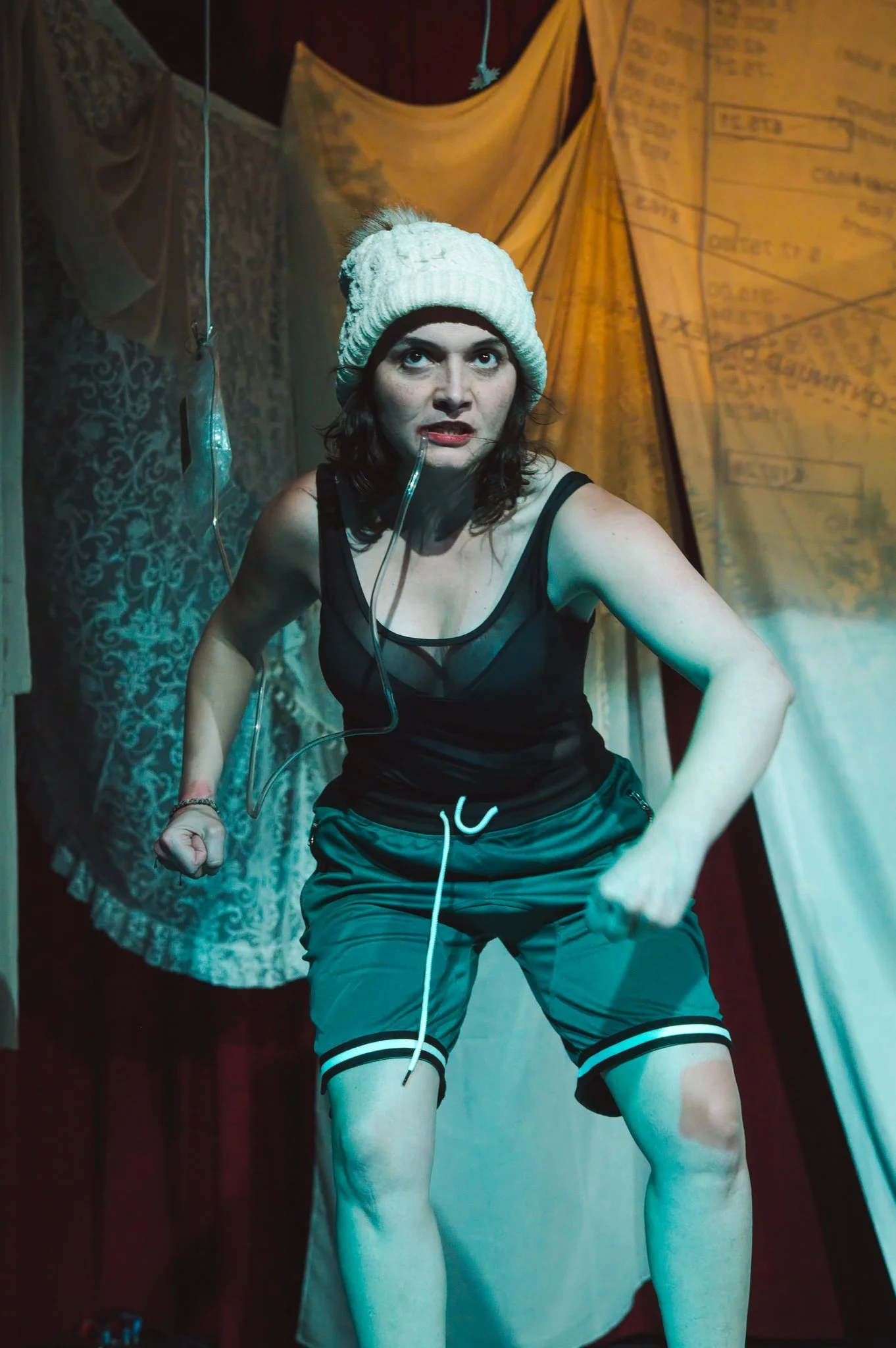
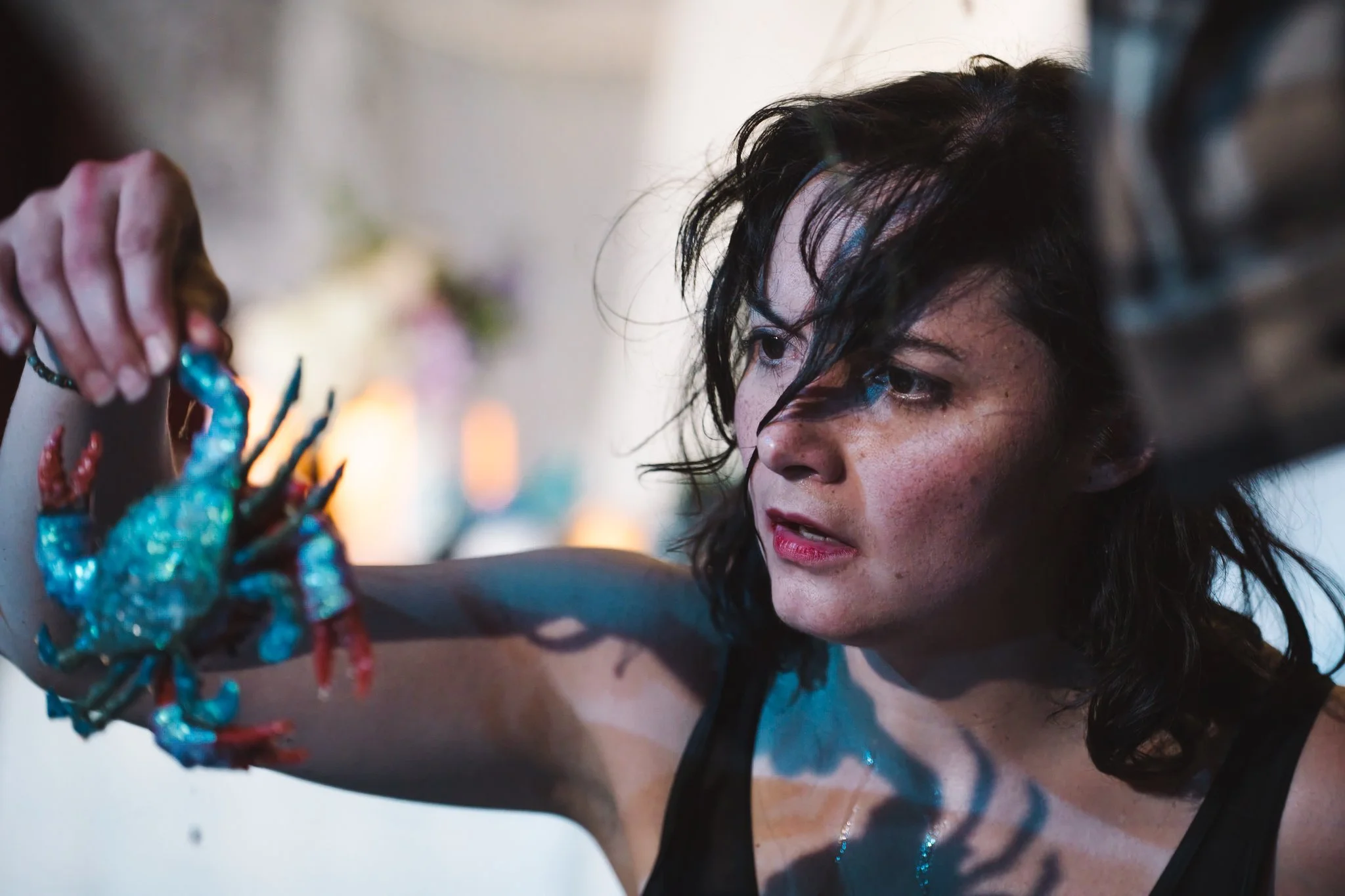
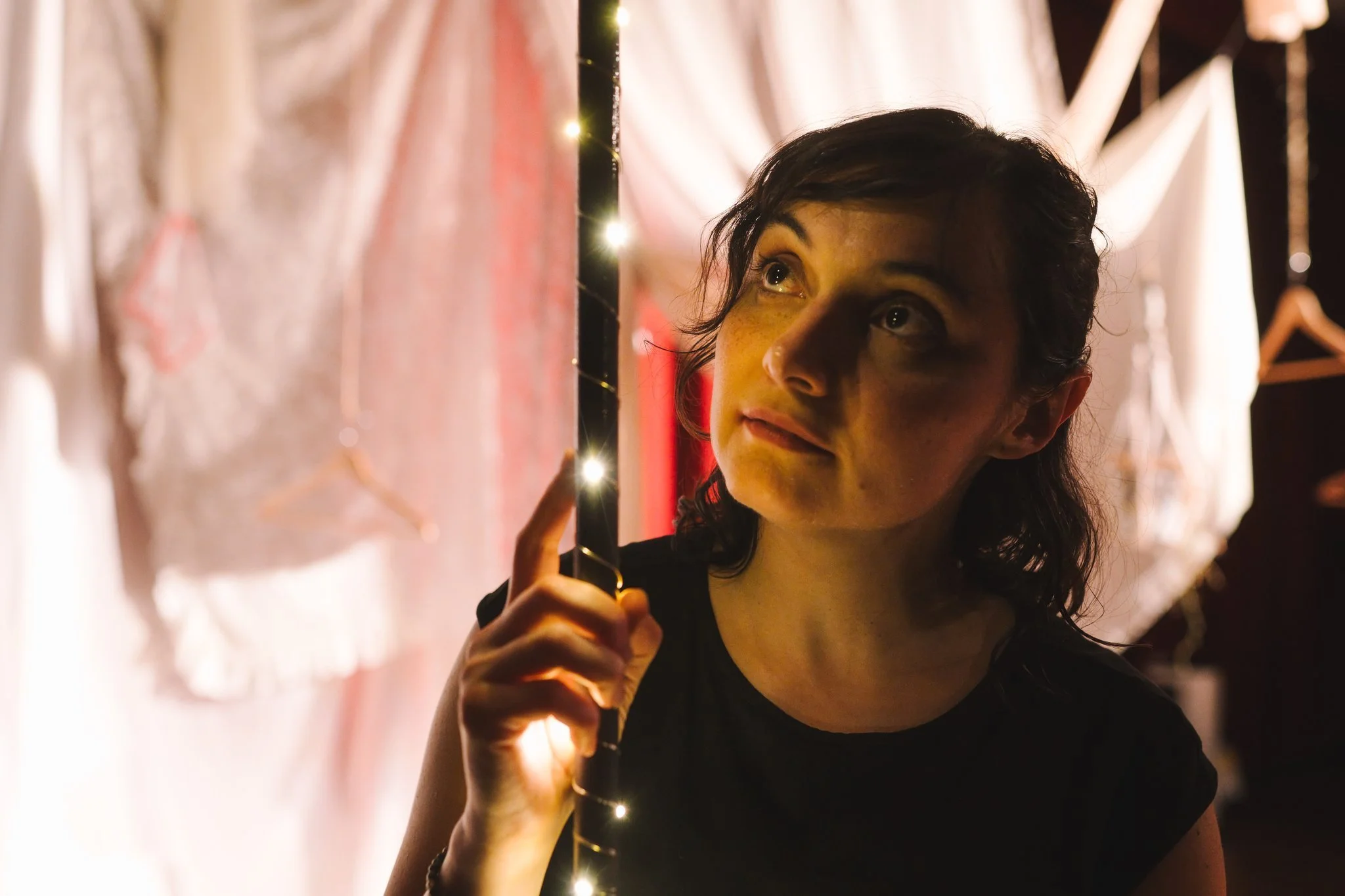
At the center of it all is Iveliz, the production's lone performer, whose work is as much performance art as traditional acting. To be fair, she’s not alone on stage, the playwright joins Iveliz, primarily operating the overhead projector, but also contributing to the performance as if she’s putting a finer point on some of the emotion behind the acting. It's a physically demanding assignment, requiring her to transform herself repeatedly, not simply into different characters, but into the emotions, memories, and experiences that populate the story. Her physicality is extraordinary, and whether she's moving through an elaborate sequence, manipulating the simplest of objects, or shifting from one emotional extreme to another, every movement contributes to the storytelling. Yet, for all the physical demands of the piece, it's her emotional range that makes it so compelling. Humor, frustration, anger, fear, tenderness, exhaustion, and overwhelming sadness all find their place in her performance, sometimes arriving so quickly that the audience barely has time to process one before being confronted with another. Her work is at once highly theatrical and deeply personal, allowing even the most abstract moments to feel grounded in something undeniably human.
One of the more entertaining devices involves Iveliz taking on the persona of a flight attendant, introducing the audience to a trip nobody would willingly choose to take. The familiar language and mannerisms of airline travel become a vehicle for exploring the frightening experience of cancer. It's funny at times, but beneath the humor is the uncomfortable reality that the passengers on this particular flight have little control over where they're going or what awaits them when they arrive.
Another imaginative sequence presents cancer as the Hydra of Greek mythology, the monstrous creature that grows two new heads whenever one is severed. Armed with a cane and a candle, Iveliz transforms these ordinary objects into weapons, using one to cut and the other to cauterize, representing the repeated treatments and seemingly endless struggle against a disease that refuses to surrender. It's a clever bit of physical storytelling that captures the exhaustion of fighting something that seems determined to return no matter how many times it's beaten back.
There is also an interesting exploration of semantic dissonance in an encounter with El Hombre's surgeon, whose crablike movements make him appear almost an embodiment of the cancer itself. The surgeon uses phrases that might seem perfectly ordinary to a native English speaker but can carry entirely different meanings for someone whose first language is something else. What is intended to communicate one thing can be interpreted as something altogether different, leaving the recipient uncertain not only about what has been said, but how to respond. It's an especially poignant observation in the context of serious illness, when clarity is desperately needed and even the smallest misunderstanding can compound an already overwhelming sense of helplessness.
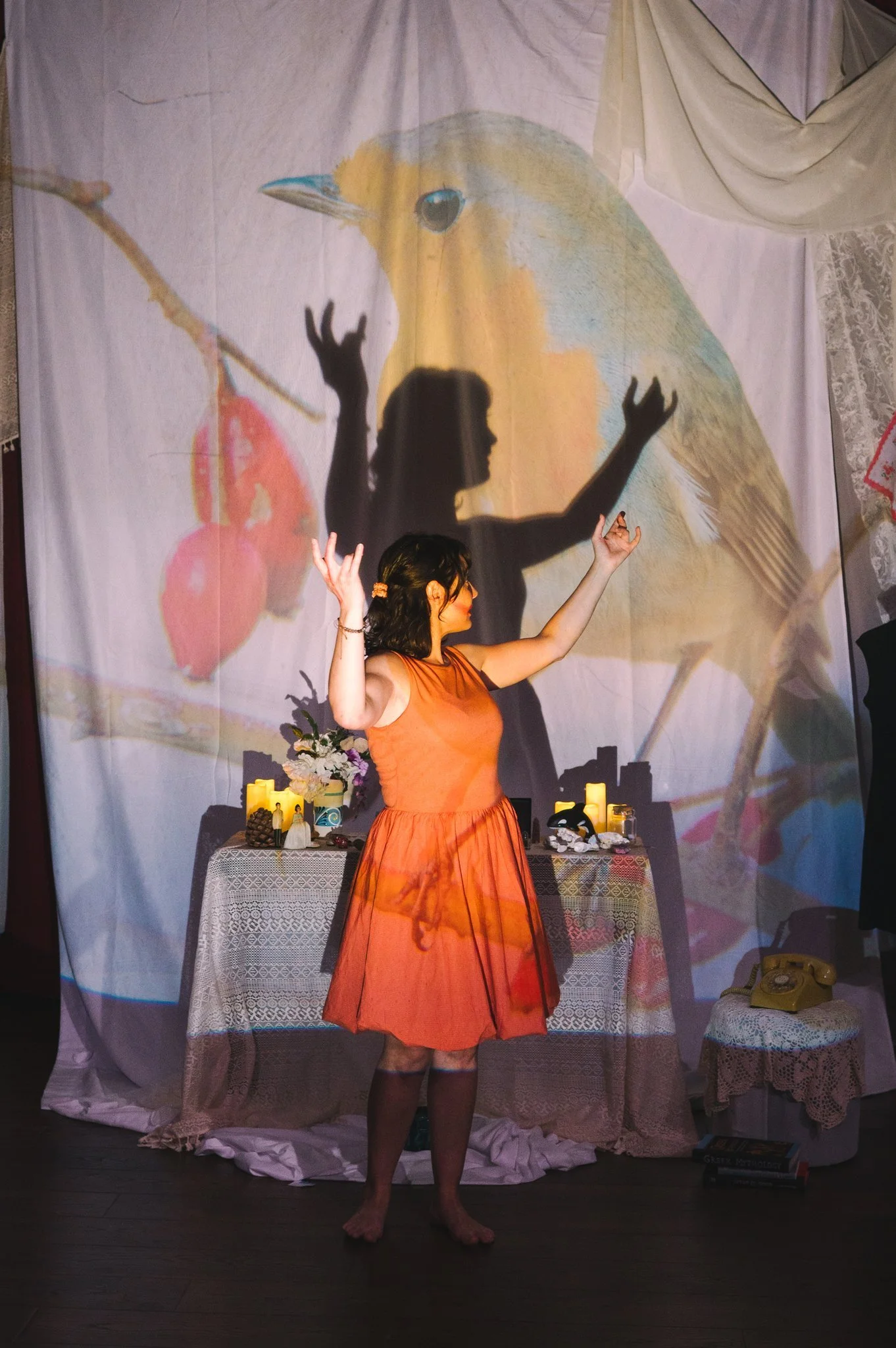
That same inventiveness extends to Bella Rivera's scenic and props design, which initially resembles a collection of objects gathered from a thrift store. An overhead projector, lace handkerchiefs, leaves, hanging sheets and drapes, and a central arrangement that could almost be considered an altar create a space that seems more haphazard than deliberately designed. Yet, as the performance unfolds, it becomes clear that everything serves a purpose. Aubree Barber's projection design casts images and textures across the hanging fabric, sometimes incorporating Iveliz herself into the visual landscape, while ordinary objects are transformed into essential storytelling devices. Xavier Martin's lighting complements those projections, creating shifts in color, mood, and atmosphere, while Ingrid Bell's sound design and Theodore Deacon's beautiful original music add further emotional depth. Beginning with a piano introduction before the performance, the music complements the action without overwhelming it. Together with the movement and choreography credited to Sarah Paul Ocampo, Julieta, and Iveliz, these elements create a production in which every object, sound, and movement contributes to the story.
There is so much considered in this play that I feel I need to call out two pieces that are slightly incongruous to the level of detail that Julieta and Iveliz have applied to the rest of Don’t Call It a Journey. At one point, the sound of a phone ringing through the handset of the the rotary device resembles a busy signal more than it does an actual ring. And, in a moment that probably says more about my age than anything else, I couldn't help noticing that when Iveliz attempts to adjust the volume on said rotary telephone, she's actually adjusting the ringer volume on the bottom of the device. Neither observation detracts a single iota from the production, but they stand out (to me, at least) in a show where so much attention has been paid to the smallest details.
Perhaps the most powerful illustration of what Julieta and Iveliz have created comes near the end, when it's worth taking a moment to look at both Iveliz and the stage around her. The woman standing on stage is not the same one who began the show, and neither is the environment in which she's been telling her story. Both bear the evidence of everything that has transpired over the preceding 85 minutes. The carefully arranged objects have been transformed by the very act of using them, just as Iveliz herself seems physically and emotionally changed by the experience of recounting El Hombre's illness and death. There is a visible weariness to it all, a sense that both the performer and her surroundings have been through something significant. And in a way, so has the audience, who has laughed with her, felt her frustration, witnessed her anger, and shared in moments of profound sadness. Those in attendance may not have lived the experiences she's recounting, but by the time the performance ends, it feels as though they’ve gone through them alongside Julieta and Iveliz. Grief leaves its mark on those who experience it, and here, quite literally, on the world around them.
Don't Call It a Journey doesn't offer the comforting suggestion that grief is something to be conquered, that healing follows a predictable path, or that there's a point at which someone can declare the experience finished and move on. Instead, it acknowledges that loss becomes part of who we are, changing how we see the world and how we move through it. Through an inventive combination of performance art, design, music, and deeply personal storytelling, eSe Teatro has created a piece that doesn't merely ask us to observe someone else's grief, but invites us to recognize something of our own within it. It's an experience that can be funny, confusing, heartbreaking, and ultimately transformative, much like grief itself. And while the title insists that we shouldn't call it a journey, what Julieta Vitullo and Iveliz Martel have created is a powerful reminder that grief isn't defined by where it takes us, but by how profoundly it changes us along the way.
The eSe Teatro production of Don’t Call It a Journey, the new original play from Julieta Vitullo and Iveliz Martel runs on stage at The Auditorium at University Heights in Seattle through December 5. For more information, including ticket availability and sales, visit https://www.eseteatro.org/.
Photo credit: Knecht Creative