
Stage Review - Dracula: A Comedy of Terrors (Anacortes Community Theatre)
Stage Review - Dracula: A Comedy of Terrors
Presented By: Anacortes Community Theatre - Anacortes, WA
Show Run: September 25 - October 17, 2026
Date Reviewed: Sunday, October 4, 2026
Run Time: 2 Hours, 30 Minutes (including a 15-minute intermissions)
Reviewed by: Greg Heilman
Dracula has been adapted so many times that it would be difficult to find an audience unfamiliar with at least the basics of Bram Stoker’s story. But anyone arriving at Anacortes Community Theatre expecting a faithful trip through the pages of the 1897 novel will discover very quickly that Dracula: A Comedy of Terrors has something considerably sillier in mind. Gordon Greenberg and Steve Rosen’s comedy takes the familiar characters and trappings of Stoker’s classic and gleefully turns them inside out, and under the direction of Elizabeth Lundquist, ACT embraces every opportunity to join in on the joke. The production runs through October 17 in Anacortes.
The basic premise of the story remains recognizable enough. Jonathan Harker travels to meet the mysterious Count Dracula, eventually setting into motion the familiar collection of vampires, victims, doctors and vampire hunters. From there, however, fidelity to Stoker becomes considerably less important than finding the next laugh. Modern references collide with Victorian England, gender and character identities are tossed around freely, and five actors are charged with populating a story requiring, frankly, considerably more than five characters.
That tiny cast is part of the joke. Actors disappear only to return moments later as someone entirely different, sometimes with little attempt to hide the theatrical machinery making it happen. Rather than asking the audience to suspend disbelief, the production frequently seems to invite everyone to notice exactly how ridiculous the whole thing is.
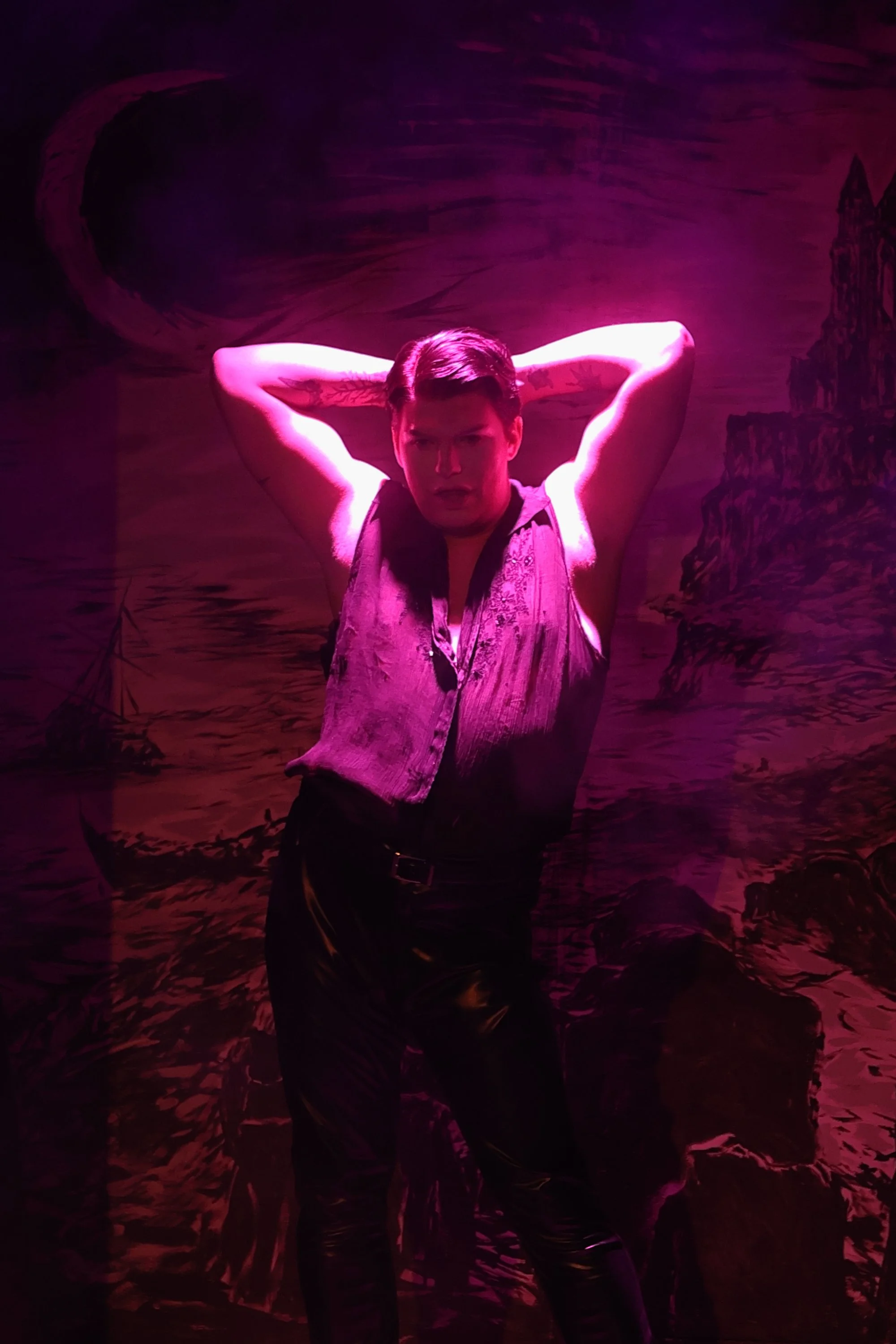
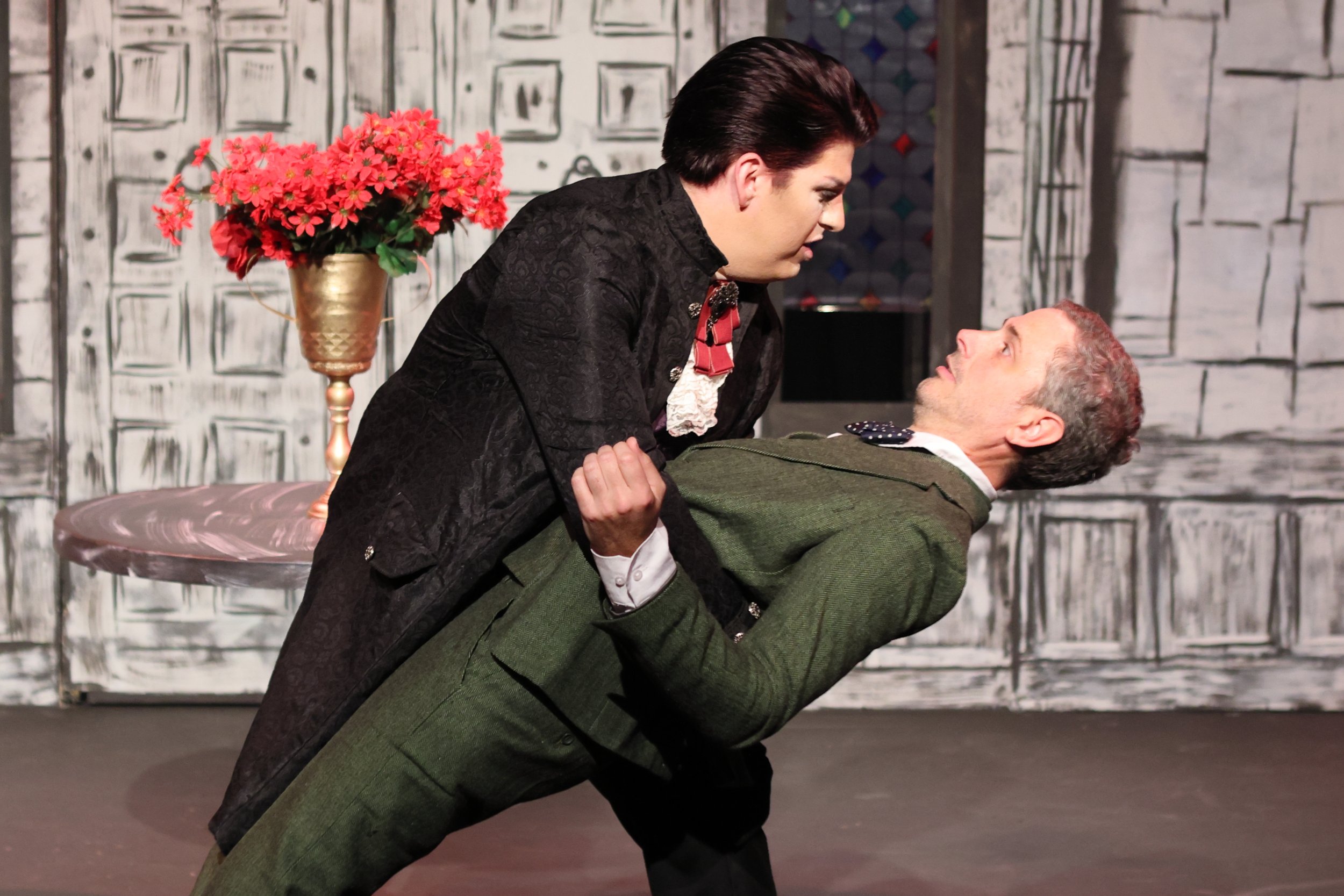
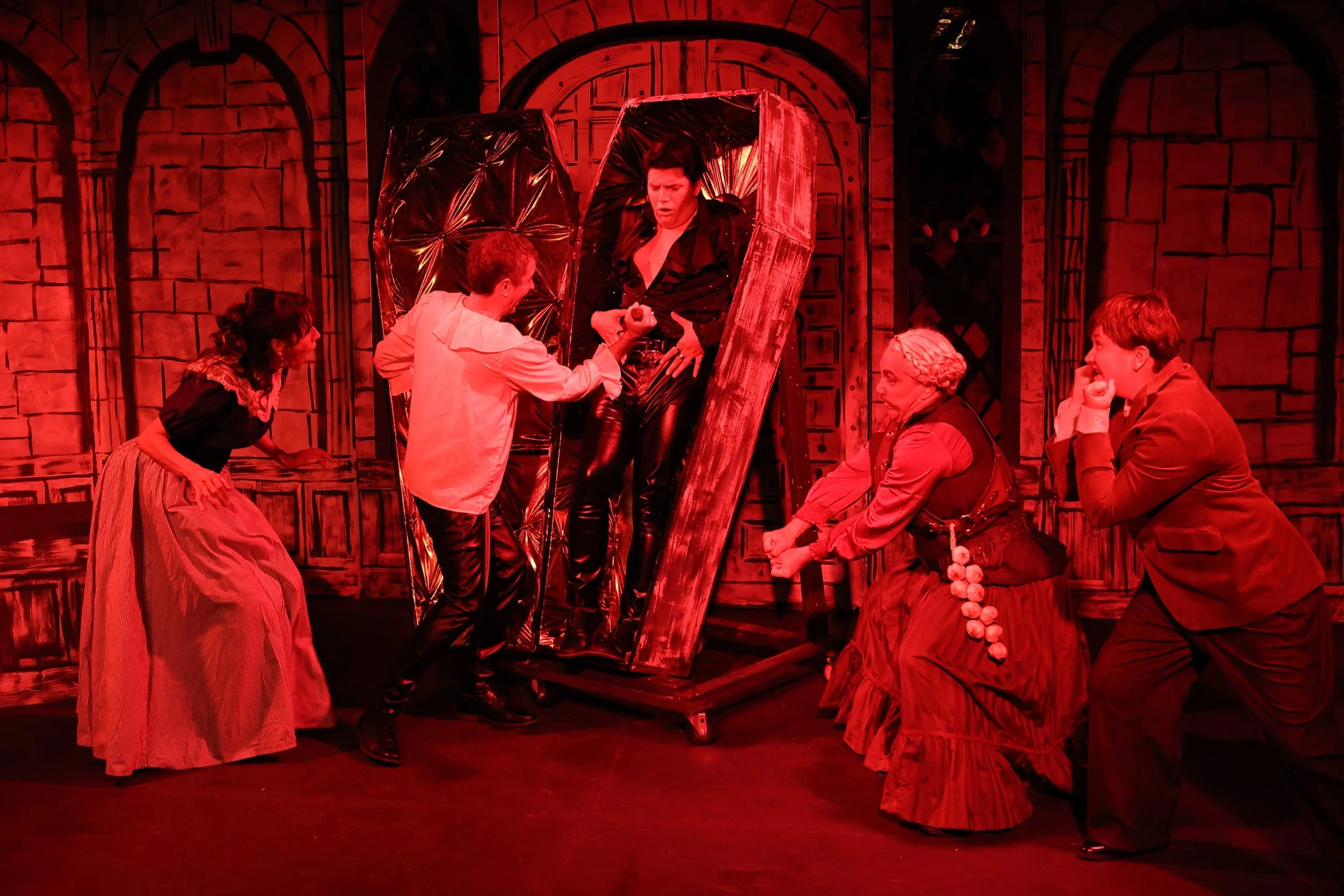
Tyler Conklin’s Dracula establishes that tone almost immediately. His design looks as though the Count might have taken a wrong turn on his way to The Rocky Horror Show, complete with dramatically pale complexion and heavy eyeliner. Yet this Dracula is just as likely to greet his visitors with a modern disclaimer as he is to threaten their necks. It is one of the earliest indications that this production has no interest in keeping 21st-century humor out of its 19th-century setting.
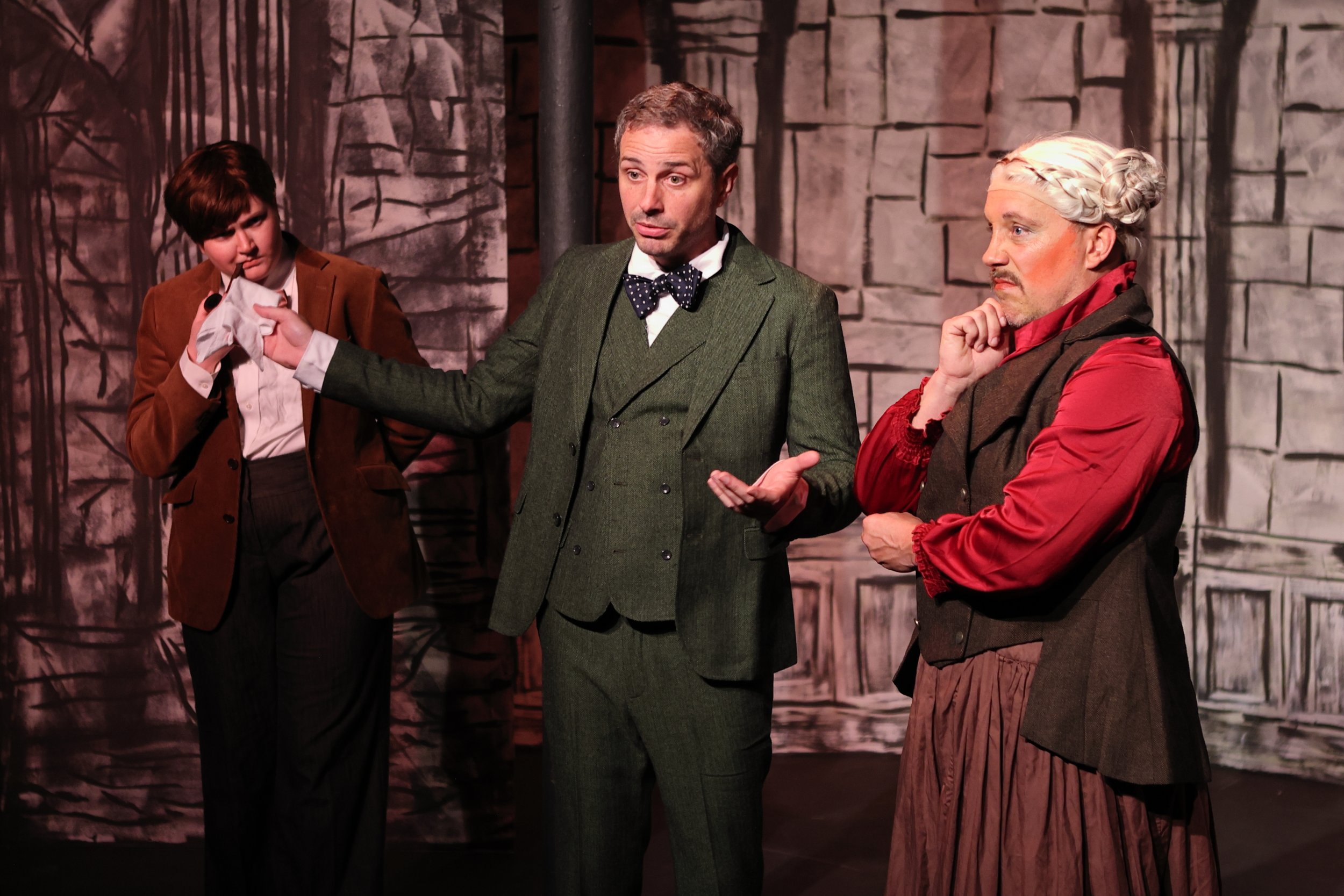
Brett P. Hall anchors much of the evening as Harker, but that role is only part of his workload. Brett takes on a collection of ancillary characters throughout the production, using exaggerated accents, voices and physical choices to distinguish one from another. As Harker, his facial expressions are particularly effective, often communicating the joke before he ever has to say anything. There is also plenty of fun in Harker’s increasingly confused response to Dracula, including an attraction that doesn’t fit particularly neatly within the expectations he brought with him to the castle.
Emily Hall likewise gets to play at opposite ends of the comic spectrum as Dr. Westfeldt and Renfield. Her Renfield is particularly memorable, built around a wonderfully ridiculous voice and a characterization that understands there is little benefit in subtlety when the production surrounding her is this intentionally broad.
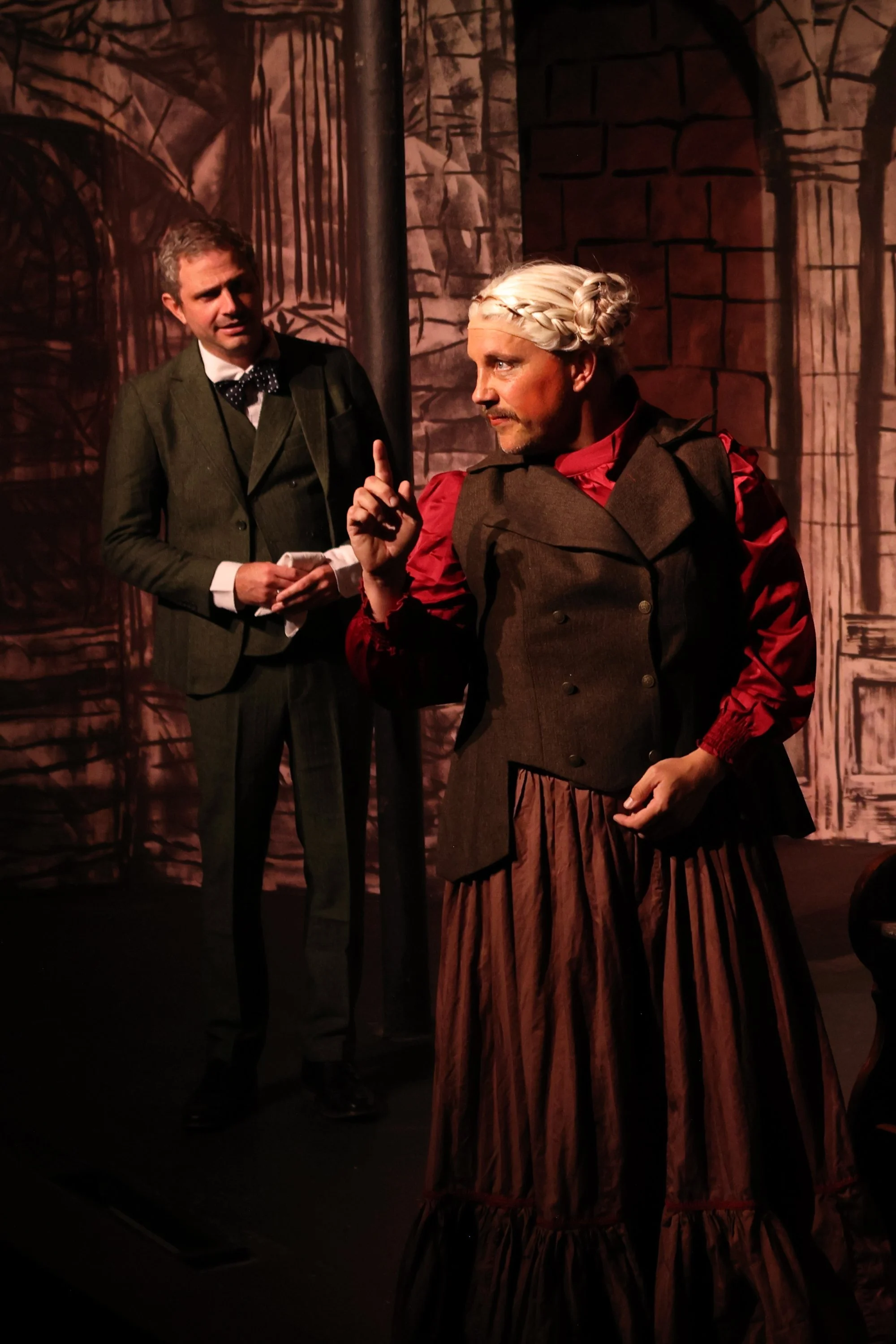
Gina DeLeo-Stamey tackles Lucy, Kitty and the carriage Driver, while Jake Schlack gets perhaps the most conspicuous bit of doubling as Mina and Van Helsing. Jake is funny in both, but especially so as Van Helsing, where the characterization goes all in on the exaggerated nature of the production. Having a male actor playing the female roles is itself part of the gag, just as the transformation between Mina and Van Helsing is never intended to disappear behind theatrical realism. The audience is supposed to recognize the absurdity of what five actors are being asked to accomplish, and Jake makes that absurdity work to his advantage.
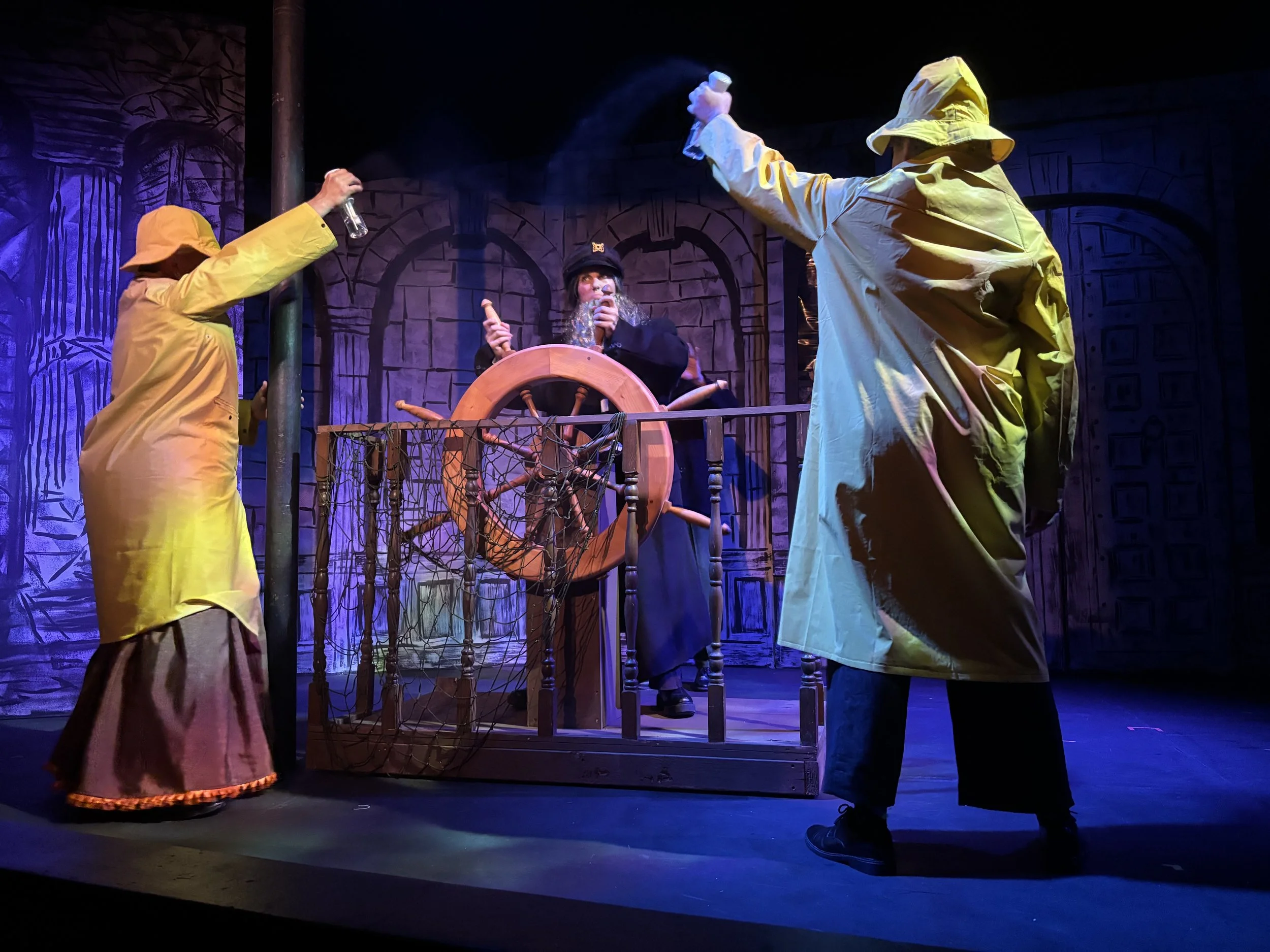
Even characters outside the principal five become opportunities for another joke. Megan Hill appears as the Sea Captain in this production, while Brett continues to turn up in unexpected places. The result is a show in which part of the entertainment becomes wondering not simply who will appear next, but which member of the cast is going to emerge as them.
Calling Dracula: A Comedy of Terrors a farce is easy enough, but on ACT’s stage it often feels closer to melodrama. The accents are exaggerated, reactions are enormous, characters are knowingly larger than life, and virtually nobody seems interested in behaving as though any of this should be taken seriously. The difference is largely academic. Whatever theatrical label best fits the production, Elizabeth understands the comic language of the piece and keeps her actors committed to it.
That commitment is important because comedy this broad can become exhausting when everyone simply tries to be louder or stranger than everyone else. Here, there is enough variation in the performances and enough precision in the timing to keep the silliness moving. Sound effects arrive at just the right moment, visual jokes are allowed to land, and the cast understands when an expression or pause can do more than another line.
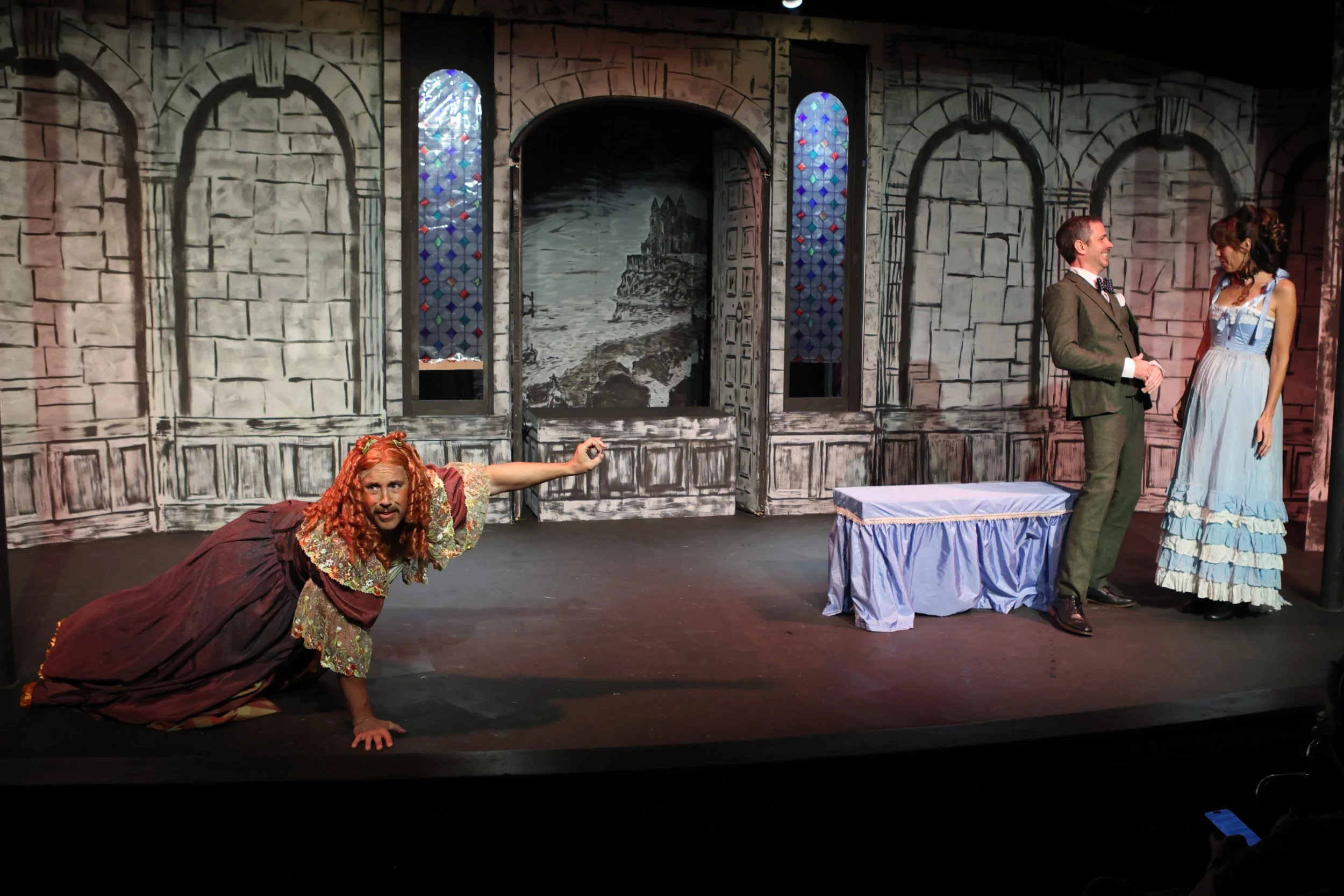
The production also makes clever use of ACT’s relatively small stage. The set provides the necessary framework without trying to overwhelm the space, while Travis Baechler’s overall scenic design helps transform it as locations change. The basic structure remains relatively simple, but details are frequently switched, and the set is nicely used throughout. For a show that depends on speed, entrances, exits and transformations, the intimacy of the space actually works in its favor.
The same willingness to expose the mechanics of theatre extends throughout the design. Puppets come to life, fog arrives through deliberately ridiculous means, water bottles can become a rainstorm, and even the stage management becomes part of the humor. None of it is trying to convince the audience that what they are seeing is real. The fun comes from watching a group of theatre artists find increasingly inventive low-tech ways to create Dracula’s world while simultaneously poking fun at it.
Miriam Smith’s costumes are another strength, particularly because they have to help the audience keep pace with all of the character changes. Dracula gets an especially memorable look for the party sequence, while Mina has one of the production’s loveliest dresses. The costumes can be attractive without sacrificing their comic function, and the speed with which some of these actors move among characters makes that visual shorthand valuable.
Kevin Elston’s lighting and Susan Buszta’s sound further support a production in which cues are often part of the punchline rather than merely atmosphere. The sound effects in particular are well timed, reinforcing the heightened theatricality without overwhelming what the actors are doing, and the lighting provides the necessary amount of theming support within each scene.
There are plenty of Dracula adaptations that lean into the darkness, sensuality and horror of Stoker’s story. This is emphatically not one of them. ACT instead gives audiences a Dracula populated by exaggerated accents, gender-bending casting, puppets, silly voices, contemporary references and five actors apparently willing to do just about anything for a laugh.
Anyone looking for page-by-page fidelity to Bram Stoker’s novel has wandered into the wrong version of Dracula. But anyone willing to watch a bunch of good actors take a series of increasingly silly turns at one of literature’s most familiar horror stories should find plenty to sink their teeth into. Farce, melodrama, parody, whatever label one chooses, Dracula: A Comedy of Terrors is a wonderfully unserious and thoroughly fun way to spend a few hours with the world’s most famous vampire.
Dracula: A Comedy of Terrors runs on stage at Anacortes Community Theatre through October 17. For more information, including ticket availability and sales, visit https://acttheatre.com/dracula/.
Photo credit: George Mehler