
Stage Review - Figure Drawing for Dummies (Annex Theatre)
Stage Review - Figure Drawing for Dummies
Presented By: Annex Theatre - Seattle, WA
Show Run: August 14 - August 29, 2026
Date Reviewed: Monday, August 24, 2026
Run Time: 2 Hours (including at 10-minute intermission)
Reviewed by: Greg Heilman
For nearly 40 years, Annex Theatre has made supporting and presenting new work a cornerstone of its identity, providing a place where artists can take risks, experiment with ideas and, importantly, continue developing work that isn't necessarily finished evolving. That mission took another step forward this season with the debut of Annex's Work-In-Progress Showcase, which selects a staged reading from the previous season's development series and gives it a full mainstage production. The first work to make that journey is Daisy Schreiber's Figure Drawing for Dummies, directed by Sammy Weinert and running at Annex Theatre in Seattle through August 29.
That journey from staged reading to full production feels particularly appropriate for Figure Drawing for Dummies because there is already a great deal here worth putting onstage and talking about, even as the piece continues to reveal places where further development could make it stronger. Daisy has built a clever premise around Woman, Nude, a controversial painting created in 1999 that sends its previously unknown artist to sudden fame. The problem is that the woman depicted in the painting is the artist's younger girlfriend, who never explicitly consented to being its nude subject, well I should say never consented to the painting ever leaving the studio walls. Years later, the artist, model and a museum curator (simply known here as Artist, Model, and Curator) revisit the circumstances surrounding the painting, wrestling with who controls the artwork, who controls its story and whether either can ever truly be separated from the relationship that created it.
It's a clever premise, essentially analyzing a piece of art through the story of its creation while simultaneously turning that story into an exhibition of its own. The audience is invited not simply to look at Woman, Nude, but to look behind it—to examine the relationship that produced it, the imbalance of power between Artist and Model and what happens when something given within the intimacy of a relationship becomes something over which the giver no longer has control.
Those questions extend well beyond the painting. Figure Drawing for Dummies is very much about the dynamics of relationships and how love can obscure our ability to recognize how a partner is treating us. Artist and Model don't enter their relationship on equal footing. There is an age differential and a power differential, but there is also a difference in how much each is willing to give. The play explores what happens when giving becomes sacrifice, particularly when that sacrifice flows predominantly in one direction. Without honest communication from the outset, resentment fills the space left behind, and a relationship built upon affection can eventually become unsustainable.
Daisy has assembled some compelling ideas here, though the script could still benefit from tightening, particularly as it approaches its conclusion. It isn't that the dialogue toward the end is pointless; rather, the story takes a long time to wrap itself up. Concluding a story succinctly while still driving home everything an artist wants an audience to consider is one of the more difficult parts of creating new work, and this feels like an area likely to become stronger as the play continues to develop.
One reason the ending feels extended is that one of Daisy's more intriguing ideas doesn't fully emerge until relatively late, the notion that controversial art needs to remain in the open, where it can be viewed and, perhaps more importantly, discussed. It's a worthwhile addition to the conversation surrounding Woman, Nude, but here it feels almost like an epilogue to the story already reaching its end. Weaving that question into the play from its beginning could give the production another thematic thread to follow throughout and allow its eventual conclusion to land with greater economy and force.
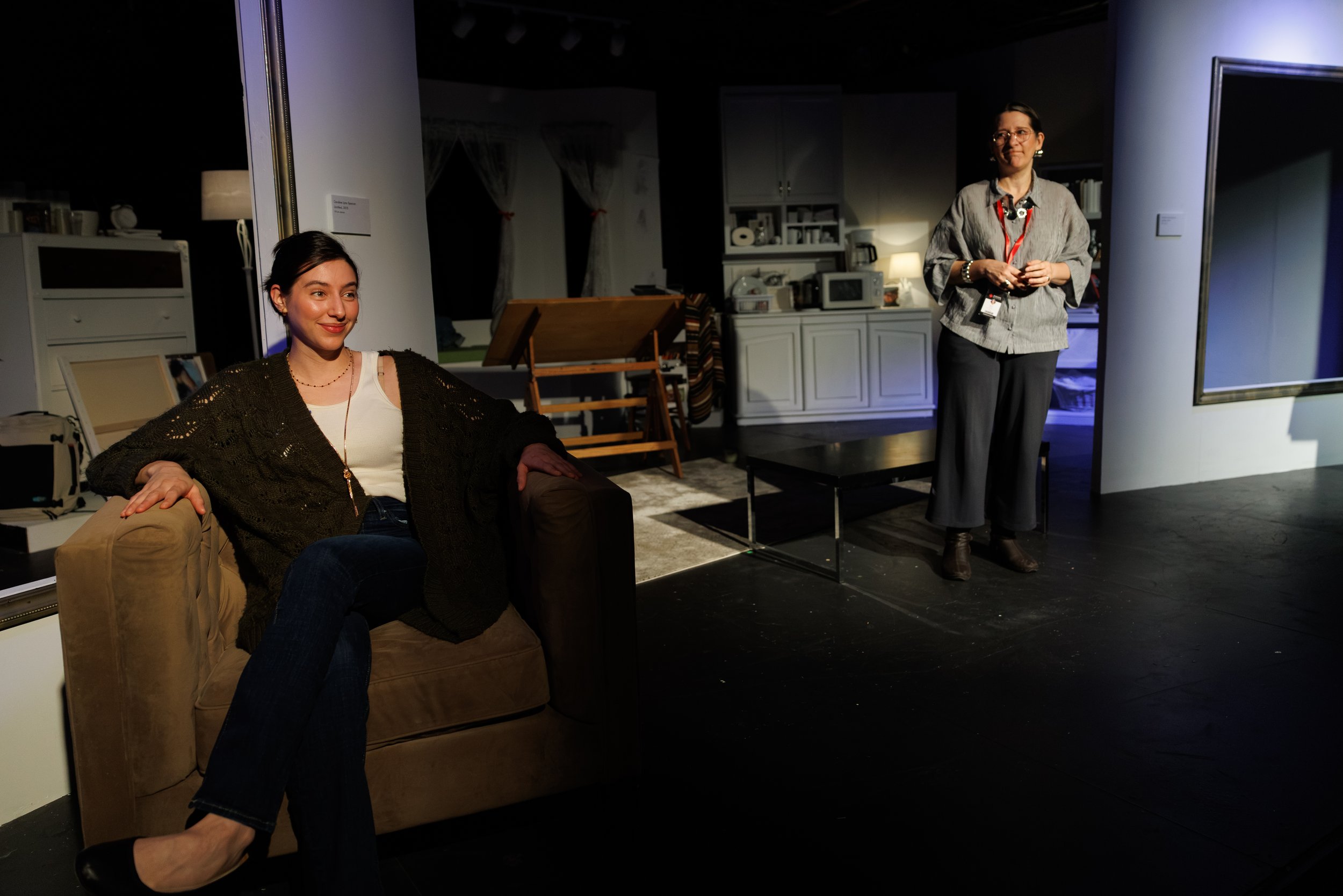
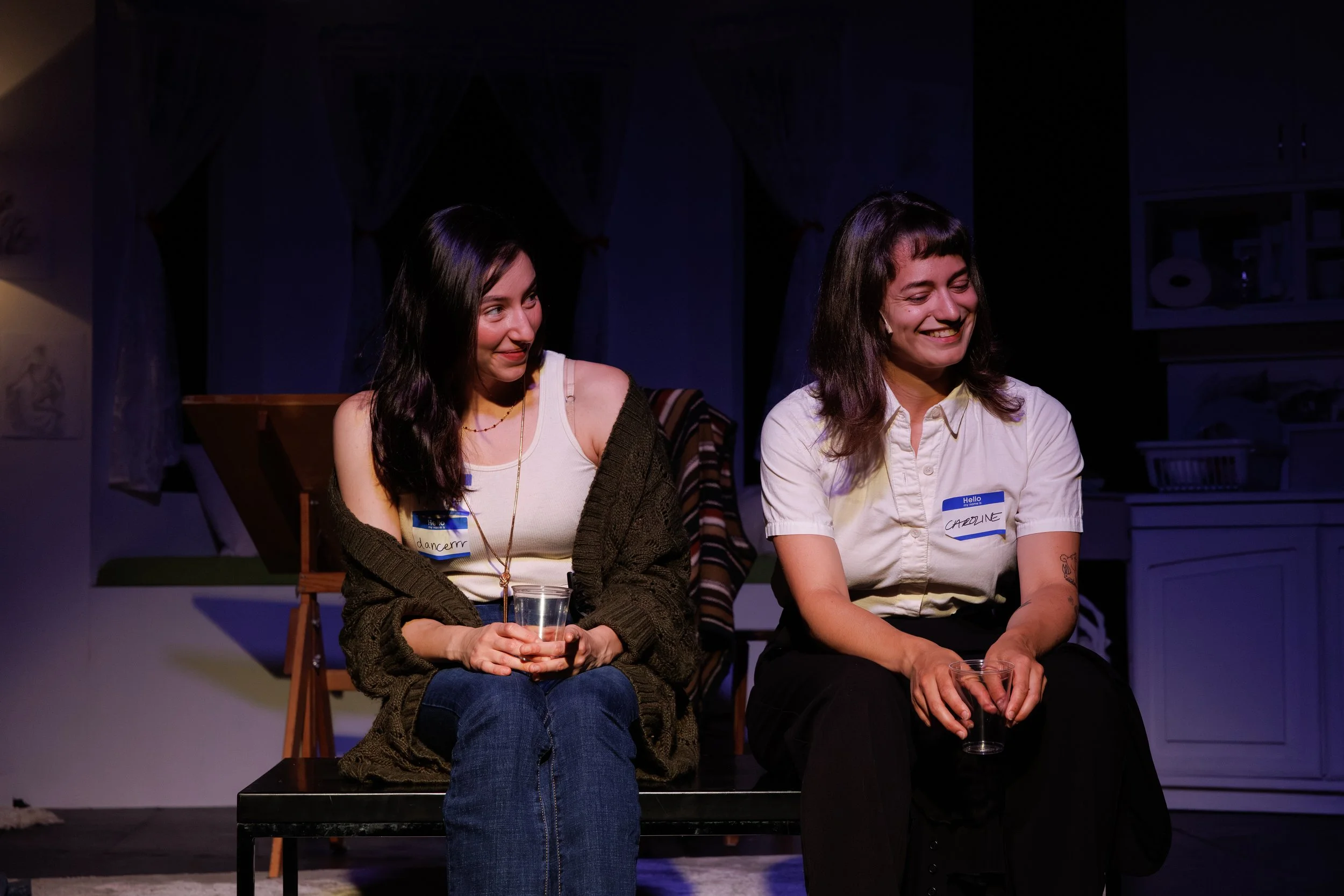
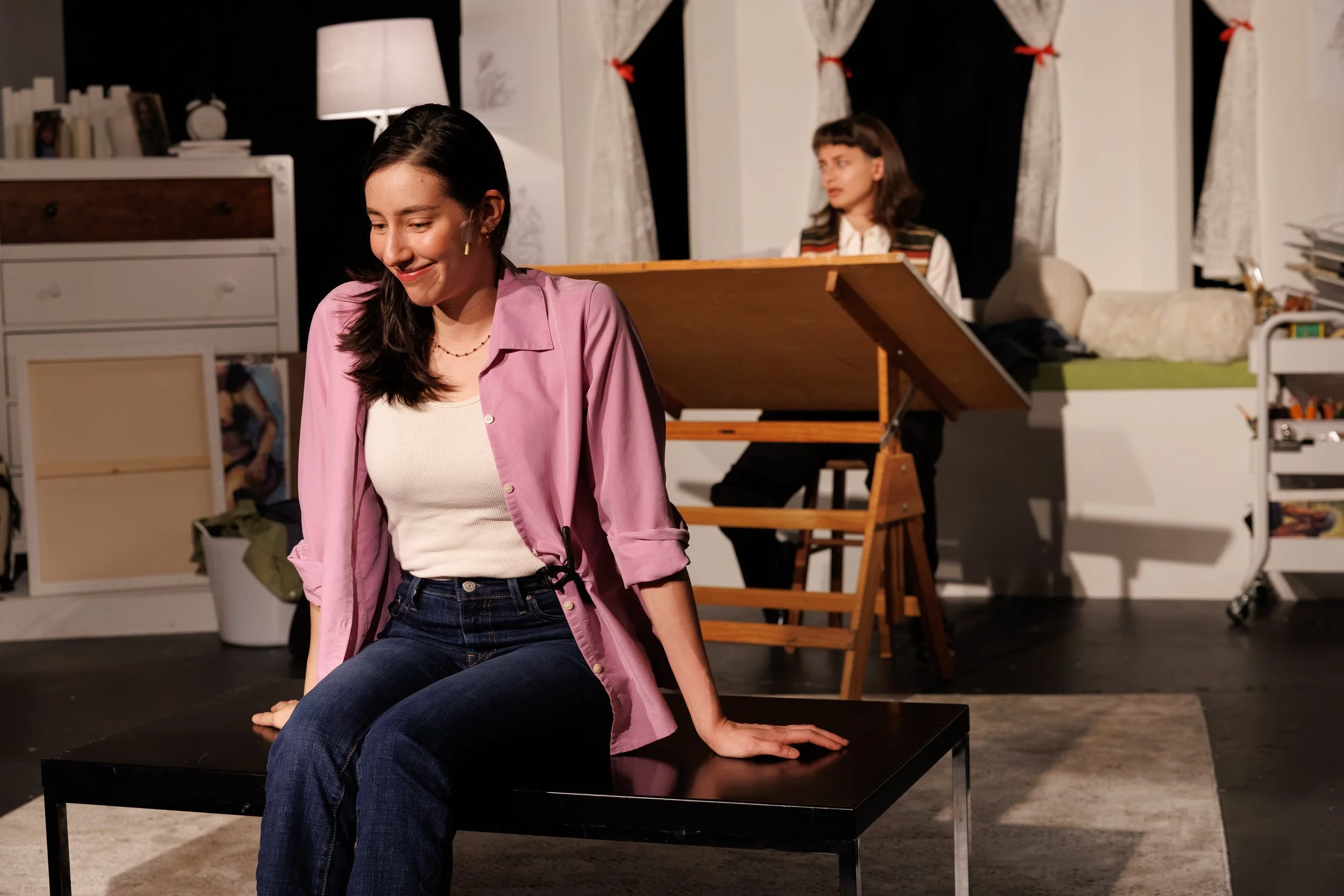
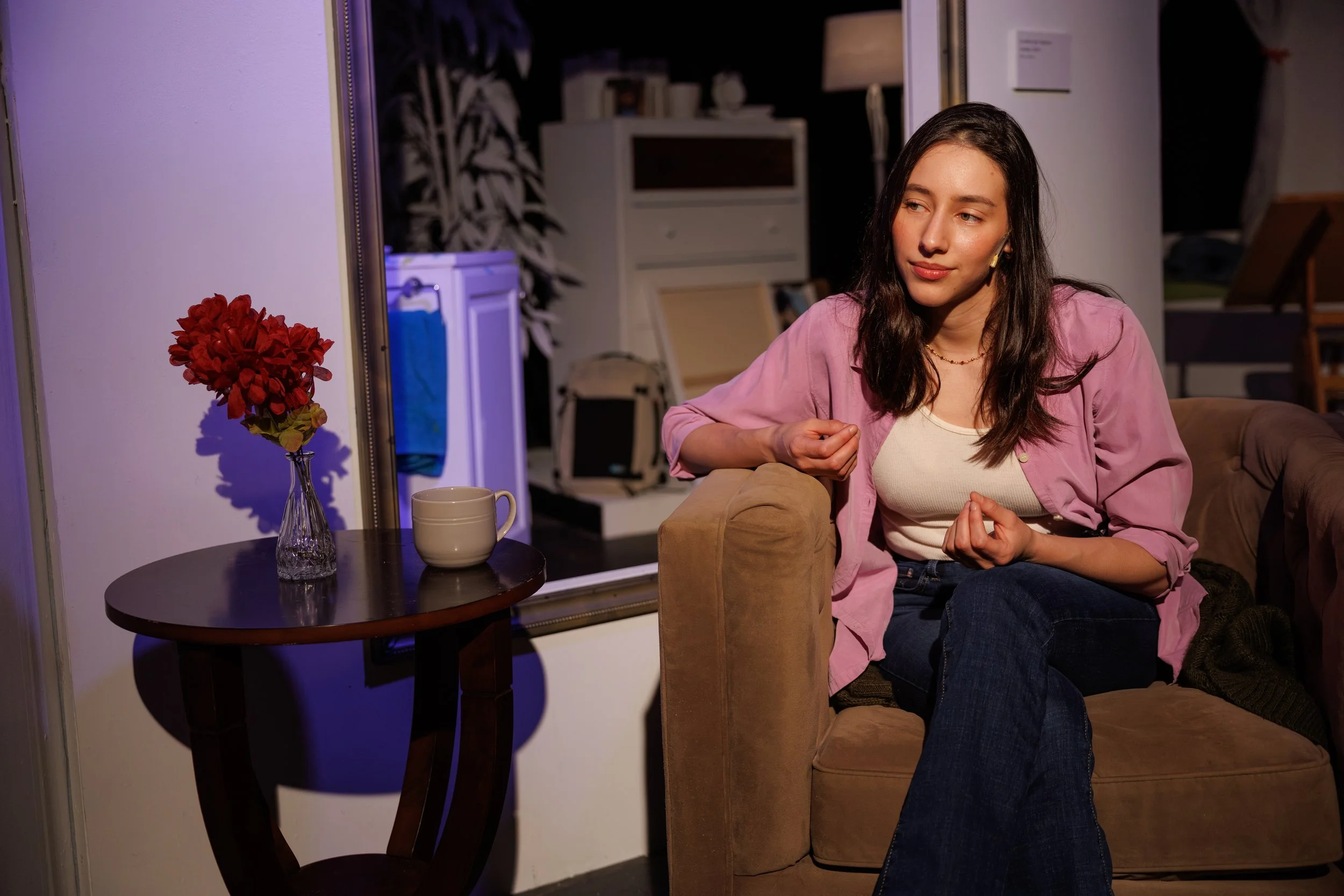
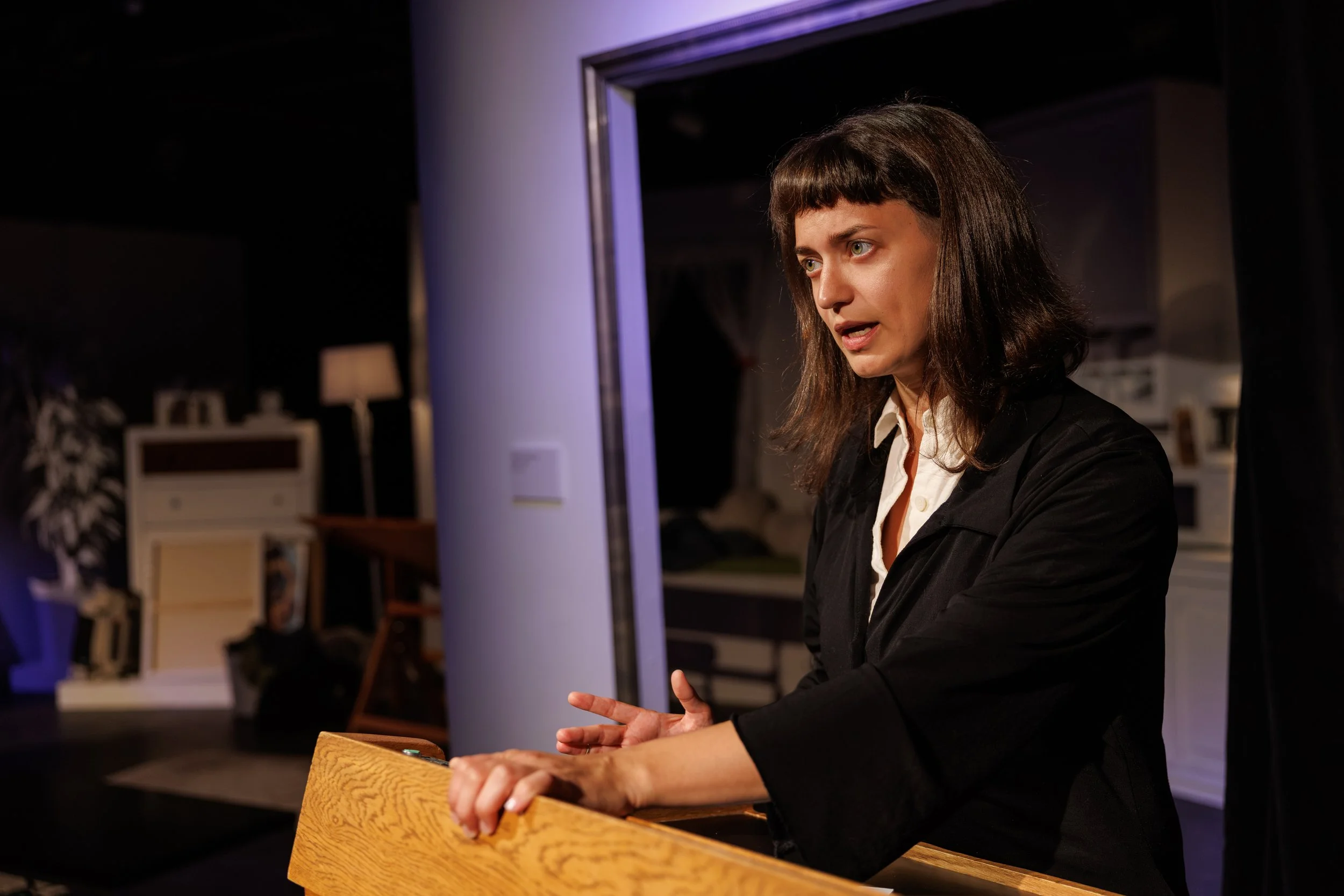
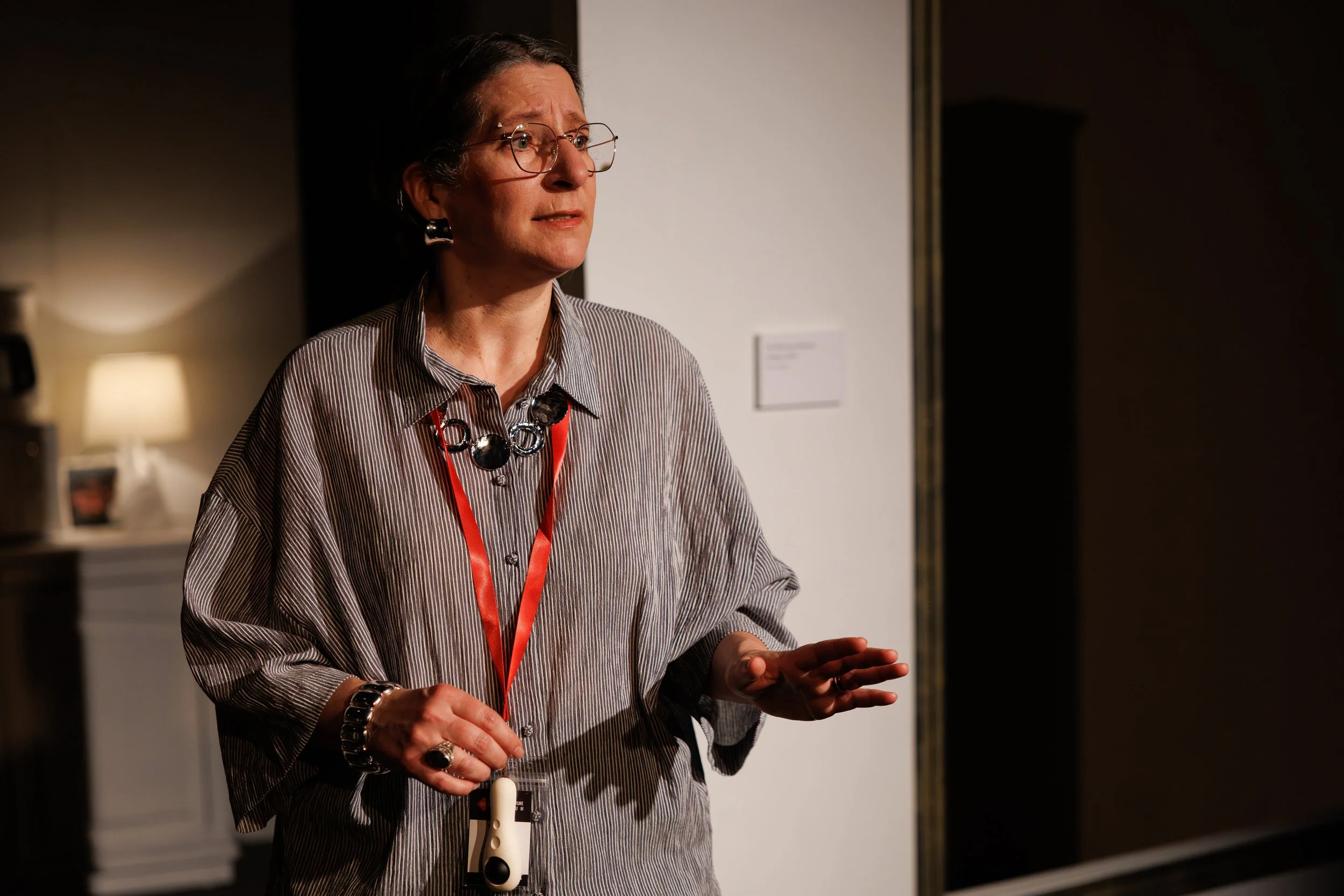
The production also establishes an interesting theatrical device that isn't always employed consistently. Dizzy Wilson's set resembles something of an IKEA showroom crossed with a museum exhibition. Clean lines, stark white books and surfaces, an artist's workspace, a television-interview area and a lectern from which Artist delivers what we eventually learn is a commencement address fill the spaces on stage. Curator, played by Alyson R H Lapan, initially controls what we see with a clicker. Artist and Model occupy separate areas of the stage, frozen until Curator activates one or the other. Another click transports us into their shared past, where Natalie Jane as Artist and Valeria Aguirre Diaz as Model reenact the events surrounding their relationship and the creation of Woman, Nude.
It's an effective theatrical language when first introduced, but its rules begin to loosen as the play progresses. The clicker's function becomes less consistent, the actors sometimes return to their present-day positions while still wearing costumes from the flashbacks, and Natalie and Valeria begin narrating portions of the story from within the reenactments themselves. None of this prevents the story from being understood, but it makes the distinction between recollection and reenactment less precise than it initially promises to be.
There is something admirable about the attempt to tell virtually the entire history using the same two actors in both periods, and Natalie and Valeria handle the demands smoothly enough that the production continues moving despite those inconsistencies. Still, the structure raises the intriguing possibility of what the piece might look like with four actors, older versions of Artist and Model reflecting on the relationship while younger versions inhabit the memories themselves. Such an approach could allow Sammy to move almost instantaneously between past and present while maintaining a clearer distinction between the women as they were and the women looking back on who they once were.
All that said, Natalie and Valeria do a nice job presenting both sides of a relationship filled with conflicting emotions. There is affection here, but also ambition, resentment, vulnerability, regret and hurt, and the two performers allow those emotions to coexist. That's important because Figure Drawing for Dummies is more interesting when it resists reducing the relationship to a simple question of which woman was right. Artist can love Model while failing to recognize what she is taking from her; Model can willingly give herself to Artist while eventually recognizing the cost of having given so much.
Valeria is particularly effective in communicating that cost. Her performance captures the vulnerability of someone who has given herself completely to a person she loves, only to discover that she may have left too little for herself. In this case that metaphor becomes startlingly literal. Model gave Artist access to her body within an intimate relationship, and an image of that body ultimately became something over which she had little control. Valeria makes the hurt underneath that realization palpable, allowing the debate surrounding Woman, Nude to become something much more personal than an argument about ownership of a painting.
Meanwhile, Natalie provides an effective counterbalance, particularly in showing how thoroughly Artist can become absorbed in her own perspective. At times she is so consumed by her work, ambition and understanding of events that she fails to recognize what is happening to the person beside her. Natalie doesn't need to turn Artist into a villain to communicate the damage she causes, instead she allows the audience to see someone whose love and artistic conviction can exist alongside an inability to recognize what her partner has sacrificed.
Alyson is also good as Curator, as the seamstress connecting the exhibition and its history, though the character could benefit from a greater sense of command. Curator is presented as the subject-matter expert in the room, and bringing more authority to her presentation would reinforce that position while also helping with projection. Volume, in fact, could be improved throughout the production, particularly when performers turn upstage. The intimacy of the space allows for conversational delivery, but some dialogue becomes more difficult to hear when the actors aren't facing the audience.
Where the production unquestionably excels is visually. Dizzy's predominantly white environment provides an almost blank canvas upon which the story can be created, while Owen Seiwerath's lighting moves smoothly among the distinct areas occupied by the television interview, commencement address and artist's studio. The transitions help establish location without requiring significant physical changes to the environment.
One scene, however, stands above everything else creatively, the recreation of the creation of Woman, Nude itself. Owen places Artist beneath a more defined spotlight while softer illumination falls across Model, rendering her almost angelic in silhouette. It's a beautiful representation not necessarily of who Model is, but of how Artist sees her. That is followed by an excellent use of backlighting, projecting Artist's silhouette onto a screen as she creates the work. The result is a strikingly beautiful piece of stagecraft and the visual highlight of the production.
More importantly, the beauty serves the story. Perhaps the production's most beautiful image occurs at the very moment one person is transforming another into an image of her own. We can understand why Artist sees Model as something extraordinary, something she desperately wants to capture, while everything surrounding that moment asks us to consider what such a beautiful image cannot capture, the subject’s autonomy, her vulnerability and ultimately her right to decide how much of herself she is willing to give, or more precisely to be taken.
That is where Figure Drawing for Dummies is at its strongest. Daisy isn't merely asking whether Artist had the right to create Woman, Nude or whether the painting should continue to be displayed. She is opening a larger conversation about what we owe the people we love, what happens when love and power become intertwined, and whether something given freely within a relationship remains ours to use once that relationship is gone.
As a new work, there are still places where Figure Drawing for Dummies can evolve. Its theatrical language could become more consistent, its conclusion more concise and some of its later ideas more fully integrated into what comes before. But those are refinements to a play with a clever premise and something worthwhile to say. Annex's commitment to developing new work provides precisely the kind of environment where a piece can experiment, discover what works and continue growing. Figure Drawing for Dummies demonstrates why that process matters. Like the controversial painting at its center, this is a piece that benefits from being put out in the open, looked at carefully and, most importantly, discussed.
Figure Drawing for Dummies, the new play from Daisy Schreiber, runs on stage at Annex Theatre in Seattle through August 29. For more information, including ticket availability and sales, visit https://www.annextheatre.org/.
Photo credit: Sayed Alamy