
Stage Review - Linda Vista (SecondStory Rep)
Stage Review - Linda Vista
Presented By: SecondStory Rep - Redmond, WA
Show Run: September 25 - October 11, 2026
Date Reviewed: Thursday, October 1, 2026
Run Time: 2 Hour, 30 Minutes (including a 15-minute intermission)
Reviewed by: Greg Heilman
Shows that use humor to set up drama are often only as successful as the extent to which the quality of the former amplifies the impact of the latter. In that respect, SecondStory Repertory’s production of Tracy Letts’ Linda Vista truly is a tale of two acts. To resurrect my favorite volleyball analogy, Act One is the set, and Act Two is most definitely the spike.
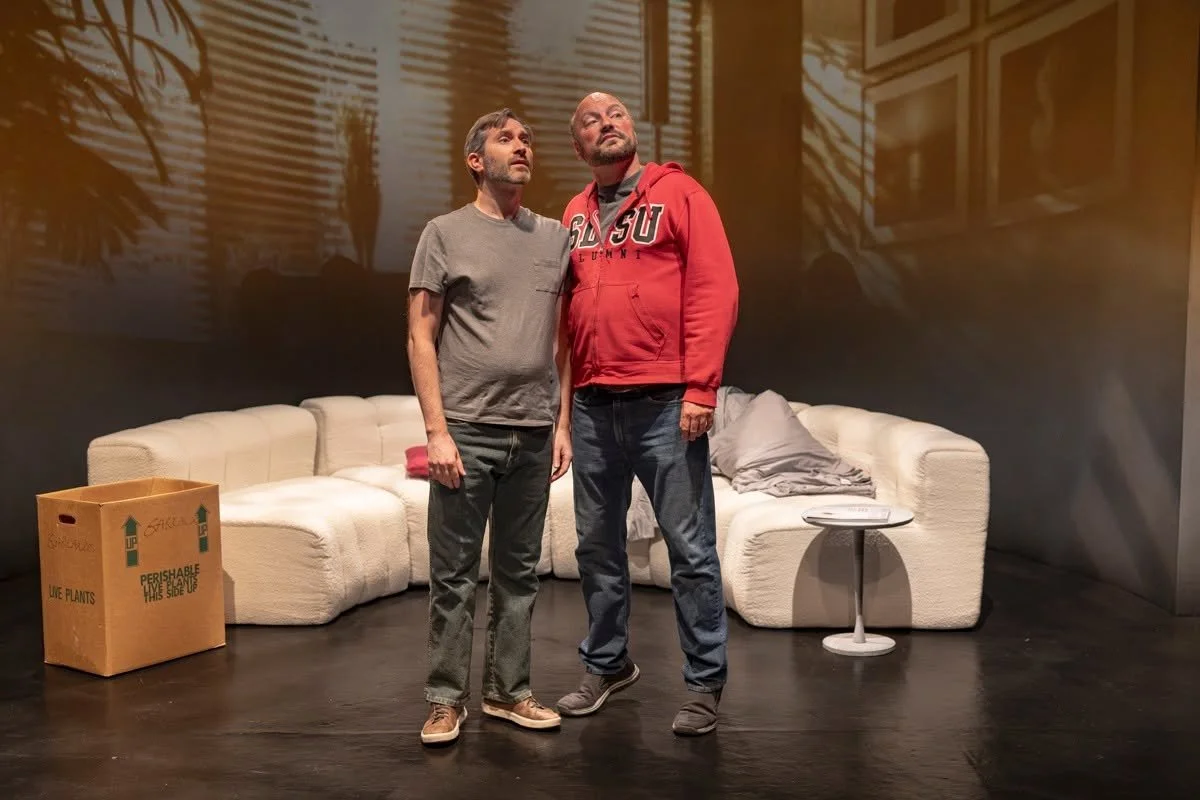
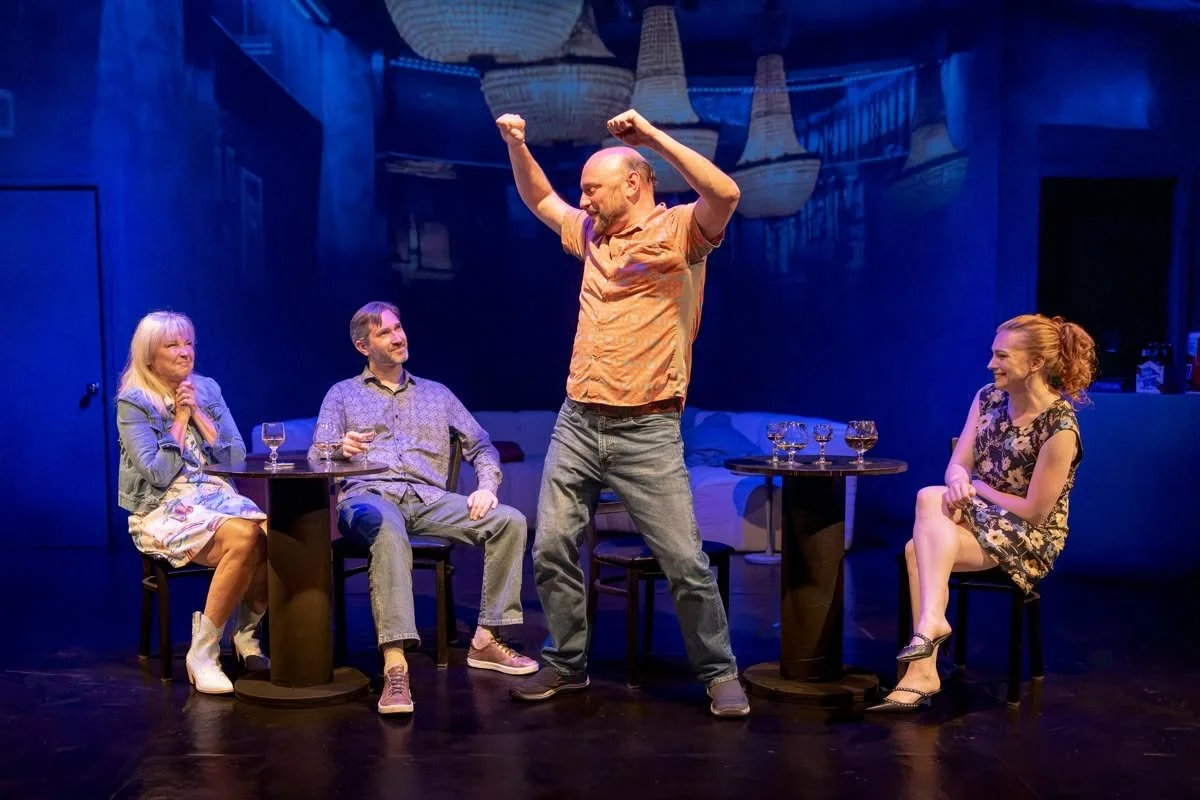
And it is quite a spike. Much of the first act is genuinely funny, introducing us to Wheeler (Lantz Wagner), a recently divorced, chronically unhappy Gen-Xer attempting to rebuild a life that has largely collapsed around him. Directed by Mark Kuntz and running through October 11 at SecondStory Repertory, Linda Vista takes its title from the San Diego neighborhood where Wheeler is trying, somewhat reluctantly, to begin again. He has spent time living in his ex-wife’s garage, has finally moved into a place of his own, and is surrounded by friends who seem considerably more interested in getting his life moving than Wheeler does himself.
For this now late-50-something Gen-Xer, there is something surprisingly refreshing about seeing a character who is relatable simply by virtue of his generational context. There are plenty of plays populated by characters in Wheeler’s age range, but I can’t remember seeing one that leans so completely into a character’s Generation X identity. His sarcasm, cynicism, cultural references, skepticism and particular way of looking at the world all feel rooted in the generation that came of age somewhere between analog and digital, idealism and disillusionment. There is an unusual pleasure in recognizing parts of yourself in a character not because you share his circumstances (and hopefully not all of his personality flaws) but simply because you speak the same generational language.
Lantz understands that language particularly well. His Wheeler is grumpy, negative, sarcastic and clearly carrying something underneath all of it. The sarcasm provides plenty of laughs, but Lantz never lets it become simply a collection of punchlines. There is always the sense that Wheeler’s humor is defensive, a way of keeping the world at a comfortable distance while convincing himself that everyone and everything else is the problem.
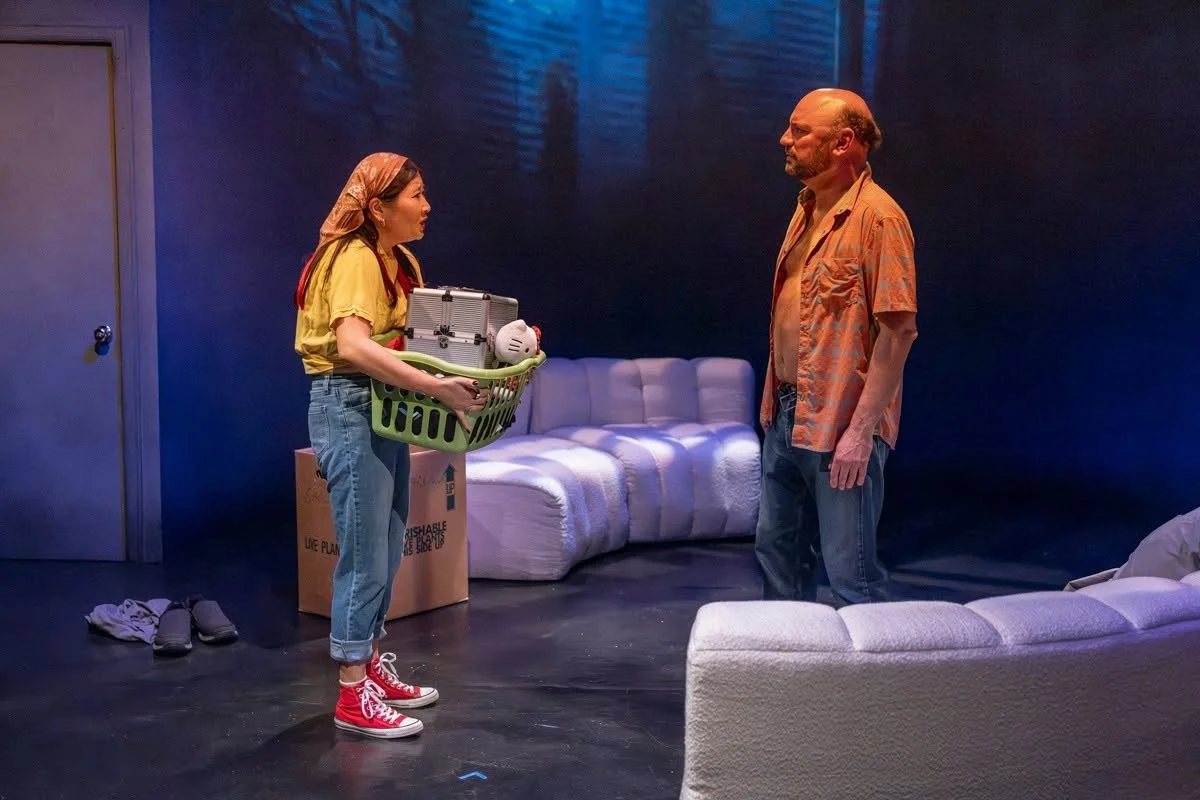
That makes his relationship with Jules (Tamara Burgess) particularly interesting. Jules is outgoing, cheerful and confident, seemingly everything Wheeler is not. Tamara brings an infectious energy to her, including a memorable karaoke moment that allows her to show off a lovely singing voice. Yet Jules is not nearly as put together as she initially appears. Wheeler is broken and wears it openly whereas Jules is broken and covers it with optimism. In a strange way, each seems to be exactly what the other needs.
That relationship also gives the production some of its quieter visual moments. The lighting during Wheeler and Jules’ scenes in his apartment softens the space and creates an intimacy that contrasts nicely with Wheeler’s harder exterior. The overall design immediately establishes Southern California, beginning with projections of palm trees and a sunset over the ocean, while blinds and changing light help transform Wheeler’s new apartment into a place that can feel alternately hopeful, lonely and confining. It’s also important to note that there are some challenging scenes to act here, none more than the intimate scenes between Wheeler and Jules and between Wheeler and Minnie. Simulated sex is not something Seattle audiences see regularly, but in the context of Wheeler’s story, it’s not gratuitous at all, there are impacts to each character’s story arc in both the tenderness and physicality of these scenes. There isn’t an intimacy coordinator specifically listed in the program, but ultimately it’s the director’s responsibility to make sure that the actors feel safe and respected in these scenes. It’s also an important part of the show to note for those who might not be comfortable seeing scenes like these on stage.
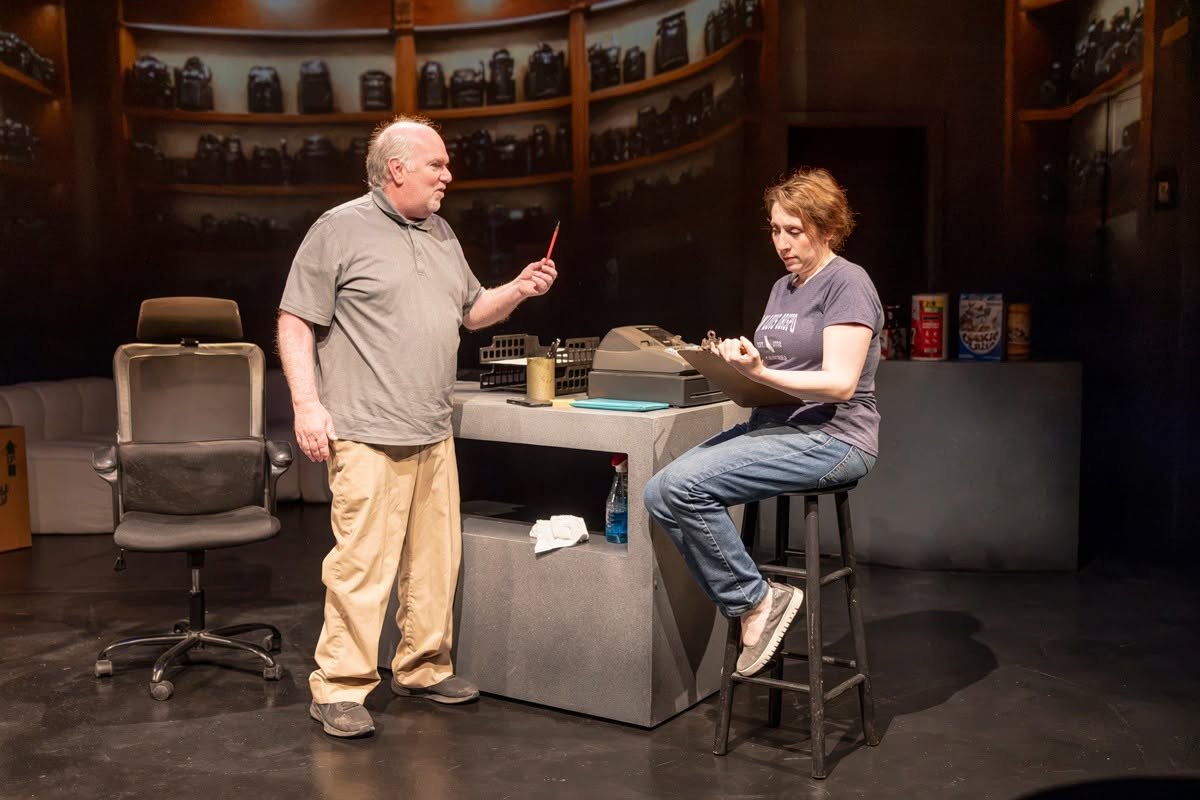
Wheeler’s friends provide both another source of humor and a window into the man he has become. Paul (Tadd Morgan) is among those trying to pull Wheeler back into the world, while Michael (Jay Jenkins) provides an amusing counterpoint of his own. Michael, the owner of the shop where Wheeler repairs cameras, may somehow be even more depressed than Wheeler, approaching his unhappiness with a matter-of-fact certainty that makes his observations (among them his apparent expertise on the various ways one might commit suicide) darkly funny rather than simply dark. The interplay among the men helps establish the world Wheeler inhabits and, more importantly, gives us a sense of the relationships that have managed to survive him.
All of this is important because the playwright isn't merely filling the first act with laughs before deciding that Linda Vista should become serious. He is positioning the pieces. We get comfortable with Wheeler. We laugh at him, and sometimes with him. For those of us who recognize his generational wavelength, we might even identify with him a little more than we would care to admit.
Then comes the spike.
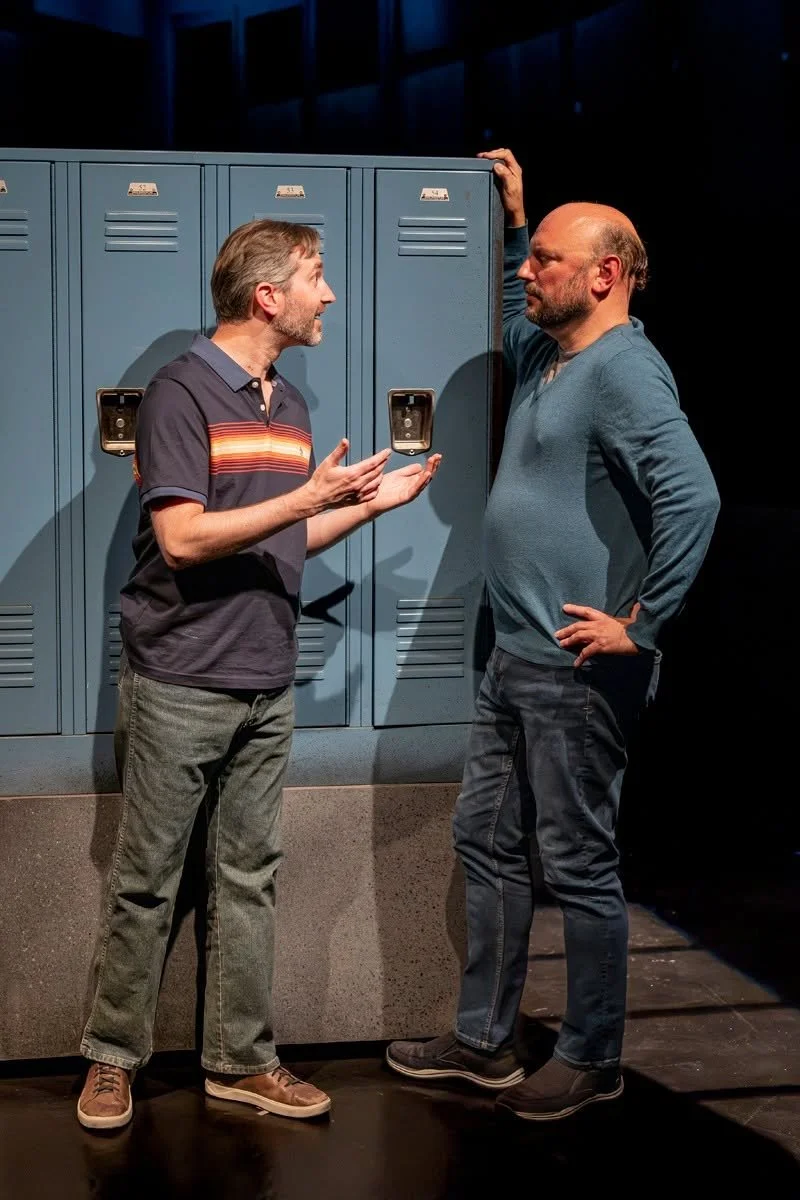
The emotional roller coaster of the second act begins in a locker room, in what is perhaps the best scene between Wheeler and Paul. It is honest and heartfelt, at times quite funny, but taken in its entirety it becomes a summation of Wheeler’s impact both on himself and on the world around him. There is history between these two men, and Tadd and Lantz play that history with an ease that makes the conversation feel less like exposition and more like something we have simply been allowed to overhear.
This is Tadd at his best. He balances affection, frustration, humor and honesty as Paul forces Wheeler to confront truths that Wheeler has become exceptionally good at avoiding. It is a scene between friends, but also between two men who have reached a point where friendship requires saying things the other person may not want to hear. In doing so, it kick-starts the dramatic escalation that will carry the rest of the act.
From there, the qualities that made Wheeler entertaining in the first act don't disappear, their consequences simply become much harder to ignore. His cynicism stops being merely funny. His detachment stops being harmless. Wheeler wears his misery almost like a medal, so consumed with everything that has happened to him that he has difficulty recognizing everything happening because of him.
Lantz handles that transition exceptionally well. Wheeler never suddenly becomes a different character. The same man who made the audience laugh in the first act is still there, he’s just being asked to be looked at differently. As Wheeler's spiral continues, it causes collateral damage he doesn't always recognize because he is so invested in his own unhappiness.
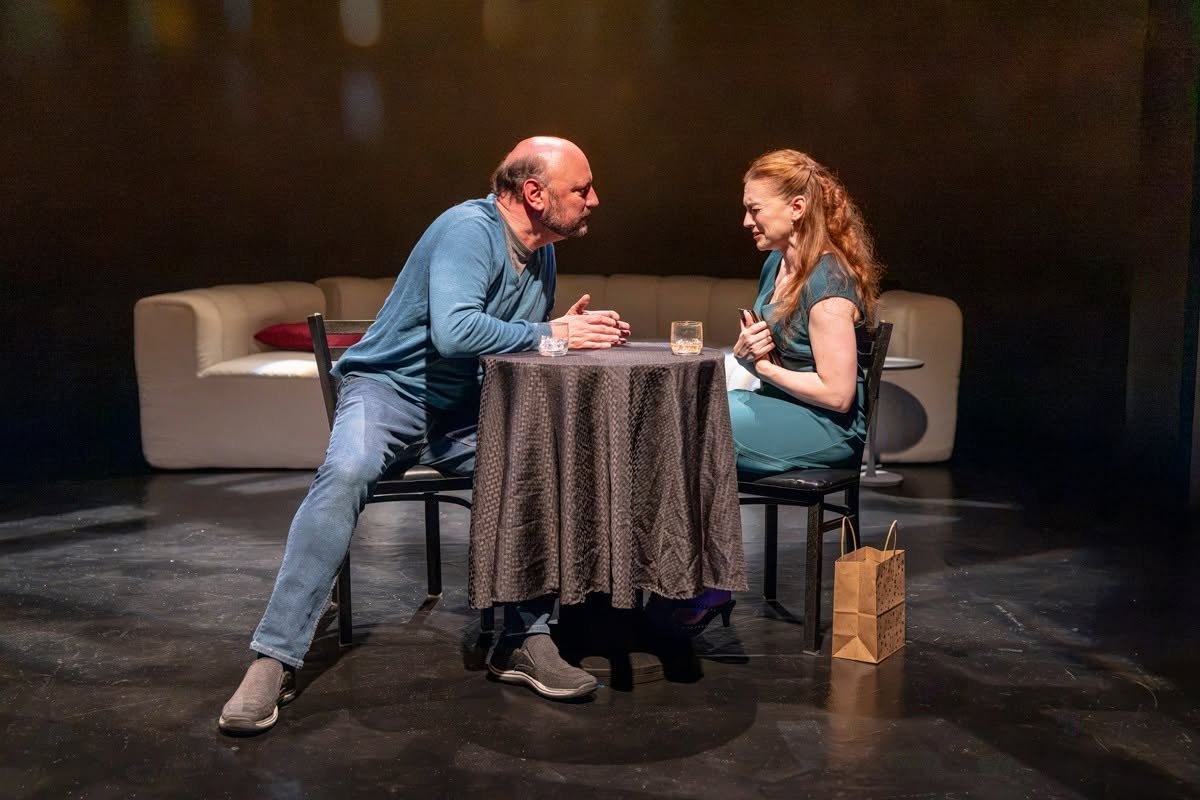
That becomes painfully clear in the later scene between Wheeler and Jules. Wheeler breaks off their relationship with an almost startling matter-of-factness, seemingly unable, or unwilling, to appreciate the emotional destruction taking place directly in front of him. Tamara is excellent here, allowing Jules’ hurt to build naturally rather than turning the scene into an exercise in manufactured emotion. What makes it hurt is precisely what made Jules so appealing earlier, that positivity and openness are still there, but suddenly they offer her no protection at all.
Wheeler, as a character, is an interesting case study in these scenes. His emotional detachment effectively makes him a vehicle through which the actors around him are given opportunities to deliver some of the production's most powerful performances. Wheeler stands at the center of the storm, but some of the most compelling moments come from watching what that storm does to everyone else.
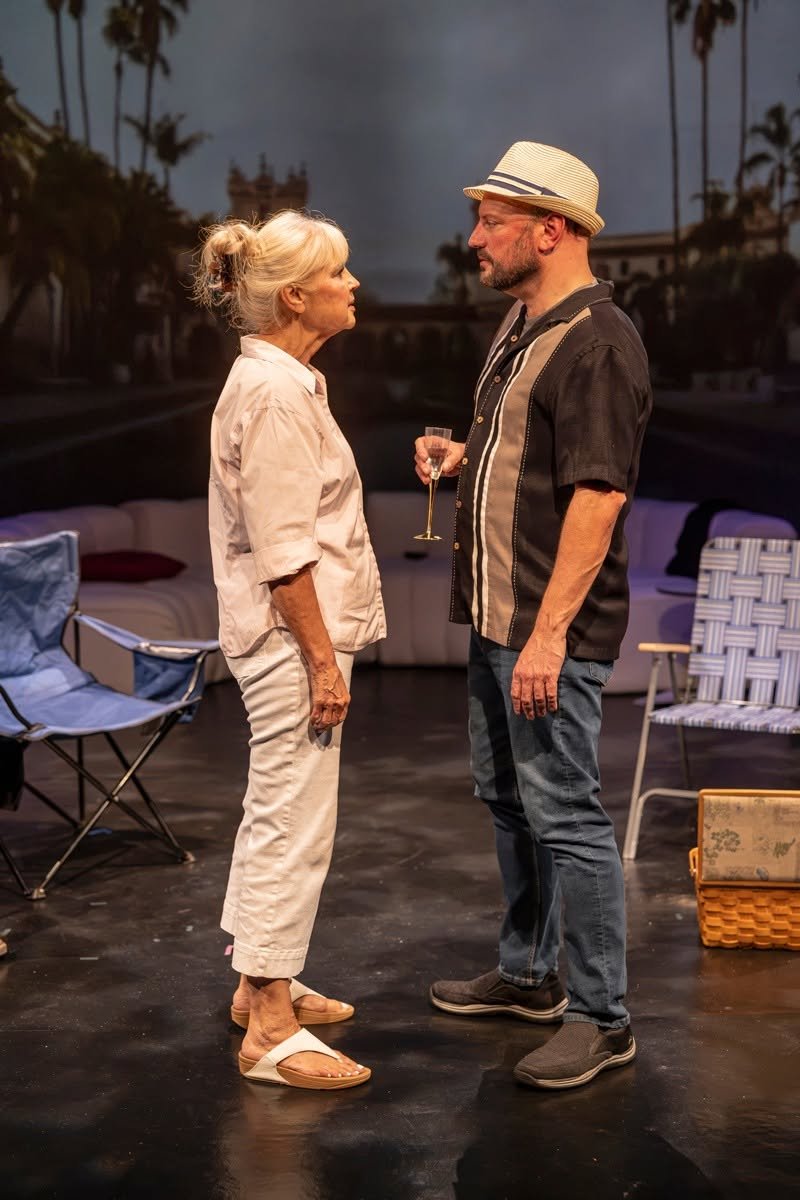
That is certainly true later when Margaret (Lisa Branham) confronts him. By this point, the pattern has become impossible to ignore, and Lisa gets an opportunity to show just how good she is when called upon to dig deep emotionally. Margaret's confrontation adds another perspective to the accumulating cost of Wheeler's behavior, and Lisa brings an emotional force to the scene that makes it another stop on the second act's increasingly intense roller coaster.
Lauren Erwin as Anita and Sara Albertson as Minnie further populate Wheeler's increasingly complicated world, ensuring that Linda Vista never becomes solely an exercise in studying one miserable man. These are people with needs, flaws, histories and damage of their own, and Wheeler's inability to see beyond himself becomes increasingly consequential as their lives intersect with his.
All that said, Linda Vista doesn't reduce Wheeler to a villain, and that is essential both to Tracy's writing and Lantz's performance. Wheeler is capable of hurting people, sometimes profoundly, but he is also hurting himself. Lantz allows both things to be true at once. His sarcasm and grumpiness are armor, but armor doesn't only keep other people out, it also traps the person wearing it inside.
There are moments when that armor finally cracks. The emotion works because Lantz has spent so much of the play keeping it contained. Wheeler's pain doesn't absolve him of the pain he causes others, but it prevents him from becoming a caricature. We understand why this man became who he is even when we want desperately for him to recognize what he is doing to himself and everyone around him.
That idea finds perhaps its most poignant expression in a scene between Wheeler and Anita. It is Anita who observes that “it’s harder than it looks...being a person,” a deceptively simple thought that lands with considerably more weight after everything that has preceded it. Lauren brings a tenderness to the moment that gives both Anita and Wheeler room simply to be human for a while.
And maybe that is ultimately what Linda Vista is asking us to consider. Being a person really is harder than it looks. So is recognizing that everyone around us is engaged in exactly the same struggle.
That is why the structure of Linda Vista works as well as it does. Act One gets us laughing at a man whose cynicism, sarcasm and generational disillusionment can be tremendously entertaining. More importantly, it gets us comfortable with him. Act Two then systematically forces us to confront the consequences of the very qualities we spent the first half of the evening enjoying.
Linda Vista doesn't ask anyone to excuse Wheeler, rather it asks that he be understood, which is considerably more difficult. And for those of us who recognize a little of our own generation in him, perhaps a little more uncomfortable as well. The set is funny enough to make us drop our guard. The spike lands because of it.
Linda Vista runs on stage at SecondStory Rep in Redmond through October 11. For more information, including ticket availability and sales, visit https://www.secondstoryrep.org/product-page/linda-vista.
Photo credit: Colin Madison Photography