
Stage Review - Noises Off (Renton Civic Theatre)
Stage Review - Noises Off
Presented By: Renton Civic Theatre - Renton, WA
Show Run: October 02 - October 18, 2026
Date Reviewed: Friday, October 2, 2026
Run Time: 3 Hours (including two 15-minute intermissions)
Reviewed by: Greg Heilman
Michael Frayn’s Noises Off is one of those plays that makes being incompetent look extraordinarily difficult. Its actors forget lines, miss entrances, lose props, feud with one another, drink too much and generally seem incapable of getting through a performance without some sort of disaster befalling them or their production. For the actual actors playing those actors, however, there is almost no room for error. Farce depends on precision, and Noises Off takes that requirement to an almost absurd extreme. Renton Civic Theatre’s production, directed by Jesse Huntwork, in his directorial debut, and running through October 18, dives into that contradiction with both feet, building an show in which things get progressively worse for the fictional company and progressively funnier for everyone watching.
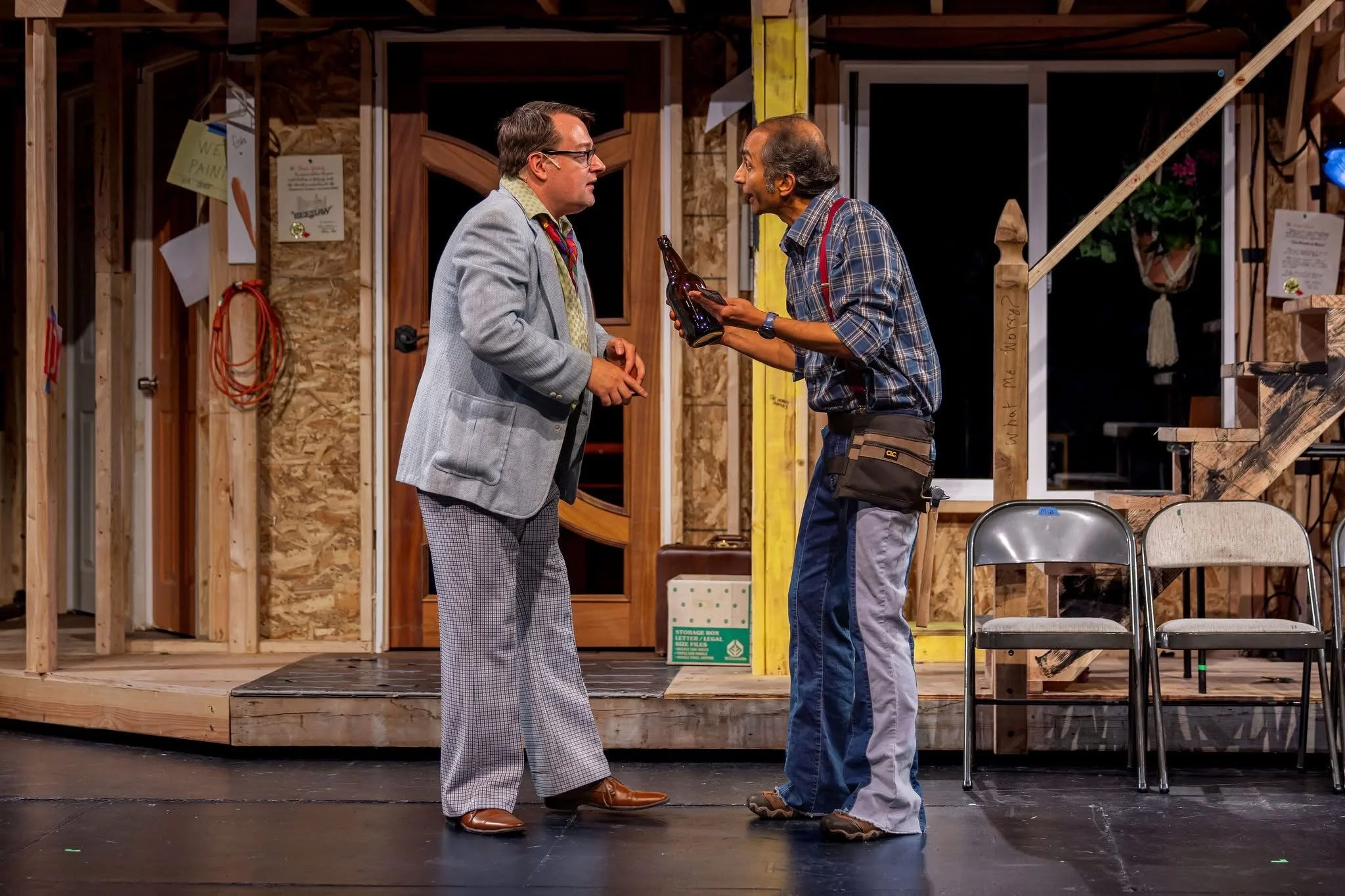
The premise begins simply enough. The audience is, well, the audience, taking in the final rehearsal of Nothing’s On, a comically dreadful British sex farce that is supposed to open the following day. Unfortunately, director Lloyd Dallas (Jalyn Green) has assembled a collection of actors who can’t seem to get much of anything right. Lines are forgotten, blocking disappears from memory, doors open when they shouldn’t, sardines are everywhere, and every time Lloyd fixes one problem, another seems to materialize in its place.
It’s a challenge for a first time director and Jesse understands that the comedy can’t simply come from people running around and slamming doors. The characters may be incompetent, but the actors portraying them have to know precisely what they are doing. A few split-second misses in the complicated timing of the doors on opening night were noticeable, but they did little to diminish the humor, and the timing will surely become more precise as the show run progresses. Most importantly, Jesse allows the comedy to come from the characters rather than asking the mechanics of the farce to do all the work.
Jalyn is the clear standout of the first act. Lloyd begins as a director desperately trying to drag his production toward something resembling opening-night readiness, but there is a gradual, albeit wonderful, buildup of his frustration. His patience erodes, his disbelief grows, and eventually he snaps. Jalyn is especially funny when Lloyd loses his temper, but there is more to the performance than volume or exasperation. Lloyd is the glue holding together a production that is perpetually threatening to collapse, and Jalyn makes it clear just how exhausting that job has become. His stage time becomes more limited in the second and third acts, but his appearances remain every bit as impactful.
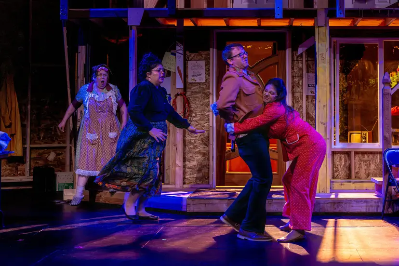
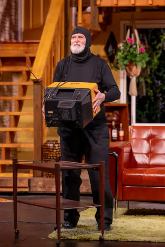
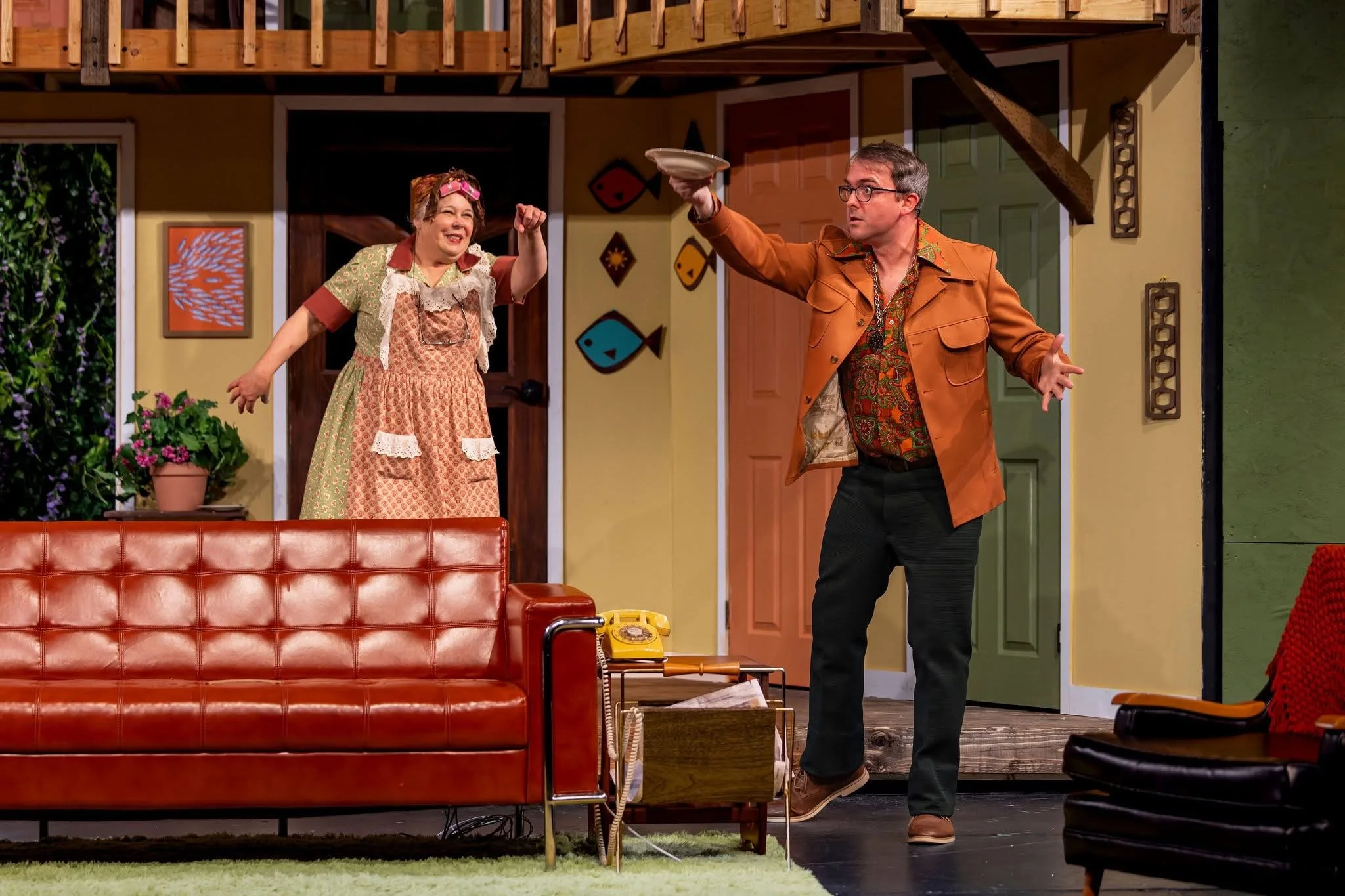
Michele Greenwood Bettinger’s Dotty Otley is at the center of many of Lloyd’s problems. Playing the housekeeper Mrs. Clackett in Nothing’s On, Dotty seems incapable of remembering where she is supposed to go, what she is supposed to say or, most importantly, what she is supposed to do with her ever-present plate of sardines. Michele establishes the comic rhythm immediately and only gets better as things fall apart. Then there is Selsdon Mowbray, played by Dale Bowers. At first, it isn’t entirely clear whether Selsdon is senile or drunk. As the evening progresses, it seems increasingly likely that he is a little of both. Dale is hilarious with the character from beginning to end, bumbling his way through the production while somehow remaining capable of surprising everyone around him. Some of Selsdon’s funniest moments are actually those flashes of clarity, when he suddenly remembers something or demonstrates an accuracy that seems completely inconsistent with the man we have been watching.
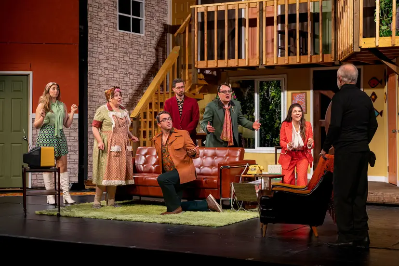
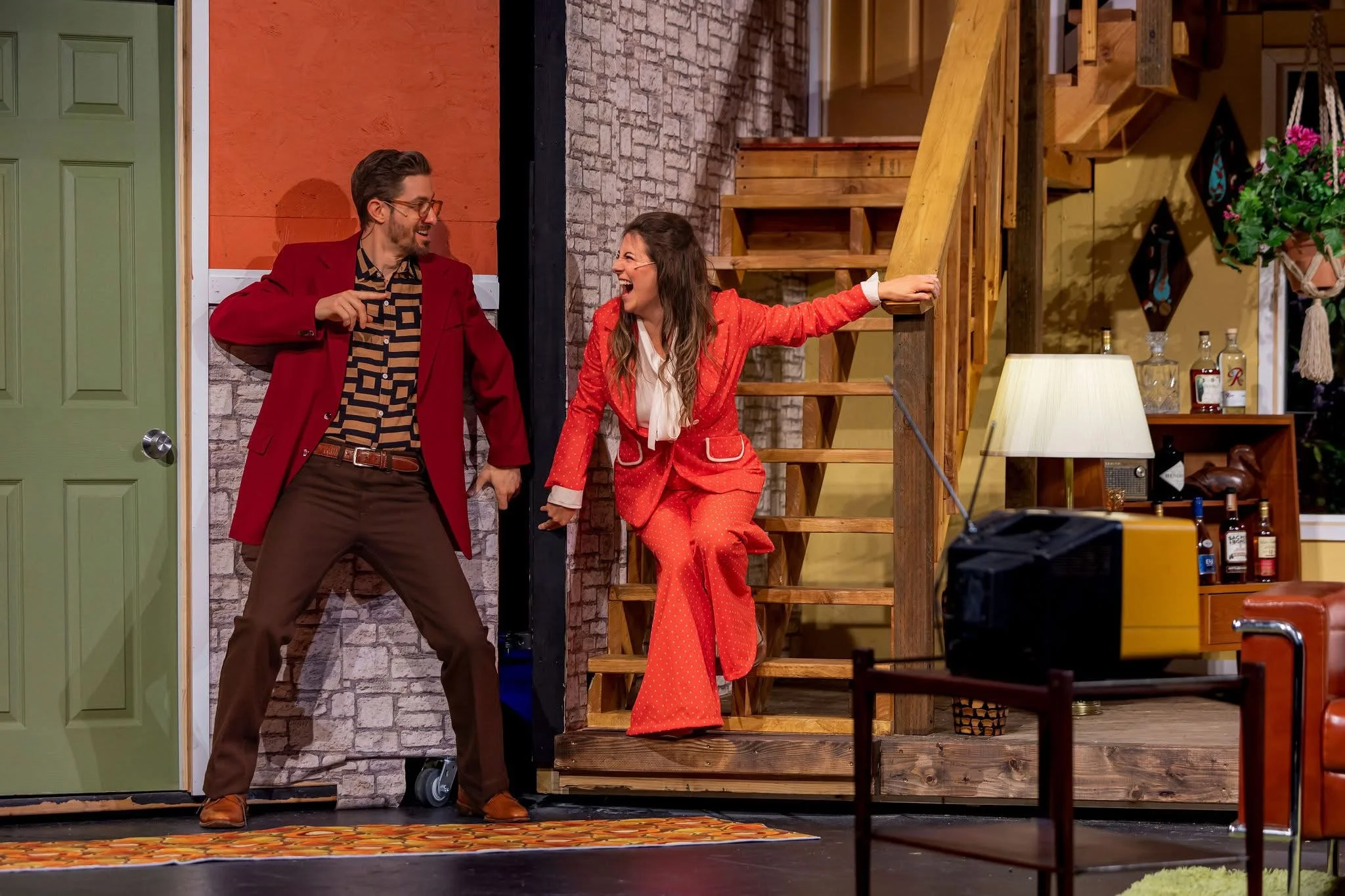
In fact, the entire ensemble seems to get better as the show within a show degrades, and there doesn’t seem to be a limit to their comedic abilities. A prime example of this is Graham Arthur Blair as Frederick Fellowes, who is good throughout the production, but he is particularly funny in the final stretch, when whatever tenuous control these people once possessed has disappeared. By that point, however, singling out one performance becomes increasingly difficult. Everyone gets a moment, everyone contributes to the collapse, and everyone is funny. The humor comes from watching nine performers collectively dismantle the production they have spent the previous two acts desperately trying to preserve.
Emily Courcy as Belinda Blair, Vanessa Gardner as Poppy Norton-Taylor, Sumant Gupta as Tim Allgood, Rachael Spencer as Brooke Ashton and Jeffrey Watson as Garry Lejeune complete an ensemble whose success is dependent on one another, important because Noises Off isn’t really a collection of individual comic performances, it’s an intricately choreographed group effort in which one actor being even slightly out of place can change what happens several beats later.
That becomes abundantly clear in Act II, when the set turns around and the audience gets to see what is happening backstage during a performance of Nothing’s On. Anyone who has spent time in theatre will recognize at least some version of what follows. Actors and crew members have all experienced backstage crises while trying to maintain absolute calm because, regardless of what is happening out of sight, the show on the other side of the wall must continue.
Of course, Frayn takes that familiar experience and pushes it somewhere near insanity.
The actors are required to continue performing Nothing’s On for the unseen audience while relationships disintegrate, tempers flare and chaos erupts backstage. Much of the comedy happens silently because these characters cannot simply stop the performance to deal with their increasingly ridiculous problems. The timing required is remarkable. Entrances on one side of the set have consequences on the other, props travel where they shouldn’t, and the actors have to simultaneously perform the play we saw in Act I while performing an entirely different comedy backstage. It’s a fantastic symphony of movement, timing, and ability making this escalating farce within a farce laugh out loud funny.
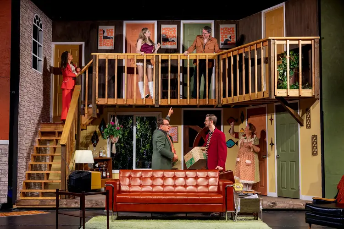
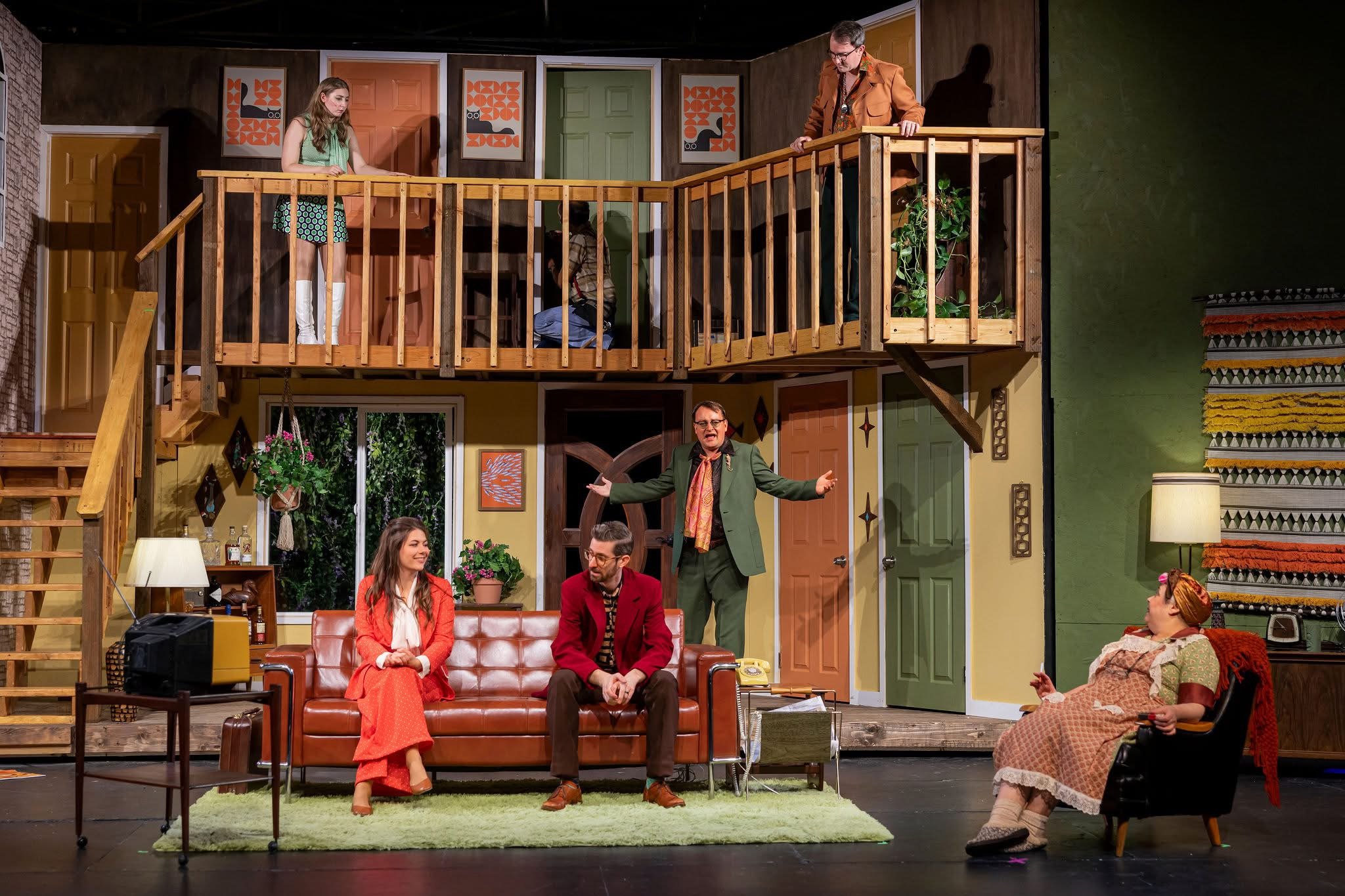
Sean Graffam’s set is effectively another member of the cast, something Jesse himself points out in his director’s note. Much like The Play That Goes Wrong, the fundamentals of the design are largely prescriptive. The script demands doors in particular places, multiple entrances and exits, and, most importantly, a structure that can turn around to reveal its backstage workings in Act II. But prescriptive doesn’t mean a designer can’t put his or her own stamp on it. Sean does that here with a late-1960s/early-1970s aesthetic dominated by avocado and burnt orange, giving Nothing’s On exactly the slightly dated visual identity it needs.
More importantly, the set has to work. It withstands an extraordinary amount of activity while allowing the production to completely change our perspective on it. When it turns around for Act II, something familiar suddenly becomes an entirely different playing space, revealing the organized chaos required to keep the performance we just watched going from the other side of the walls. By the time it returns to its original orientation for Act III, we know considerably more about what is happening behind those doors, which makes watching the whole thing finally go off the rails that much funnier.
By Act III, the company has reached the end of its tour and everyone looks exhausted, irritated and nearly finished with one another. Any pretense of keeping Nothing’s On intact has largely disappeared. The whole thing goes spectacularly off the rails.
The technical team deserves considerable credit for making that possible. Valerie Reid stage manages a production in which cues, entrances, exits, props and physical comedy have to remain tightly coordinated, assisted by Garth Ball. Jacob Viramontes’ lighting, Jesse’s props, Krista Lofgren’s costumes and Ariana Nikas’ sound all contribute to the deliberately theatrical world, while intimacy coordinator Alyssa Hope Maas and stunt coordinator Ryan Spickard help support a production that becomes increasingly physical as control disappears.
There is something wonderfully appropriate about Noises Off serving as Jesse’s directorial debut. It is not an easy show on which to learn the job. Farce exposes timing problems immediately, and this particular farce adds a revolving set, physical comedy, overlapping action and a play-within-a-play whose deterioration must remain carefully controlled even when it looks anything but.
The ultimate trick of this play is that the worse Nothing’s On becomes, the better Noises Off has to be performed. Renton Civic Theatre has assembled an ensemble capable of making chaos look spontaneous while keeping enough control underneath it to land the joke. By the time the final act arrives and everything has completely fallen apart, there is little point trying to decide who is funniest. The whole thing has gone off the rails…and everyone aboard is hilarious.
Noises Off runs on stage at Renton Civic Theatre through October 18. For more information, including ticket availability and sales, visit https://www.rentoncivictheatre.org/shows/noises-off.
Photo credit: Colin Madison Photography