
Stage Review - Come From Away
Presented By: Oregon Shakespeare Festival - Ashland, OR
Show Run: March 14 - October 24, 2026
Date Reviewed: Wednesday, June 3, 2026
Run Time: 1 Hour, 40 Minutes (no intermission)
Reviewed by: Greg Heilman
The Oregon Shakespeare Festival continues its 2026 season with Come From Away, running in the Angus Bowmer Theatre through October 24. Since its premiere at La Jolla Playhouse in 2015 and subsequent development at Seattle Rep before its Broadway run, Irene Sankoff and David Hein’s musical has become one of the defining theatrical works of the twenty-first century. Built from interviews with the residents of Gander, Newfoundland, and the nearly 7,000 airline passengers unexpectedly stranded there following the closure of North American airspace on September 11, 2001, the musical tells a story that could easily have been overwhelmed by the enormity of the tragedy that surrounds it. Instead, it focuses on something far more intimate: the capacity for ordinary people to do extraordinary good when confronted with extraordinary circumstances.
That perspective feels particularly important today. We live in a world where bad news dominates headlines, where outrage drives engagement, and where stories of conflict often drown out stories of compassion. Come From Away serves as a reminder that the darkness of a moment does not define humanity’s response to it. The people of Gander did not have special powers, limitless resources, or any expectation that their actions would be remembered. They simply saw thousands of frightened strangers in need and chose to help. One blanket, one meal, one spare room, one conversation at a time. The musical’s enduring message is that kindness creates ripples. What begins as a single act of generosity can grow into something far larger, touching lives in ways that cannot always be measured. More than two decades after the events it depicts, the story remains as moving and relevant as ever.
Director Laurie Woolery understands that the power of the piece lies in its humanity rather than its spectacle. While the musical certainly contains moments of humor, joy, and celebration, the production never loses sight of the people at its center. The pacing is crisp, the transitions fluid, and the emotional beats land with remarkable consistency. Sunny Min-Sook Hitt’s choreography works hand-in-hand with the staging, turning what could have been a logistical challenge into one of the production’s greatest strengths. Tables and chairs become airplanes, buses, waiting rooms, bars, and community gathering spaces through carefully orchestrated movement. The constant flow of people and places creates a sense of momentum that mirrors the confusion and urgency of the days following September 11.
Efren Delgadillo, Jr.‘s scenic design provides an evocative framework for the storytelling. Hardwood planks cover the stage while rock formations surround the playing space, immediately evoking Newfoundland’s rugged landscape. The design incorporates alcoves among the rocks to house the musicians, while piles of luggage upstage serve as a constant visual reminder of the thousands of travelers suddenly stranded far from home. The simplicity of the design allows the audience’s imagination to do much of the work, yet it never feels sparse. One particularly effective sequence involving the air traffic controllers demonstrates just how much can be accomplished through thoughtful staging and a few well-chosen visual elements.
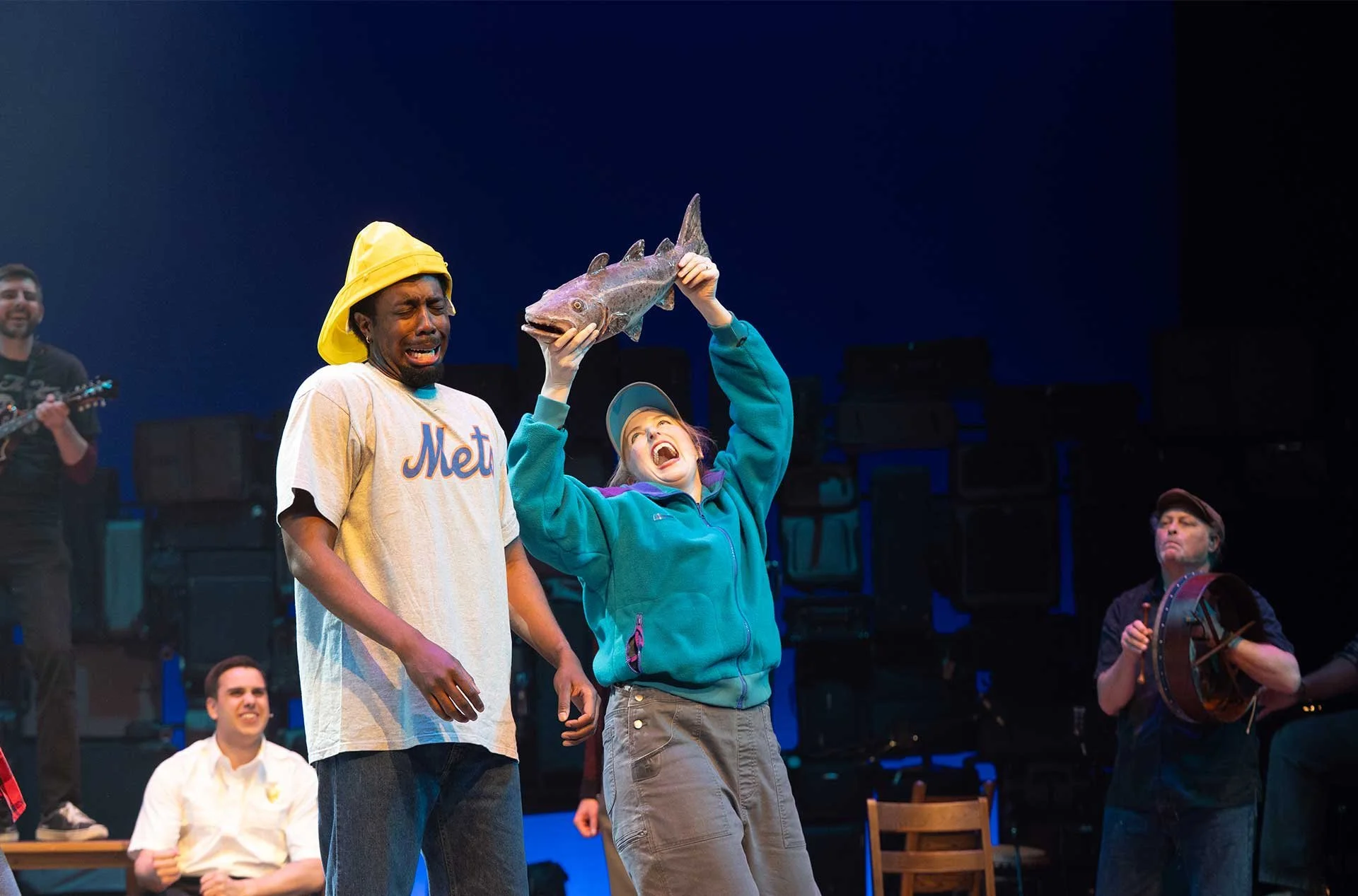
What stands out most to me, however, is the extensive use of props throughout the production. This was my fifth time seeing Come From Away, dating back to its pre-Broadway run at Seattle Rep more than a decade ago, and it is the most prop-intensive staging of the musical that I have encountered. Beyond the familiar use of tables and chairs, blankets, relief supplies, luggage, and even crates representing the animals trapped aboard the grounded aircraft become active storytelling devices. These objects are not simply decorative additions; they help illustrate the scale of the community response and reinforce the countless acts of generosity that define the story. It is a subtle but effective enhancement that helps bring the events of Gander to life.
Pablo Santiago’s lighting design provides clarity amid the constant movement, helping the audience navigate the rapid shifts in location and perspective without ever becoming distracting. Val Turos’ sound design is equally effective, ensuring that the show’s many overlapping voices and musical moments remain clear and balanced. Micha Espinosa’s work as Voice and Text Director deserves recognition as well. Newfoundland accents can be notoriously difficult to master, and considering that each performer portrays multiple characters throughout the evening, the consistency across the company is impressive.
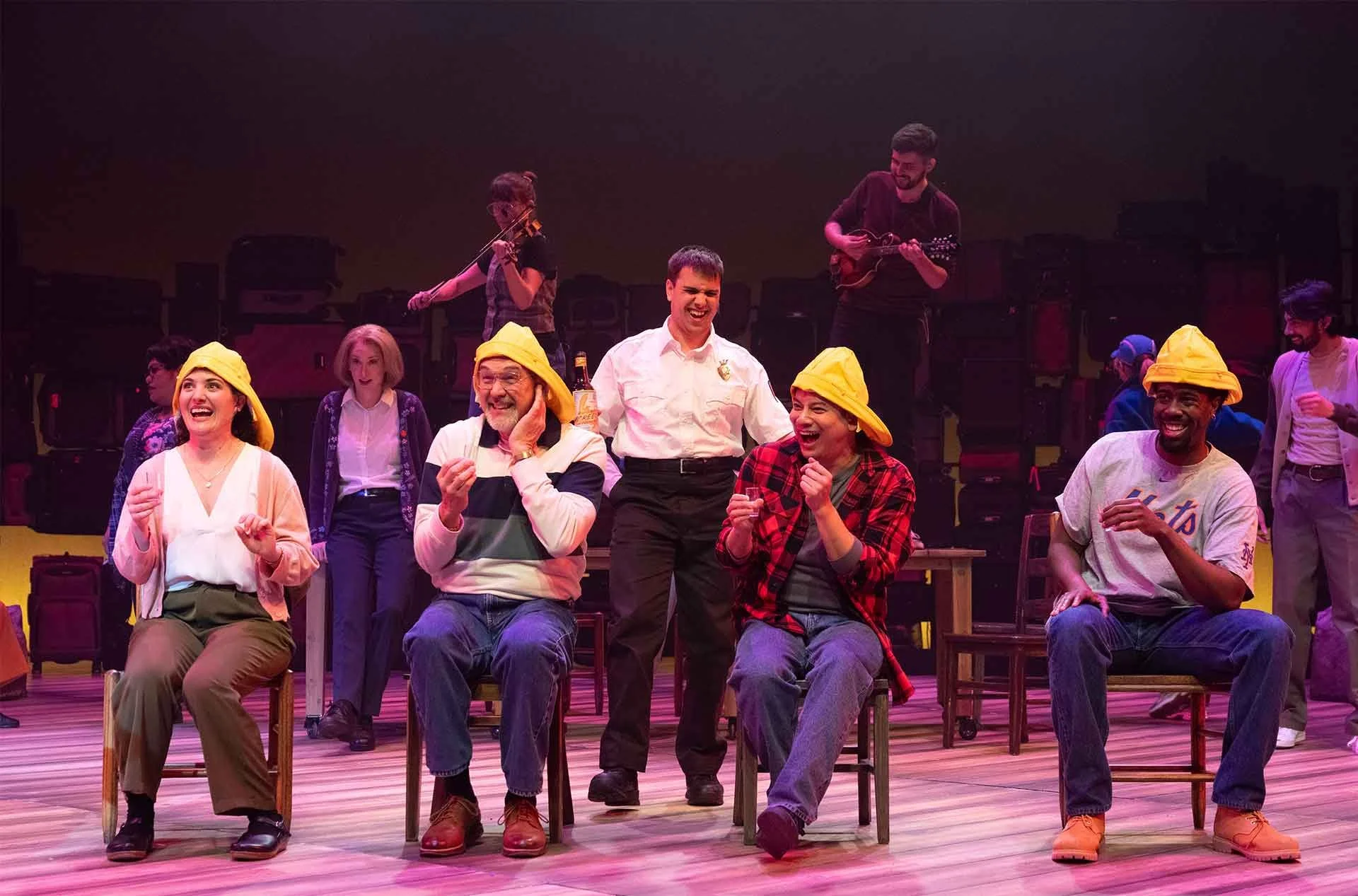
Under Angie Benson’s music direction, the vocal performances are excellent. Harmonies are rich and full, and the ensemble singing captures the emotional heart of the score. The onstage band remains one of the musical’s signature elements and sounds terrific throughout the performance. Visually, the musicians nestled within the scenic alcoves create a striking image. Yet there were moments when I found myself missing the stronger sense of integration that some productions achieve by keeping the musicians more actively connected to the storytelling. The musical is at its best when the band feels like part of the community itself, and some of the evening’s strongest moments come when musicians join the action directly, particularly during the scenes set in the local bar. Even so, the musicians deliver the score with energy and precision, providing a solid foundation for the performers on stage.
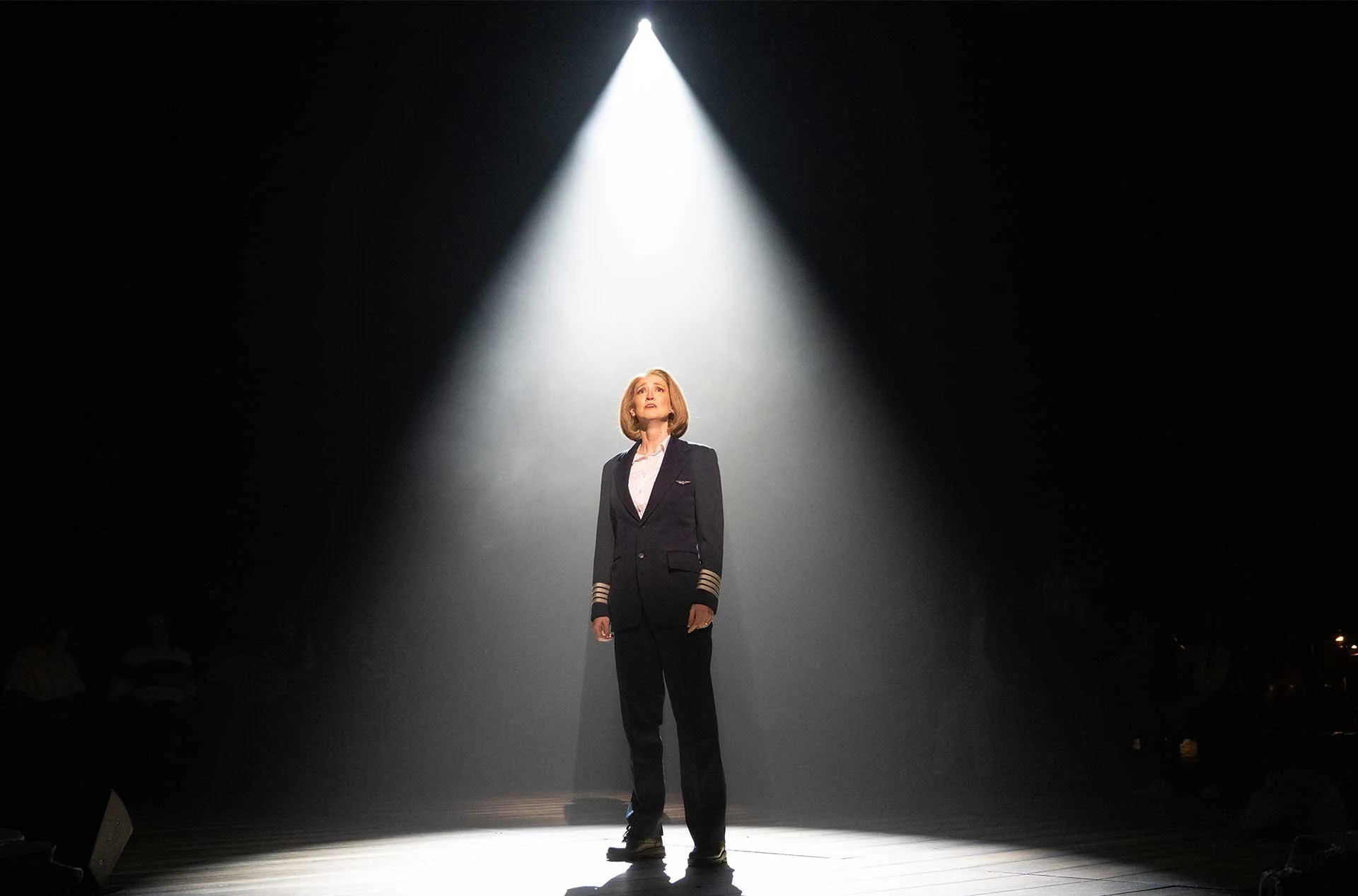
As Beverley Bass, the first female captain for American Airlines, Victoria Frings delivers one of the production’s standout performances. Beverley’s journey is among the musical’s most emotional, and Victoria captures both her professionalism and vulnerability beautifully. Her rendition of “Me and the Sky” is a highlight of the evening, delivered with power, clarity, and emotional honesty. Just as impressive is the contrast she creates as Annette, bringing warmth, humor, and a playful flirtatiousness to the role. The ability to shift so completely between those characters exemplifies the versatility required throughout the production.
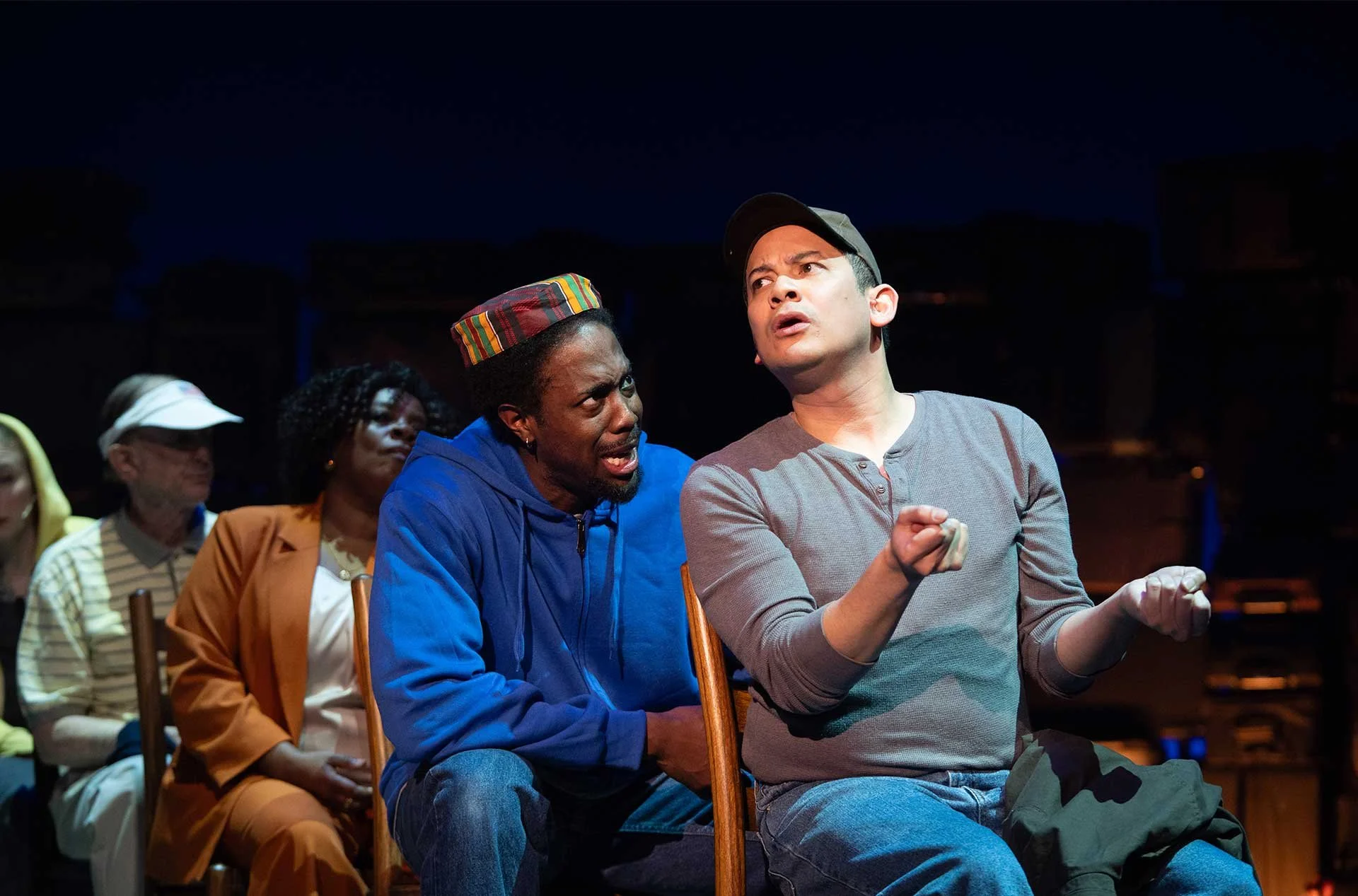
Another particularly memorable performance comes from Nathan Karnik. As Ali, the Egyptian chef whose appearance and background make him the target of suspicion in the aftermath of the attacks, Nathan brings tremendous humanity to the role. His portrayal never asks for sympathy; instead, it simply presents Ali as a decent man caught in circumstances beyond his control. The dignity, patience, and quiet heartbreak Nathan brings to the character create some of the production’s most affecting moments.
To single out only a few performers, however, feels somewhat contrary to the spirit of Come From Away. This is, above all else, an ensemble piece, and Oregon Shakespeare Festival has assembled an exceptional company. Royer Bockus, Imani Brissett, Teri Brown, Kiki deLohr, Al Espinosa, Justin Huertas, Kate Hurster, David Kelly, Amy Lizardo, and Jonathan Luke Stevens all contribute outstanding work. The cast members shift seamlessly between the residents of Gander and the stranded passengers, often changing characters in an instant through nothing more than a posture adjustment, a vocal change, or a simple costume piece. The transitions are quick, precise, and effortless to the audience, but they require an extraordinary level of discipline and trust among the performers. Every actor rises to the challenge, creating a company that functions as a true ensemble in every sense of the word.
More than twenty years after the events it depicts, Come From Away remains one of the most uplifting experiences in contemporary musical theatre. Its success is not rooted in sentimentality, but in its belief that compassion matters. Oregon Shakespeare Festival’s production captures that spirit beautifully. It reminds us that even in our darkest moments, people are capable of remarkable kindness, and that those acts, no matter how small they may seem, can ripple outward in ways we may never fully understand. In a time when stories of division often dominate the conversation, Come From Away offers something increasingly valuable: hope.
The Oregon Shakespeare Festival production of Come From Away runs on stage at the Angus Bowmer Theatre through October 24. For more information about the current season and this show, including ticket availability and sales, visit https://www.osfashland.org/.
Photo credit: Jenny Graham