
Stage Review (Oregon Shakespeare Festival) - You Are Cordially Invited to the End of the World
Stage Review - You Are Cordially Invited to the End of the World
Presented By: Oregon Shakespeare Festival - Ashland, OR
Show Run: April 16 - August 21, 2026
Date Reviewed: Tuesday, June 2, 2026
Run Time: 1 Hour, 40 Minutes (no intermission)
Reviewed by: Greg Heilman
Keiko Green writes the kind of plays that are surprisingly rare. Her work exists at the intersection of humanity and theatricality, combining recognizable people and situations with imaginative storytelling devices that can only truly come alive on a stage. In You Are Cordially Invited to the End of the World, now playing at the Oregon Shakespeare Festival’s Thomas Theatre through August 21, Keiko takes an experience many audience members will immediately recognize—the slow, painful reality of watching someone navigate the final stages of a life-threatening illness—and transforms it into something both deeply personal and boldly theatrical. The conversations feel authentic, the family dynamics relatable, and the emotional responses painfully familiar. Yet through humor, fantasy, and inventive stagecraft, Keiko elevates the material beyond realism, creating a play that explores not only mortality, but humanity’s place in the larger world. The result is a piece that is as entertaining as it is moving, balancing humor and heartbreak while remaining wholly engaging as a theatrical experience.
You Are Cordially Invited to the End of the World continues many of the themes that have become hallmarks of Keiko’s work. The play centers on M, who serves not only as a character within the story but also as its narrator, guiding the audience through what they repeatedly describe as the already occurred end of the world, providing the omniscient narrator with a kind of hindsight that provides a perspective based on an actual history, rather than a hypothetical, viewing the impending event as a foregone conclusion and not as a warning, though in the the way only Keiko can, she paints it as a little of both. That world, however, is both literal and deeply personal. As M recounts the events leading up to it, the audience learns of father Greg’s cancer diagnosis and witnesses how every person in his orbit adjusts their behavior in response to the news. At the same time, M is navigating their own struggle for acceptance. While mother Viv appears largely comfortable with M’s identity, Greg continues to slip back into using M’s dead name, a behavior that at times worsens as his illness progresses and at others seems to improve as the reality of his situation becomes impossible to ignore. As Greg’s journey unfolds, including a marijuana-induced epiphany that forces him to reconsider his relationship with climate change and humanity’s place within the natural world, the play gradually transforms into something larger. What begins as a family drama becomes a metaphor wrapped in a parable, using one family’s experience with illness, identity, and acceptance to explore humanity’s broader relationship with mortality, change, and the world around it.
Under the direction of Zi Alikhan, the production finds a thoughtful balance between intimate family drama and larger philosophical exploration. Zi never loses sight of the fact that the play’s success depends on audiences investing in these people first and its ideas second. There is a familiarity to many of the interactions that feels almost uncomfortably recognizable. Whether it is family members avoiding difficult conversations, support group participants searching for comfort, or loved ones struggling to reconcile acceptance with hope, the behaviors ring true. That authenticity allows the production’s more theatrical elements to land with greater impact.
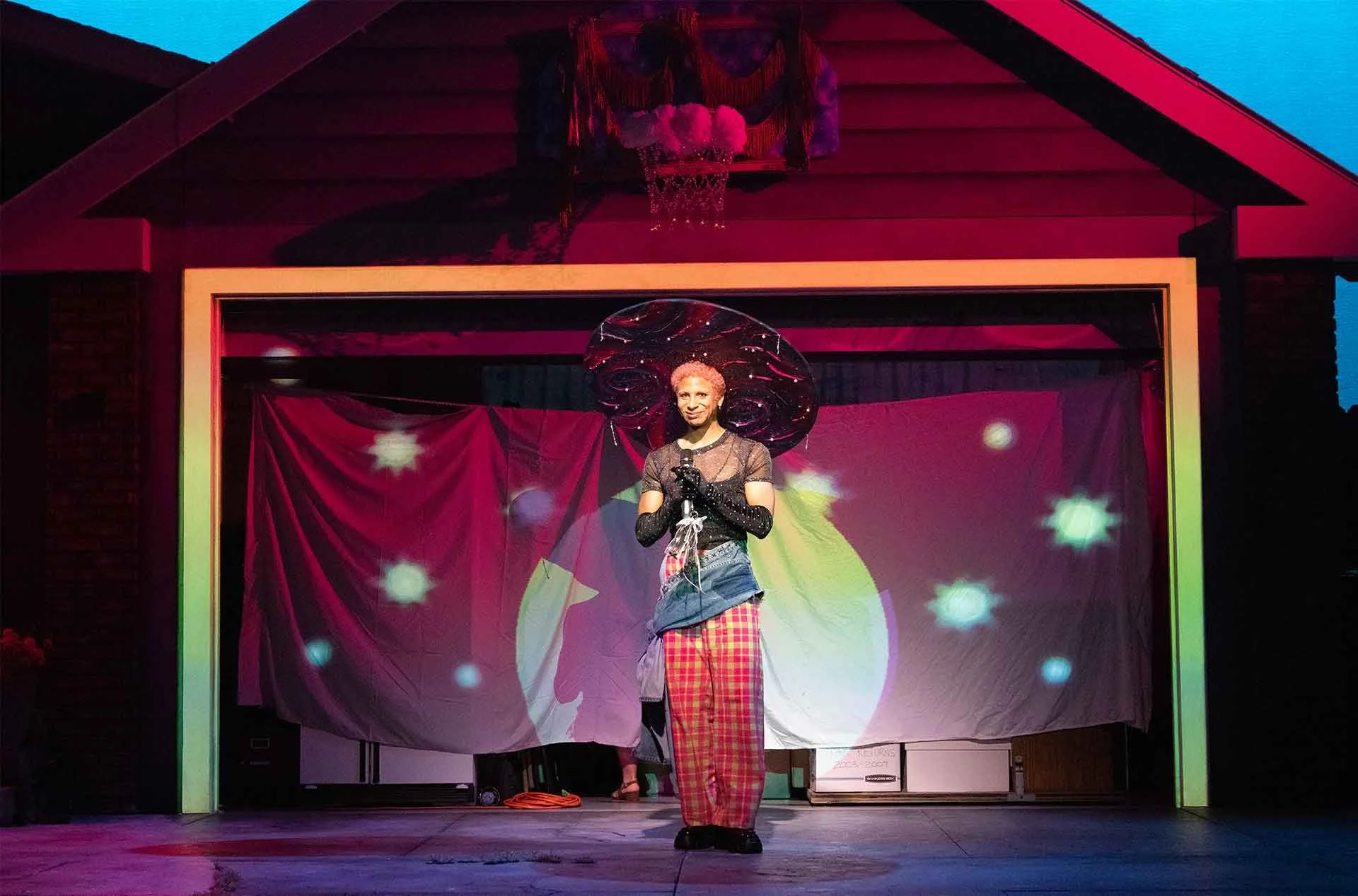
At the center of the production is Winter Olamina’s remarkable performance as M. This is a truly layered performance, one that requires Winter to function simultaneously as narrator, observer, participant, and emotional guide. As narrator, Winter commands the stage with a strong and engaging presence, effortlessly drawing the audience into the story. As the child of Greg and Viv, however, M’s journey is a winding and often painful one. Following Greg’s diagnosis and as the cancer progresses, M struggles to find balance while attempting to rebuild a fragile relationship with their father and facing the grim prospect of eventually moving forward without him. It is a performance that comes face to face with mortality, asking not only what it means to lose someone, but how we carry those people forward in our memories. Winter approaches these moments with remarkable honesty and vulnerability, making M’s experiences feel deeply personal and universally recognizable. Add the performative aspect of M’s personality as a drag artist, in which Winter’s skills bring an infectious energy and entertainment value to the role, and the full body of work becomes not just emotionally resonant, but wholly captivating.
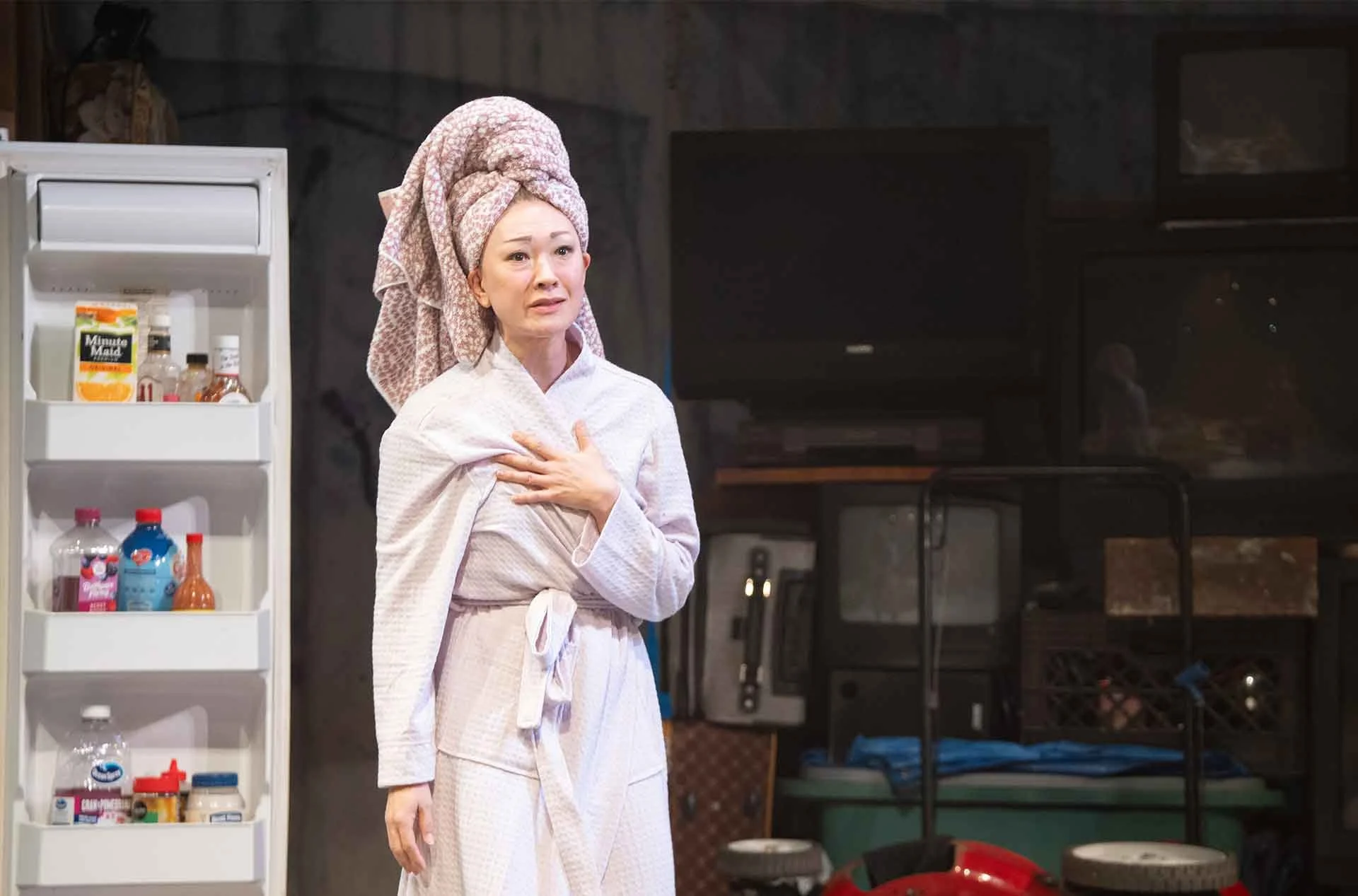
Amy Kim Waschke gives a powerful performance as Viv, who may ultimately be the play’s most relatable character. When Greg receives his diagnosis, he appears almost frozen by the news, while Viv seems to cycle through every stage of grief in rapid succession. Amy captures that emotional whirlwind beautifully. One moment she is supportive and nurturing, the next frustrated, combative, confused, frightened, or overwhelmed by sadness. Rather than presenting those emotions separately, Amy allows them to coexist, creating a portrait of someone desperately trying to hold a family together while processing devastating news herself. The result is a deeply authentic performance that feels less like acting and more like witnessing a real person navigate an impossible situation.
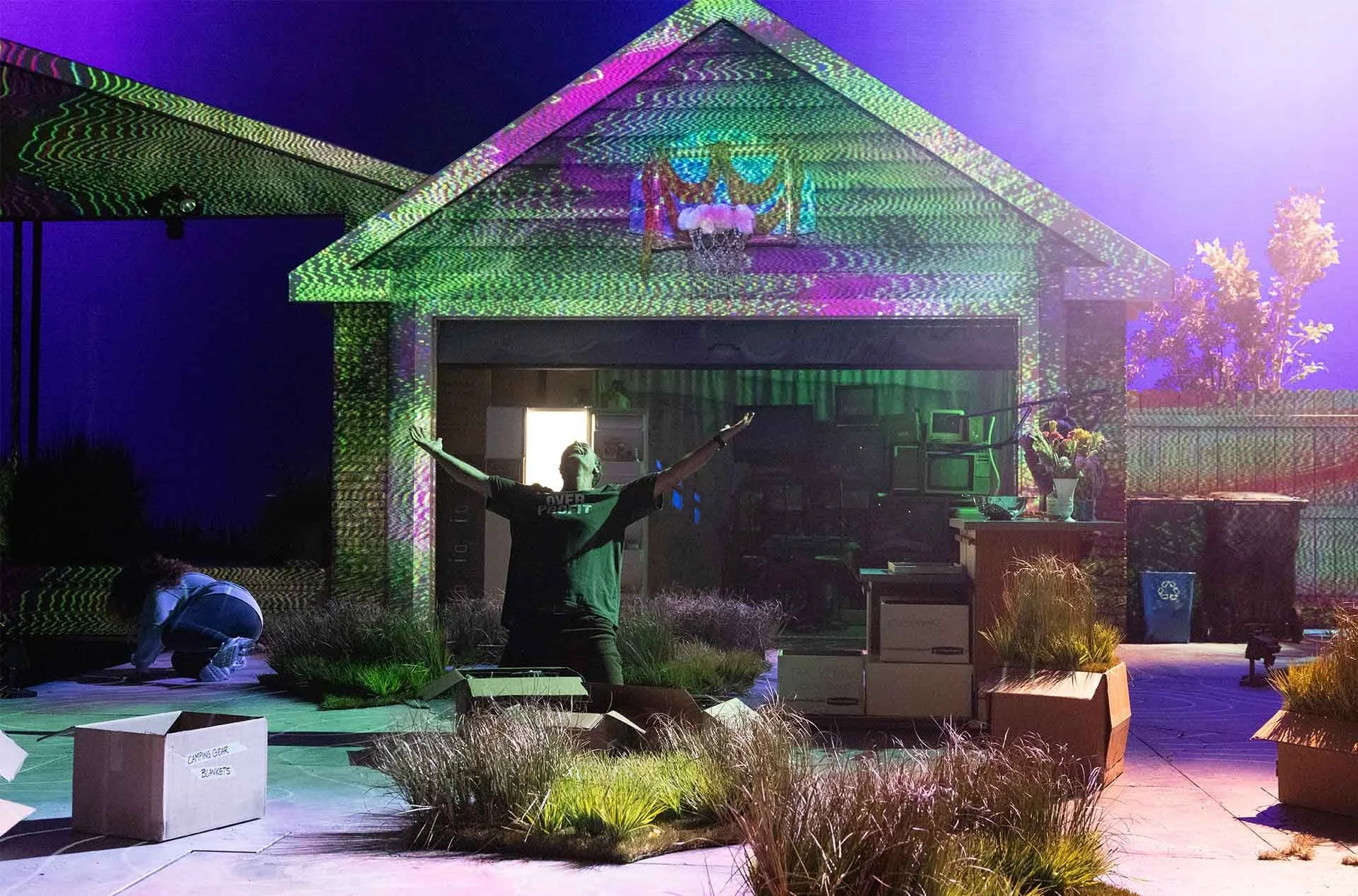
While M is the center of the performance, their father is around which every plot point orbits. As Greg, Tim Getman delivers the production’s most transformative performance. At the outset, Greg is recognizable as a husband, father, and cancer patient struggling to navigate circumstances that feel increasingly beyond his control. Yet as the play progresses, Tim skillfully charts Greg’s evolution from a man focused primarily on his own diagnosis into someone wrestling with humanity’s place in the natural world. His relationship with M is particularly affecting, especially as Greg continues to revert to M’s dead name, a habit that at times worsens as his condition advances and at others softens as the reality of his situation strips away old assumptions and defenses. What could have become a simple redemption arc instead becomes something more nuanced. Through Greg’s illness and eventual climate-related epiphany, Tim guides the audience through the play’s larger metaphorical journey, transforming Greg into a reluctant prophet whose personal awakening becomes inseparable from the play’s broader message.
One of the more interesting characters, at least from my perspective, is Rafael V. Goldstein’s Will, who serves an important function both within the family story and within the play’s larger thematic framework. As M’s boyfriend, and still relatively new to Greg and Viv, Will arrives with a perspective that challenges long-held assumptions. It is through Will that the climate narrative begins to take shape, often through rapid-fire monologues filled with facts, observations, and challenges to Greg’s (and the audience’s) understanding of humanity’s impact on the planet. Rafael’s delivery is quick, precise, and remarkably clear, ensuring that even the densest material remains engaging. The performance becomes an essential engine for the production’s momentum, helping propel both Greg and the audience toward the larger questions that define the play.
This cast is superb from top to bottom, and that includes the leads as well as the supporting group. Leading the latter collection of actors is Kat Peña as Viv’s sister Lila, who brings welcome humor and humanity to the family dynamic. Kat understands exactly how to navigate the play’s shifts between comedy and drama, often finding moments of levity without undermining the emotional stakes. Her relationship with Viv feels particularly authentic, capturing the rhythms and occasional tensions that often define sibling relationships during times of crisis. In addition to Kat is Kate Wisniewski with strong work as Janet and Dr. Thomas. Through those roles, Kate helps broaden the production’s emotional and thematic landscape, bringing both humor and insight to the story’s larger conversations. The support group scenes, and others in which Viv and Janet meet up with each other become some of the play’s most engaging moments, filled with conversations and behaviors that many audience members will immediately identify from their own experiences.
Much of the play’s theatricality emerges through these supporting characters portrayed by Rafael, Kat, and Kate. While each plays recognizable individuals within the story, they also take on roles that function as embodiments of larger ideas. Characters such as Army Guy (or “the military industrial complex’s relationship to the climate crisis”) and Greta Thunberg especially help expand the narrative beyond the Murphy family, becoming voices within the play’s larger ecological and philosophical conversation. The actors navigate these shifts seamlessly, allowing the audience to move between family drama, satire, allegory, and parable without ever losing the emotional thread of the story.
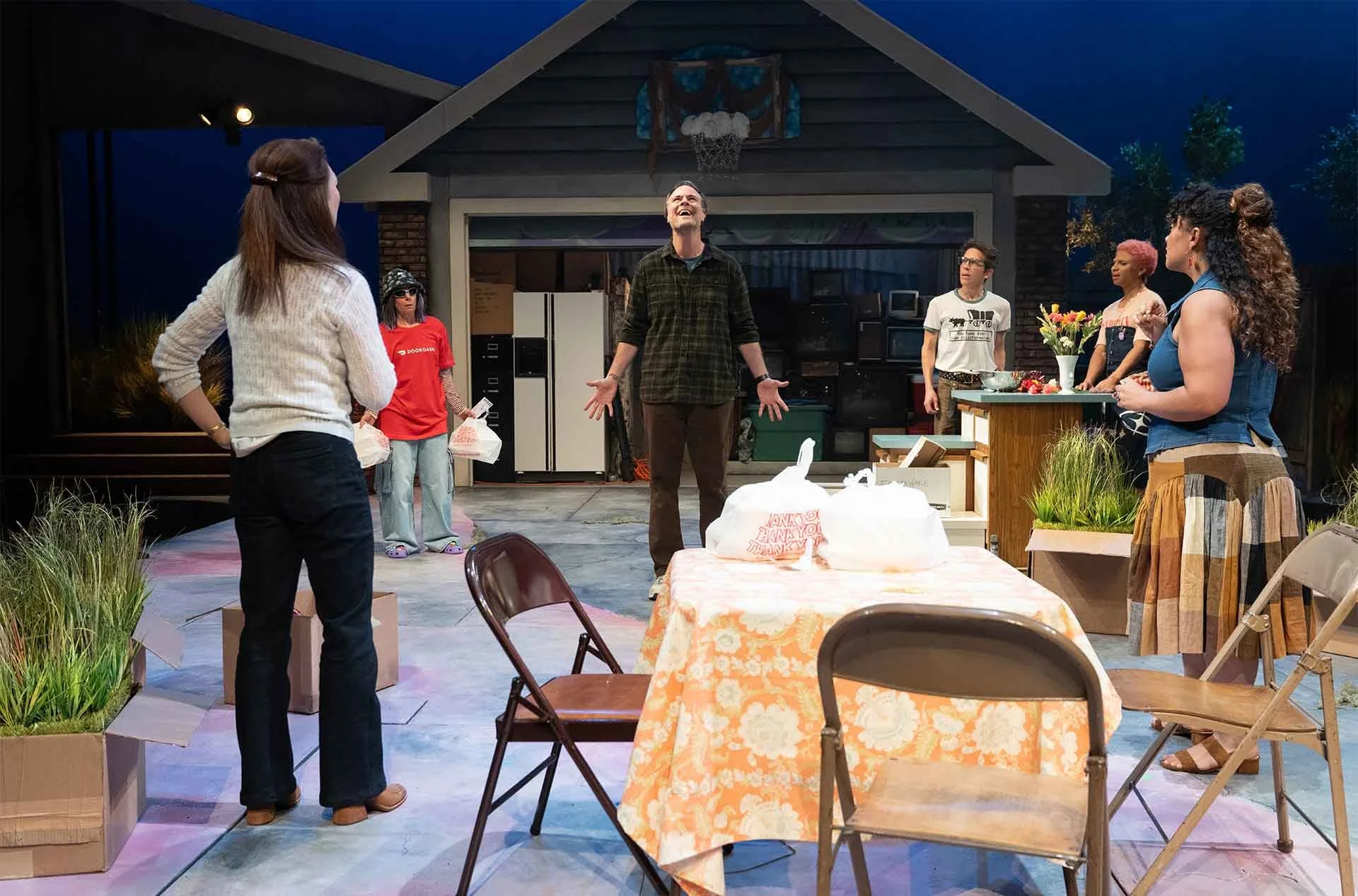
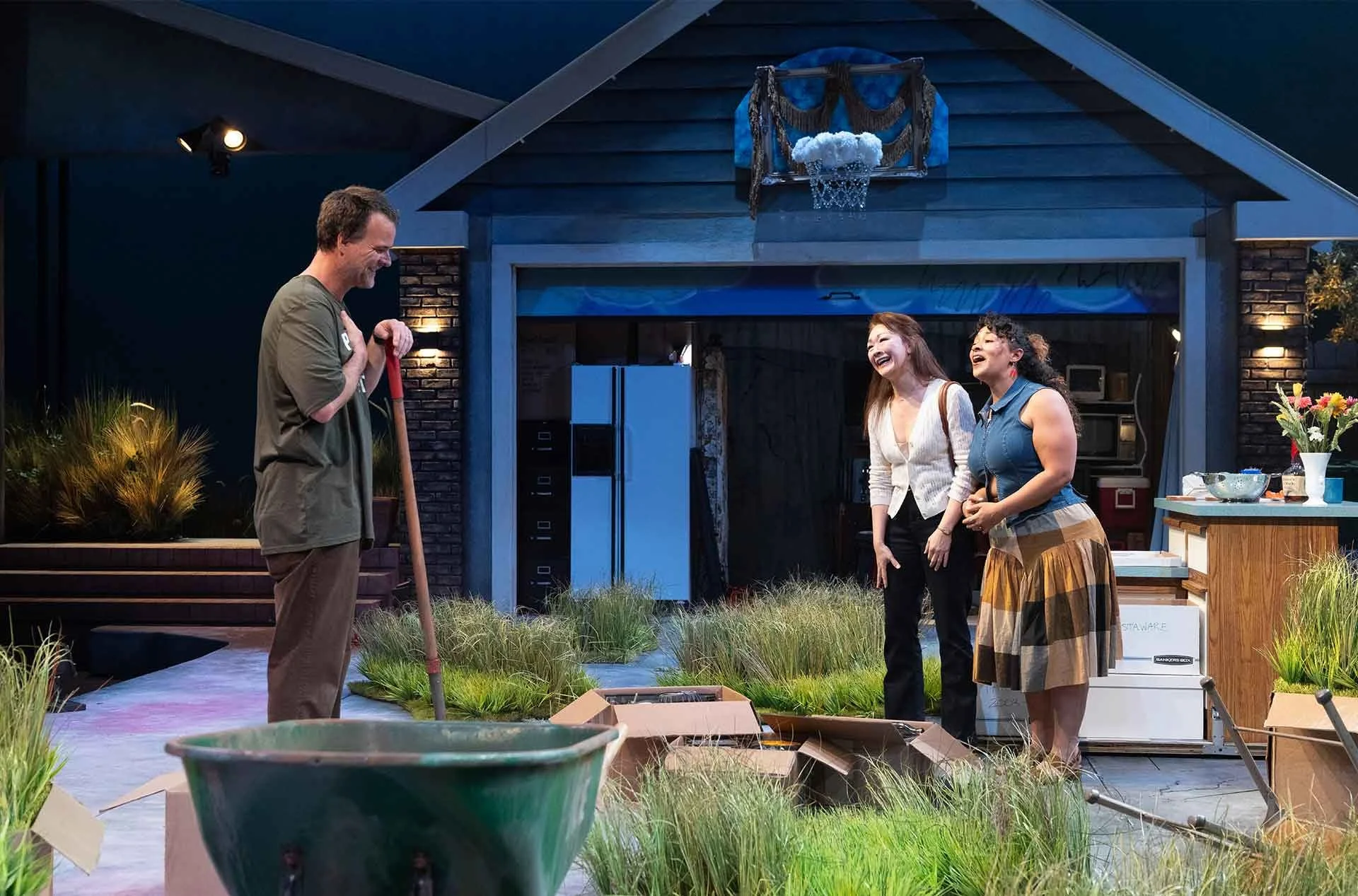
The creative team does spectacular work bringing a play so dependent on pace and momentum to life. Scene changes arrive abruptly and purposefully, each pulling the audience deeper into the story and rarely allowing the energy to dissipate. One particularly striking sequence finds Greg watching a nature documentary as he is falling into the complications of his illness. What begins with a single television within Síbyl Wickersheimer’s wonderfully realized suburban home set gradually expands to two screens, then three, before projections spill across the stage itself. Combined with Nicholas Hussong’s projection design, Barbara Samuels’ lighting, and Palmer Heffran’s sound design, the sequence becomes a vivid representation of the chaos unfolding inside Greg’s mind. It is one of the production’s most effective theatrical moments, illustrating how the various design disciplines work together to transform an internal realization into a visually compelling stage picture.
Visually, the production embraces the play’s theatrical ambitions. Síbyl’s scenic design provides a flexible framework that supports both realism and fantasy, while Nicholas’ projections become an invaluable storytelling tool throughout the evening. The projections help establish setting, illustrate larger concepts, and guide audiences through shifts in perspective without ever feeling intrusive. Dana Wilson’s choreography contributes significantly to the production’s visual storytelling. The movement vocabulary often incorporates everyday gestures and recognizable human behaviors, helping connect the play’s larger philosophical themes to the ordinary experiences at its center, and M’s drag performance is designed and executed beautifully, matching the exquisite costume that Lux Haac designed for that scene. Costuming is also a nice component to the overall scenic design, one of my personal favorites being Greta Thunberg’s IKEA raincoat.
What truly makes You Are Cordially Invited to the End of the World so compelling is its refusal to separate the personal from the planetary. Greg’s cancer diagnosis becomes a lens through which Keiko examines humanity’s relationship with mortality itself. Just as Greg must come to terms with the limits of his own existence, humanity is forced to confront the consequences of ignoring the limits of the natural world around it. Yet the play’s climate themes feel especially timely because they are not presented as a distant warning, but as a reality already unfolding around us. Much like the loss of a loved one, climate change is something many people would rather avoid discussing until they are forced to confront it directly. The play challenges that instinct.
In examining the coinciding “end of the world” and the end of an individual life, Keiko invites the audience to consider what that phrase truly means. Is the end of the world the destruction of the planet itself, or is it simply the end of humanity’s ability to exist comfortably within it? She posits that the planet will likely persist long after humanity is gone, following that what is at stake is not necessarily the survival of the planet, but our place upon it. Through Greg’s awakening, the play suggests that humanity’s greatest mistake may be viewing itself as something apart from the ecosystems that sustain it. While we have become a species capable of reshaping and often dominating our surroundings, true success lies not in domination but in coexistence. Our future depends upon recognizing that we are part of a larger system, one in which the health of every component contributes to the health of the whole.
The solutions the play gestures toward are neither simple nor easy. They require sacrifice, responsibility, and a willingness to think beyond ourselves. Yet, much like the difficult work of confronting illness, grief, or personal change, the play reminds us that the most worthwhile things rarely come easily. By rooting these ideas in recognizable people and relationships, Keiko avoids preaching and instead creates space for reflection, allowing audiences to wrestle with these questions long after leaving the theatre.
With You Are Cordially Invited to the End of the World, what begins as an intimate family story evolves into something much larger. It becomes a meditation on life, death, acceptance, legacy, and humanity’s responsibility to the world it inhabits. Yet despite those expansive themes, the production never loses sight of the individuals at its center. Funny, moving, thought-provoking, and deeply human, You Are Cordially Invited to the End of the World demonstrates exactly what makes Keiko Green such a distinctive playwright. She finds profound truths in ordinary people and then uses the unique tools of the theatre to expand those truths into something universal. In this excellent Oregon Shakespeare Festival production, Keiko’s remarkable script receives a staging that embraces both its humanity and its theatrical imagination, delivering an evening that lingers long after the final curtain.
You Are Cordially Invited to the End of the World, part of Oregon Shakespeare Festival’s 2026 season, runs on stage at the Thomas Theatre in Ashland through August 21. For more information about this season, and this show, including ticket availability and sales, visit https://www.osfashland.org/.
Photo credit: Jenny Graham