
Stage Review - Ragtime (Village Theatre)
Stage Review - Ragtime
Presented By: Village Theatre - Issaquah, WA
Show Run: September 15 - October 18, 2025 (Everett: October 24 - November 15)
Date Reviewed: Saturday, September 26, 2025
Run Time: 2 Hours, 50 minutes (including a 15-minute intermission)
Reviewed By: Greg Heilman
Some musicals simply tell us about history, while some ask us to recognize ourselves in it. Ragtime has always belonged to the latter group, but Village Theatre’s decision to stage it now, in the shadow of the 250th anniversary of the signing of the Declaration of Independence, gives its reflection an uncomfortable clarity. And while some artistic directors make their mark with how they weave their programming methodology through a season, or by championing new work, each of which Village Theatre’s Artistic Director Adam Immerwahr has a penchant for, Adam deserves a great deal of credit for taking on a different kind of risk, that being the programming of Ragtime at this particular moment in our history. Plenty of shows attempt to connect the past to our present by pointing toward the political leaders of then and now. Ragtime takes a harder look in the mirror. It focuses on the people who actually drive a society, their ambitions, prejudices, fears, hopes and actions, reminding us that our political leaders are often less the cause of where we find ourselves than the result of the history, actions and attitudes of the people they represent.
Directed by Joe Calarco, Ragtime is on stage at Village Theatre’s Francis J. Gaudette Theatre in Issaquah through October 18 before moving to the Everett Performing Arts Center from October 24 through November 15. With a book by Terrence McNally, music by Stephen Flaherty and lyrics by Lynn Ahrens, based on E.L. Doctorow’s novel, the musical brings together three very different groups at the beginning of the 20th century, a prosperous white family in New Rochelle, Black residents of Harlem, and Jewish immigrants arriving in America in search of something better. Historical figures including Emma Goldman, Harry Houdini, Booker T. Washington, Evelyn Nesbit, Henry Ford and J.P. Morgan move through their lives as those three worlds, initially separate, begin to intersect.
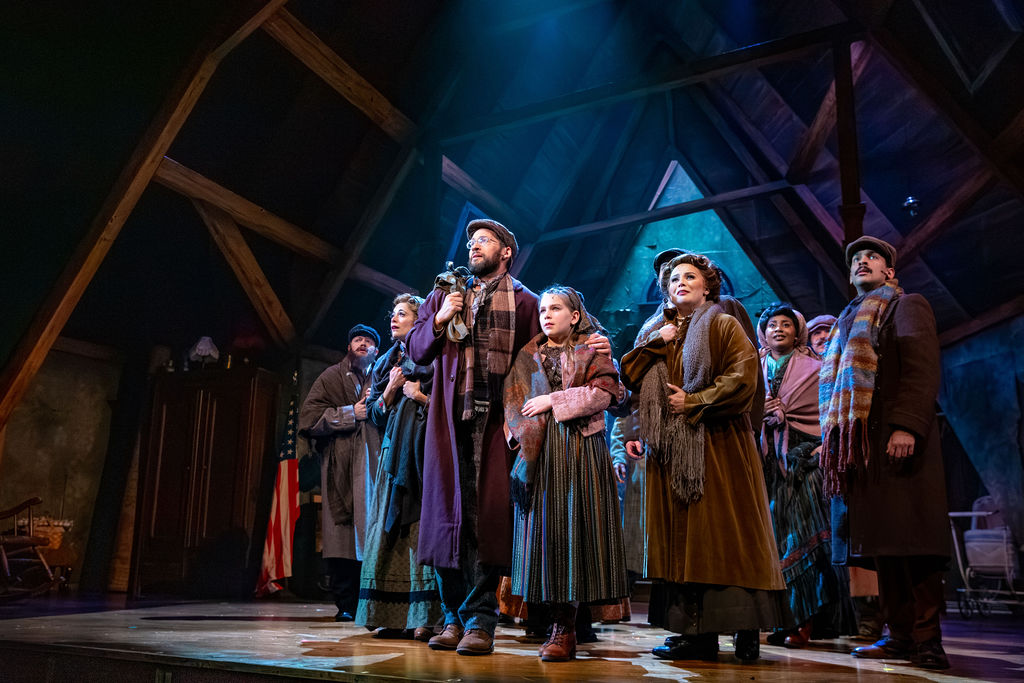
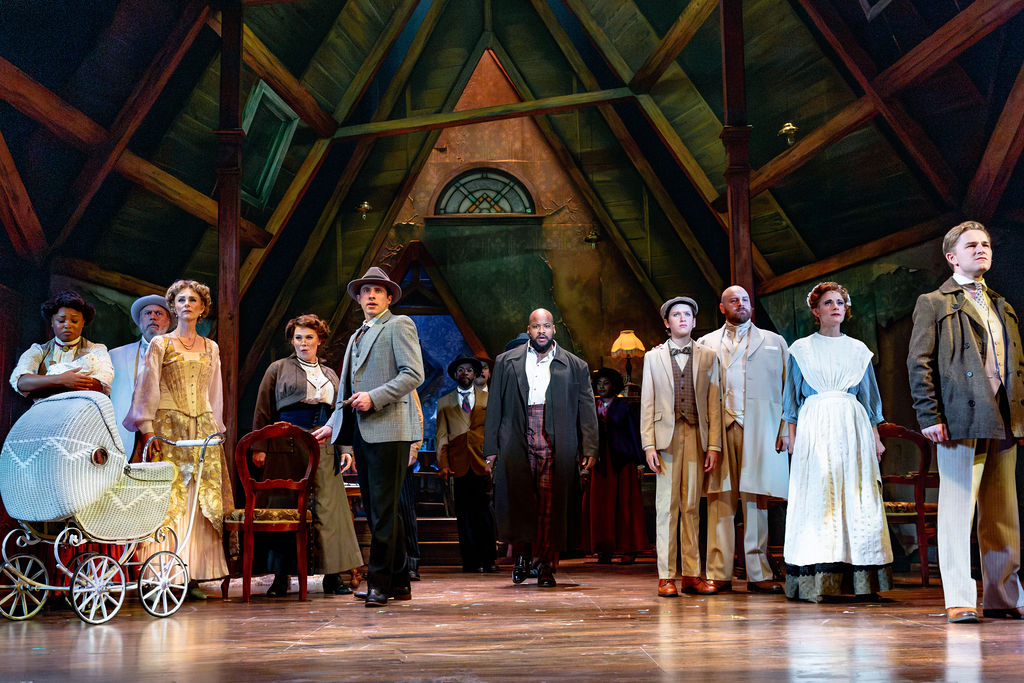
That separation is established immediately in an opening number that may be one of the most powerful introductions in musical theatre. Joe and choreographer Jimmy Shields initially allow each group to exist independently, each with its own movement, musical language and identity. They occupy the same stage without truly occupying the same world. Then they begin singing together, and the result is magnificent.
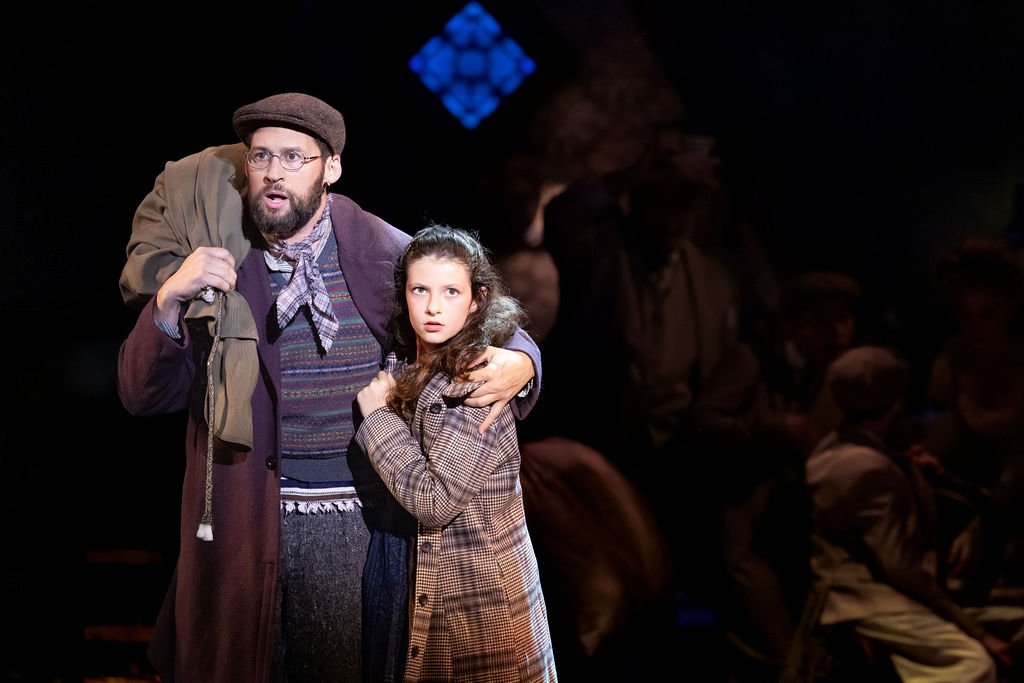
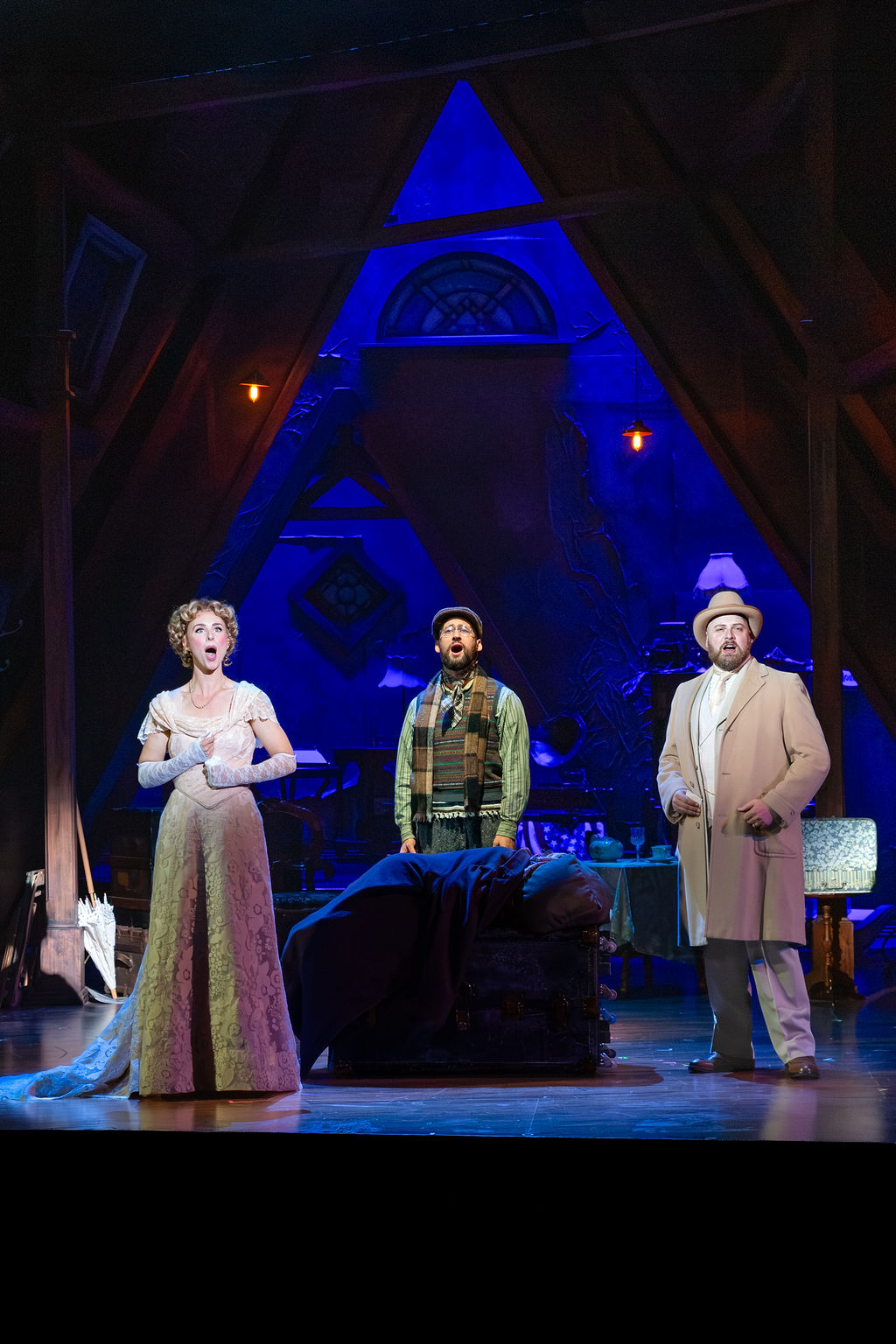
It establishes one of the considerable challenges of the score. Ragtime repeatedly asks different groups and characters to sing their own melodies, rhythms and even conversations simultaneously before eventually allowing those disparate voices to meet in harmony. “Journey On” is a particularly good example, with Father, played by Matthew Posner, preparing to leave on his expedition to the North Pole, Tateh, played by Jed Resnick, arriving in America with his daughter, and Mother, played by Allison Standley, remaining behind. Their lives are moving in different directions and their musical lines compete with one another, yet somehow they belong together. That tension (separate voices struggling to coexist before occasionally finding harmony) becomes a musical representation of the country Ragtime is examining.
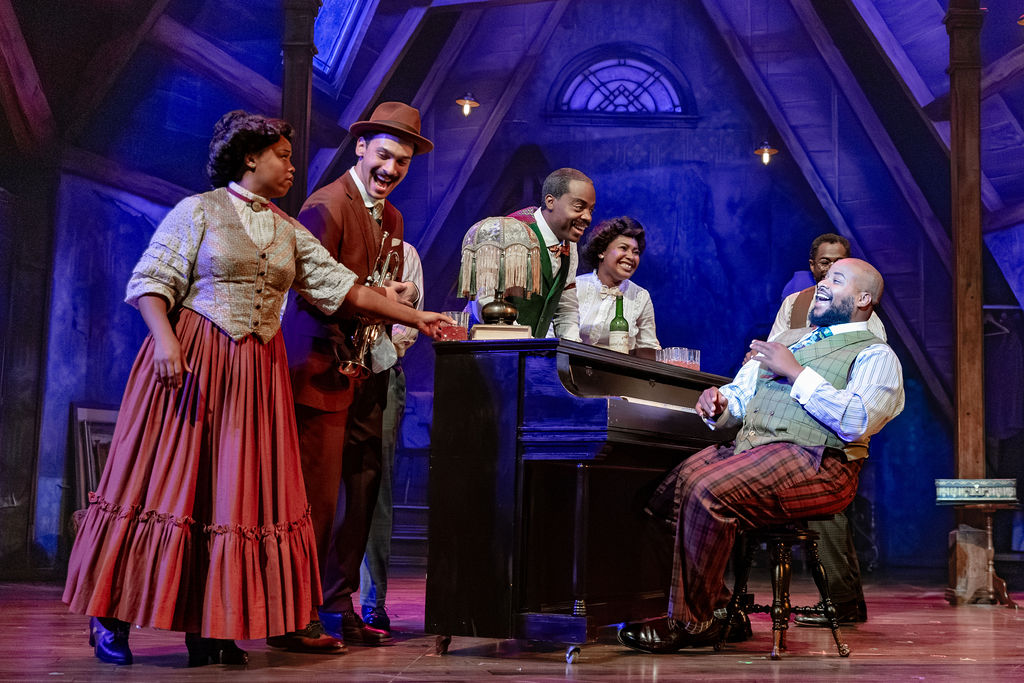
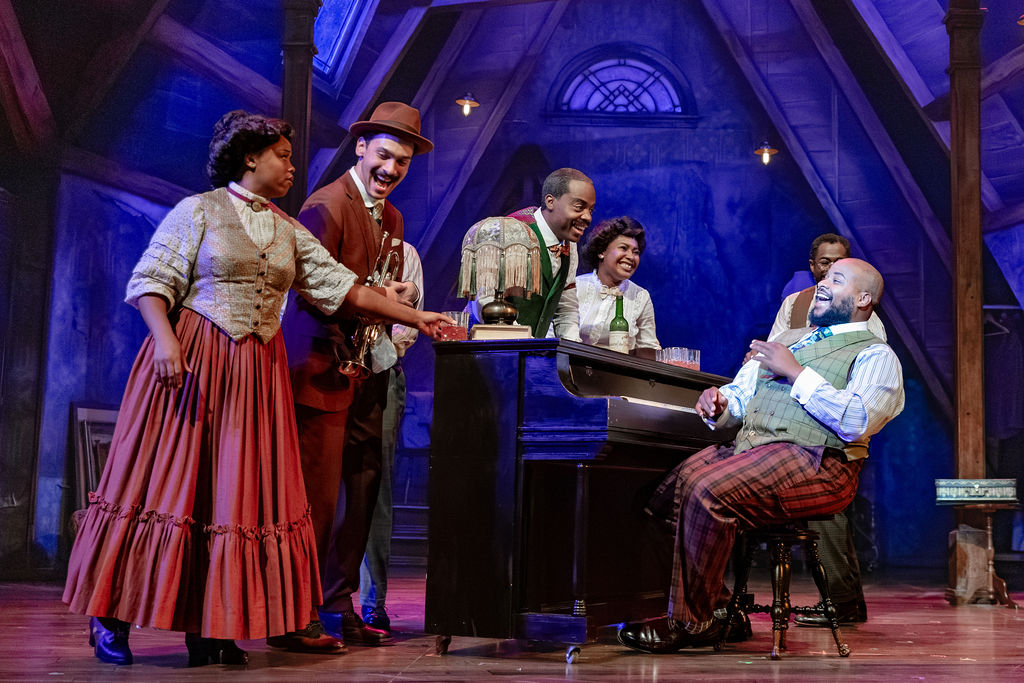
Christopher J. Mumaw’s set is extraordinary in both its scale and its detail. Stained glass and light descending from above like skylights come together to illuminate an attic seemingly containing the accumulated possessions of generations, creating the sense of a prosperous home, but upon closer examination the sheer amount of detail becomes remarkable. There appear to be hundreds of props incorporated into the production, and yet the stage never feels cluttered simply for the sake of spectacle. Every object seems purposeful. Together they create a story of their own.
That same storytelling extends throughout the creative team. Sarita P. Fellows’ costumes do more than establish period. Different styles, fabrics and silhouettes reinforce the racial and economic divisions between the groups. Sherrice Mojgani’s lighting helps move the production between its many worlds, while Gino Scarpino’s sound design handles an exceptionally demanding score with clarity. More than individual designers executing their specialties, this feels like a collection of storytellers. The best example of this is in the choreography. This has always been a hallmark of Jimmy’s work, telling the story of a people or a group through movement. Here it operates the same way, giving each community a movement vocabulary of its own before increasingly allowing those worlds to intermingle.
The result is that the creative work constantly reinforces what Ragtime is saying about America. Some characters are chasing the American Dream. Others have already achieved it. Still others control who is allowed access to it.
And then there is Coalhouse Walker.
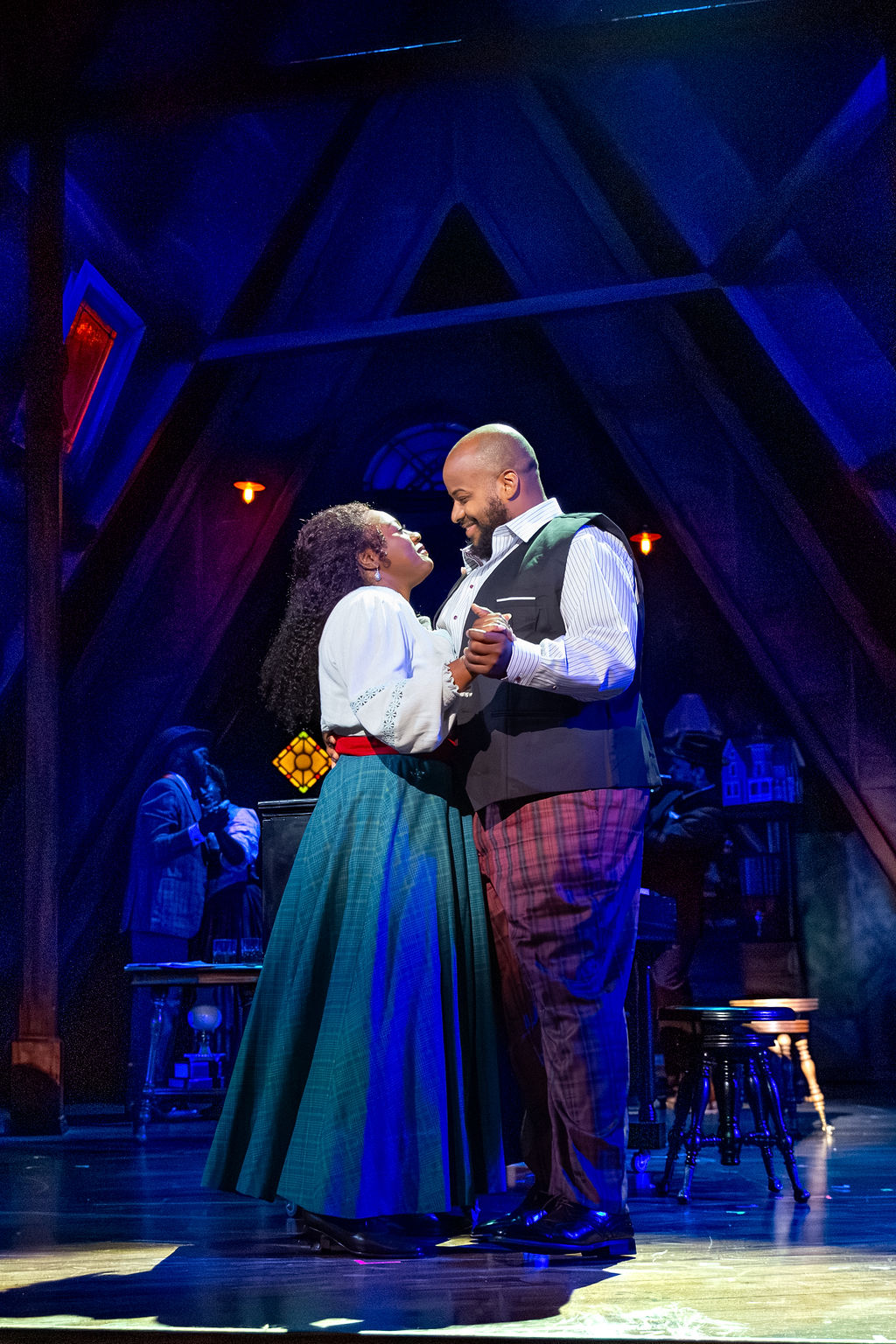
Yusef D Seevers leads this exceptional ensemble by giving Coalhouse an easy confidence and dignity when he first enters the story, a man who believes there is a place for him within the promise America has made. His relationship with Sarah, played by Jaden Dominique, supplies some of the production’s most beautiful music. Jaden’s “Your Daddy’s Son” is especially powerful, her voice carrying both strength and a sweet vulnerability as Sarah sings to their child about his father.
When Coalhouse and Sarah finally allow themselves to imagine their future together in “Wheels of a Dream,” Yusef and Jaden bring tremendous power individually but are beautifully balanced against one another. There is a purity to their voices, filled with hope, love and determination. The song becomes an anthem for the life they believe is waiting for them and, by extension, for the promise that drew so many different people toward the idea of America in the first place. That is precisely why what follows is so devastating. Coalhouse isn’t asking America for something extraordinary. He is asking it to live up to the promise he believed it had already made. His story asks what happens when someone pursuing the American Dream discovers that others have the power to place a roadblock in front of it simply because they can.
By the beginning of Act II, Coalhouse’s optimism has been shattered. Following the Entr’acte, Yusef returns with “Coalhouse’s Soliloquy,” carrying an extraordinary combination of pain, sadness, anger and determination for justice. The warmth and confidence that initially defined Coalhouse have been transformed into something much harder, but Yusef never allows the character to become simply an embodiment of rage. The pain underneath remains visible, making the transformation all the more tragic. Coalhouse gives Yusef the kind of material capable of displaying the range of what he can do, the charm and humor of his arrival, the tenderness of his relationship with Sarah, the vocal power of the score and ultimately the grief, anger and conviction behind “Make Them Hear You.” Yusef meets every part of that journey. His vulnerability and emotional depth, complemented by his powerful (and sometimes booming) vocals make this performance a truly memorable one.
One of Ragtime’s most interesting counters to all of this is Younger Brother, played by Kooper Campbell. While the older generations have inherited the divisions that define their worlds, Younger Brother increasingly crosses them. Kooper captures both the restlessness of a young man who doesn’t quite know where he belongs and the conviction that develops once he discovers something worth believing in. Ragtime also feels like a showcase for Kooper’s range and vocal ability in a way that nothing I’ve previously seen him in has. The role gives him room to move from youthful uncertainty and searching to passion and resolve, while the score allows him to demonstrate just how strong and versatile a vocalist he is. His journey suggests something hopeful beneath a musical that can otherwise be painfully cynical, that youth can serve as the bridge between disparate groups and generations. Ultimately, it falls to those who come next to cross boundaries their predecessors could not and move everyone forward.
That idea also appears in Tateh’s story. Jed begins as an immigrant arriving with little more than his daughter and the hope that America might provide something better. His path eventually brings him into another version of the American Dream, but Ragtime is never naïve enough to suggest that everyone is offered the same opportunity. His eventual relationship with Mother becomes one of the musical’s gentler intersections between worlds that initially seemed incapable of meeting. Allison gives Mother a particularly satisfying evolution. She begins within the carefully prescribed boundaries of her life in New Rochelle, but each encounter with the world beyond it chips away at those constraints. “What Kind of Woman?” begins that awakening, while “Back to Before” eventually gives voice to how completely she has changed. Her independence does not arrive all at once, it develops gradually as she recognizes that the life to which she is expected to return no longer fits the woman she has become. It’s a wonderful example of how some can break the bonds of their predestined circumstances, but also in how difficult it is to move forward.
“Our Children,” shared by Mother and Tateh, is beautiful precisely because of its simplicity. After so much conflict, Allison and Jed allow two parents from radically different backgrounds to discover common ground through their children. The staging that follows creates an especially effective contrast with the brightness and excess of Atlantic City, reminding us how quickly Ragtime can move from exuberance to introspection.
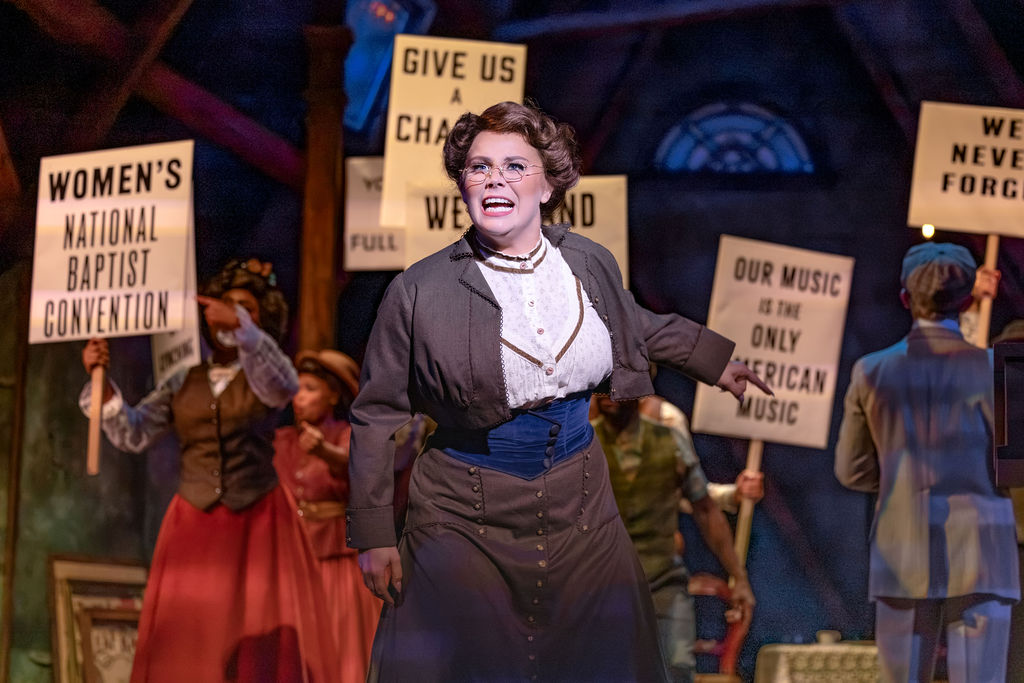
Cherisse Martinelli, stepping in for Jasmine Jean Sim as Emma Goldman and Others during Saturday’s performance, brings another perspective to the competing ideas of what America is and ought to be. Emma’s influence on Younger Brother is another example of the way this story allows people from seemingly unrelated worlds to collide and change one another. Arlando Smith’s Booker T. Washington offers yet another response to the injustices facing Coalhouse, particularly as the musical begins asking not only whether justice is necessary, but what form the pursuit of it should take.
In playing some of the real life characters that the playwrights have taken some artistic liberties with, Miranda Antoinette Westman as Evelyn Nesbit and Nick McCarthy as Harry Houdini provide some of the production’s lighter theatricality, particularly in “Atlantic City,” without ever feeling disconnected from the larger tapestry. Ragtime has room for celebrity, spectacle and popular entertainment alongside its darker history because all of it is part of the same country it is examining.
Even “What a Game!” becomes more than a comic baseball number. Led by Matthew as Father, the sequence turns baseball into a microcosm of the society surrounding it, complete with its hierarchies, tribal loyalties, resentments and ideas about who belongs. That is one of Ragtime’s great strengths, seemingly small pieces of American culture continually become reflections of something much larger, and that has always been a hallmark of America’s Pastime.
The orchestra, under the music supervision of Tim Symons, is asked to navigate a score that moves from ragtime and marches to gospel, blues and sweeping musical theatre melodies, sometimes combining multiple musical ideas at once. Many of these songs have enough musical strength to stand independently in concert, but their meaning changes when placed back into the story. The score is not merely accompanying these characters, it is constantly revealing how their lives relate to one another.
There are moments in Ragtime when the century separating its characters from us seems to disappear entirely. That is not because the contemporary parallels are forced into the material, they don’t need to be. The parallels are already there.
That may ultimately be what makes Adam’s decision to program Ragtime now so consequential. The production does not simply point backward and congratulate us for having moved beyond the uglier parts of our history, nor does it offer the comfortable explanation that a handful of powerful people were responsible for them. Instead, it asks audiences to look at the people on stage, the wealthy and poor, Black and white, immigrants and native-born, activists and industrialists, parents and children, and recognize the forces that collectively determine what America becomes.
The American Dream runs throughout Ragtime, but the musical is less interested in whether that dream exists than in who gets to pursue it, who gets to define it and who controls the door. Village Theatre’s production understands that question. It also understands that history isn’t something done to ordinary people by the names that eventually appear in textbooks. It is created by ordinary people, one choice, one prejudice, one act of courage and one generation at a time. And perhaps that is why, 250 years into the American experiment, Ragtime feels less like a history lesson than a mirror.
Ragtime runs on stage at Village Theatre in Issaquah through October 18 before moving to Everett on October 24, where it runs through November 15. For more information, including ticket availability and sales, visit https://villagetheatre.org/.
Photo credit: Nikki Womac