
Stage Review - Rent (Drama Dock Theatre Company)
Stage Review - Rent
Presented By: Drama Dock Theatre Company - Vashon Island, WA
Show Run: August 19 - August 23, 2026
Date Reviewed: Wednesday, August 19, 2026 (Opening Night)
Run Time: 2 Hours, 45 Minutes (including at 15-minute intermission)
Reviewed by: Greg Heilman
Thirty years after Rent exploded onto the American theatre scene, Jonathan Larson’s rock musical has lost little of its ability to hit an audience squarely in the heart. Loosely based on Puccini’s La bohème, Jonathan transported the story to New York City’s East Village, following a group of artists and friends struggling with poverty, relationships, addiction, identity and the HIV/AIDS epidemic. Jonathan died suddenly from an aortic aneurysm just before the show’s first public performance in 1996, never getting to see the phenomenon his work would become. Rent went on to win the Pulitzer Prize for Drama and four Tony Awards, including Best Musical, becoming one of the defining musicals of its generation, helping to usher in what some have called a new Golden Age on Broadway.
That history is well known by this point. What matters when staging Rent today is whether a company can make a musical so firmly embedded in theatrical culture feel relevant again, especially considering the distance we’ve come from the height of the panic around the AIDS crisis. Drama Dock Theatre Company does exactly that. Directed by Kelly Godell and on stage at Vashon Center for the Arts on Vashon Island through August 23, this production arrives as part of Drama Dock’s 50th anniversary season, a fitting showcase for a company that has been creating theatre on Vashon Island since 1976, and with it this organization has produced a piece of art that isn’t just good, it’s utterly superb.
Over the course of a year, Rent follows filmmaker Mark Cohen and musician Roger Davis and the chosen family that surrounds them. Roger becomes involved with Mimi Marquez, a dancer who shares more with him than either initially realizes, Tom Collins falls in love with the relentlessly joyful Angel Dumott Schunard, performance artist Maureen Johnson and attorney Joanne Jefferson navigate their volatile relationship, and former friend Benjamin Coffin III, better known as Benny, becomes the landlord threatening the home and creative space around which much of this community revolves. Hovering over everything is the reality of HIV/AIDS and the knowledge that time, for many of these characters, is something they simply cannot take for granted. There’s a lot going on in Rent, not the least of which is the fact that the aforementioned tenants have neither the wherewithal nor the willingness to pay any of their past, present, or future rent.
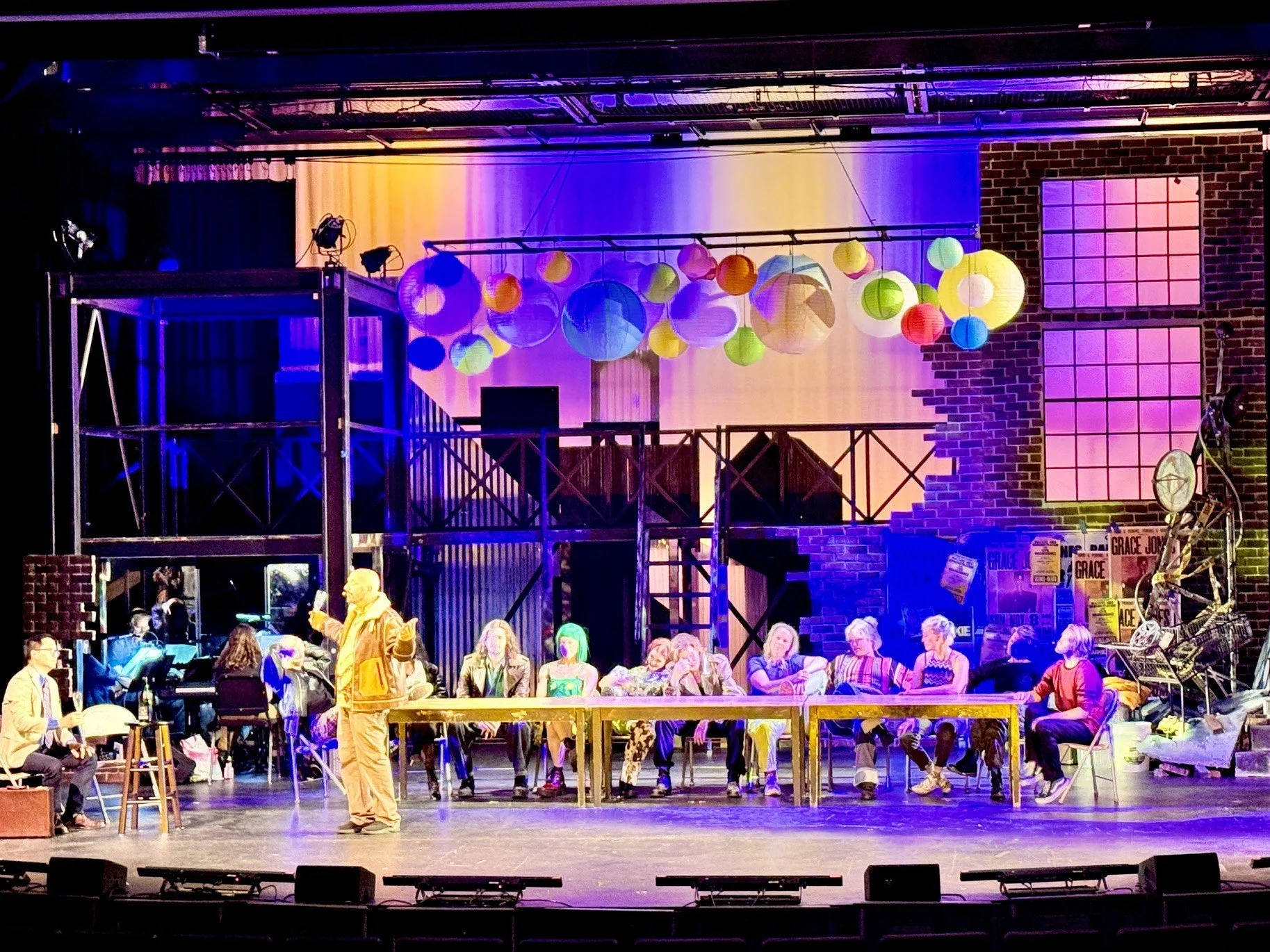
Kelly places that story within an environment that immediately feels right. Scenic designer Ryan Ross gives the stage a rough, urban, industrial appearance, with large metal architecture and a deliberately lived-in quality rather than something pristine or overly theatrical. The band is tucked beneath an elevated platform and becomes part of the environment rather than something separated from it, while a lighted screen behind the set expands the Kelly's possibilities for telling this story. The result captures the makeshift quality of the world these characters inhabit, people creating homes, art and community out of whatever is available.
While the design aspects are important, nothing in Rent is as crucial as its defining strength, its music.
Jonathan’s score is deceptively difficult. Individual vocal lines collide with one another, melodies compete for attention, harmonies stack on top of harmonies, and performers have to maintain their own musical identities while simultaneously listening to everyone around them. There is not a single weak spot in this ensemble. Under music director Marita Ericksen and vocal director Korby Myrick, this cast attacks that complexity with confidence and power, producing harmonies that are rich, deep and remarkably well balanced.
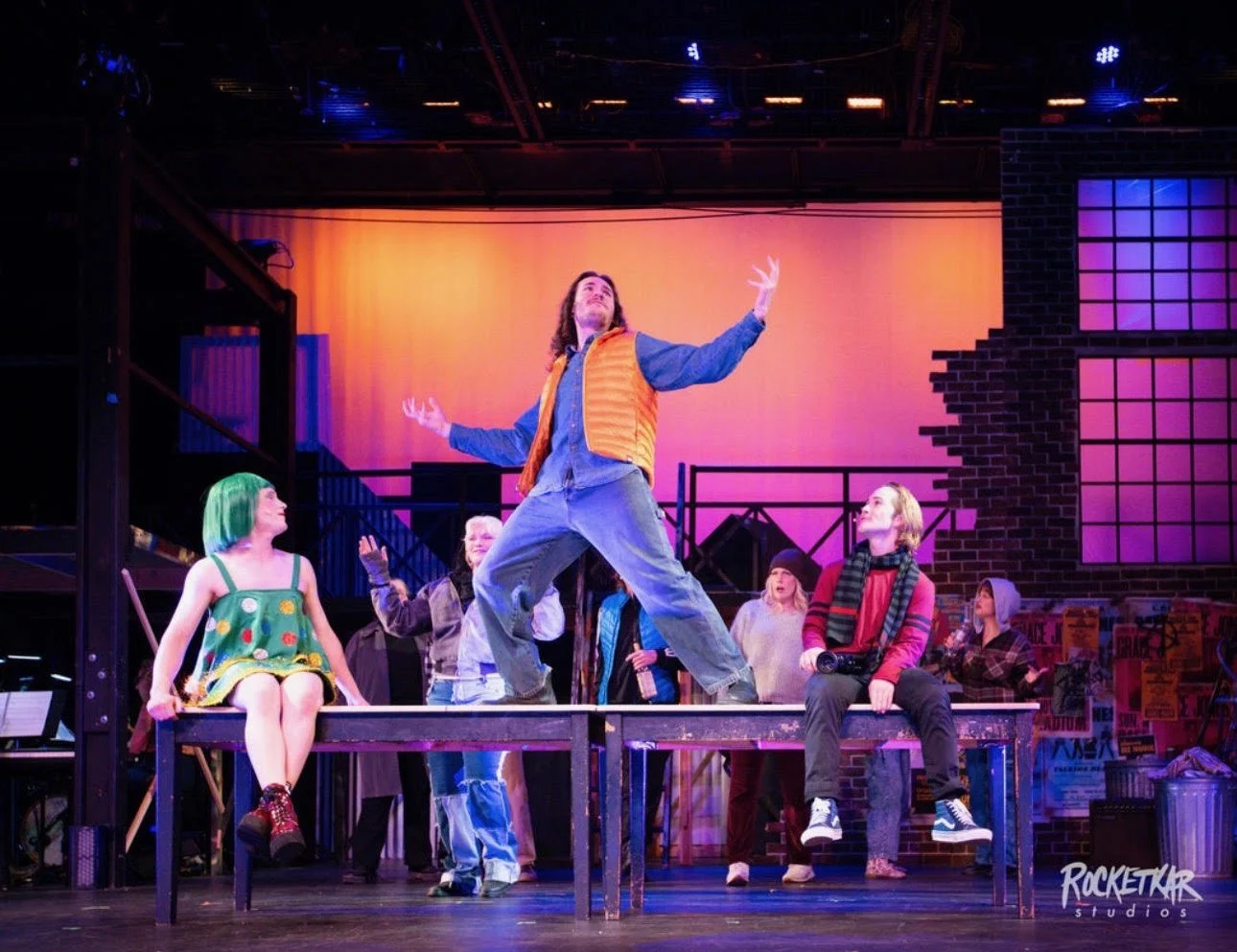
“Rent” establishes that ability early. There is terrific harmony between the male voices, but the number becomes even more impressive as the rest of the company enters and Jonathan begins layering voices and musical ideas on top of one another. Kelly also uses the ensemble effectively as a visual tool, allowing performers outside the immediate focus of the action to freeze as attention moves elsewhere. It keeps the stage from becoming cluttered even when the music itself is intentionally anything but simple.
“Seasons of Love” provides another showcase for the company’s vocal depth, its layered harmonies beautifully balanced around its featured voices. “Take Me or Leave Me” demonstrates something different: just how much power two exceptional performers can bring to a song. Throughout the evening, whether two voices are working together or nearly the entire company is singing at once, the musical precision remains remarkable.
The cast is simply first-rate. Kyle Sinclair brings a strong presence to Roger, with the anger, frustration and sadness beneath the character never far from the surface. Opposite him, Sierra Tinhof gives Mimi a combination of vulnerability and fire. “Light My Candle” immediately establishes the chemistry between them, while “Another Day” is a fantastic duet, allowing both performers to unleash the vocal and emotional power of their characters.
“Out Tonight” asks something different of Sierra. It is an intensely physical number, and there are moments when the sheer energy of the choreography and the abandon she brings to it affect her tone. But that is an exception in a performance that otherwise stands comfortably alongside the tremendous vocal work happening throughout this cast. As the number progresses, Sierra finds greater control, and the fearlessness she brings to Mimi is never in question.
Ethan Jarvik’s Tom Collins comes equipped with something particularly special, a big, booming baritone with a richness rarely encountered on Seattle-area stages. Ethan doesn’t merely have volume, there is extraordinary warmth and depth within his voice. That lower register gives the ensemble harmonies a foundation, balancing the talented higher voices almost magically and contributing to the fullness of the company’s overall sound.
It becomes even more effective when Ethan is allowed to connect that voice to his character’s emotional journey. “I’ll Cover You” is filled with warmth, but what happens later gives the song and the relationship at its center considerably more weight. Ethan’s vocals are capable of communicating tremendous power and pain, and his best dramatic work arrives as Tom is forced to confront loss.
Much of the reason that loss hurts so badly is Gabriel Dawson’s Angel. Gabriel fills the character with such hope, generosity and love that it becomes contagious. Angel brings light into nearly every space she enters, which only makes the conclusion of the character’s story arc more heartbreaking. Gabriel and Ethan have wonderful chemistry together, and the emotional rise and fall of their relationship becomes almost a story unto itself.
Gabriel is also a formidable physical performer. “Today 4 U,” choreographed by Chip Sherman, is exuberant, creative and demanding, providing Gabriel an opportunity to demonstrate considerable dance ability while never losing Angel’s personality within the movement. That is something this production does particularly well: even amid complicated choreography and musical staging, the performers remain their characters rather than becoming singers and dancers executing steps.
The same is true of “Tango: Maureen,” with choreography by Cristy Stone. It is funny on the surface but filled with hurt underneath, and the vocals and choreography work together to capture both. The actors maintain their individual characters even as the number grows more musically and physically complicated, with percussion and vocal harmony combining into something that feels simultaneously playful and wounded.
And then Maureen finally arrives.
Zoey Wilson’s performance of “Over the Moon” is pure performance art. There isn’t a vocal miss in it, but the voice is only part of what makes the number work. Zoey’s movement is strong, sensual and rebellious, and her stage presence is utterly fantastic. Maureen spends relatively little time on stage during much of Act I, but after “Over the Moon” she becomes impossible to ignore. Into Act II, Zoey turns her into a force on stage, carrying much of the rebellious energy at the heart of the story.
That force meets its match in Vanessa Bassi’s Joanne. Together, Vanessa and Zoey make “Take Me or Leave Me” far more than a vocal showcase. There is something bluesy and soulful in the sound, but also genuine affection underneath the combativeness. For all the fighting built into the song, they perform it with so much heart that it becomes an enormous, messy love song between two people who can infuriate each other precisely because they care so deeply.
And none of these performances would have the same impact without the company surrounding them. Alison Bagby, Bethie Hungerford, Maya Krah, Brooke Osment, Erika Strandberg, Leonard Su and Meg Thompson form an exceptional ensemble. There are no throwaway voices here and no moments when the performers on the periphery simply disappear. Each contributes to the wall of sound that makes the large company numbers soar, while remaining engaged dramatically even when someone else occupies the center of the scene. Their work is especially important in numbers like “Rent” and “Seasons of Love,” where individual vocal lines eventually coalesce into something far bigger. In a musical in which community and chosen family are central ideas, the collective commitment of this ensemble matters enormously.
Marita’s live band, Marlowe Cardoza, Rick Doussett, Peter Bonow, Korby Myrick and John Pierce, handles Jonathan’s rock score beautifully. The musicians provide all of the energy and drive the score demands while remaining sensitive to what is happening vocally on stage. Dillon Stearnes’ sound design keeps the balance between the band and performers remarkably clean, allowing the instrumentation to have power without swallowing the vocals. There were a couple of instances where performers appeared either not to be mic’d or to have microphone issues, forcing them to compensate vocally and momentarily affecting the quality of the surrounding harmony. Those moments are noticeable primarily because the balance and vocal blend are otherwise so consistently strong.
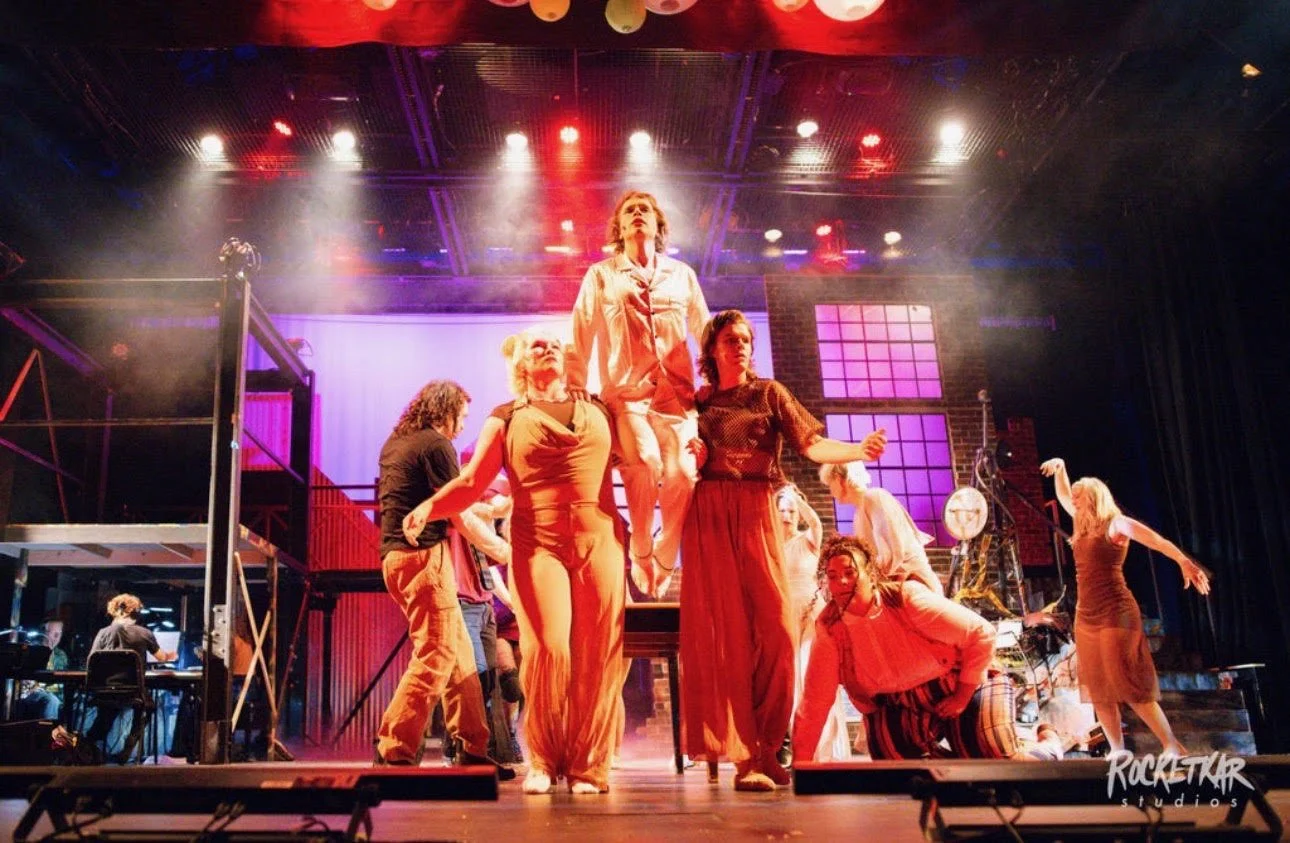
Alex Wren’s lighting design is equally integral to the storytelling. From the outset, Alex uses light to provide emotional context rather than simply visibility, shifting with the increasingly difficult journey these characters undertake. That work culminates beautifully late in the musical during “Goodbye Love.” There is something almost supernatural about the light in the scene, as though it is emanating from somewhere beyond the physical world occupied by these characters. Shadows, angles and precisely placed illumination combine to create one of the evening’s most striking images.
It is also an example of what Kelly accomplishes throughout the production. The moment works not because of any one element but because acting, lighting, sound, music and direction all arrive at exactly the same place at exactly the same time. Kelly understands when Rent needs to explode and, just as importantly, when it needs to become still enough for its characters’ pain to register.
That balance is essential. Rent is filled with anger and rebellion, but beneath both is fear, fear of losing a home, losing a relationship, losing an artistic voice and, most profoundly, losing time. Drama Dock never allows the spectacle of Jonathan’s music to bury those human stakes. Even at its loudest, this production remains about people.
That may ultimately be why this Rent succeeds so completely. The technical work is excellent. The band is excellent. The direction is assured. Individual performances repeatedly rise to standout levels. But the defining achievement is the company itself. Jonathan wrote a musical in which individual voices fight to be heard before joining together to create something greater than any one of them, and Drama Dock has assembled a cast capable of doing exactly that.
I’ve seen a number of productions of Rent over the years, and Drama Dock’s belongs right alongside anything I’ve seen produced by a large Equity house. There simply isn’t a weak spot in this company. From its deepest baritone to its highest harmonies, from its quietest moments of grief to its biggest explosions of rock-and-roll defiance, this cast brings extraordinary talent to bear on one of musical theatre’s most demanding contemporary scores. Thirty years after Jonathan’s musical first arrived, we already know Rent is great. Drama Dock reminds us just how great a production of it can be.
The Drama Dock Theatre Company production of Rent runs on stage at Vashon Performing Arts Center on Vashon Island through August 23. For more information, including ticket availability and sales, visit https://www.dramadock.org/.
Photo credit: Kelly Godell, Rocketkar Studios