
Stage Review - The 39 Steps (Centerstage Theatre)
Stage Review - The 39 Steps
Presented By: Centerstage Theatre - Federal Way, WA
Show Run: March 27 - April 19, 2026
Date Reviewed: Saturday, March 28, 2026 (Opening Weekend)
Run Time: 2 Hours, 15 Minutes (including a 15-minute intermission)
Reviewed by: Greg Heilman
There are plenty of plays out there with something to say, with messaging that makes the audience think, and asks them to go away trying to be the best versions of themselves that they can be. The 39 Steps, the current production from Centerstage Theatre and running on stage at the Knutzen Family Theatre at Dumas Center in Federal Way through April 19, is not one of these plays. Directed by Angela Bayler, this adaptation of John Buchan’s novel by Patrick Barlow instead sets its sights on something just as valuable: delivering a thoroughly entertaining, cleverly constructed theatrical experience that knows exactly what it is and never pretends to be anything else.
From the outset, Angela establishes a tone that celebrates the show’s vaudeville-inspired roots, with a sense of theatricality that carries through the production, embracing exaggeration and playful overstatement in a way that feels both intentional and sharply controlled. The result is a piece that is consistently self-aware, not only in its humor, but in how it constructs its storytelling.
Originally a 1915 novel by John Buchan and later adapted into Alfred Hitchcock’s 1935 film, The 39 Steps has since taken on new life through Patrick Barlow’s stage adaptation, which distills the story into a fast-paced, theatrical romp built for a small cast. The plot follows Richard Hannay, an ordinary man who becomes entangled in a web of espionage after a chance encounter leads to a murder in his apartment. Forced to go on the run, Richard races across the country to clear his name and uncover the truth behind a shadowy organization, encountering a host of characters along the way—all brought to life through inventive staging and quick transformations.
That self-awareness of the production extends to the many Hitchcock easter eggs embedded in the script, with this production finding its own inventive ways to bring those moments to life. Through both design choices and performance details, these references become more than just nods—they’re integrated into the fabric of the show, adding an extra layer of enjoyment for those who catch them while still serving the pacing and tone of the piece. It’s one of several ways the production demonstrates a clear understanding of its identity and how to lean into it effectively.
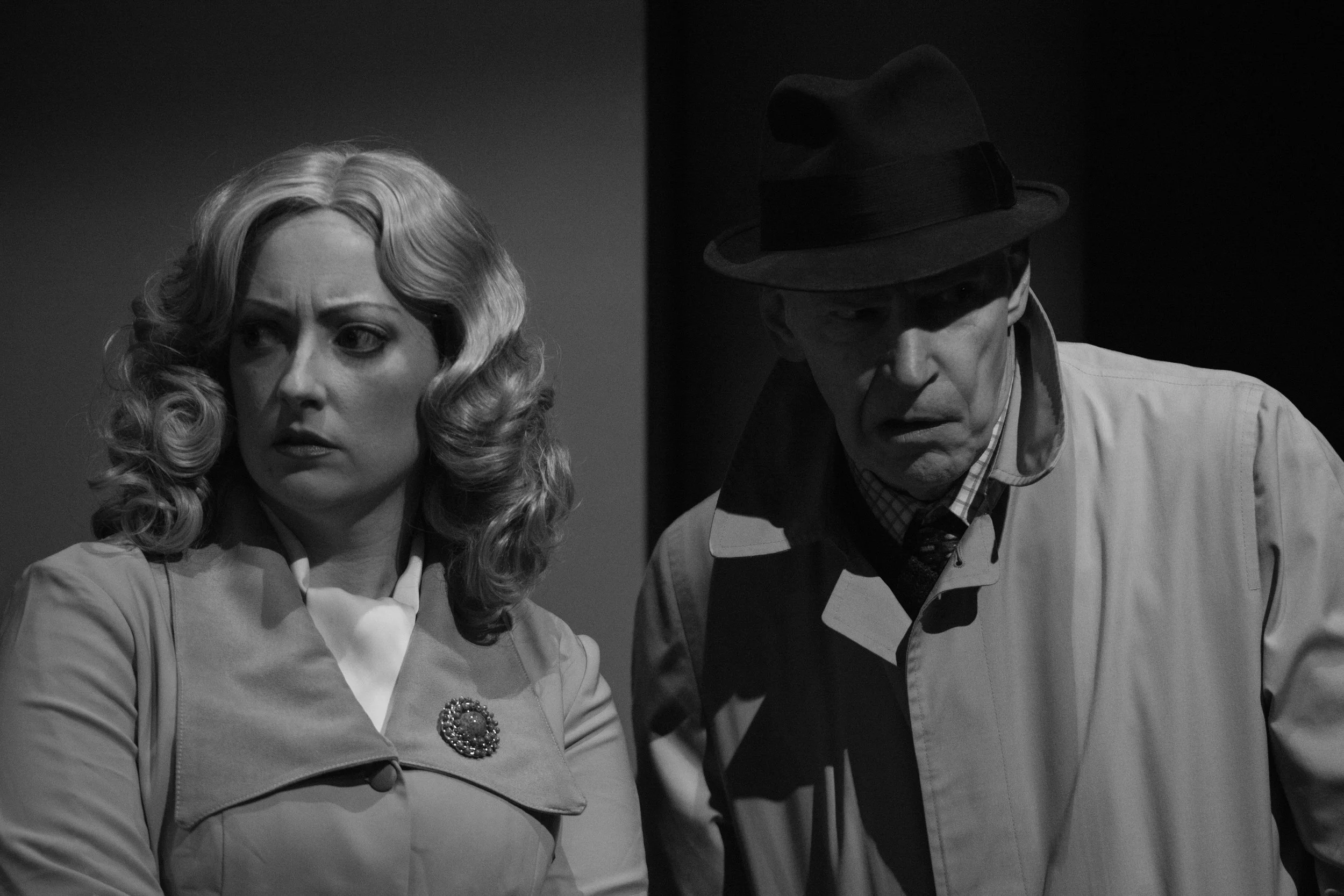
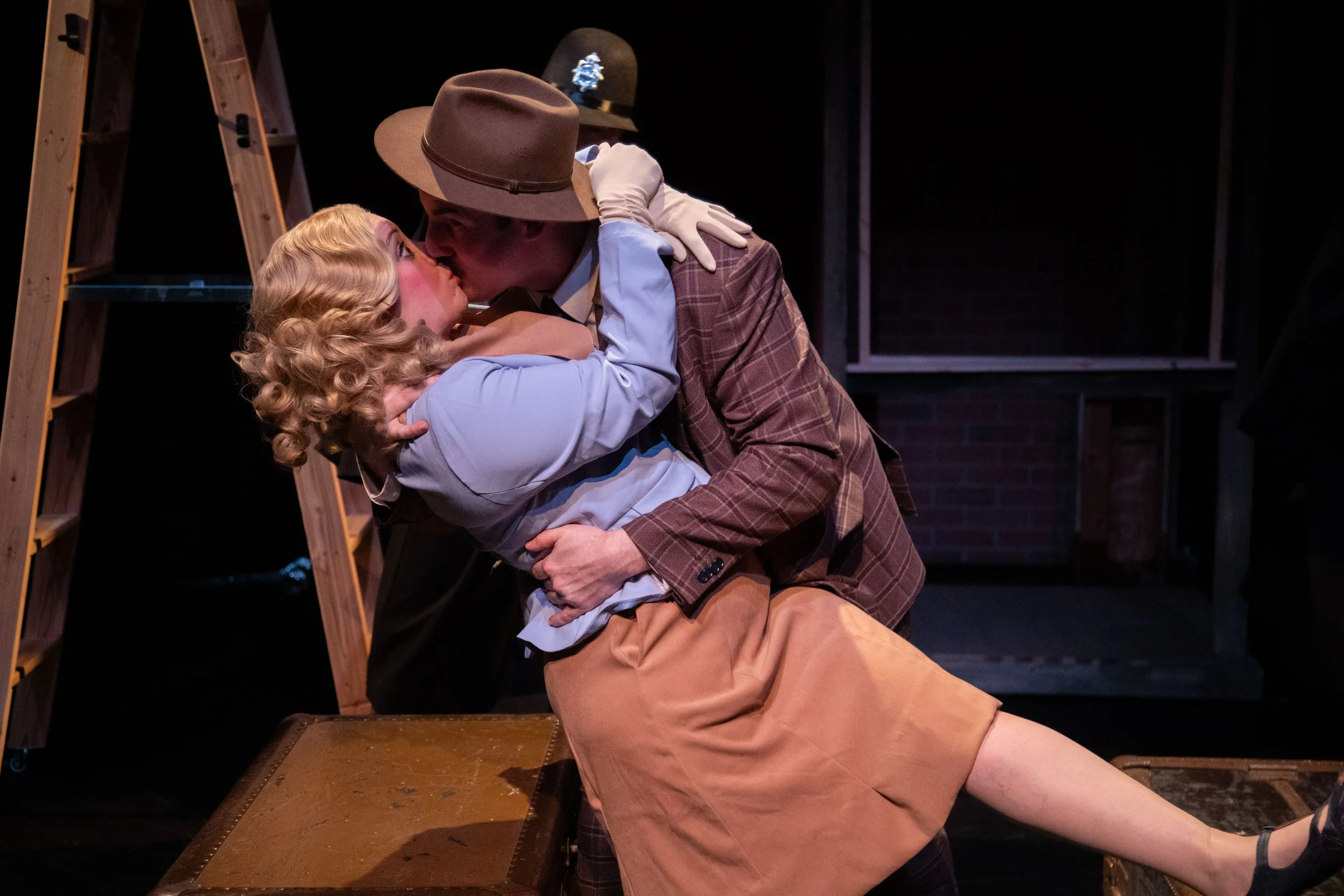
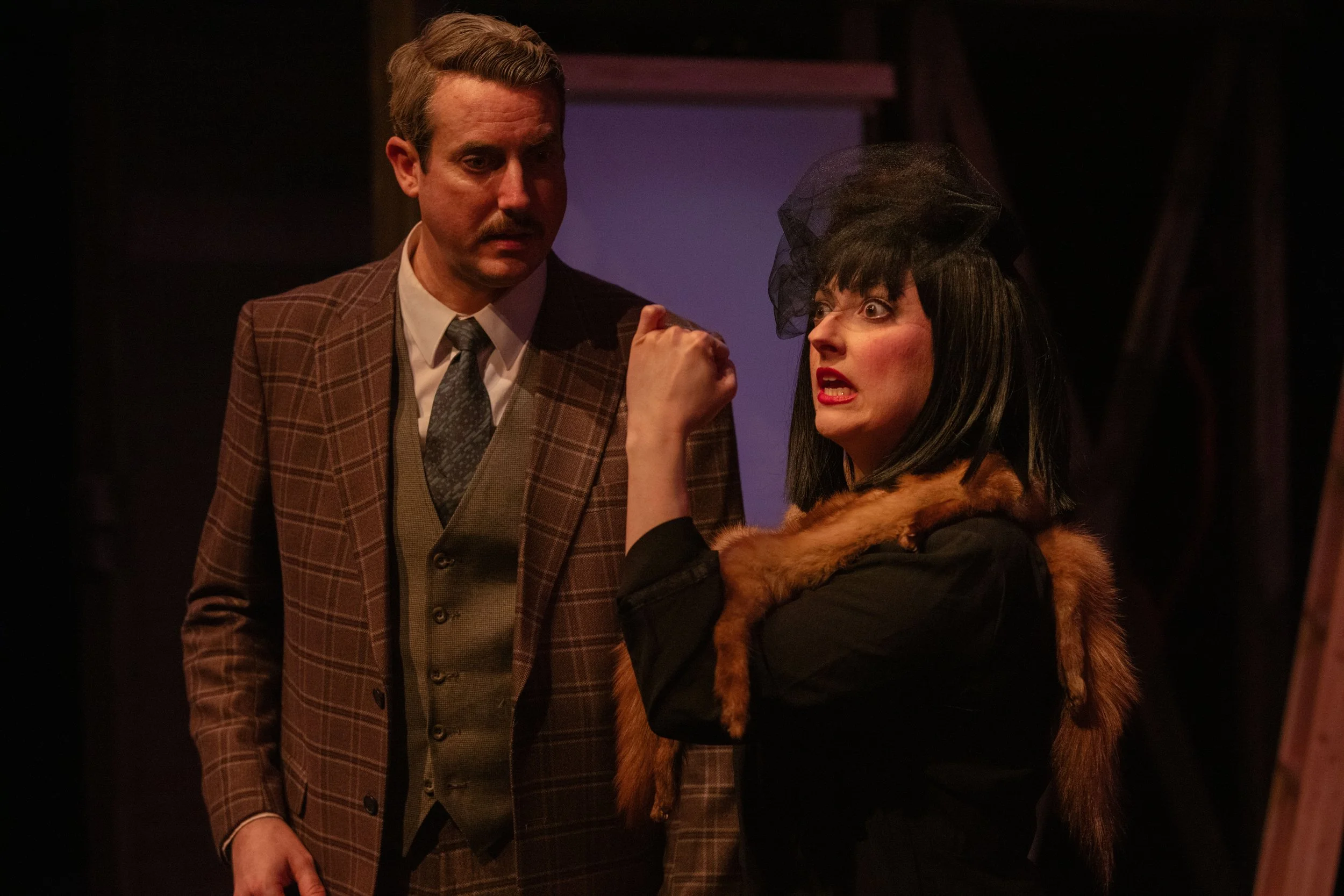
At the center of the story is Richard Hannay, played by Jacob Tice, who serves as the calm anchor in an increasingly chaotic world. Jacob approaches the role with a confident steadiness, maintaining a strong accent and a subtle, tongue-in-cheek awareness that allows the humor to build around him rather than from him. It’s an approach that pays off, as much of the comedy lands because of how firmly he holds the center while everything else spirals outward.
Karina Becker takes on the multiple roles of Annabella Schmidt, Pamela, and Margaret, bringing a lively versatility to each. Karina moves fluidly between characters, giving each a distinct personality while maintaining the brisk pace the show demands. There’s a playful energy to her work, balancing moments of flirtation, mystery, and sharp comedic timing in a way that keeps each transition engaging.
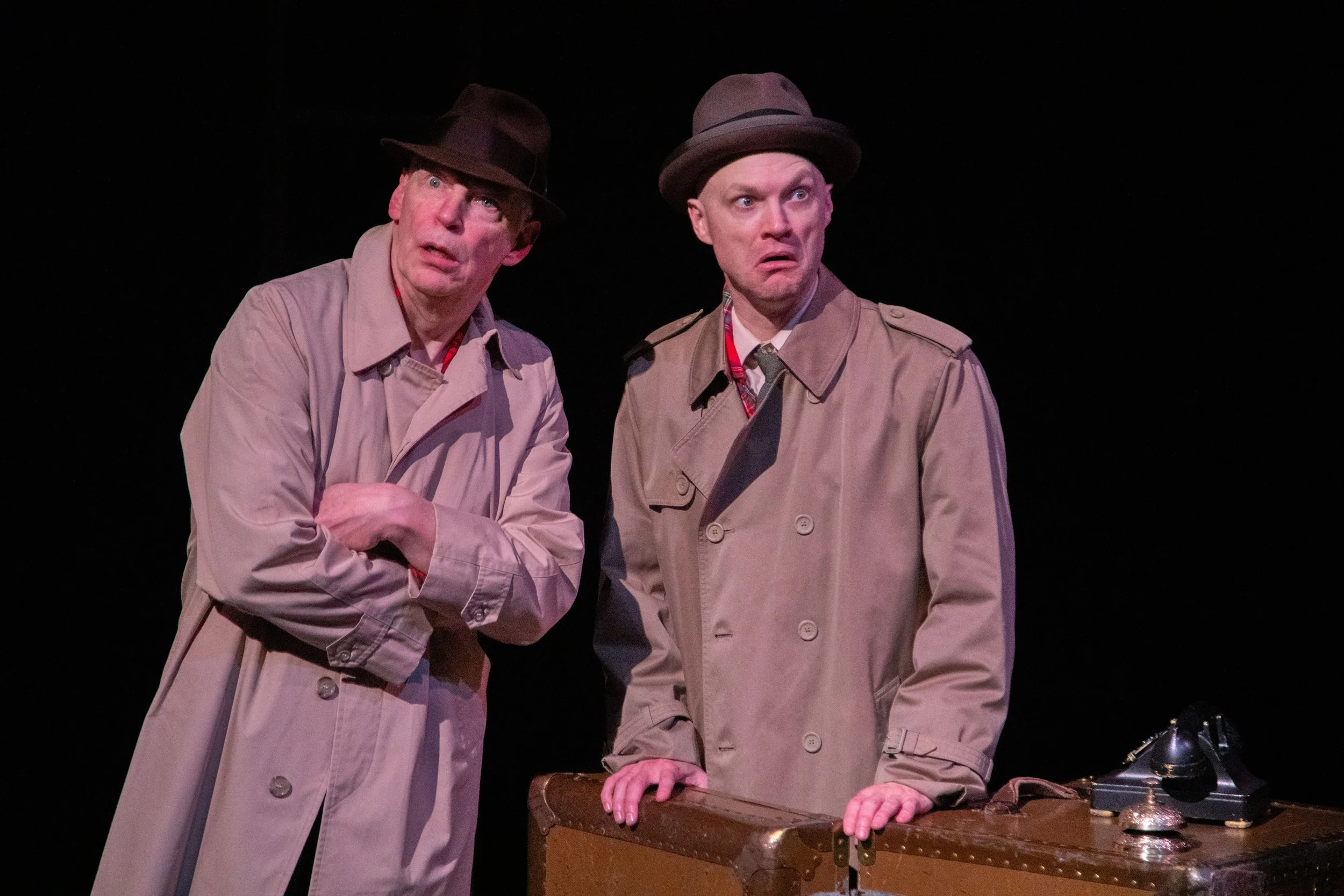
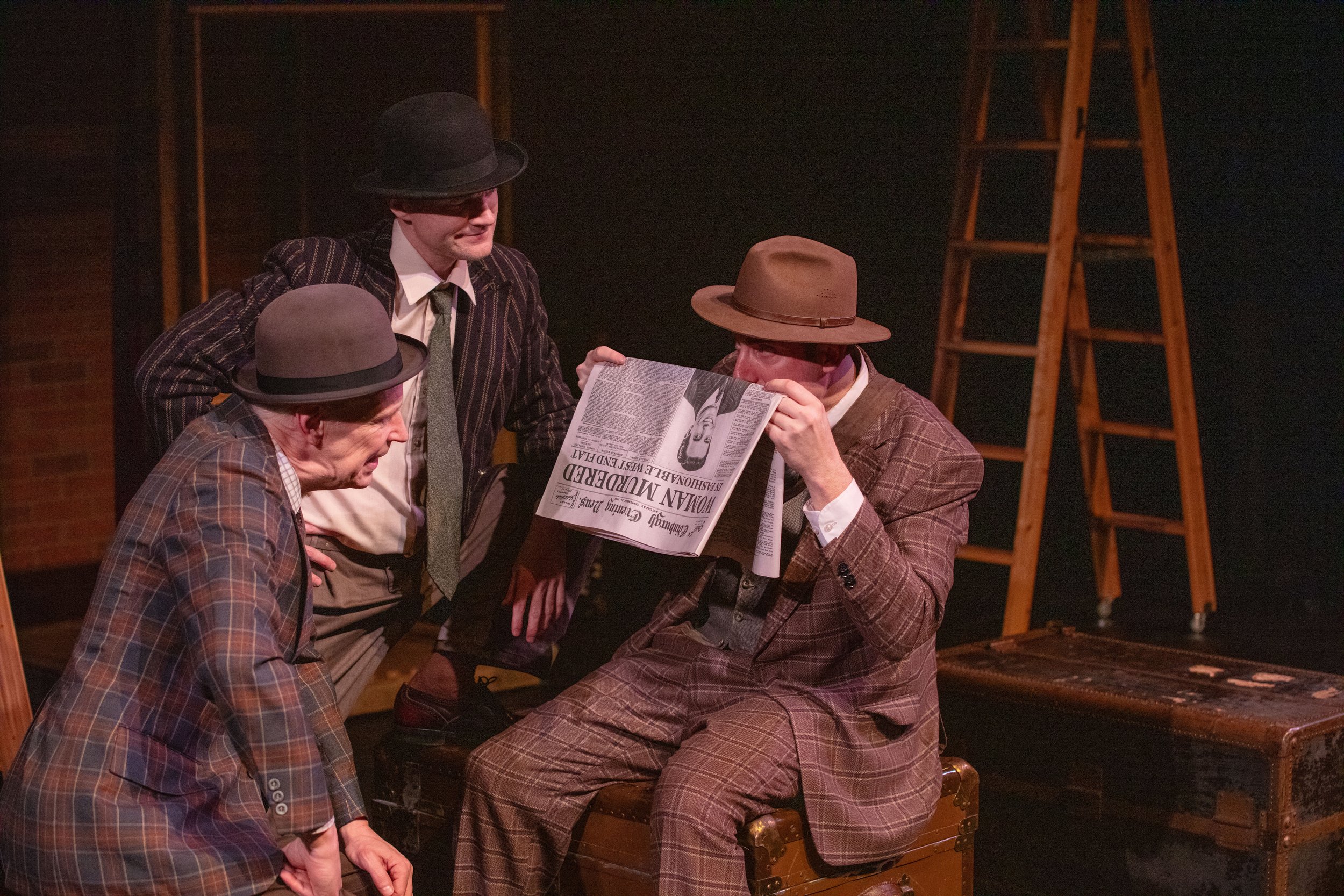
Much of the show’s kinetic energy comes from Vince Brady and Kyle Sinclar as Clown 1 and Clown 2, who function as a tightly coordinated comedy duo. Their rapid-fire character changes, supported by quick shifts in accents, costumes, and physicality, are executed with impressive precision. The choreography of these transitions is particularly notable, as the pair navigate a constant stream of entrances, exits, and transformations without losing momentum. Their work highlights just how much of the storytelling here is driven by physical performance.
On the creative side, it’s worth making special mention of the accent work across the production, because it is nothing short of impressive. There is, of course, Richard’s expertly delivered English accent, and then the distinct personas that Karina creates across her roles. But with Vince and Kyle, the challenge expands exponentially. Between them, they bring to life well over a hundred characters, and with each comes its own vocal identity. What stands out is not just the variety, but the consistency and clarity with which these accents are executed. In fact, the work is so strong that I found myself checking the program multiple times for a dialect coach, assuming there had to be one guiding this level of detail. When none was listed, I followed up with the creative team, only to learn that there wasn’t one. All of this work rests solely on the shoulders of the actors, and the fact that it feels so polished is a testament to just how well they rise to that challenge.
The reliance on physicality to deliver the many gags in the play is reinforced by the scenic design from Natalie Clark, which embraces a deliberately minimal approach. The set is, by design, quite barebones, but it’s exactly that simplicity that allows the production to thrive. Ladders, small structural elements, and a cleverly utilized moving door are used in creative and often unexpected ways, forcing the performers to carry the weight of the storytelling through movement and invention. The result is a style of comedy that feels immediate and imaginative, with the audience invited to meet the production halfway.
The technical elements follow suit, with John Chenault’s lighting and Chelsea “Mo” Moniz’s sound design working in tandem with the action on stage. Both are not only effective in establishing environment and mood, but also play directly into the humor, with well-timed cues that enhance the show’s comedic beats. The costumes, provided by From the Closet, support the rapid transitions required of the cast, especially with Vince and Kyle’s many change-ups and with Karina’s looks in particular helping to clearly define each of her characters.
What ultimately makes this production work, though, is the cohesion of the ensemble that Angela has assembled and prepared. There’s a clear sense that everyone on stage understands both the style and the demands of the piece, and they play off one another with an ease that keeps the show moving at a brisk, engaging pace. Even as the production leans fully into its humor, it never loses sight of the narrative, maintaining a throughline that keeps the audience invested from beginning to end.
This isn’t a play that asks big questions or searches for deeper meaning, and it doesn’t need to. What Centerstage Theatre has created here is a smart, inventive, and thoroughly enjoyable production that embraces its own theatricality and invites the audience along for the ride. Sometimes, that’s exactly what a night at the theatre should be.
The Centerstage Theatre production of The 39 Steps runs on stage at the Knutzen Family Theatre at Dumas Bay Centre in Federal Way through April 19. For more information, including ticket availability and sales, visit https://centerstagetheatre.com/.
Photo credit: Timothy Jacques