
Stage Review - The 39 Steps
Presented By: Olympic Theatre Arts - Sequim, WA
Show Run: August 28 - September 13, 2026
Date Reviewed: Sunday, August 30, 2026 (Opening Weekend)
Run Time: 2 Hours (including a 15-minute intermission)
Reviewed by: Greg Heilman
The same theatre that only weeks ago brought audiences the enormously funny and gleefully outrageous Lavender Melodrama is back at it again. This time, Olympic Theatre Arts trades the lavender fields of Sequim for spies, murder, train chases and Alfred Hitchcock, finding plenty of opportunities for laughs along the way. Directed by Ron Graham, The 39 Steps, adapted by Patrick Barlow, is on the Main Stage at Olympic Theatre Arts in Sequim through September 13. And much like that earlier summer production, the real joy here comes from a company willing to embrace theatrical absurdity without the slightest hesitation.
Barlow’s The 39 Steps takes Alfred Hitchcock’s 1935 film, itself based on John Buchan’s novel, and transforms its espionage thriller into a theatrical parody. A story that once depended on cinematic locations, chases and suspense becomes an exercise in imaginative stagecraft, where a tiny group of performers creates a seemingly endless parade of people and places. Olympic Theatre Arts expands the central group with four ensemble members, but preserves the essential joke: this is a ridiculously ambitious story being created before the audience’s eyes by performers who know perfectly well how ridiculous the undertaking is.
Richard Hannay (Matt Forrest) begins as an ordinary man whose uneventful life changes when he meets the mysterious Annabella Schmidt (Nikki Forrest), a woman claiming to be a spy. After Annabella is murdered in his home, Hannay finds himself implicated in her death and on the run, attempting to unravel her warnings about a mysterious organization known as “The 39 Steps.” His flight takes him from London toward Scotland, with police, spies and an assortment of increasingly eccentric characters in pursuit. Olympic Theatre Arts describes the show as “Comedy Suspense,” but anyone expecting Hitchcockian suspense played straight is in the wrong theatre. Here, the mystery is almost secondary to watching this company figure out increasingly preposterous ways to tell it.
Ron establishes that idea before the play even officially begins. The pre-show set consists of a series of mismatched chairs (an easy chair, wooden chairs and theatre seats) all positioned toward a screen showing Hitchcock’s film. Even the curtain speech refuses to behave like a curtain speech, eventually becoming part of the performance itself. Once someone realizes, essentially, “We already have an audience,” the machinery of The 39 Steps starts turning.
And that machinery is where this production is at its funniest.
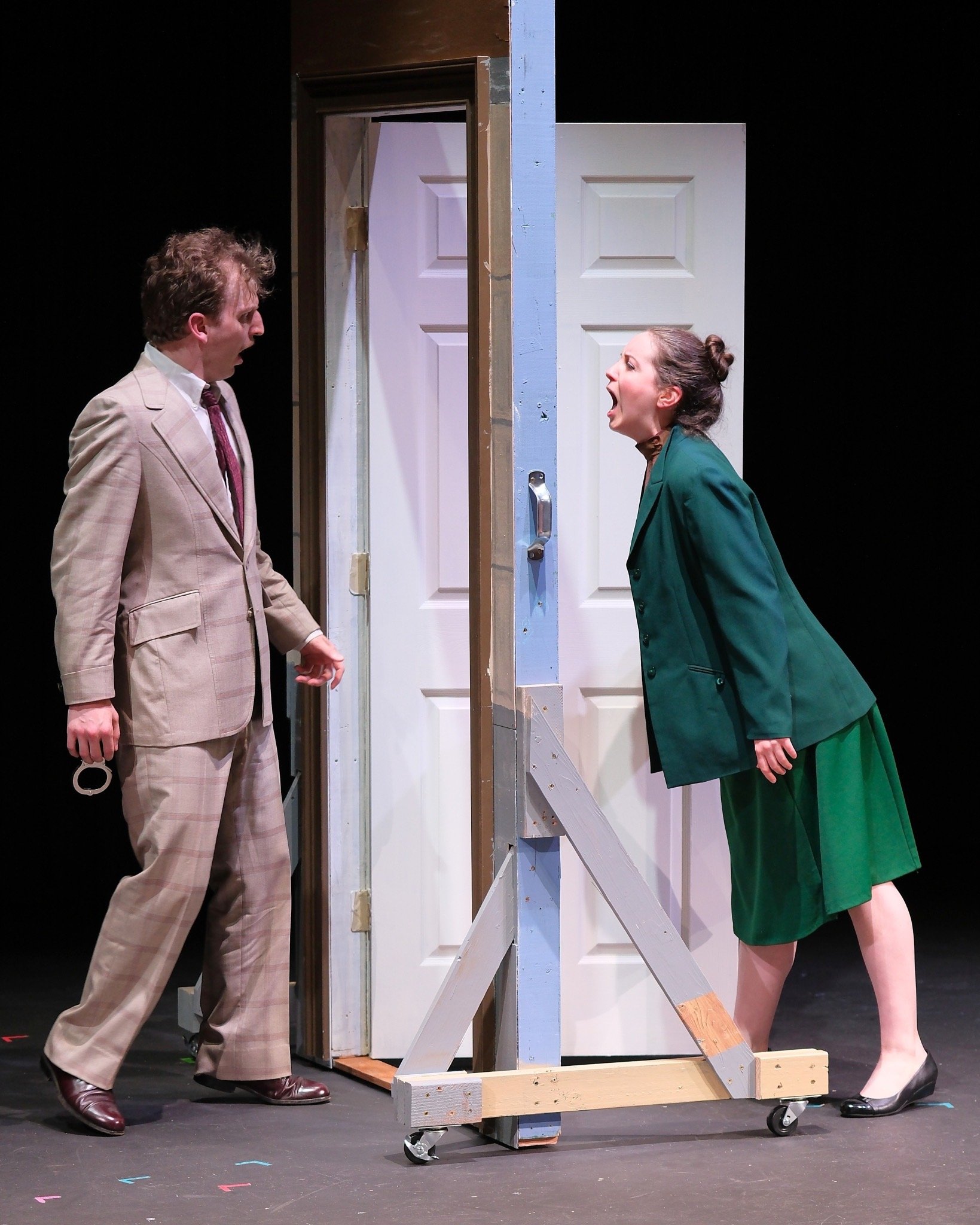
There is no attempt to disguise the fact that the audience is watching people make theatre. Quite the opposite. Scene changes that might ordinarily be hidden become comic events of their own. Sets move with intentionally imperfect precision. Stagehands become participants in the joke. Props substitute imagination for realism. The production continually seems to ask, “How are they possibly going to put that onstage?” before answering with the simplest and frequently silliest solution available. Some of the evening’s biggest laughs come not from dialogue at all, but from watching the company manufacture another location, chase or cinematic effect right in front of the audience.
That approach is exactly what makes The 39 Steps unique among other local productions. Trying to realistically recreate everything Hannay encounters would miss the point entirely. The joke lies in watching the performers create something enormous using deliberately modest theatrical means. The production never asks the audience to forget that they are sitting in a theatre; instead, it makes that awareness essential to the comedy.
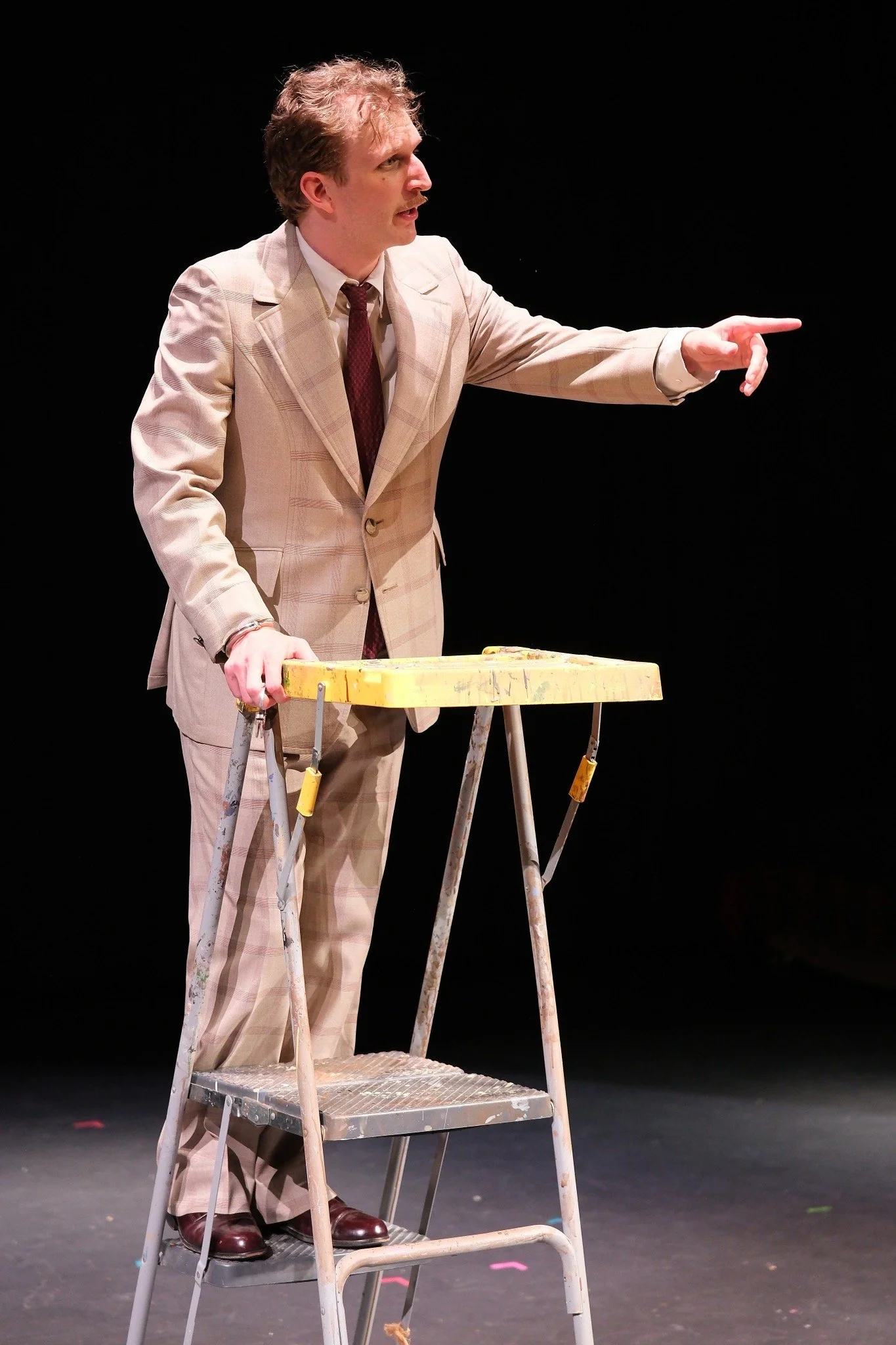
Matt anchors all of this wonderfully as Hannay. While chaos develops everywhere around him, he maintains the bearing of the dashing leading man who apparently wandered into the wrong version of his own spy thriller. A frequently present drink becomes part of his characterization, but Matt is especially good at the physical comedy required of him. His commitment is important, the more seriously Hannay approaches his increasingly ludicrous circumstances, the funnier those circumstances become.
Nikki is equally strong opposite him, moving among Annabella, Margaret and Pamela and creating enough distinction among the three that each feels like a separate character rather than simply another costume. She and Matt work particularly well together, and their accents are consistently strong. Dialect coach Karen Twight deserves recognition here as well. In a production where performers continually jump among characters, nationalities and comic archetypes, vocal differentiation becomes another essential storytelling tool, and this small but mighty group is agile enough under Karen’s tutelage to make each character work.
But the most daunting assignments belong to Clown 1 (Colby Thomas) and Clown 2 (Deanna Eickhoff). They are asked to become seemingly everyone Hannay encounters, sometimes with scarcely enough time to change a hat, coat, posture or accent before becoming somebody else. Colby and Deanna attack those transformations with enthusiasm, and the speed of the changes becomes part of the comedy. Their accents and characterizations make each new arrival identifiable, while rapid costume changes add another layer to the joke. At times, the comedy isn't simply that two actors are playing so many people, it's that the production makes absolutely no effort to pretend the audience hasn't noticed.
Mario Arruda, Fey Beeson, Joodie Klinke and Amber Tjemsland round out the ensemble, and their participation allows Ron to expand the controlled chaos beyond the central four performers. They are particularly effective when the production turns the mechanics of scene changes into performance. Rather than disappearing into the background, the people moving and manipulating the world of the play become part of its farcical rhythm. Some of the funniest moments of the entire production occur during these transitions, when the stage crew openly plays into the absurdity of what is happening.
That requires considerable coordination behind the apparent disorder. Amber also serves as stage manager, with Mario as assistant stage manager, while Fey and Joodie are credited as stagehands/dressers. Nikki handles choreography as well. What looks deliberately sloppy or spontaneous still has to happen at precisely the right moment for the joke to land. There is a significant difference between genuine chaos and carefully rehearsed chaos, and Ron's production understands it.
The physical production follows the same philosophy. Becca Orozco leads lighting and sound, while Carol Willis serves as costume lead. The costumes are particularly important to Colby and Deanna's rapid transformations, where a relatively small change can instantly communicate an entirely new person. Likewise, the props, credited to Amber, Fey, Joodie and Kathy Balducci, don't need to convince anyone that what they are seeing is real. They give the performers exactly enough to invite the audience to fill in everything else.
Finally, the set operates on that same principle. Rather than creating literal cinematic locations, it provides the building blocks from which the company constructs them. That simplicity makes the transitions themselves part of the storytelling instead of interruptions to it.
And Hitchcock is never very far away. Easter eggs referencing the director and his films are scattered throughout the production, sometimes overtly and sometimes tucked into places where attentive Hitchcock fans will catch them. They aren't simply decorations hanging somewhere on the wall, either. They become part of the world Ron and the company are constructing, providing another game for audiences familiar with Hitchcock's work while never becoming necessary for those who aren't.
Ultimately, the mystery of The 39 Steps isn't really the attraction. The fun is in the telling. Olympic Theatre Arts takes a story filled with locations, characters and cinematic spectacle and gleefully reveals every theatrical seam required to make it happen. The audience sees the costume changes, the scene changes, the performers scrambling from one character to another and the wonderfully low-tech solutions to decidedly high-concept problems. Instead of diminishing the illusion, revealing all of that becomes the illusion.
After Lavender Melodrama, Olympic Theatre Arts has once again found a production particularly suited to a company willing to be big, broad and unapologetically silly. The 39 Steps doesn't take itself seriously, but this company takes the business of being funny very seriously indeed. The result is an inventive, self-aware farce in which Hitchcock supplies the chase, Barlow supplies the framework, and Olympic Theatre Arts supplies the controlled chaos.
The Olympic Theatre Arts production of The 39 Steps runs on stage in Sequim through September 13. For more information, including ticket availability and sales, visit https://www.olympictheatrearts.org/.
Photo credit: Blu Rok Photography