
Stage Review - The Game’s Afoot (or Holmes for the Holidays) (Woodinville Rep)
Stage Review - The Game’s Afoot (or Holmes for the Holidays)
Presented By: Woodinville Repertory Theatre - Woodinville, WA
Show Run: October 02 - October 25, 2026
Date Reviewed: Friday, October 10, 2026
Run Time: 2 Hours, 20 Minutes (including a 20-minute intermission)
Reviewed by: Greg Heilman
Ken Ludwig’s penchant for taking familiar theatrical conventions and turning them into something fresh, clever, and frequently hilarious, is well known. It’s part of the reason why he has consistently landed in the top 20 most prolifically produced playwrights year after year. His comedies often succeed not simply because of their absurd situations, but because of the ingenuity with which he constructs them, and the cleverness he applies to his dialogue. The Game's Afoot (or Holmes for the Holidays), currently being presented by Woodinville Repertory Theatre at The Restaurant at DeLille Cellars through October 25, like many of his plays, relies on the familiar, situations that draw humor from the audience’s collective understanding of where the plot comes from. This play, however, at least in its construction, doesn't quite reach the heights of some of Ludwig's other work. Directed by Rael Esteves, this holiday-themed murder mystery is certainly entertaining, particularly when its cast fully embraces the exaggerated theatricality of the material, but the story itself feels a bit lacking in its originality, and resembles something seen before, just with some slightly different trimmings.
The play takes its inspiration from William Gillette, the real-life American actor who became famous for his portrayal of Sherlock Holmes in the late nineteenth and early twentieth centuries. Gillette was so closely associated with the character that his interpretation helped establish much of the popular image of Holmes, including his distinctive deerstalker cap and curved pipe. Gillette also built an extraordinary castle in Connecticut, complete with unusual architectural features and hidden passages, where he entertained friends and fellow performers. Ludwig uses this fascinating bit of theatrical history as the foundation for a fictional mystery, setting his story in December 1936 as Gillette invites a collection of fellow actors to his castle for Christmas weekend. What begins as a festive gathering quickly turns into a murder investigation, with Gillette adopting the persona of his famous fictional detective to uncover the killer.
It's a promising premise, particularly given the opportunity to combine the eccentricities of a theatrical company with the conventions of a classic whodunit. Unfortunately, the resulting story doesn't offer much that feels particularly unique. There are suspicious guests, hidden secrets, romantic entanglements, supernatural diversions, and the expected assortment of twists and revelations. All the familiar murder-mystery tropes are present, often delivered with a wink toward the audience, but the cleverness that distinguishes many of Ludwig's other plays isn't quite as evident here. That's not to say The Game's Afoot isn't fun. It is. There's simply a difference between a story that's entertaining and one that feels genuinely inventive, and this play falls more comfortably into the former category.
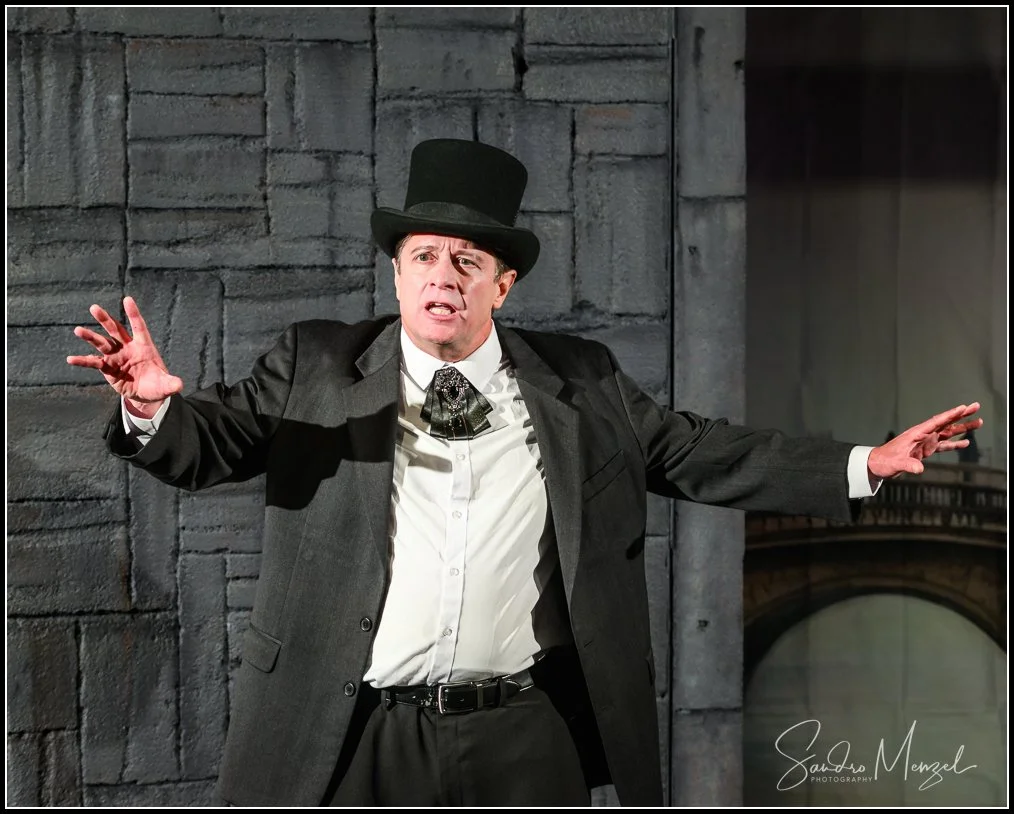
Fortunately, Rael and her ensemble understand the kind of comedy they're presenting. The dialogue is intentionally cheesy, the situations are frequently ridiculous, and nearly every interaction is heightened to the point of melodrama. Characters don't simply exchange words, they deliver pronouncements, trade insults, and react to revelations as though each represents the most significant moment in theatrical history. Even casual conversations become grand dramatic confrontations, including an entertaining exchange between Gillette and fellow actor Felix Geisel that takes on the quality of a Shakespearean battle of words, analogous to the 1930s version of a rap battle. The result is a production that feels deliberately satirical, populated by actors portraying actors who seem incapable of leaving their theatrical instincts behind, even when their own lives are at stake.
John Hoch Deck leads the ensemble as William Gillette, the actor whose enthusiasm for Sherlock Holmes extends well beyond the stage. Patrick Hogan plays Felix Geisel, while Lori Stein portrays Gillette's mother, Martha. Jason Dean and Kylie Jones appear as Simon Bright and Aggie Wheeler, and Lily Zaldivar takes on the role of Inspector Goring. Throughout the production, the ensemble commits to the broad performance style that the material demands, allowing the increasingly absurd circumstances to unfold with an appropriate degree of theatrical excess.
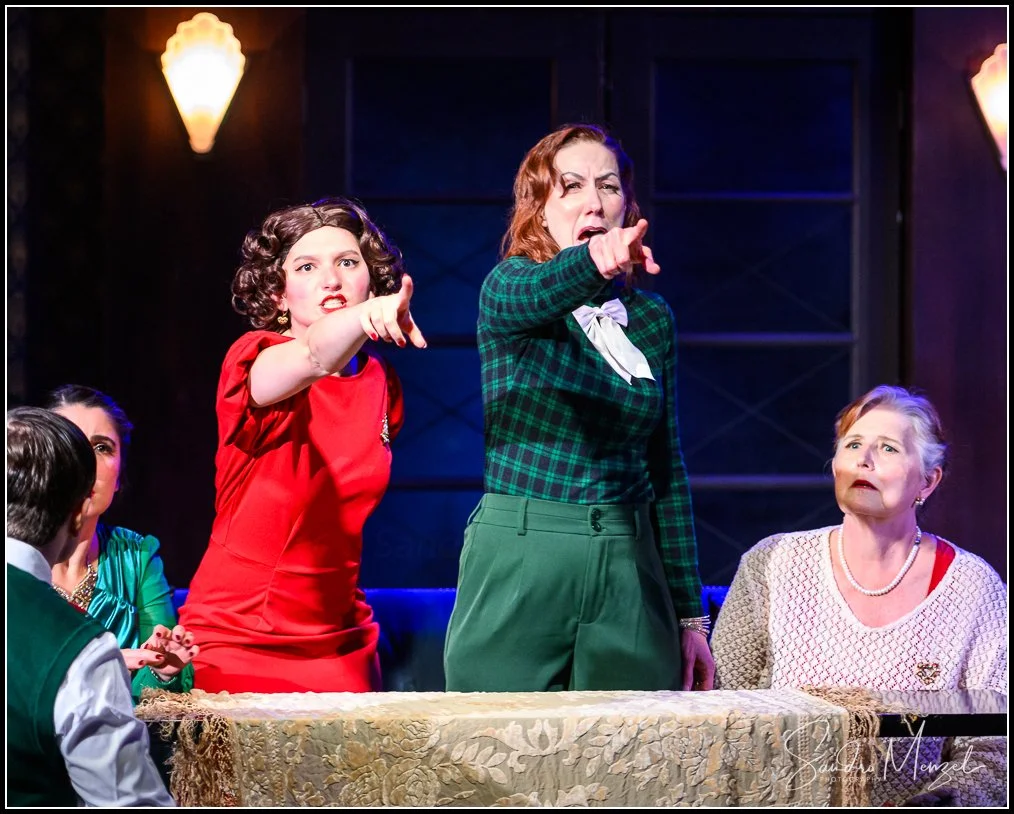
Among the cast, Kristina Sutherland Rowell is particularly effective as Madge Geisel, Felix's wife, whose reactions to the unfolding events are frequently as entertaining as the events themselves. Kristina has an excellent understanding of the exaggerated style of the piece, leaning into Madge's dramatic tendencies without losing the humor beneath them. She's especially good during a séance sequence in which Madge appears to be overtaken by a spirit, embracing the absurdity of the moment with a wonderfully overblown performance. She's equally effective as the jilted wife, making the most of Madge's emotional outbursts and proving that, in a play where practically everyone is overacting by design, there's still an art to doing it particularly well.
The production's standout, though, is Natalee Merrill-Boyet as Daria Chase, a theatre critic and columnist whose sharp tongue is matched only by her apparent delight in exposing everyone else's secrets. Daria is a formidable presence, dispensing insults with remarkable efficiency and demonstrating little patience for anyone unfortunate enough to find themselves in her path. Natalee's delivery is rapid-fire and comparatively natural, even as the character herself is among the most outrageous in the play. It's an approach that makes Daria's barbs land particularly well, and Natalee has an excellent sense of how to use timing and attitude to elevate the comedy. Whether she's revealing an uncomfortable truth or simply ordering someone to shut up or get out, she commands attention whenever she's onstage. The character is perhaps best summarized by one of the play's more memorable lines (and one that received an extra chuckle from me): "She was ruthless, she was evil. She was a theatre critic for God's sake!" Natalee makes Daria every bit as formidable, and considerably more entertaining, than that description suggests.
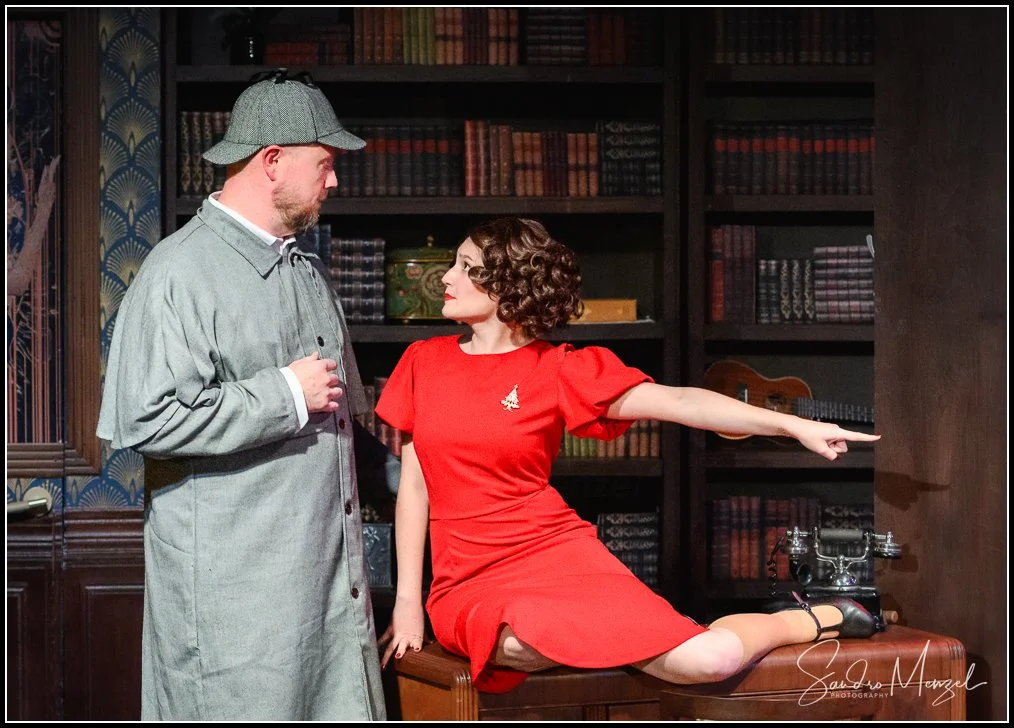
The physical environment also contributes significantly to the production's atmosphere. Set designer Molly West has created a space that extends along the wall of the performance area, incorporating period-inspired 1930s decor and the architectural eccentricities one would expect from Gillette's unusual home. What initially appears to be a relatively straightforward interior reveals additional depth through hidden doors and moving bookshelves, features that are particularly appropriate for a Sherlock Holmes-inspired mystery. The space is also decorated for Christmas, reinforcing the holiday setting without overwhelming the period design. Set builder Tim Watson deserves recognition for helping bring the practical elements of the design to life. Lastly on this, I would be lying if I said I didn’t question the positioning of a Christmas-themed play in October, I did, but it’s not part of the theming that drives the story, and I’ve learned that there’s more that goes into scheduling than just what date fits when, especially when relying on a specific venue, so I’m willing to forego any criticism of this aspect of the production, let’s just say it’s part of the suspension of disbelief that the play itself asks of its audience.
On that theming, Missa Kelsch's costume design complements the setting, with period-appropriate clothing and a coordinated visual palette that supports the Christmas atmosphere. Leroy Timblin's lighting and Chris Edgers' sound design also contribute to the storytelling, particularly during the more dramatic and supernatural moments. The lighting and sound effects help establish the necessary shifts in mood, allowing the production to move between drawing-room comedy, mystery, and the occasional suggestion of something more sinister. In a play so dependent upon theatrical contrivances, these technical contributions are important to making the various surprises work.
One of the interesting challenges of The Game's Afoot is that its humor depends so heavily on theatrical exaggeration. The actors are portraying performers who are themselves prone to melodrama, creating a world in which practically every emotional response is amplified and every revelation is treated as a cause for dramatic spectacle. There's an inherent silliness to the entire exercise, and the audience needs to accept that silliness for the comedy to succeed. Rael generally maintains that atmosphere throughout, with the strongest moments coming when the cast's commitment to the absurdity is matched by the kind of sharp delivery and timing that Kristina and, especially, Natalee demonstrate so effectively.
The Game's Afoot is a pleasant diversion rather than one of Ken Ludwig's more memorable theatrical achievements. Its murder mystery is assembled from familiar pieces, and even the intriguing historical inspiration doesn't entirely overcome the feeling that we've encountered much of this material before, albeit in slightly different packages. But Woodinville Repertory Theatre has assembled a cast willing to embrace the play's eccentricities, supported by a design team that gives its unusual setting an appropriately mysterious atmosphere. With particularly enjoyable performances from Kristina Sutherland Rowell and the excellent Natalee Merrill-Boyet, this production finds plenty of humor in a story that may not be Ludwig at his most inventive, but still offers an entertaining evening of theatrical mischief.
The Game’s Afoot (or Holmes for the Holidays), from Woodinville Repertory Theatre, runs on stage at The Restaurant at DeLille Cellars through October 25. For more information, including ticket availability and sales, visit https://www.woodinvillerep.org/current-season/.
Photo credit: Sandro Menzel