
Stage Review - Twelfth Night (Bainbridge Performing Arts)
Stage Review - Twelfth Night
Presented By: Bainbridge Performing Arts - Bainbridge Island, WA
Show Run: August 08 - August 23, 2026
Date Reviewed: Friday, August 14, 2026
Run Time: 2 Hours, 30 Minutes (including at 15-minute intermission)
Reviewed by: Greg Heilman
There may be no better marriage of Shakespeare and setting in the region than Bainbridge Performing Arts’ annual Bard at Bloedel productions. Surrounded by the natural beauty of Bloedel Reserve on Bainbridge Island, Shakespeare’s words seem to hold a special kind of magic when recited beneath the open sky, and this year BPA turns to one of the Bard’s most enduring comedies, Twelfth Night. Directed by Elizabeth Allum, the production runs through August 23 and approaches Shakespeare’s familiar tangle of mistaken identities, romantic confusion and unrequited love through a admittedly and decidedly queer lens.
Twelfth Night begins, as so many Shakespearean complications do, with a shipwreck. Viola, believing her twin brother Sebastian has drowned, lands upon the shores of Illyria, where upon she disguises herself as a young man named Cesario and enters the service of Duke Orsino. Orsino, meanwhile, is hopelessly enamored with a wealthy countess named Olivia, who wants nothing to do with him, and sends Cesario to plead his case. Instead, Olivia falls for Cesario, while Cesario develops feelings for Orsino. Meanwhile, the carefree members of Olivia’s household create their own brand of chaos, particularly at the expense of her officious steward Malvolio. Then, just as things seem like they can’t get any crazier, the eventual arrival of the very-much-alive Sebastian makes what is an already complicated web of attraction and mistaken identity considerably more tangled.
From its opening moments, music establishes the world of this Twelfth Night. A haunting cello gives way to powerful vocals, with dissonance creating something simultaneously beautiful and slightly unsettled, all part of a beautifully choreographed representation of the aforementioned shipwreck and separation of brother and sister. Music director Charis Goolsby shows that she can pick up just about any instrument and play it, from that haunting cello to open the show, to the accordion, harmonica, and autoharp, she makes the music not just an accompaniment, but an integral part of the storytelling. Charis also plays jester Feste here, and the intersection of her character and her role as music director (and performer) makes her work memorable and crucial to the storytelling. Charis creates the landscape of Illyria, and with Eleanor Aurora on clarinet and Julia Bryce on flute also contributing to the musical landscape, the ensemble becomes an important part of establishing the atmosphere of the production. Juno Grimes doubles as the Captain and Valentine, Cesar Trejo appears as Curio, and Hannah Nikka Odsimada and Rae Hyra serve as Ladies-in-Mourning, each helping populate a world that feels active beyond its central characters. Together, the ensemble gives Illyria a sense of community, while the musicians ensure it has a sound all its own.makes it her own.
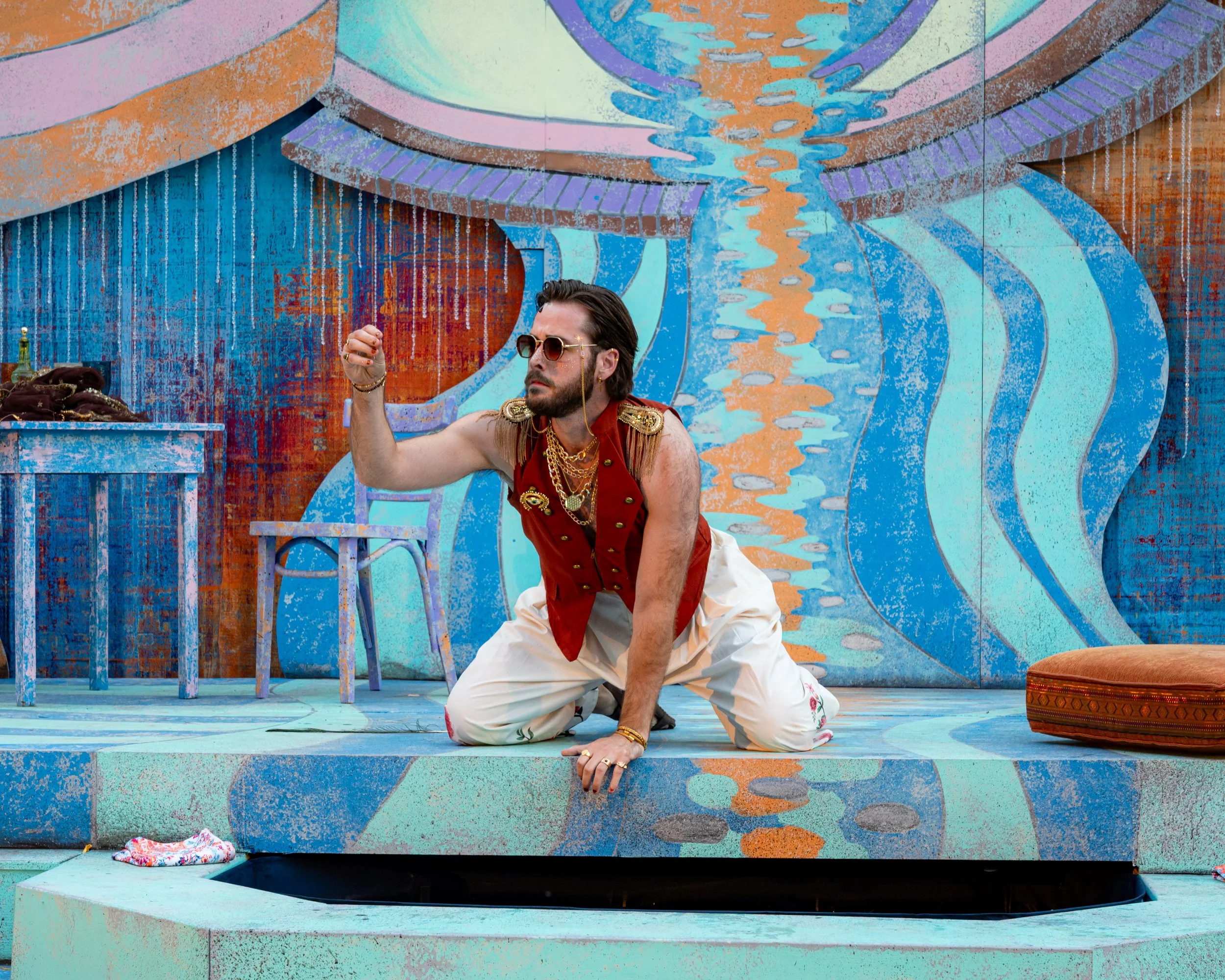
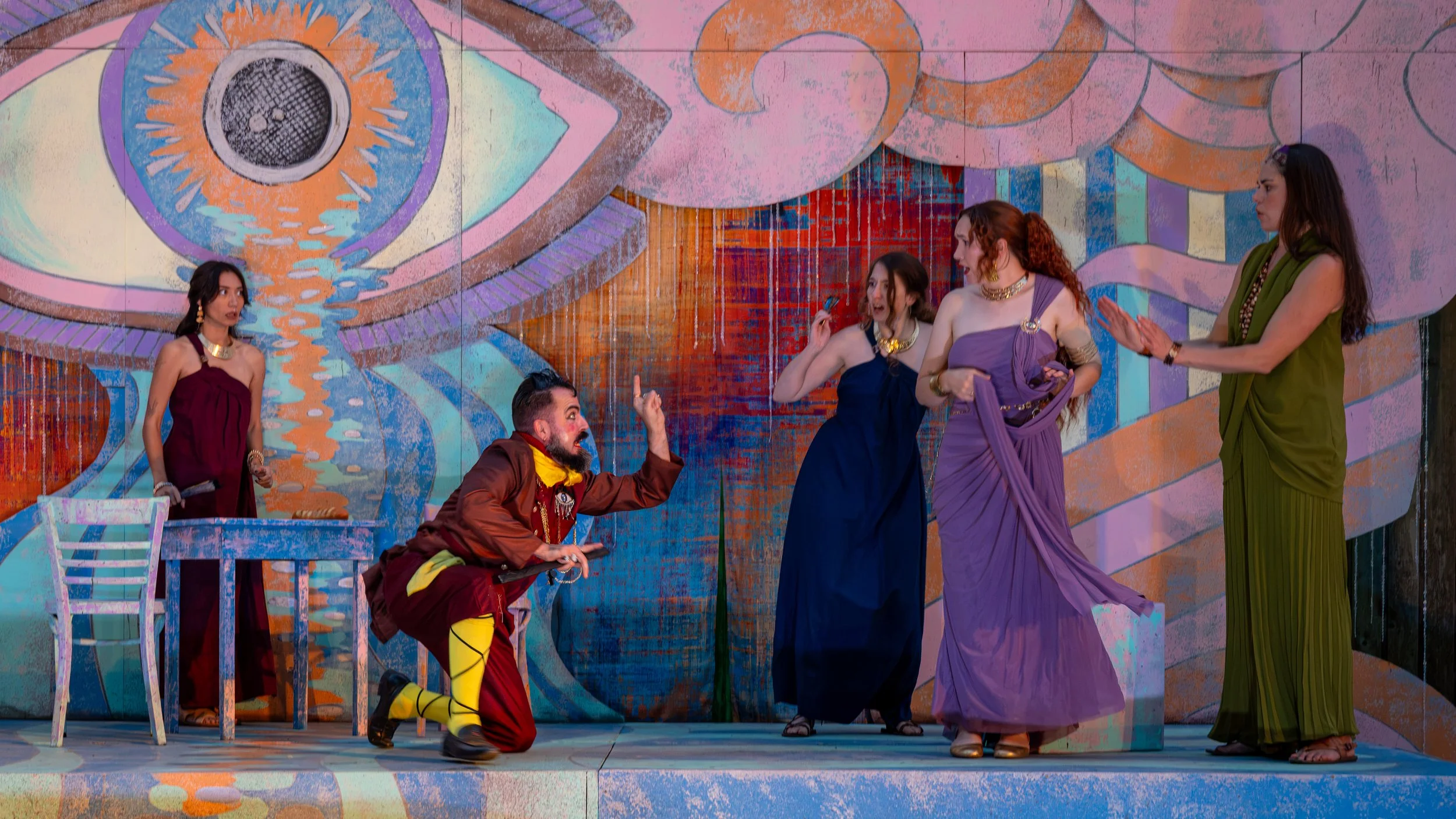
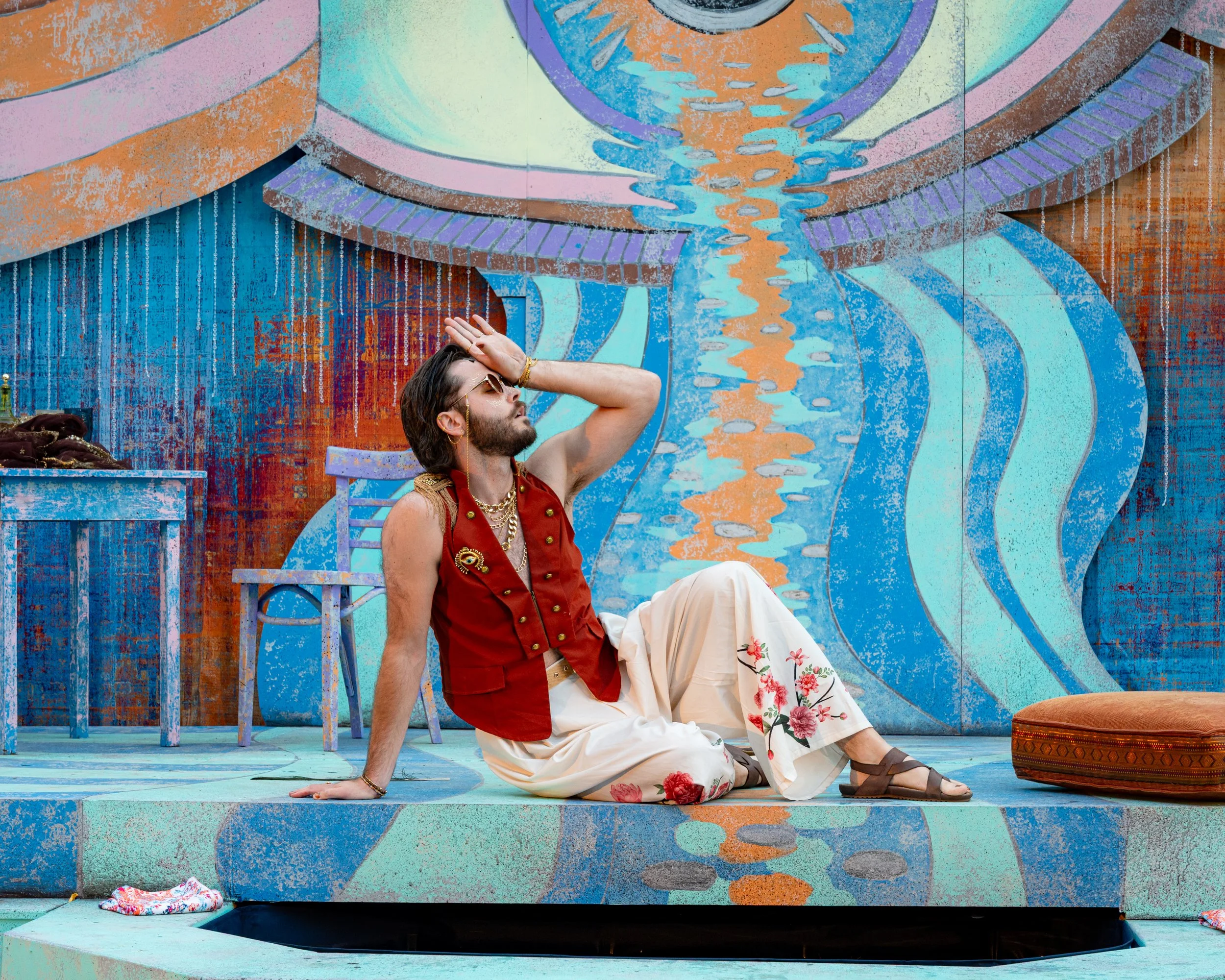
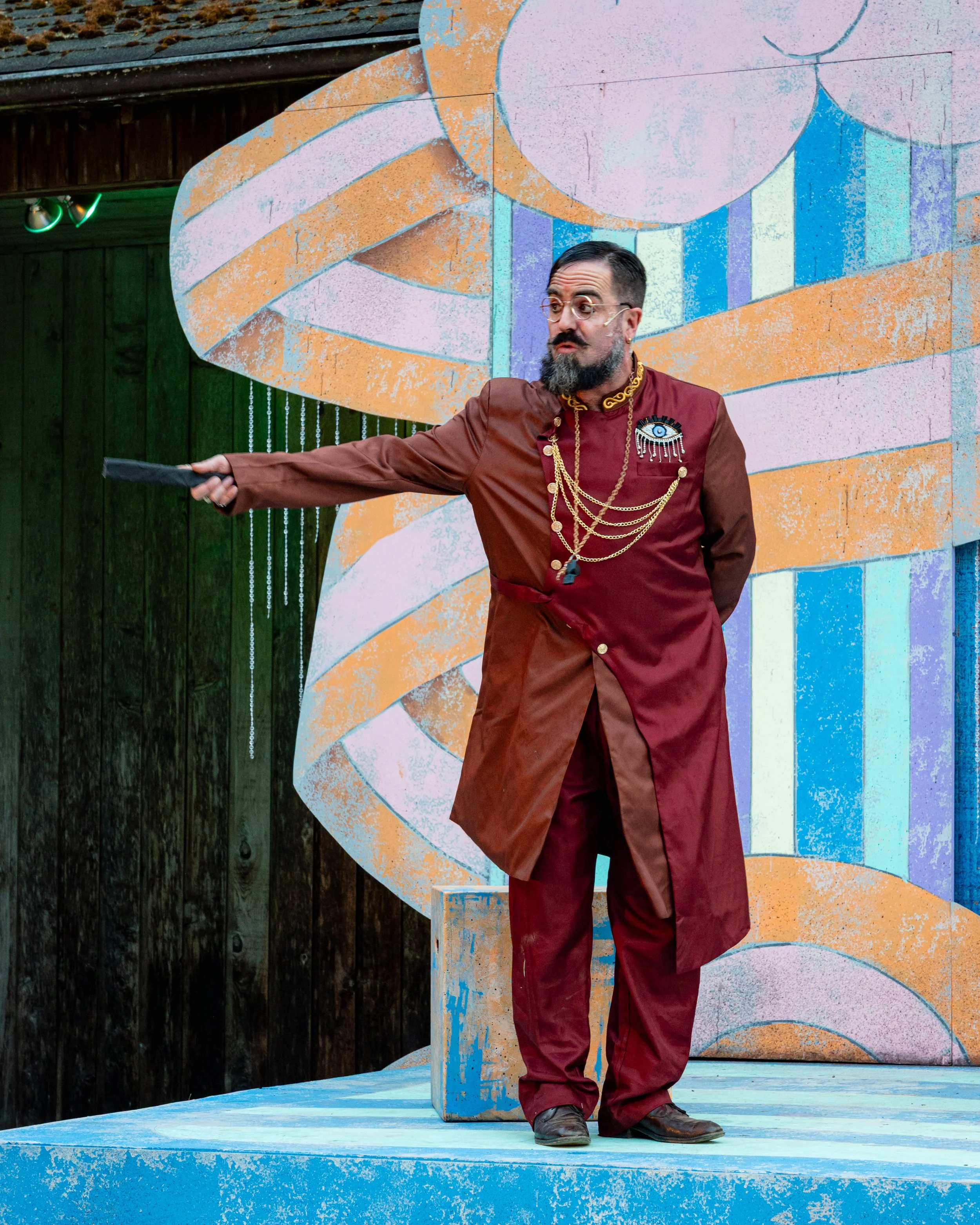
That world has a strong visual identity as well. Costume designer Kristin Bradberry helps establish the divisions within Olivia’s household before anyone needs to explain them. Olivia and those surrounding her tend toward formal dress, solid colors and carefully coordinated accessories, while Feste's more relaxed pastels immediately establish a different energy. Lady Toby looks increasingly as though formality has become an inconvenience she'd rather not bother with. Scenic design artist Matthew Lazure, meanwhile, wisely works with the surroundings rather than attempting to compete with them, allowing Bloedel itself to remain an essential part of the production's visual vocabulary.
Of course, though, as with any performance of Shakespeare’s work, ultimately it comes down to the actors. The monicker for the most memorable of these here belongs to Cole Wimpee, who brings an excellent interpretation to his Malvolio and emerges as the production's comic standout. Malvolio can easily become little more than the pompous target of one of Shakespeare's crueler practical jokes, but Cole establishes him first as loyal, protective and almost militarily formal. That makes his transformation after discovering the forged letter supposedly written by Olivia all the funnier. The situation Shakespeare has written is inherently ridiculous, but the real humor comes from how Cole plays it. His reading of that letter provides the funniest turn of the first act, and his escalating certainty that Olivia secretly desires him turns Malvolio into the character you find yourself waiting to see again.
Elizabeth Allum, in addition to directing, takes on the traditionally male Sir Toby Belch as Lady Toby, and she plays a fantastically funny drunk (almost frighteningly so). Her physicality and commitment to Toby's perpetually lubricated condition generate some of the show's biggest laughs. One recurring gag is her character’s snort, laugh-out-loud funny the first few times, though repetition gradually diminishes the return; by the end, what begins as a terrific comic surprise becomes more chuckle-worthy than uproarious. Still, Elizabeth understands precisely how much comic havoc Toby should bring whenever she enters the scene.
Among the leads, Reed Viydo finds another rich vein of comedy in Duke Orsino, playing him as arrogant, self-centered and not necessarily burdened by an overabundance of self-awareness. Sporting sunglasses and an almost studied coolness, his Orsino would make Joe Cool take notice. It's an amusing interpretation that makes the Duke's romantic self-importance considerably more entertaining than it might otherwise be. Ariel Rose is equally effective as Olivia, finding the mystery and flirtation beneath a woman who begins the play determined to shut herself away from romance. Her scenes with Telana Laine’s Cesario are particularly good, with Ariel confidently navigating her character’s changing feelings as Olivia's certainty gives way to fascination and desire. Just as importantly, she has an excellent grasp of Shakespeare's dialogue, allowing the language to feel conversational rather than recited.
Talena Laine continues to show the breadth of her artistic range in the dual role of Viola and her alter ego, Cesario. Creating two distinct personalities within the same character allows the confusion written into Viola’s story arc to feel real, rather than simply a contrivance needed to make Shakespeare’s plot work. Talena is an expert at navigating that divide, once again nailing every aspect of the role she’s playing. As Cesario, she meets every emotional mark, from the confusion of navigating relationships built upon a false identity to the determination necessary to maintain it, all while allowing glimpses of Viola to remain just beneath the surface. It’s a deceptively complicated balancing act, and Talena makes it look effortless. Her chops are indeed a reckoning.
In the supporting cast, Rosaletta Curry demonstrates that same facility with the text as Maria, but adds a flavor distinctly her own. Rosaletta is particularly good at playing with the emotion and mood within the dialogue, finding shifts that keep Maria unpredictable and alive. She makes the character every bit as enjoyable to watch as any of the leads, particularly as Maria engineers the scheme against Malvolio and then delights in watching it unfold. Richard Cubí brings considerable energy to his Antonio, portrayed here as the flamboyant rescuer and romantic interest of Clayton Paige’s Sebastian. Richard's occasional digressions into Spanish earn some laughs, although the device doesn't always land as clearly as it could. For an audience member who doesn't understand Spanish, there isn't always enough contextual information in the surrounding action or performance to understand what is being communicated. When untranslated language is used as a theatrical tool, the words themselves don't necessarily need translation, but their meaning does; gesture, reaction and context need to be in place to allow the entire audience into the joke or emotional moment.
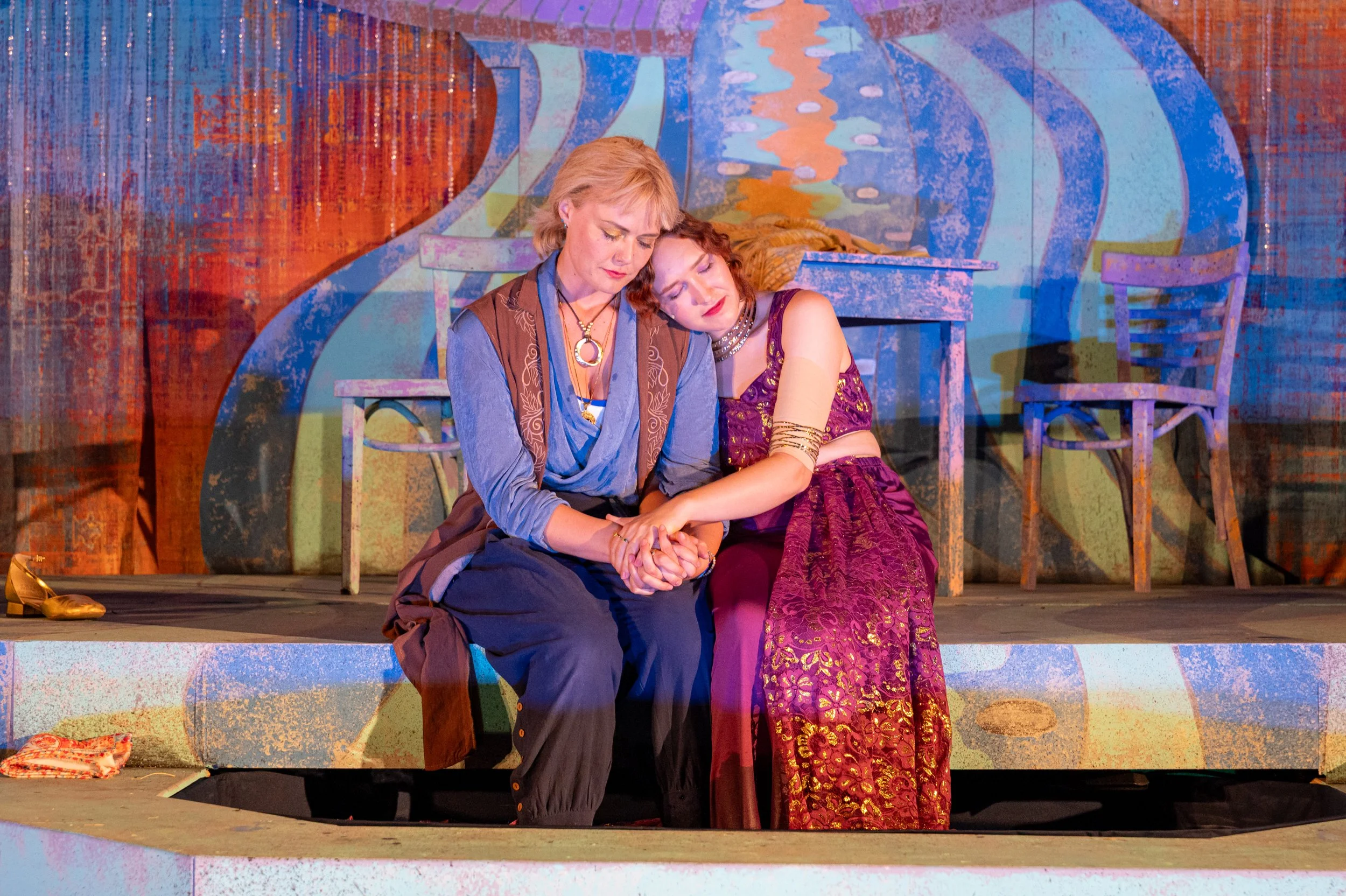
That relationship also points toward the production's most complicated artistic choice. Elizabeth's Twelfth Night isn't simply populated by queer characters; it deliberately reexamines the story through a queer perspective, altering relationships and character dynamics to make that perspective foundational to this version of Illyria. Shakespeare's play certainly provides fertile ground for that exploration. Gender disguise, fluid attraction and the instability of identity are already embedded deeply in the text. At times, however, the emphasis on this particular perspective seems to pull attention away from the mechanics that make the story work. The reshaping of Antonio and Sebastian's relationship is the clearest example. Antonio is no longer simply the sea captain whose extraordinary devotion to Sebastian feeds directly into the play's confusion of identities; the production places much greater emphasis on a romantic relationship between the two. In doing so, their relationship sometimes becomes more important than the dramatic function their encounters serve within the larger story.
That issue is compounded by what feels like an abridged Sebastian storyline. There are moments when characters reference encounters or circumstances without the production having given them enough dramatic space beforehand, making the plot briefly feel as though a scene has gone missing. In a comedy whose resolution depends so heavily on two identical siblings unknowingly moving through the same world, Sebastian's presence isn't incidental. The audience needs to remain sufficiently connected to both twins for the eventual convergence to have its full impact. By placing additional weight on the nature of Sebastian and Antonio's relationship while seemingly reducing some of Sebastian's connective material, this adaptation occasionally draws attention away from the very story mechanism that relationship ultimately needs to support.
None of that argues against viewing Twelfth Night through a queer lens. Quite the opposite. Shakespeare gives a director an extraordinary amount to explore there. Cesario's place at the center of a romantic triangle already complicates conventional ideas of gender and attraction, while the eventual reunion of Viola and Sebastian forces the characters, along with the audience, to reconsider relationships that have developed around a mistaken understanding of identity. But the most successful reinterpretations allow a new perspective to illuminate the existing dramatic architecture rather than compete with it. Here, I occasionally came away feeling that the production's emphasis on how it wanted us to view these relationships took something away from the strength and clarity of the storytelling itself.
Fortunately, this Twelfth Night is at its best when it trusts Shakespeare's comedy and lets this cast play. Cole's wonderfully portrayed Malvolio, Rosaletta's expressive Maria, Ariel's flirtatious Olivia, Reed's comically self-satisfied Orsino and Elizabeth's hilariously inebriated Lady Toby provide plenty to enjoy. And running through it all is Charis's remarkable musical contribution, giving this Illyria a voice that belongs specifically to BPA's production.
BPA’s Bard at Bloedel series has always had one collaborator no director can entirely control, Bloedel Reserve itself. The landscape, open air and changing natural environment become part of the performance, lending Shakespeare's imagined world a sense of place no conventional scenic design could reproduce. This Twelfth Night may occasionally become tangled in its own reinterpretation of an already tangled story, but when the music rises, the comedy clicks and Shakespeare's language meets the landscape around it, BPA once again demonstrates why returning to Bloedel each summer is such an appealing tradition.
This year’s edition of The Bard at Bloedel, the annual Shakespeare in the Park production from Bainbridge Performing Arts, runs on stage at the Bloedel Reserve through August 23. For more information, including ticket availability and sales, visit https://www.bainbridgeperformingarts.org/.
Photo credit: Small World Photographer