
Stage Review - Walden (ArtsWest)
Stage Review - Walden
Presented By: ArtsWest - Seattle, WA
Show Run: April 09 - May 03, 2026
Date Reviewed: Thursday, April 09, 2026 (opening night)
Run Time: 1 Hour, 40 Minutes (no intermission)
Reviewed by: Greg Heilman
Amy Berryman’s Walden, now on stage at ArtsWest through May 3 under the direction of Mathew Wright, is a thoughtful and quietly immersive piece that asks its audience to look both forward and inward. Set in a “not-so-distant future”, the play presents a world that feels at once dystopian and hopeful, teeming with nature, contrasting ideologies, and deeply human relationships. It is a work that doesn’t rush to define itself, instead inviting reflection on where we are headed—both as individuals and as a species.
The plot follows twin sisters Stella and Cassie, whose reunion at a remote cabin brings long-simmering differences to the surface, particularly as Cassie arrives to find a number of changes that have occurred since the last time the sisters saw each other, well before Cassie’s most recent mission to the Moon, including the addition of Earth Advocate Bryan into Stella’s life. What begins as a visit quickly becomes a collision of ideologies, relationships, and personal truths, as the three navigate questions of love, purpose, and the future they are each working toward.
The play itself is quite thought provoking. It’s a timely piece, yet it is set clearly in the future, balancing contradiction with intention. It’s world is one that feels like it’s on the brink, while still holding space for possibility. Amy weaves these ideas seamlessly into the text, asking us to consider our future on Earth versus expansion into the stars. It’s especially resonant in a moment where missions like Artemis II signal a renewed push toward the Moon, a stepping stone toward Mars and beyond. What can we learn from space exploration that we can apply here at home? Is the destruction of our planet inevitable, or is it our own extinction that we fear most?
These questions echo ideas explored decades ago by Carl Sagan, who reflected on both the fragility of our “Pale Blue Dot” and our tendency toward carelessness in preserving it. The play seems to suggest that while the planet itself may endure, it is humanity’s place on it that remains uncertain. Cassie’s work becomes a focal point of that debate—whether her scientific achievement is meant to serve as a tool for future colonization or something that could, and perhaps should, be applied here on Earth. If we can build sustainable environments elsewhere, why not here? It’s a question that lingers, one that Amy poses without offering easy answers, instead allowing the perspectives of her characters to shape the conversation.
Under Mathew’s assured direction, those perspectives are given clarity and balance. Cassie approaches the world through a scientific lens, Bryan advocates for the preservation of the natural one, and Stella exists somewhere between the two, having experienced both sides. What emerges is not a definitive answer, but the suggestion that any path forward will require compromise, honesty, and a willingness to truly listen. That sense of dialogue extends beyond the characters and into the audience, who are left to wrestle with the same questions long after the lights come up.
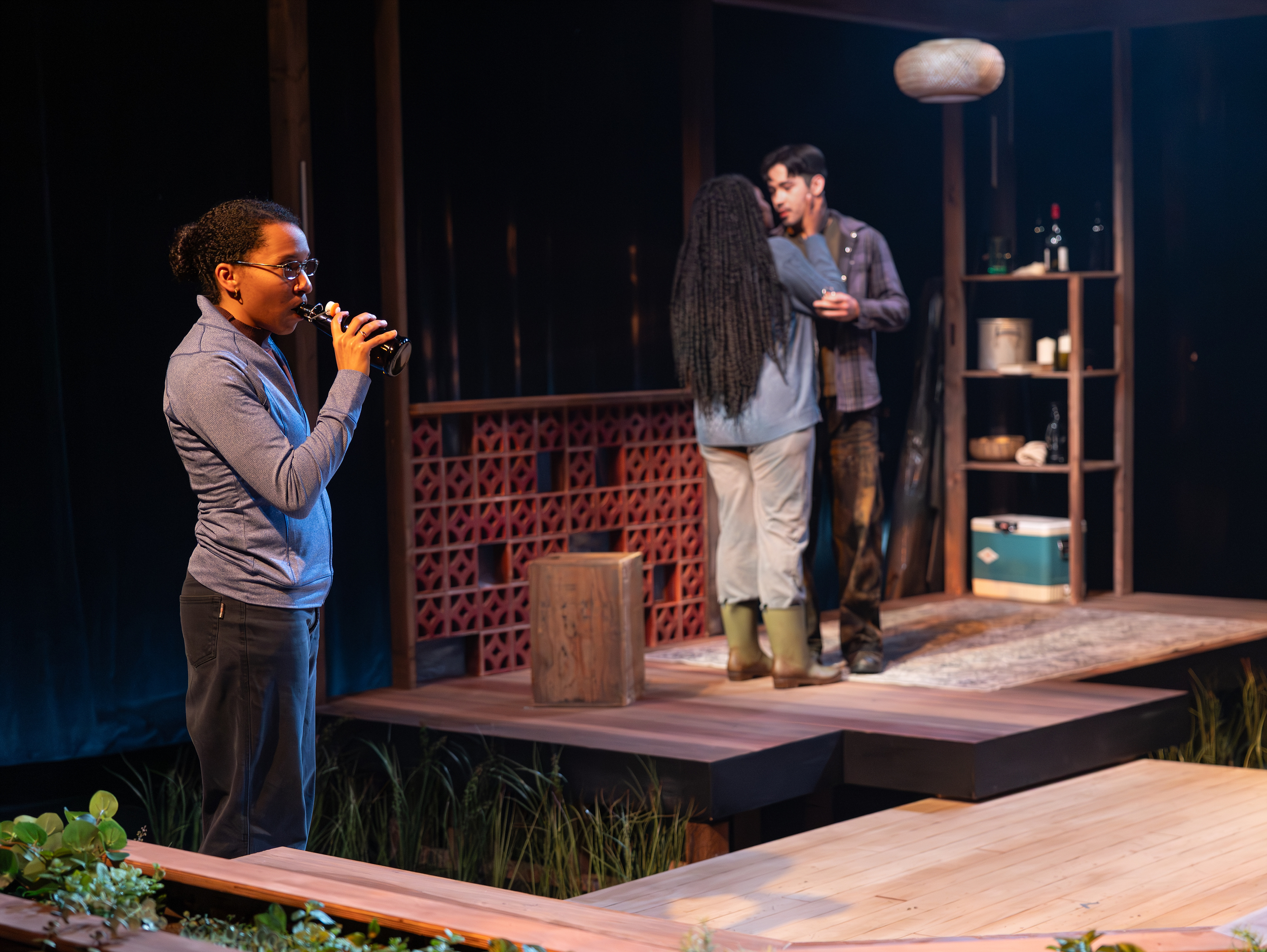
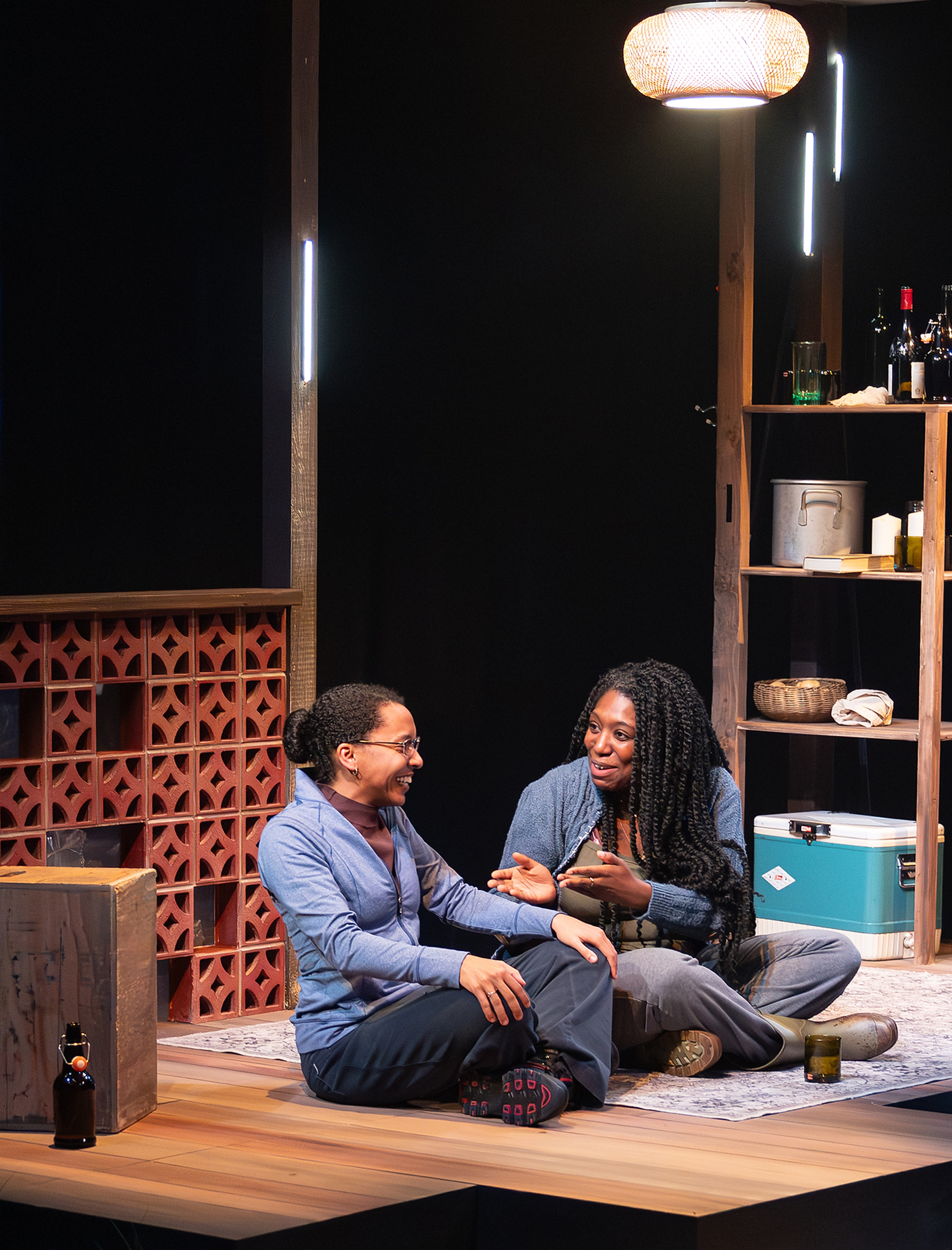
Before the play even begins, the production signals its intent to immerse. As the audience settles in, a sky of stars is projected across the back wall, the sounds of surrounding nature fill the space, and the audience is immediately drawn in. This defines the world of the play, which is established through Adair MacCormack’s scenic design, which evokes a contemporary Walden Pond with a layered and somewhat abstract aesthetic. At first glance, the space suggests a swampy, water-laden environment, complete with grasses and what appears to be a dock-like structure. However, as the action unfolds, that perception shifts. What initially reads as water reveals itself to be solid ground, a wooded and untamed space surrounding a cabin. It’s a choice that may feel visually inconsistent at first, but ultimately reinforces the sense of wildness and lack of order that defines both the setting and the thematic undercurrents of the play.
Robin Macartney’s properties further enhance that lived-in quality, with objects that feel intentionally placed yet slightly disparate, contributing to the overall sense of a world in flux. Among them is a uniquely devised rabbit that simply has to be seen to be fully appreciated—an inventive and memorable piece of stagecraft that stands out within an already thoughtful design.
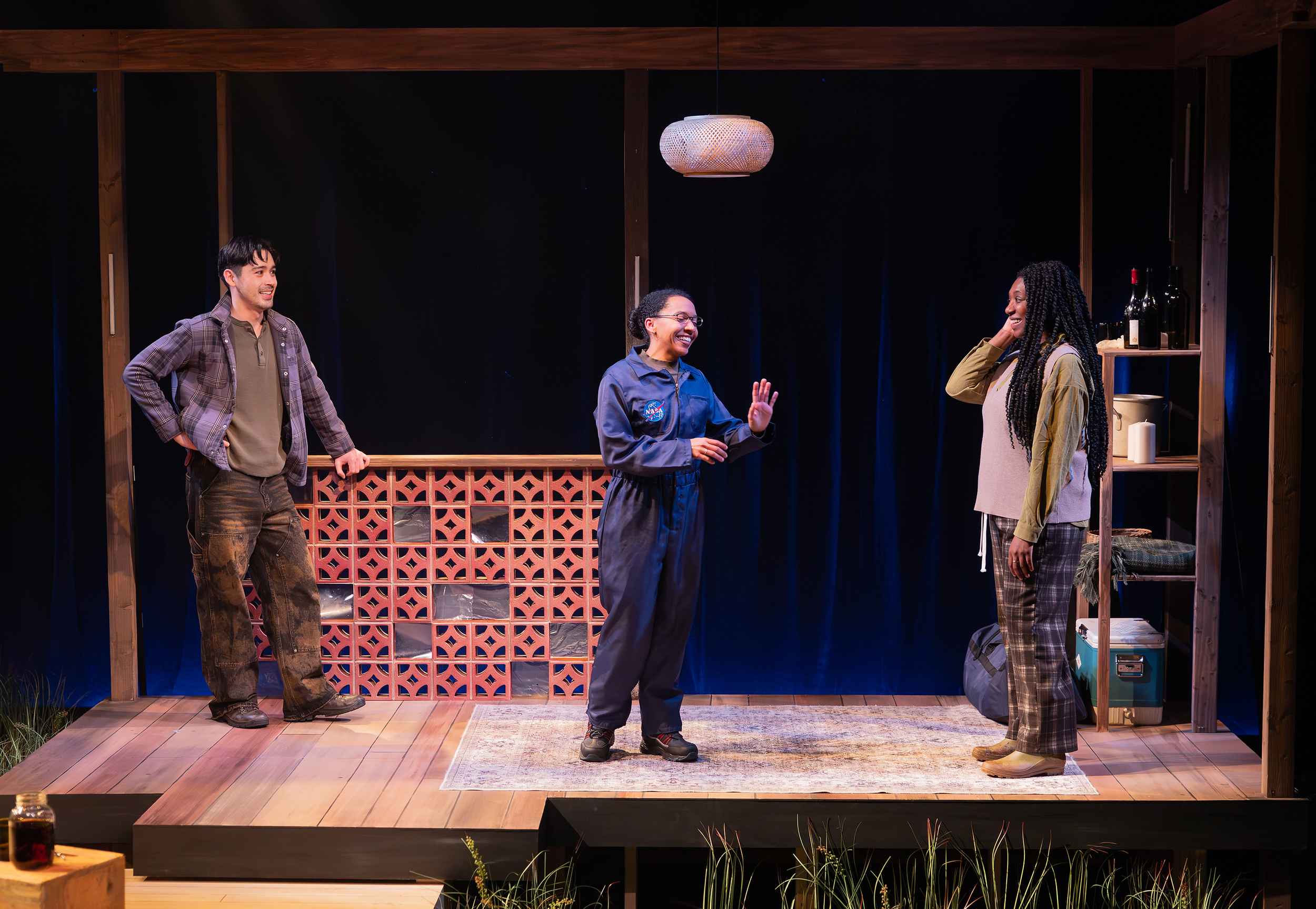
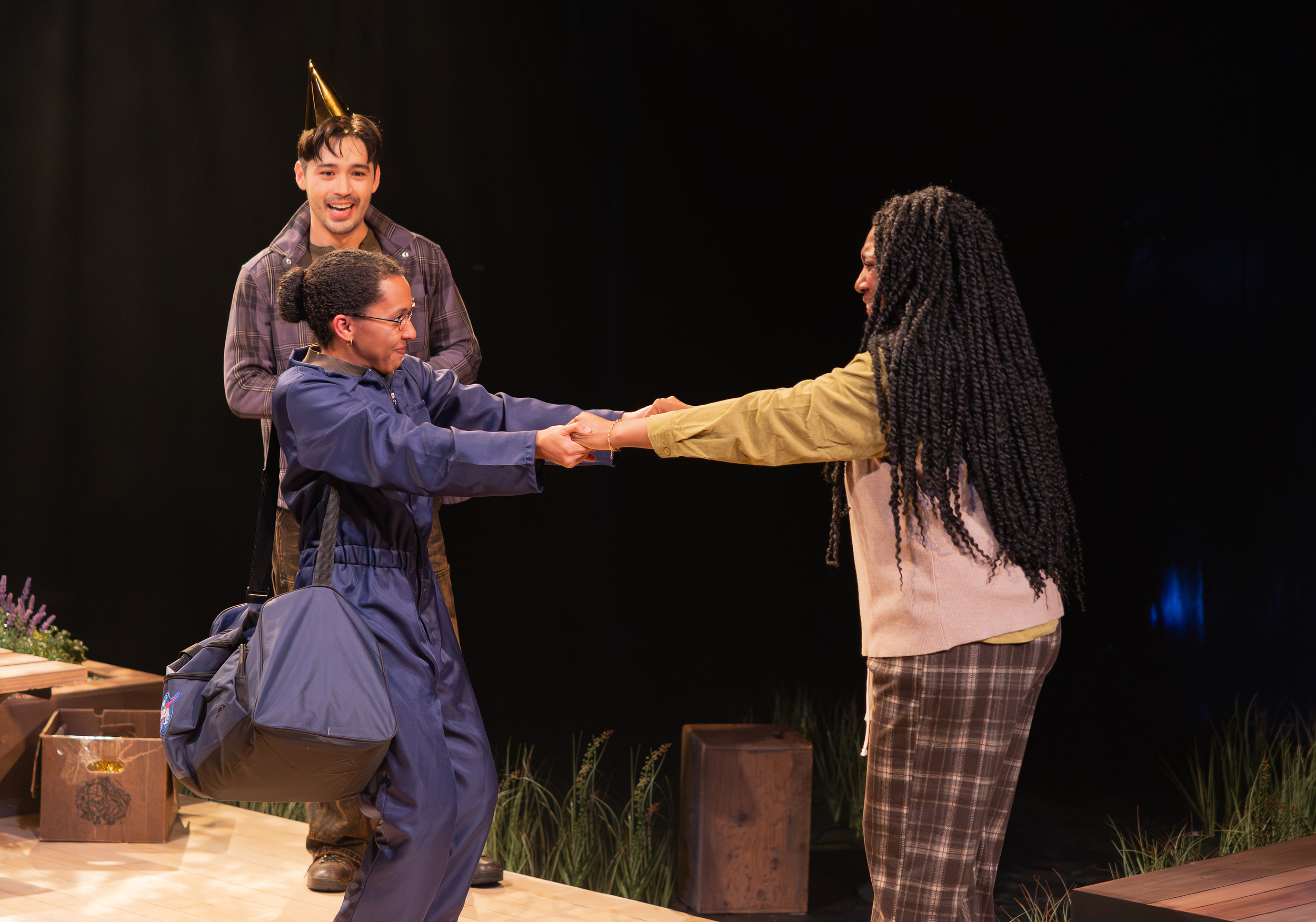
Costume design by Tianxing Yan complements the world beautifully, grounding Bryan and Stella in natural, earthy tones that reflect their connection to the environment, while sharply contrasting with Cassie’s NASA blue jumpsuit. That visual distinction reinforces the ideological divide at the heart of the play, giving immediate clarity to the differing worlds each character inhabits.
The true achievement of the design, though, comes from Trevor Cushman’s lighting, which is particularly effective in shaping the environment, from soft, naturalistic tones to a beautifully rendered nighttime sequence where shadows stretch and settle across the space. The design works hand in hand with the sound work of Evan Mosher and Mya Woods, which moves between technological intrusion and the calming presence of nature. The result is an immersive atmosphere that aligns closely with Mathew’s directorial style, creating a sensory experience that supports the storytelling without overwhelming it.
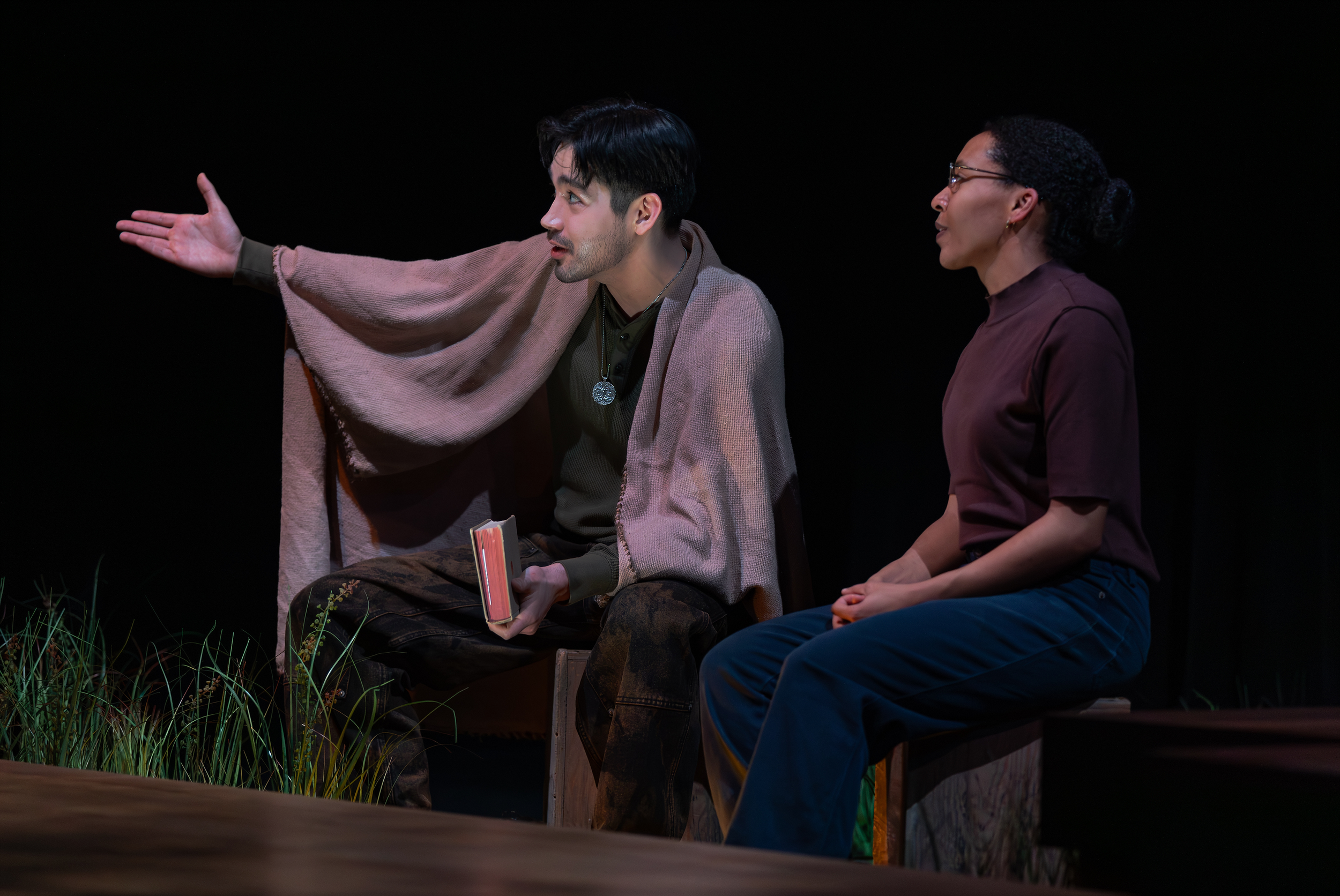
At the center of it all are three performances that are as precise as they are compelling. As Cassie, Marena Kleinpeter brings a focused and analytical presence, embodying a character driven by intellect and purpose, yet struggling to reconcile the emotional shifts happening around her. There is a rigidity to Cassie, a difficulty in recognizing change—particularly in Stella—that Marena navigates with clarity and control. Porscha Shaw’s Stella provides a beautifully realized counterbalance. Stella’s world, just like the broader one, is in flux, having given up a career that would have put her on the same path as her sister, and now finds herself in Bryan’s, focused on nature, hope, and a positive future through the heart of humanity. The sibling dynamic between Stella and Cassie is one of the production’s strongest elements. Amy’s writing captures the rhythm and synchronicity of that relationship with remarkable accuracy—the shorthand communication, the underlying competition, and the way each sister’s choices ripple outward and back again. It is portrayed here with authenticity and performed exquisitely by Marena and Porscha.
The relationship between Stella and Bryan is equally well drawn. Josh Kenji Langager’s Bryan carries an intentional awkwardness, a sense of someone trying to navigate a space where he doesn’t quite belong, yet deeply wants to. There is sincerity in Bryan’s efforts to connect, to facilitate, to understand, even when he doesn’t have the right words. That dynamic allows the audience to witness a relationship in all its complexity—its flaws, its tenderness, and its quiet beauty. A scene late in the play between Stella and Bryan stands out as one of the most delicate and affecting moments of theatre this season. It is sweet, raw, and deeply human, a testament to Amy’s writing, Mathew’s staging, and the performances that bring it to life. It’s in moments like this, where the larger thematic questions give way to intimate connection, that Walden finds a different, but just as impactful, voice.
Structurally, the play is supported by transitions that incorporate music and elements of news reporting, reinforcing the broader world beyond the cabin while keeping the focus on the personal. These shifts help ground the story in a reality that feels both immediate and expansive, reminding us that the questions being asked are not confined to the stage.
ArtsWest’s Walden is a thoughtful and engaging production that leans into the complexity of its ideas while delivering a cohesive and polished theatrical experience. The strength of its design elements—from the evocative scenic work to the immersive lighting and sound—creates a world that supports and enhances the storytelling at every turn. Combined with three excellent, finely tuned performances, the result is a production that not only invites reflection, but rewards it, leaving the audience with lingering questions and a deep appreciation for the artistry on stage.
The ArtsWest production of Amy Berryman’s Walden runs on stage in West Seattle through May 9. For more information, including ticket availability and sales, visit https://www.artswest.org/
Photo credit: John McLellan